i
 | ||||||||
 | ||||||||
| ||||||||
Translingual
Etymology 1

Letter
i (upper case I)
- The ninth letter of the basic modern Latin alphabet.
i (upper case İ)
See also
- (Latin script): Aa Bb Cc Dd Ee Ff Gg Hh Ii Jj Kk Ll Mm Nn Oo Pp Qq Rr Sſs Tt Uu Vv Ww Xx Yy Zz
- (Variations of letter I): Íí Ìì Ĭĭ Îî Ǐǐ Ïï Ḯḯ Ĩĩ Įį Īī Ỉỉ Ȉȉ Ȋȋ Ịị Ḭḭ Ɨɨɨ̆ ᵻ ᶖ İi Iı ɪ Ii fi ffi IJij IJij
- (Letters using dot sign): Ȧȧ Ạạ Ặặ Ậậ Ǡǡ Ḃḃ Ḅḅ Ċċ Ḋḋ Ḍḍ Ėė Ẹẹ Ḟḟ Ġġ Ḣḣ Ḥḥ Ii İi Iı Ịị Ḳḳ Ḷḷ Ṁṁ Ṃṃ Ṅṅ Ṇṇ Ȯȯ Ọọ Ợợ Ṗṗ Ṙṙ Ṛṛ Ṡṡ Ṣṣ ẛ Ṫṫ Ṭṭ Ụụ Ựự Ṿṿ Ẇẇ Ẉẉ Ẋẋ Ẏẏ Ỵỵ Żż Ẓẓ
Derived symbols
Similar and related symbols
Etymology 2
- (mathematics, imaginary number): abbreviation of imaginary
- (computer programming, generic index): abbreviation of index
Pronunciation
IPA (file)
Symbol
i
- (mathematics, often in italics or bold) The imaginary unit; a fixed square root of -1. Graphically, i is shown on the vertical (y-axis) plane.
- (engineering, often in bold) The current flow in a circuit in amperes.
- (mathematics, programming) A common variable name representing a generic index, especially in loops.
- (IPA, romanization) close front unrounded vowel.
Synonyms
Etymology 3
Lower case form of upper case roman numeral I, apparently derived from the shape of a notch scored across a tally stick.
Alternative forms
Numeral
i (lower case Roman numeral, upper case I)
See also
- Next: ii (2)
- Roman numerals
Gallery
- Letter styles
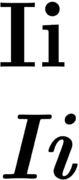 Normal and italic I, i
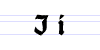 Uppercase and lowercase I in Fraktur
See also
Other representations of I:


English
Etymology 1
Pronunciation
Letter
i (lower case, upper case I, plural i's)
Usage notes
The English letter i represents many different sounds, often the diphthong /aɪ/ (from Middle English /iː/), as in the pronoun I, or /ɪ/ as in bit.
See also
Number
i (lower case, upper case I)
Noun
i (plural ies)
- The name of the Latin-script letter I/i.
- the position of an i-dot (the dot of an i)
- i-mutation, i-umlaut
Translations
|
See also
Etymology 2
From Old English ic.
Pronunciation
Pronoun
i
- Nonstandard spelling of I.
Usage notes
- Also used in instant messaging due to limitations of entering capitals on a mobile phone's keypad.
Acehnese
Pronunciation
- IPA(key): [i]
Noun
i
References
- 2007. The UCLA Phonetics Lab Archive. Los Angeles, CA: UCLA Department of Linguistics.
Adangme
Pronoun
i
- I
- I suɔ mo. ― I love you.
Albanian
Pronunciation
- IPA(key): [i]
Letter
i (lower case, upper case I)
See also
Article
i
- masculine singular nominative adjectival article
See also
| masculine (gjinia mashkullore) |
feminine (gjinia femërore) |
plural (numri shumës) | ||||||
|---|---|---|---|---|---|---|---|---|
| indefinite (trajta të pashquara) |
definite (trajta të shquara) |
indefinite (trajta të pashquara) |
definite (trajta të shquara) |
indefinite (trajta të pashquara) |
definite (trajta të shquara) | |||
| nominative (emërore) |
i | i | e | e | të | e | ||
| accusative (kallëzore) |
të | e | të | e | të | e | ||
| genitive, dative and ablative (gjinore, dhanore dhe rrjedhore) |
të | të | të | së | të | të | ||
| Note that regardless of the definite state of the noun being described, the definite articles are only used when immediately following a definite-form noun. If two adjectives (or other words that use these articles) come back to back, the second word's article will be indefinite.
Notice that while both adjectives require the adjectival article and the same masculine plural agreement, only the first adjectival article takes its definite form, as the second is not in the immediate environment of the modified definite noun. | ||||||||
Ama
Pronunciation
- IPA(key): /ĩː/
Noun
i
Anambé
Noun
i
Further reading
- Paul Ehrenreich, Materialien zur Sprachenkunde Brasiliens IV: Vocabulare der Guajajara und Anambē (Para) (1895) (i)
- Wolf Dietrich, Correspondências fonológicas e lexicais entre Karitiána (Arikém, Tupí) e Tupí-Guaraní (y)
Araweté
Noun
i
References
- Eliete de Jesus Bararuá Solano, Descrição gramatical da Língua Araweté, page 80, 2009
Aruá
Noun
i
References
- Čestmír Loukotka, Documents et vocabulaires inédits de langues et de dialectes Sud Américains, JSAP 52: 7-60 (1963), page 44
Azerbaijani
Pronunciation
- (phoneme) IPA(key): /ɪ/
Letter
i lower case (upper case İ)
See also
- (Latin-script letters) hərf; A a, B b, C c, Ç ç, D d, E e, Ə ə, F f, G g, Ğ ğ, H h, X x, I ı, İ i, J j, K k, Q q, L l, M m, N n, O o, Ö ö, P p, R r, S s, Ş ş, T t, U u, Ü ü, V v, Y y, Z z
Bambara
Pronoun
i
- you (personal pronoun)
Bislama
Particle
i
- Separates the subject of a sentence from the predicate, used when the subject is a pronoun or a noun
Borôro
Pronunciation
- IPA(key): /iː/
Noun
i
Bourguignon
Alternative forms
- je (rare)
Etymology
From Old French je, from Vulgar Latin *eo, from Latin ego, from Proto-Indo-European *éǵh₂. Near cognates include Franc-Comtois i and standard French je.
Pronoun
i
- I
- I panse qu'i seus maulaide. ― I think that I'm sick.
- I t'aime. ― I love you.
Related terms

| Number | Person | Gender | Nominative (subject) |
Inversion | Reflexive | Accusative (direct complement) |
Dative (indirect complement) |
Disjunctive (tonic) |
Locative (at) |
Genitive (of) |
|---|---|---|---|---|---|---|---|---|---|---|
| Singular | First | — | i (rarely je) | -je | me, m’ | moi | — | — | ||
| Second | — | tu, t' | -tu | te, t’ | toi | — | — | |||
| Third | Masculine | ai, before vowels el | -ti | se, s’ | le, l’ | lu | lu | y | en | |
| Feminine | ale | la, l’ | lei | |||||||
| Neuter | çai | -ce | çai | çai, çan | — | — | ||||
| — | an | -an | — | — | soi | — | — | |||
| Plural | First | — | i (rarely je) | -je | nos | — | — | |||
| Second | — | vos | -vos | vos | — | — | ||||
| Third | Masculine | ai, before vowels el | -ti | se, s’ | les | lor | lor | y | en | |
| Feminine | ales | |||||||||
Catalan
Pronunciation
Etymology 1
Noun
i f (plural is)
Derived terms
Etymology 2
From Latin et (“and”), from Proto-Indo-European *éti.
Conjunction
i
- and; used to connect two similar words, phrases, sentences, etc.; as well as; together with; in addition to.
- Hi ha moltes colomes i teuladins — There are many pigeons and sparrows.
- Ella escriu els articles i ell els il·lustra amb els seus dibuixos — She writes the articles and he illustrates them with his drawings.
Derived terms
Further reading
- “i” in Diccionari de la llengua catalana, segona edició, Institut d’Estudis Catalans.
Chuukese
Pronoun
i
Related terms
Classical Nahuatl
Pronunciation
- IPA(key): /iː/
Verb
i
- (transitive) to drink
Cornish
Pronoun
i
Czech
Pronunciation
- IPA(key): /ɪ/
Audio (file)
Conjunction
i
- and (also), and even
- even (implying an extreme example, used at the beginning of sentences)
- I slepá veverka někdy najde ořech. - Even a blind squirrel finds an acorn sometimes.
Synonyms
Derived terms
Dalmatian
Etymology
From Latin illī, nominative masculine plural of ille. Compare Italian i, gli.
Article
i m (plural)
- the; masculine plural definite article
Related terms
Danish
Etymology
From Old Norse í, from Proto-Germanic *in, from Proto-Indo-European *en.
Pronunciation
- Rhymes: -i
- Homophone: I
- Rhymes: -iː
Preposition
i
- in, inside
- Indicates exponentiation.
- Tre i femte. [note that the exponent is in the ordinal form]
- Three to the power of five.
- Tre i femte. [note that the exponent is in the ordinal form]
- for (some duration)
- Jeg har boet her i tre år.
- I have lived here for three years.
- Jeg har boet her i tre år.
Drehu
Pronunciation
- IPA(key): /i/
Noun
i
References
- Greenhill, S.J., Blust. R, & Gray, R.D. (2008). The Austronesian Basic Vocabulary Database: From Bioinformatics to Lexomics. Evolutionary Bioinformatics, 4:271-283.
Dutch
Pronunciation
Audio (file) - Rhymes: -i
- (letter name): IPA(key): /i/
Letter
i (lower case, upper case I)
See also
Elfdalian
Etymology
From Old Norse í, from Proto-Germanic *in. Cognate with Swedish i.
Preposition
i
Emilian
Etymology
Pronunciation
- IPA(key): /i/
- Hyphenation: i
Pronoun
i (personal)
Alternative forms
Related terms
| Number | Person | Gender | Disjunctive (tonic) |
Nominative (subject) |
Accusative (direct complement) |
Dative (indirect complement) |
Reflexive (-self) |
Comitative (with) |
|---|---|---|---|---|---|---|---|---|
| Singular | First | — | mè | a | me | mêg | ||
| Second | — | tè | et | te | têg | |||
| Third | Masculine | ló | al | ge | se | sêg | ||
| Feminine | lê | la | ||||||
| Plural | First | Masculine | nuēter | a | se | nōsk | ||
| Feminine | nuētri | |||||||
| Second | Masculine | vuēter | a | ve | vōsk | |||
| Feminine | vuētri | |||||||
| Third | Masculine | lôr | i | ge | se | sêg | ||
| Feminine | el | li | ||||||
Esperanto
Pronunciation
IPA(key): /i/
Audio (file)
Letter
i (lower case, upper case I)
See also
Noun
i (accusative singular i-on, plural i-oj, accusative plural i-ojn)
See also
- (Latin-script letter names) litero; a, bo, co, ĉo, do, e, fo, go, ĝo, ho, ĥo, i, jo, ĵo, ko, lo, mo, no, o, po, ro, so, ŝo, to, u, ŭo, vo, zo
Extremaduran
Conjunction
i
Fala
Alternative forms
Etymology
From Old Portuguese e, from Latin et (“and”), from Proto-Indo-European *éti.
Conjunction
i
- and (expressing two elements to be taken together)
- 2000, Domingo Frades Gaspar, Vamus a falal: Notas pâ coñocel y platical en nosa fala, Editora regional da Extremadura, Chapter 1: Lengua Española:
- A grandeda da lengua española é indiscotibli, i sei estudio, utilización defensa debin sel algo consostancial a nos, […]
- The greatness of the Spanish language is unquestionable, and its study, use and defense must be something consubstantial to us, […]
- A grandeda da lengua española é indiscotibli, i sei estudio, utilización defensa debin sel algo consostancial a nos, […]
-
Faroese
Pronunciation
Letter
i (upper case I)
See also
Noun
i n (genitive singular is, plural i)
Declension
| Declension of i | ||||
|---|---|---|---|---|
| n4 | singular | plural | ||
| indefinite | definite | indefinite | definite | |
| nominative | i | iið | i | iini |
| accusative | i | iið | i | iini |
| dative | i, ii | inum | ium | iunum |
| genitive | is | isins | ia | ianna |
See also
- (Latin-script letter names) bókstavur; a / fyrra a, á, be, de, edd, e, eff, ge, há, i / fyrra i, í / fyrra í, jodd, ká, ell, emm, enn, o, ó, pe, err, ess, te, u, ú, ve, seinna i, seinna í, seinna a, ø
Foi
Noun
i
French
Pronunciation
- IPA(key): /i/
Noun
i m (plural is)
Friulian
| Friulian Definite Articles | ||
|---|---|---|
| singular | plural | |
| masculine | il l' |
i |
| feminine | la l' |
lis |
Etymology
Article
i m pl (singular il)
Pronoun
i (third person masculine/ feminine indirect object)
See also
Fula
Letter
i (lower case, upper case I)
Usage notes
See also
- (Latin-script letters) karfeeje; ', A a, B b, Mb mb, Ɓ ɓ, C c, D d, Nd nd, Ɗ ɗ, E e, F f, G g, Ng ng, Ɠ ɠ, H h, I i, J j, Nj nj, K k, L l, M m, N n, Ŋ ŋ, Ñ ñ, Ɲ ɲ, O o, P p, R r, S s, T t, U u, W w, Y y, Ƴ ƴ
Hawaiian
Etymology
From Proto-Polynesian *i.
Particle
i
- used to mark the following (noun or noun phrase) as a direct object
- Ua ʻai ka pōpoki i ka ʻiole.
- The cat eats/ate the mouse.
- used to indicate past tense (precedes verb)
- I hana au.
- I worked.
- used to indicate perfect participle (precedes verb)
- i haʻalele
- having left, who had left
Preposition
i
See also
Ido
Pronunciation
- (context pronunciation, letter name) IPA(key): /i/
Letter
i (upper case I)
See also
- (Latin-script letters) litero; A a, B b, C c, D d, E e, F f, G g, H h, I i, J j, K k, L l, M m, N n, O o, P p, Q q, R r, S s, T t, U u, V v, W w, X x, Y y, Z z
Irish
Alternative forms
Etymology
From Old Irish i, from Proto-Celtic *eni (compare Welsh yn), from Proto-Indo-European *en (compare English in, Latin in, Ancient Greek ἐν (en)).
Pronunciation
- IPA(key): /ɪ/
Preposition
i (plus dative, triggers eclipsis, before the definite article ins)
Inflection
Derived terms
- i gceann (“at the end of; attained to; engaged in, attending to; in addition to”)
- i mborr le (“puffed up with”)
| Basic form | Contracted with | Copular forms | ||||||||
|---|---|---|---|---|---|---|---|---|---|---|
| an (“the sg”) | na (“the pl”) | mo (“my”) | do (“your”) | a (“his, her, their; which (present)”) | ár (“our”) | ar (“which (past)”) | (before consonant) | (present/future before vowel) | (past/conditional before vowel) | |
| de (“from”) | den | de na desna* | de mo dem* | de do ded*, det* | dá | dár | dar | darb | darbh | |
| do (“to, for”) | don | do na dosna* | do mo dom* | do do dod*, dot* | dá | dár | dar | darb | darbh | |
| faoi (“under, about”) | faoin | faoi na | faoi mo | faoi do | faoina | faoinár | faoinar | faoinarb | faoinarbh | |
| i (“in”) | sa, san | sna | i mo im* | i do id*, it* | ina | inár | inar | inarb | inarbh | |
| le (“with”) | leis an | leis na | le mo lem* | le do led*, let* | lena | lenár | lenar | lenarb | lenarbh | |
| ó (“from, since”) | ón | ó na ósna* | ó mo óm* | ó do ód*, ót* | óna | ónár | ónar | ónarb | ónarbh | |
| trí (“through”) | tríd an | trí na | trí mo | trí do | trína | trínár | trínar | trínarb | trínarbh | |
| *Dialectal. | ||||||||||
References
- "i" in Foclóir Gaeilge-Béarla, An Gúm, 1977, by Niall Ó Dónaill.
Italian
Pronunciation
- Rhymes: -i
Etymology 1
Article
| Italian Definite Articles | ||
|---|---|---|
| singular | plural | |
| masculine | il lo/l' |
i gli |
| feminine | la/l' | le |
i m pl (singular il)
Usage notes
i is used before masculine plural words beginning with a single consonant other than x or z, or the plural noun dei; gli is used before masculine plural words beginning with a vowel, x, z, gn, or multiple consonants including pn, ps, and s+consonant, and before the plural noun dei.
Derived terms
Etymology 2
From Latin ī (the name of the letter I).
Noun
i f (invariable)
Derived terms
See also
References
- ↑ Patota, Giuseppe (2002) Lineamenti di grammatica storica dell'italiano (in Italian), Bologna: il Mulino, →ISBN, page 126
Japanese
Romanization
i
Ladin
Article
i m (plural)
See also
Ladino
Etymology
From Old Spanish é or e, from Latin et.
Conjunction
i (Latin spelling, Hebrew spelling אי)
Latgalian
Etymology
Shortened from an older Baltic form *ir, which is preserved in Lithuanian as ir (with the same meaning).
Conjunction
i
Particle
i
Latin
Pronunciation
- (Classical) IPA(key): /iː/
Etymology 1
Noun
ī (indeclinable)
- The name of the letter I.
Coordinate terms
References
- i in Charles du Fresne du Cange’s Glossarium Mediæ et Infimæ Latinitatis (augmented edition, 1883–1887)
- i in Harry Thurston Peck, editor (1898) Harper's Dictionary of Classical Antiquities, New York: Harper & Brothers
- Arthur E. Gordon, The Letter Names of the Latin Alphabet (University of California Press, 1973; volume 9 of University of California Publications: Classical Studies), part III: “Summary of the Ancient Evidence”, page 32: "Clearly there is no question or doubt about the names of the vowels A, E, I, O, U. They are simply long A, long E, etc. (ā, ē, ī, ō, ū). Nor is there any uncertainty with respect to the six mutes B, C, D, G, P, T. Their names are bē, cē, dē, gē, pē, tē (each with a long E). Or about H, K, and Q: they are hā, kā, kū—each, again, with a long vowel sound."
Etymology 2
Verb
ī
Latvian
Etymology
Proposed in 1908 as part of the new Latvian spelling by the scientific commission headed by K. Mīlenbahs, which was accepted and began to be taught in schools in 1909. Prior to that, Latvian had been written in German Fraktur, and sporadically in Cyrillic.
Pronunciation
- IPA(key): [i]
| (file) |
Letter

i (lower case, upper case I)
See also
Pronunciation
- IPA(key): [i]
Noun
i m (invariable)
See also
- Latvian letter names:
Ligurian
| Ligurian Definite Articles | ||
|---|---|---|
| singular | plural | |
| masculine | o | i |
| feminine | a | e |
Pronunciation
- IPA(key): /i/
Article
i m pl (singular o)
Lithuanian
Pronunciation
- (phoneme) IPA(key): /ɪ/
Letter
i (upper case I)
See also
- (Latin-script letters) A a, Ą ą, B b, C c, Č č, D d, E e, Ę ę, Ė ė, F f, G g, H h, I i, Į į, Y y, J j, K k, L l, M m, N n, O o, P p, R r, S s, Š š, T t, U u, Ų ų, Ū ū, V v, Z z, Ž ž
Livonian
Pronunciation
- (phoneme) IPA(key): /i/
Letter
i (upper case I)
See also
- (Latin-script letters) kēratēḑ; A a, Ā ā, Ä ä, Ǟ ǟ, B b, D d, Ḑ ḑ, E e, Ē ē, F f, G g, H h, I i, Ī ī, J j, K k, L l, Ļ ļ, M m, N n, Ņ ņ, O o, Ō ō, Ȯ ȯ, Ȱ ȱ, Õ õ, Ȭ ȭ, P p, R r, Ŗ ŗ, S s, Š š, T t, Ț ț, U u, Ū ū, V v, Z z, Ž ž
Lower Grand Valley Dani
Pronunciation
- IPA(key): /i/
Noun
i
References
- H. Myron Bromley, A Grammar of Lower Grand Valley Dani (1981)
- H. Myron Bromley, The Phonology of Lower Grand Valley Dani (2013)
- The Papuan Languages of New Guinea (1986, →ISBN
Lule Sami
Verb
i
- second-person singular present of ij
Malay
Letter
i
See also
- (Latin-script letters) A a, B b, C c, D d, E e, F f, G g, H h, I i, J j, K k, L l, M m, N n, O o, P p, Q q, R r, S s, T t, U u, V v, W w, X x, Y y, Z z
Mandinka
Pronoun
i
- you (personal pronoun)
- as i busa — he/she struck you.
See also
Maori
Etymology
From Proto-Polynesian *i.
Particle
i
- from
- past-tense verbal particle
- particle indicating the direct object of a transitive sentence
- past-tense particle indicating location
Middle English
Etymology 1
Preposition
i
- Alternative form of in (“in”)
Etymology 2
From Old English iċ, from Proto-Germanic *ek, *ik, from Proto-Indo-European *éǵh₂.
Pronoun
i
- Alternative form of I
References
- “ich (pron.)” in MED Online, Ann Arbor, Mich.: University of Michigan, 2007, retrieved 5 May 2018.
Etymology 3
Pronoun
i
- Alternative form of he
References
- “he, pron. (3)” in MED Online, Ann Arbor, Mich.: University of Michigan, 2007, retrieved 12 June 2018.
Middle Low German
Pronunciation
- IPA(key): /iː/
Pronoun
i m
- Alternative form of gî.
Mirandese
Etymology
Pronunciation
- IPA(key): /i/
Conjunction
i
Mondé
Noun
i
References
- Čestmír Loukotka, Documents et vocabulaires inédits de langues et de dialectes Sud Américains, JSAP 52: 7-60 (1963), page 44
Navajo
Letter
i (upper case I)
- The thirteenth letter of the Navajo alphabet:
- i = /ɪ˨/
- į = /ɪ̃˨/
- í = /ɪ˥/
- į́ = /ɪ̃˥/
- ii = /iː˨˨/
- įį = /ĩː˨˨/
- íi = /iː˥˨/
- į́į = /ĩː˥˨/
- ií = /iː˨˥/
- įį́ = /ĩː˨˥/
- íí = /iː˥˥/
- į́į́ = /ĩː˥˥/
Neapolitan
Etymology 1
From Latin īre, present active infinitive of eō. Compare Italian gire, ire, Sicilian jiri, giri, ghiri, iri.
Pronunciation
- IPA(key): [ji]
Verb
i
- to go
Alternative forms
Etymology 2
Pronunciation
- IPA(key): [iː]
Pronoun
i
- I: the first-person singular nominative personal pronoun.
Alternative forms
Norwegian Bokmål
Etymology
From Old Norse í, from Proto-Germanic *in, from Proto-Indo-European *en.
Pronunciation
Letter
i
Preposition
i
- (location) in, inside of
- Ligge i sengen
- Laying in bed
- Oppe i fjellene
- Up in the mountains
- (duration of time) for, in, during
- Møtet varte (i) to timer
- The meeting lasted (lit. went during) two hours
- Han var utenlands i mange år
- He lived abroad for many years
- I høst, i vår, i dag, i går
- In autumn, in spring, today, yesterday
- (condition, state) in
- Være i fred
- To be in peace
- Være i god stand
- To be in shape (physically fit)
- Leve i fattigdom
- To live in poverty
- (means, method) in
- Betale i gull
- To pay in gold.
- Gjøre noe i all hast
- To do something urgently (lit. in all haste)
- i hemmelighet
- in secret
- pertaining to, in reference to
- I deg har jeg en sann venn.
- In you I have a true friend.
Norwegian Nynorsk
Etymology
From Old Norse í, from Proto-Germanic *in, from Proto-Indo-European *en. Akin to English in.
Pronunciation
- IPA(key): /iː/ (example of pronunciation)
Preposition
i
References
- “i” in The Nynorsk Dictionary.
Old French
Etymology
Adverb
i
- there
- circa 1155, Wace, Le Roman de Brut:
- Et grant compagnie i a d'omes
- And there is a large company of men
- Et grant compagnie i a d'omes
-
Descendants
- French: y
Old Irish
Alternative forms
Etymology
From Proto-Celtic *en (compare Welsh yn), from Proto-Indo-European *h₁én (compare English in, Latin in, Ancient Greek ἐν (en)).
Preposition
i (triggers eclipsis)
- in (with dative)
- c. 800, Würzburg Glosses on the Pauline Epistles, published in Thesaurus Palaeohibernicus (reprinted 1987, Dublin Institute for Advanced Studies), edited and with translations by Whitley Stokes and John Strachan, vol. I, pp. 499–712, Wb. 14d26
- Is i persin Crist da·gníu-sa sin.
- It is in the person of Christ that I do that.
- c. 800, Würzburg Glosses on the Pauline Epistles, published in Thesaurus Palaeohibernicus (reprinted 1987, Dublin Institute for Advanced Studies), edited and with translations by Whitley Stokes and John Strachan, vol. I, pp. 499–712, Wb. 14d26
- into (with accusative)
Derived terms
- Combinations with the definite article
- isin (accusative/dative masculine/feminine singular)
- issa (accusative neuter singular)
- isind (dative singular)
- isna (accusative plural)
- isnaib (dative plural)
- Combinations with possessive determiners
- Combinations with object pronouns
| Person | Singular | Plural |
|---|---|---|
| 1 | indium, indiumm | indiunn |
| 2 | indiut | indib |
| 3 masc./neut. dat. | and | indib |
| 3 fem. dat. | indi | |
| 3 masc./neut. acc. | ind | intiu |
| 3 fem. acc. | inte |
Descendants
Old Occitan
Etymology
Adverb
i
- there
- 12th century, Bernard de Ventadour — Anc no gardei sazo ni mes
- E las melhors domnas i son !
- And the best women are there!
- E las melhors domnas i son !
- 12th century, Bernard de Ventadour — Anc no gardei sazo ni mes
Descendants
- Occitan: i
Paicî
Noun
i
References
- Jim Hollyman, K. J. Hollyman, Études sur les langues du Nord de la Nouvelle-Calédonie, page 52, 1999
Papiamentu
Etymology
From Spanish y and Portuguese e and Kabuverdianu í.
Conjunction
i
Pijin
Particle
i
- Separates the subject of a sentence from the predicate, used when the subject is a pronoun or a noun
Polish
Pronunciation
- IPA(key): /i/
audio (file)
Conjunction
i
- and
- Adam i Ewa tylko zjedli jabłko. ― Adam and Eve only ate an apple.
- Patrzę na nią i oczom nie wierzę. ― I look at her and can't believe my eyes.
Further reading
- i in Polish dictionaries at PWN
Portuguese
Pronunciation
- IPA(key): /i/
Audio (BR) (file) - Homophone: e (some accents)
Letter
i (lower case, upper case I)
See also
Noun
i m (plural is)
- i (name of the letter I, i)
Rapa Nui
Etymology
From Proto-Polynesian *i.
Particle
i
- relational particle that marks the object of a verb
Usage notes
Used in all cases except with verbs of sensing; in which case, use e.
Preposition
i
Romanian
Etymology 1
See Translingual section.
Pronunciation
- IPA(key): /i/
Letter
i (lowercase, capital I)
- The eleventh letter of the Romanian alphabet, written in the Latin script. Generally representing the phoneme /i/. Preceded by h and followed by î.
Usage notes
See I for notes on pronunciation.
Etymology 2
From Old Church Slavonic и (i).
Pronunciation
- IPA(key): /i/
Conjunction
i
- (obsolete) and
Usage notes
Mostly used in the context of iproci (and so on...)
Synonyms
- (and): și
Samoan
Etymology
From Proto-Polynesian *i.
Particle
i
- used to mark the following (noun or noun phrase) as a direct object
Preposition
i
- (indicating destination) to
Sathmar Swabian
Pronoun
i
References
- Claus Stephani, Volksgut der Sathmarschwaben (1985)
Savi
Noun
i
References
- Kendall D. Decker Languages of Chitral )1992), Sociolinguistic Survey of Northern Pakistan, 5. Islamabad: National Institute of Pakistan Studies, Quaid-i-Azam University and Summer Institute of Linguistics xxii, page 185
Scots
Etymology
From Middle English i, variant of in (“in”).
Pronunciation
- IPA(key): /ɪ/
Preposition
i
Scottish Gaelic
Pronunciation
- IPA(key): [i]
Pronoun
i
Related terms
- ise (emphatic)
See also
Serbo-Croatian
Etymology 1
See Translingual section.
Pronunciation
- (phoneme) IPA(key): /i/
Letter
i (Cyrillic spelling и)
Etymology 2
From Proto-Slavic *i, from Proto-Indo-European *éy.
Pronunciation
- IPA(key): /i/
audio (file)
Conjunction
i (Cyrillic spelling и)
- and
- Ivica i Marica se vole ― Ivica and Marica love each other.
- i tako dalje ― and so on
- (i..i..) both..and..
- ne možeš istovremeno i tužiti i suditi. ― you can't simultaneously both sue and judge
- also, too
- i meni se sviđa vaš odabir ― I like your choice too
- even (usually preceded by čȁk)
- (čak) i ja sam pozvan na zabavu! ― even I have been invited to the party
- (ne sȁmo .. nȅgo/vȅć i...) also, too
- on je ne samo darovit, nego i jako marljiv ― he is not only talented, but also very industrious
- so, so that (= te, pa)
- umorio sam se i nisam mogao više igrati košarku ― I grew tired, so I couldn't play basketball anymore
Silimo
Noun
i
References
- Cornelis L. Voorhoeve, Languages of Irian Jaya Checklist (1975, Canberra: Pacific Linguistics), page 105
Sirionó
Noun
i
References
Skolt Sami
Pronunciation
- (phoneme) IPA(key): /i/, /j/
Letter
i (upper case I)
See also
- (Latin-script letters) bukva; A a, Â â, B b, C c, Č č, Ʒ ʒ, Ǯ ǯ, D d, Đ đ, E e, F f, G g, Ǧ ǧ, Ǥ ǥ, H h, I i, J j, K k, Ǩ ǩ, L l, M m, N n, Ŋ ŋ, O o, Õ õ, P p, R r, S s, Š š, T t, U u, V v, Z z, Ž ž, Å å, Ä ä, ʹ
Slovak
Etymology
From Proto-Slavic *i, from Proto-Indo-European *éy.
Pronunciation
- IPA(key): /ˈi/
Conjunction
i
Derived terms
- i keď
Further reading
- i in Slovak dictionaries at korpus.sk
Spanish
Pronunciation
- (Phoneme): IPA(key): /i/, /j/
- (Letter name): IPA(key): /i/
Audio (Spain) (file)
Etymology 1
Directly from Latin.
Letter
i (lower case, upper case I)
Noun
i f (plural íes)
- Name of the letter I.
Synonyms
Etymology 2
See y.
Conjunction
i
- Obsolete spelling of y
Swedish
Etymology 1
From Old Swedish ī, from Old Norse í, from Proto-Germanic *in, from Proto-Indo-European *en.
Pronunciation
- IPA(key): /iː/
audio (file)
Adverb
i (verb particle)
- used to signify that an action is done with intensity
Derived terms
Preposition
i
- in; located inside
- in; specifies a place, a region or a country
- Kim bor i Stockholm, som ligger i Sverige.
- Kim lives in Stockholm which lies in Sweden.
- (about time) to; before a full hour
- Klockan tjugo i elva gick slutligen jag hem.
- At twenty to eleven I finally went home.
- (about time) for; duration
- Jag sover i flera timmar.
- I sleep for several hours.
- (in various constructions) last, previous
- i måndags
- last Monday
- i julas
- last Christmas
Usage notes
In definition 4, (last, previous) the following noun gets a suffix -s (weekdays: i måndags) or -as (seasons: i höstas, certain holidays, e.g. jul, midsommar, påsk, pingst). Other holidays instead use förra, senaste, sista, e.g. förra nyåret.
Derived terms
|
|
|
See also
Etymology 2
from Proto-Germanic *ek.
Pronunciation
- IPA(key): /iː/
Pronoun
i
- (pitemål) I
References
- i in Elof Hellquist, Svensk etymologisk ordbok (1st ed., 1922)
Tahitian
Etymology
From Proto-Polynesian *i.
Preposition
i
Tok Pisin
Etymology
Particle
i
- Separates the subject of a sentence from the predicate, used when the subject is a pronoun, or a noun
- 1989, Buk Baibel long Tok Pisin, Bible Society of Papua New Guinea, Genesis 1:2 (translation here):
- Tasol graun i no bin i stap olsem yumi save lukim nau.
- 1989, Buk Baibel long Tok Pisin, Bible Society of Papua New Guinea, Genesis 1:2 (translation here):
Tongan
Etymology
From Proto-Polynesian *i.
Preposition
i
Tupinambá
Pronoun
i
- He, she, it, they (with descriptive verbs)
- i porang ― he/she/it is / they are beautiful
- Him, her, it, them (with transitive verbs)
- a-i-kuab ― i know him/her/it/them
- His, her, its, their (with nouns)
- i py ― his/her/its/their foot/feet
- Him, her, it, them (before postpositions)
- i xupé ― to him/her/it/them
Turkish
Letter
i (lower case, upper case İ)
See also
Noun
i
See also
- (Latin-script letter names) harf; a, be, ce, çe, de, e, fe, ge, yumuşak ge, he, ı, i, je, ke, le, me, ne, o, ö, pe, re, se, şe, te, u, ü, ve, ye, ze
Turkmen
Pronunciation
- (phoneme) IPA(key): /i/, /iː/
Letter
i (upper case I)
See also
- (Latin-script letters) harp; A a, B b, Ç ç, D d, E e, Ä ä, F f, G g, H h, I i, J j, Ž ž, K k, L l, M m, N n, Ň ň, O o, Ö ö, P p, R r, S s, Ş ş, T t, U u, Ü ü, W w, Y y, Ý ý, Z z
Vietnamese
Etymology
Borrowed from French i or Portuguese i.
Pronunciation
- (Hà Nội) IPA(key): [ʔi˧˧]
- (Huế) IPA(key): [ʔɪj˧˧]
- (Hồ Chí Minh City) IPA(key): [ʔɪj˧˧]
Noun
i
Synonyms
Volapük
Adverb
i
Walloon
Etymology 1
From Vulgar Latin *illī, from Classical Latin ille.
Pronoun
i
Related terms
Etymology 2
From Vulgar Latin illos, used in place of the missing third-person pronoun, from Latin illos, accusative plural of ille.
Pronoun
i
Related terms
Wano
Noun
i
References
- Willem Brurung, The Phonology of Wano, SIL Electronic Working Papers 2007-003 (2007), page 30
Welsh
Pronunciation
- IPA(key): /iː/
Etymology 1
From Proto-Brythonic *mi, from Proto-Celtic *mī, from Proto-Indo-European *m̥(m)é ~ me (“me”).
Pronoun
i
See also
Etymology 2
From Proto-Celtic *de, *to (“to”), related to Breton da (“to, for”), Cornish dhe (“to, for”), Irish do (“to, for”).
Preposition
i
- to, for
- Mae’r jem i Siân.
- The jewel’s for Siân.
- that
- Maen nhw’n dweud iddi hi yfed gormod o gwrw.
- They say that she drank too much beer.
Usage notes
- i is used to mean ‘that’ with verbs originally in the preterite tense. The subject moves to the front of the subordinate clause, directly following i, and the verb changes back to its verbal noun form.
Inflection
Derived terms
See also
Westrobothnian
Etymology 1
From unstressed forms of Old Norse ein(a) f and eitt n.
Article
i
- feminine and neuter singular of n
Etymology 2
From Old Norse í, from Proto-Germanic *in.
Preposition
i
- in
- i väntöm dagöm
- in days of waiting; waiting for something
- Han tönnrera uti’n
- He expressed his dissatisfaction over him (“in him”.)
- N O’ḷ-Pärsa däri Bränntjännlin
- Olof Persson (who lives) in Bränntjärnliden
- Da drivi däm i lann däri Burvikslanneṇ.
- Then they ran ashore in the Burvik tract.
- Däri n ânnar histori (...)
- In another story (...)
- i väntöm dagöm
- with, of
- full i vatn
- full of water
- fullpâkke i fåḷk
- fully packed with people
Usage notes
In the first sense often combined with ut (“out”) > uti, utöy. This combination is commonly used for things concrete and close, while i by itself commonly is used for larger or more abstract concepts. To refer to a known geographical place, such as a town or village in the near region, the word der is commonly place in front.
Etymology 3
From Old Norse úr, from Proto-Germanic *uz.
Preposition
i
Usage notes
Often combined with båhtt.
Alternative forms
White Lachi
Pronunciation
Noun
i
References
- Weera Ostapirat, Proto-Kra, Linguistics of the Tibeto-Burman Area 23(1) (2000) (as ʔi) (see ASJP)
- ↑ Tai-Kadai 100-wordlists, compiled by Ilya Peiros
- ↑ Jerold A. Edmondson, kenneth J. Gregerson, Outlying Kam-Tai, in Mon-Khmer Studies 27
- ↑ ABVD, citing Li Yunbing [李云兵], A Study of Lachi [拉基语硏究 / Laji yu yan jiu] (Beijing: 中央民族大学出版社 / Zhong yang min zu da xue chu ban she, 2000)
- ↑ ABVD, citing Ryuichi Kosaka [小坂, 隆一], A descriptive study of the Lachi language: syntactic description, historical reconstruction and genetic relation (2000, PhD dissertation, Tokyo: Tokyo University of Foreign Studies)
Yuqui
Noun
i
References
- Perry N. Priest, A contribution to comparative studies in the Guaraní linguistic family, Language Sciences 9(1): 17-20, page 18 (1987)
- L. Villafañe, Gramática Yuki. Lengua Tupí-Guaraní de Bolivia (Universidad Nacional de Tucumán, Ediciones del Rectorado, 2004), page 302
Zulu
Letter
i (lower case, upper case I)