u
 | ||||||||
| ||||||||
Translingual
Etymology 1

Letter
u (upper case U)
- The twenty-first letter of the basic modern Latin alphabet.
See also
- (Latin script): Aa Bb Cc Dd Ee Ff Gg Hh Ii Jj Kk Ll Mm Nn Oo Pp Qq Rr Sſs Tt Uu Vv Ww Xx Yy Zz
- (Variations of letter U): Úú Ùù Ŭŭ Ûû Ǔǔ Ůů Üü Ǘǘ Ǜǜ Ǚǚ Ǖǖ Űű Ũũ Ṹṹ Ųų Ūū Ṻṻ Ủủ Ȕȕ Ȗȗ Ưư Ứứ Ừừ Ữữ Ửử Ựự Ụụ Ṳṳ Ṷṷ Ṵṵ Ʉʉ ᵾ ᶙ ᴜ Uu Ꜷꜷ Ȣȣ ᵫ
- (other scripts) Cyrillic у (u), Greek υ (y, “upsilon”), Hebrew ו (w, “vav”)

Etymology 2
Pronunciation
IPA (file)
Symbol
u
- (metrology) symbol for unified atomic mass unit
- (phonetics) Used in the International Phonetic Alphabet and in several romanization systems of non-Latin scripts to represent a close back rounded vowel (/u/).
- (physics) up quark
Gallery
- Letter styles
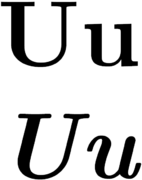 Capital and lowercase versions of U, in normal and italic type
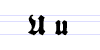 Uppercase and lowercase U in Fraktur
See also
Other representations of U:


English
Etymology

From Middle English lower case letter v (also written u), from Old English lower case u, from 7th century replacement by lower case u of the Anglo-Saxon Futhorc letter ᚢ (u, “ur”), derived from Raetic letter u.
Before the 1700s, the pointed form v was written at the beginning of a word, while a rounded form u was used elsewhere, regardless of sound. So whereas valor and excuse appeared as in modern printing, have and upon were printed haue and vpon. Eventually, in the 1700s, to differentiate between the consonant and vowel sounds, the v form was used to represent the consonant, and u the vowel sound. v then preceded u in the alphabet, but the order has since reversed.
Pronunciation
- Letter name
- IPA(key): /juː/
- Homophones: ewe, yew, you, hew (in h-dropping dialects), hue (in h-dropping dialects)
- Phoneme
- (General Australian) IPA(key): /a/, /ʉː/, /ʊ/
Audio (CA) (file) - (Received Pronunciation) IPA(key): /ʌ/, /uː/, /ʊ/
- (US) IPA(key): /ʌ/, /u/, /ʊ/
Audio (US) (file)
Letter
u (lower case, upper case U, plural u's)
- The twenty-first letter of the English alphabet, called u and written in the Latin script.
- I prefer the u in Arial to the one in Times New Roman.
See also
Noun
u (plural ues)
See also
Translations
Derived terms
- u-turn
- u-bolt
Pronoun
u (second person, singular or plural, nominative or objective)
- (abbreviation, slang, text messaging, Internet) you (in text messaging and internet conversations)
- Take me with u.
Abbreviation
u
Derived terms
- u-boat (1)
Acehnese
Pronunciation
- IPA(key): [u]
Noun
u
- coconut (fruit of the coco palm)
References
- 2007. The UCLA Phonetics Lab Archive. Los Angeles, CA: UCLA Department of Linguistics.
Afrikaans
Pronunciation
- IPA(key): /y/
Etymology 1
Pronoun
u
- (formal) you (singular, subject and object)
See also
| subjective | objective | possessive | ||||
|---|---|---|---|---|---|---|
| singular | 1st | ek | my | |||
| 2nd | jy | jou | ||||
| 2nd, formal | u | |||||
| 3rd, masc | hy | hom | sy | |||
| 3rd, fem | sy | haar | ||||
| 3rd, neut | dit | sy | ||||
| plural | 1st | ons | ||||
| 2nd | julle | julle / jul1 | ||||
| 3rd | hulle | hulle / hul1 | ||||
| 1. In the second and third persons plural, the usual possessive forms are julle and hulle (like the subjective and objective forms), but jul and hul are sometimes used instead when the sentence would otherwise be ambiguous. | ||||||
Etymology 2
Determiner
u
- (formal) your (singular)
See also
| subjective | objective | possessive | ||||
|---|---|---|---|---|---|---|
| singular | 1st | ek | my | |||
| 2nd | jy | jou | ||||
| 2nd, formal | u | |||||
| 3rd, masc | hy | hom | sy | |||
| 3rd, fem | sy | haar | ||||
| 3rd, neut | dit | sy | ||||
| plural | 1st | ons | ||||
| 2nd | julle | julle / jul1 | ||||
| 3rd | hulle | hulle / hul1 | ||||
| 1. In the second and third persons plural, the usual possessive forms are julle and hulle (like the subjective and objective forms), but jul and hul are sometimes used instead when the sentence would otherwise be ambiguous. | ||||||
Ajië
Pronunciation
- IPA(key): [u]
Verb
u
- to swim
References
- Greenhill, S.J., Blust. R, & Gray, R.D. (2008). The Austronesian Basic Vocabulary Database: From Bioinformatics to Lexomics. Evolutionary Bioinformatics, 4:271-283.
Albanian
Etymology
From Proto-Albanian *wa, from Proto-Indo-European *su̯om.
Pronoun
u
- reflexive pronoun
Aragonese
Etymology
Conjunction
u
Aromanian
Etymology
Probably from an early (proto-Romanian) root *eaua, from Latin illam, accusative feminine singular of ille. Compare Romanian o.
Pronoun
u f (short/unstressed accusative form of ea)
- (direct object) her
Related terms
Asturian
Etymology 1
Conjunction
u
Etymology 2
Pronoun
u
- where (relative pronoun)
Adverb
u
Related terms
Azerbaijani
Pronunciation
- (phoneme) IPA(key): /u/
Letter
u lower case (upper case U)
See also
- (Latin-script letters) hərf; A a, B b, C c, Ç ç, D d, E e, Ə ə, F f, G g, Ğ ğ, H h, X x, I ı, İ i, J j, K k, Q q, L l, M m, N n, O o, Ö ö, P p, R r, S s, Ş ş, T t, U u, Ü ü, V v, Y y, Z z
Catalan
Pronunciation
Etymology 1
Noun
u f (plural us)
Etymology 2
Noun
u m (plural uns)
Corsican
Article
u m
Related terms
Pronoun
u m
Czech
Pronunciation
- IPA(key): /u/
audio (file)
Preposition
u + genitive
Dutch
Etymology
Originally the accusative/dative form of jij/gij, from Middle Dutch u, from Old Dutch iu, from Proto-Germanic *iwwiz, West Germanic variant of *izwiz, dative/accusative of *jūz, from Proto-Indo-European *yū́. Doublet of jou.
The use as a nominative stems from an original possessive uwe edelheid (“your gentility”), which was later shortened to U E. and finally to u.
Cognate with West Frisian jo, Low German jo, ju, English you, German euch.
Pronunciation
audio (file) - IPA(key): /y/
Pronoun
u
- (personal, second-person singular, subjective) you (polite).
- Bent u klaar? ― Are you ready?
- Bent u er nog? ― Are you still there?
- (personal, second-person singular, objective) you (polite).
- Ik zal het aan u geven. ― I will give it to you.
- Dit zal niet werken voor u. ― This won’t work for you.
- (personal, second-person singular, objective) thee (dialectal).
- Ik doe dat wel voor u. ― I’ll do it for thee.
- (personal, second-person plural, subjective) you (polite).
- Hebt u die oefening gemaakt? ― Have you prepared that exercise?
- (personal, second-person plural, objective) you (polite).
- Ze zullen dat wel voor u doen. ― They’ll do it for you.
- (reflexive, second-person singular) thyself (dialectal)
- Gij hebt u niet gewassen. ― Thou hast not washed thyself.
- (reflexive, second-person plural) yourselves (dialectal)
- Wast u eens. ― Wash yourselves.
Usage notes
- The capitalization of u (as in U or Uw) is now considered old-fashioned, and no longer compulsory. In religious contexts, it is still often capitalized.
- See usage notes at gij.
Inflection
| subject | object | possessive | reflexive | genitive5 | |||||
|---|---|---|---|---|---|---|---|---|---|
| singular | full | unstr. | full | unstr. | full | unstr. | pred. | ||
| 1st person | ik | 'k1 | mij | me | mijn | m'n1 | mijne | me | mijner |
| 2nd person | jij | je | jou | je | jouw | je | jouwe | je | jouwer |
| 2nd person archaic or regiolectal | gij | ge | u | – | uw | – | uwe | u | uwer |
| 2nd person formal | u | – | u | – | uw | – | uwe | zich | uwer |
| 3rd person masculine | hij | ie1 | hem | 'm1 | zijn | z'n1 | zijne | zich | zijner |
| 3rd person feminine | zij | ze | haar | h'r1, 'r1, d'r1 | haar | h'r1, 'r1, d'r1 | hare | zich | harer |
| 3rd person neuter | het | 't1 | het | 't1 | zijn | z'n1 | zijne | zich | zijner |
| plural | |||||||||
| 1st person | wij | we | ons | – | ons, onze2 | – | onze | ons | onzer |
| 2nd person | jullie | je | jullie | je | jullie | je | – | je | – |
| 2nd person archaic or regiolectal6 | gij | ge | u | – | uw | – | uwe | u | uwer |
| 2nd person formal | u | – | u | – | uw | – | uwe | zich | uwer |
| 3rd person | zij | ze | hen3, hun4 | ze | hun | – | hunne | zich | hunner |
| 1) Not as common in written language. 2) Inflected as an adjective. 3) In prescriptivist use, used only as direct object (accusative). 4) In prescriptivist use, used only as indirect object (dative). |
5) Archaic. Nowadays used for formal, literary or poetic purposes, and in fixed expressions. 6) To differentiate from the singular gij, and in a similar vein to "you lot" or "you guys" in English, it is common to use gijlui ("you people") or gijlieden ("you people") or one of their contracted variants, and their corresponding objects, possessives and reflexives, in the plural. | ||||||||
Alternative forms
- (Brabantian) a
Synonyms
Letter
u (lower case, upper case U)
- The twenty-first letter of the Dutch alphabet.
See also
Esperanto
Pronunciation
- (letter name): IPA(key): /u/
- (phoneme): IPA(key): /u/
Audio (file)
Letter
u (lower case, upper case U)
See also
Noun
u (accusative singular u-on, plural u-oj, accusative plural u-ojn)
See also
- (Latin-script letter names) litero; a, bo, co, ĉo, do, e, fo, go, ĝo, ho, ĥo, i, jo, ĵo, ko, lo, mo, no, o, po, ro, so, ŝo, to, u, ŭo, vo, zo
Faroese
Pronunciation
- IPA(key): /uː/
Letter
u (upper case U)
See also
- (Latin-script letters) bókstavur; A a, Á á, B b, D d, Ð ð, E e, F f, G g, H h, I i, Í í, J j, K k, L l, M m, N n, O o, Ó ó, P p, R r, S s, T t, U u, Ú ú, V v, Y y, Ý ý, Æ æ, Ø ø
French
Pronunciation
- IPA(key): /y/
Noun
u m (plural us)
Fula
Letter
u (lower case, upper case U)
Usage notes
See also
- (Latin-script letters) karfeeje; ', A a, B b, Mb mb, Ɓ ɓ, C c, D d, Nd nd, Ɗ ɗ, E e, F f, G g, Ng ng, Ɠ ɠ, H h, I i, J j, Nj nj, K k, L l, M m, N n, Ŋ ŋ, Ñ ñ, Ɲ ɲ, O o, P p, R r, S s, T t, U u, W w, Y y, Ƴ ƴ
Ido
Pronunciation
- (context pronunciation, letter name) IPA(key): /u/
Letter
u (upper case U)
See also
- (Latin-script letters) litero; A a, B b, C c, D d, E e, F f, G g, H h, I i, J j, K k, L l, M m, N n, O o, P p, Q q, R r, S s, T t, U u, V v, W w, X x, Y y, Z z
Interlingue
Adverb
u
Italian
Etymology
Pronunciation
- IPA(key): /u/
- Rhymes: -u
- Hyphenation: u
Noun
u f (invariable)
See also
- (Latin-script letter names) lettera; a, bi, ci, di, e, effe, gi, acca, i, i lunga, kappa, elle, emme, enne, o, pi, cu, erre, esse, ti, u, vu, doppia vu, ics, ipsilon, zeta
Japanese
Romanization
u
Latin
Pronunciation
- (Classical) IPA(key): /uː/
Noun
ū (indeclinable)
- The name of the letter V.
Coordinate terms
References
- u in Gaffiot, Félix (1934) Dictionnaire Illustré Latin-Français, Hachette
- Carl Meissner; Henry William Auden (1894) Latin Phrase-Book, London: Macmillan and Co.
- anger is defined as a passionate desire for revenge: iracundiam sic (ita) definiunt, ut ulciscendi libidinem esse dicant or ut u. libido sit or iracundiam sic definiunt, ulc. libidinem
- anger is defined as a passionate desire for revenge: iracundiam sic (ita) definiunt, ut ulciscendi libidinem esse dicant or ut u. libido sit or iracundiam sic definiunt, ulc. libidinem
- u in Harry Thurston Peck, editor (1898) Harper's Dictionary of Classical Antiquities, New York: Harper & Brothers
- Arthur E. Gordon, The Letter Names of the Latin Alphabet (University of California Press, 1973; volume 9 of University of California Publications: Classical Studies), part III: “Summary of the Ancient Evidence”, page 32: "Clearly there is no question or doubt about the names of the vowels A, E, I, O, U. They are simply long A, long E, etc. (ā, ē, ī, ō, ū). Nor is there any uncertainty with respect to the six mutes B, C, D, G, P, T. Their names are bē, cē, dē, gē, pē, tē (each with a long E). Or about H, K, and Q: they are hā, kā, kū—each, again, with a long vowel sound."
Latvian
Etymology
Proposed in 1908 as part of the new Latvian spelling by the scientific commission headed by K. Mīlenbahs, which was accepted and began to be taught in schools in 1909. Prior to that, Latvian had been written in German Fraktur, and sporadically in Cyrillic.
Pronunciation
- IPA(key): [u]
Letter

u (lower case, upper case U)
See also
Pronunciation
- IPA(key): [u]
Noun
u m (invariable)
See also
- Latvian letter names:
Lithuanian
Pronunciation
- (phoneme) IPA(key): /ʊ/
Letter
u (upper case U)
See also
- (Latin-script letters) A a, Ą ą, B b, C c, Č č, D d, E e, Ę ę, Ė ė, F f, G g, H h, I i, Į į, Y y, J j, K k, L l, M m, N n, O o, P p, R r, S s, Š š, T t, U u, Ų ų, Ū ū, V v, Z z, Ž ž
Livonian
Pronunciation
- (phoneme) IPA(key): /u/
Letter
u (upper case U)
See also
- (Latin-script letters) kēratēḑ; A a, Ā ā, Ä ä, Ǟ ǟ, B b, D d, Ḑ ḑ, E e, Ē ē, F f, G g, H h, I i, Ī ī, J j, K k, L l, Ļ ļ, M m, N n, Ņ ņ, O o, Ō ō, Ȯ ȯ, Ȱ ȱ, Õ õ, Ȭ ȭ, P p, R r, Ŗ ŗ, S s, Š š, T t, Ț ț, U u, Ū ū, V v, Z z, Ž ž
Malay
Letter
u (lower case, upper case U)
See also
- (Latin-script letters) A a, B b, C c, D d, E e, F f, G g, H h, I i, J j, K k, L l, M m, N n, O o, P p, Q q, R r, S s, T t, U u, V v, W w, X x, Y y, Z z
Maltese
Etymology
From Semitic. Cognate with Arabic وَ (wa), Hebrew וְ־ (v').
Conjunction
u
- and (used to connect two similar words, phrases, etc.)
Mauritian Creole
Pronoun
u (informal to)
- Alternative spelling of ou
See also
Middle Dutch
Etymology 1
From Old Dutch iuwa, from Proto-Germanic *izweraz.
Determiner
u
- your (plural)
- your (singular, informal)
Usage notes
See the usage notes for gi.
Descendants
Etymology 2
See etymology on the main entry.
Pronoun
u
- accusative and dative of gi
Further reading
Middle English
Noun
u
- Alternative form of ew
Middle French
Etymology
Letter
u
Usage notes
- u and v were represented by a single character in Middle French, although scholars consider them to be separate letters both in terms of usage and in terms of pronunciation.
Middle High German
Pronoun
ū
- (personal pronoun, dative, Middle German) Alternative form of iu.
Middle Low German
Pronunciation
- IPA(key): /uː/
Pronoun
û
Declension
Possessive pronoun:
| nominative | accusative | dative | genitive | |
|---|---|---|---|---|
| Strong declension | ||||
| Masculine | û | ûwen | ûwem(e) (ûwennote) | ûwes |
| Neuter | û | |||
| Feminine | ûwe | ûwer(e) | ||
| Plural | ûwe | ûwen | ûwer(e) | |
| Weak declension | ||||
| Masculine | ûwe | ûwen | ûwen | |
| Neuter | ûwe | |||
| Feminine | ûwen | |||
| Plural | ûwen | |||
| The longer forms become rarer in the course of the period. | ||||
Norman
Alternative forms
Etymology
From Old French ueil, from Vulgar Latin oclus, from Latin oculus, from Proto-Indo-European *h₃ekʷ- (“eye; to see”).
Noun
u m (plural uûs or uur)
Norwegian
Pronunciation
- (letter name): IPA(key): /ʉː/
- (phoneme): IPA(key): /ʉː/, /ʉ/, /ʊ/
Letter
u
- The 21st letter of the Norwegian alphabet
Old French
Etymology 1
Adverb
u
- (interrogative) where
Descendants
Etymology 2
Letter
u
Usage notes
- u and v were represented by a single character in Old French, although scholars consider them to be separate letters both in terms of usage and in terms of pronunciation.
Old Portuguese
Etymology
Pronunciation
- IPA(key): /ˈu/
Adverb
u
- where
- 13th century, Vindel manuscript, Martín Codax, Mia irmana fremosa, treides comigo (facsimile)
- Mia irmana fremoſa treides de grado / ala ygreia de uigo u e o mar leuado / E miraremos las ondas.
- Lovely sister, come willingly / To the church in Vigo, where the sea is up, / And we will gaze at the waves.
- Mia irmana fremoſa treides de grado / ala ygreia de uigo u e o mar leuado / E miraremos las ondas.
- 13th century, Vindel manuscript, Martín Codax, Mia irmana fremosa, treides comigo (facsimile)

Descendants
Polish
Etymology
From Proto-Slavic *u, from Proto-Indo-European *h₂ew.
Pronunciation
- IPA(key): /u/
Audio (file)
Preposition
u (+ genitive)
Further reading
- u in Polish dictionaries at PWN
Portuguese
Pronunciation
- IPA(key): /ˈu/
- Homophone: o
Etymology 1
Letter
u (lower case, upper case U)
Noun
u m (plural us)
- u (name of the letter U, u)
See also
Etymology 2
From Old Portuguese u, from Latin ubi. Cognate with Galician u, French où, Italian ove and Romanian iuo.
Adverb
u
- (obsolete) where
- 1534, Gil Vicente, Auto de Mofina Mendes:
- […] nam ſey per u
- […] (I) don't know where
- 1534, Gil Vicente, Auto de Mofina Mendes:
Synonyms
- (where): onde
Etymology 3
Article
u m
- Eye dialect spelling of o.
Pumpokol
Etymology
From Proto-Yeniseian *ʔaw (/ *ʔu) ("thou").
Pronoun
u
- you (second-person plural subjective)
Synonyms
Romanian
Pronunciation
- IPA(key): /u/
Letter
u (lowercase, capital U)
- The twenty-fifth letter of the Romanian alphabet representing the phoneme /u/. Preceded by ţ and followed by v.
Romansch
Etymology
Conjunction
u
Rumu
Noun
u
References
- Rumu-English-Motu dictionary; Rumu (misc)
- Transnewguinea.org, citing G. E. MacDonald, The Teberan Language Family, pages 111-121, in The Linguistic Situation in the Gulf District and Adjacent Area, Papua New Guinea (editor K. J. Franklin) (1973)
- Karl J. Franklin, Comparative Wordlist 1 of the Gulf District and adjacent areas (1975), page 67
Serbo-Croatian
Etymology 1
See Translingual section.
Alternative forms
- (uppercase) U
Pronunciation
- (phoneme) IPA(key): /u/
audio (file)
Letter
u (Cyrillic spelling у)
Etymology 2
From Proto-Slavic *u, from Proto-Indo-European *h₂ew.
Pronunciation
- IPA(key): /u/
audio (file)
Preposition
u (Cyrillic spelling у)
- (+ locative case) in, at (without change of position, answering the question gdjȅ/gdȅ)
- biti u školi ― to be in school
- u c(ij)elom društvu ― in the whole society
- (+ accusative case) to, into (with change of position, answering the question kùda)
- ići u školu ― to go to school
- putovati u Ameriku ― to travel to America
- (+ accusative case) on, in, at, during (in expressions concerning time)
- u podne ― at noon
- u sr(ij)edu ― on Wednesday
- u zoru ― at dawn
- U koliko sati? ― At what time?
- (+ locative case) in, during (in expressions concerning time)
- u jednom danu ― in one day
- u mladosti ― during one's youth
Skolt Sami
Pronunciation
- (phoneme) IPA(key): /u/, /w/
Letter
u (upper case U)
See also
- (Latin-script letters) bukva; A a, Â â, B b, C c, Č č, Ʒ ʒ, Ǯ ǯ, D d, Đ đ, E e, F f, G g, Ǧ ǧ, Ǥ ǥ, H h, I i, J j, K k, Ǩ ǩ, L l, M m, N n, Ŋ ŋ, O o, Õ õ, P p, R r, S s, Š š, T t, U u, V v, Z z, Ž ž, Å å, Ä ä, ʹ
Somali
Preposition
u
Usage notes
- In Somali, prepositions fall before the verb and not before the noun they modify:
Spanish
Etymology 1
Pronunciation
- IPA(key): /u/
Audio (Spain) (file)
Letter
u (lower case, upper case U)
- The 22nd letter of the Spanish alphabet.
Noun
u f (plural úes)
- Name of the letter U.
Etymology 2
Pronunciation
- IPA(key): /u/, [u], [w]
Conjunction
u
Usage notes
Used instead of o when the following word starts with a vowel sound which is pronounced /o/.
See also
Swedish
Pronunciation
- Letter name
- IPA(key): /ʉː/
- Phoneme
- IPA(key): /ʉː/, /ɵ/
Letter
u (lower case, upper case U)
Tolai
Pronoun
u
- Second-person singular pronoun: you (singular)
Declension
Torres Strait Creole
Noun
u
Usage notes
U is the sixth stage of coconut growth. It is preceded by pes and followed by drai koknat.
Turkish
Letter
u (lower case, upper case U)
See also
Noun
u
See also
- (Latin-script letter names) harf; a, be, ce, çe, de, e, fe, ge, yumuşak ge, he, ı, i, je, ke, le, me, ne, o, ö, pe, re, se, şe, te, u, ü, ve, ye, ze
Turkmen
Pronunciation
- (phoneme) IPA(key): /u/, /uː/
Letter
u (upper case U)
See also
- (Latin-script letters) harp; A a, B b, Ç ç, D d, E e, Ä ä, F f, G g, H h, I i, J j, Ž ž, K k, L l, M m, N n, Ň ň, O o, Ö ö, P p, R r, S s, Ş ş, T t, U u, Ü ü, W w, Y y, Ý ý, Z z
Tzotzil
Pronunciation
- IPA(key): /ʔu/
Noun
u
Synonyms
- (moon): jch'ul me'tik
References
- “ˀu(1)” in Laughlin, Robert M. (1975) The Great Tzotzil Dictionary of San Lorenzo Zinacantán. Washington: Smithsonian Institution Press.
Uzbek
Pronoun
u (Cyrillic у)
- Demonstrative pronoun used to indicate a thing that is far away from the speaker. that.
- U eshik. ― That is a door. / That door.
Vietnamese
Pronunciation
- (Hà Nội) IPA(key): [ʔu˧˧]
- (Huế) IPA(key): [ʔʊw˧˧]
- (Hồ Chí Minh City) IPA(key): [ʔʊw˧˧]
Etymology 1
Noun
u
Synonyms
Etymology 2
From Proto-Vietic *ʔuː (“hump (of a zebu)”).
Noun
(classifier khối, cục) u (幽, 𢉾)
Derived terms
- u mỡ
- u xơ tử cung
- u nang buồng trứng
Related terms
Etymology 3
From Portuguese u.
Noun
u
Volapük
Conjunction
u
Alternative forms
- (in front of vowels) ud
Zulu
Letter
u (lower case, upper case U)