y
 | ||||||||
| ||||||||
Translingual
Letter
y (upper case Y)
- The twenty-fifth letter of the basic modern Latin alphabet.
See also
Pronunciation
IPA (file)
Symbol
y
Gallery
- Letter styles
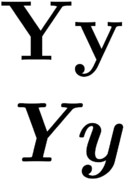 Capital and lowercase versions of Y, in normal and italic type
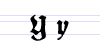 Uppercase and lowercase Y in Fraktur
See also
Other representations of Y:

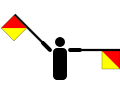
English
Pronunciation
Letter
Usage notes
See also
Abbreviation
y
- Abbreviation of year.
- 2003, Howard Tanner, Sonia Jones, Becoming a Successful Teacher of Mathematics
- Consider the following questions selected from the tests and estimate the proportion of Y8 pupils you would expect to answer correctly.
- 2003, Howard Tanner, Sonia Jones, Becoming a Successful Teacher of Mathematics
- (Britain, television) Abbreviation of youth., usually followed by an age appropriate for the content so marked.
- Y7
- (computing) Abbreviation of yes.
- (slang, text messaging, Internet) Abbreviation of why.
Derived terms
See also
Aragonese
Etymology
From Latin et, from Proto-Indo-European *éti.
Conjunction
y
Asturian
Etymology
From Latin et, from Proto-Indo-European *éti.
Conjunction
y
Pronoun
y (y (or -y), plural ys/yos or -ys/-yos)
- Pronoun for the third-person singular indirect object.
- da-y pan
- give him/her bread
Usage notes
- Usually seen as -y
Azerbaijani
Pronunciation
- (phoneme) IPA(key): /j/
Letter
y lower case (upper case Y)
See also
- (Latin-script letters) hərf; A a, B b, C c, Ç ç, D d, E e, Ə ə, F f, G g, Ğ ğ, H h, X x, I ı, İ i, J j, K k, Q q, L l, M m, N n, O o, Ö ö, P p, R r, S s, Ş ş, T t, U u, Ü ü, V v, Y y, Z z
Cornish
Pronunciation
- IPA(key): /iː/
Pronoun
y
Dutch
Alternative forms
- ij (in some words)
Pronunciation
- (letter name): IPA(key): /ɛɪ/
Audio (file)
Letter
y (lower case, upper case Y)
- The twenty-fifth letter of the Dutch alphabet.
Usage notes
In certain dialects the letter is pronounced similar to IPA: /ji:/. In these dialects, they will actually write "y" such as in "jy" (IPA: /ji:/) instead of modern standard Dutch jij (IPA: /jɛɪ/).
See also
Fala
Conjunction
y
- Alternative form of i
Faroese
Pronunciation
Letter
y (upper case Y)
See also
- (Latin-script letters) bókstavur; A a, Á á, B b, D d, Ð ð, E e, F f, G g, H h, I i, Í í, J j, K k, L l, M m, N n, O o, Ó ó, P p, R r, S s, T t, U u, Ú ú, V v, Y y, Ý ý, Æ æ, Ø ø
French
Etymology 1
From i grec (“Greek i”), referring to the letter upsilon (Υ), originally borrowed from the Greek alphabet, as opposed to "Latin i" (I).
Pronunciation
- (letter name) IPA(key): /i.ɡʁɛk/
Letter
y
Etymology 2
10th century; from Old French i, from Latin hīc (“here”) (ultimately from Proto-Indo-European *ǵʰi-ḱe (“this, here”)), with meaning influenced by Old French iv (“there, thither”), itself from Latin ibī. Derivation from the latter poses difficulty from a phonetic standpoint.
Pronunciation
Pronoun
y (adverbial)
- there (at a place)
- Il est dans la maison. Il y est.
- He is in the house. He is there.
- there, thither (to there)
- Nous allons au Mexique. Nous y allons.
- We are going to Mexico. We are going there.
- Used as a pronoun to replace à followed by an indirect object.
- With verbs: see Appendix:French verbs followed by à for verbs which use this structure.
- (archaic) With adjectives. Only used with handful of adjectives (the most usual being y compris, which is a special case), mainly in juridical language.
- personnes y nommées ― (please add an English translation of this usage example)
- procédures y afférentes ― (please add an English translation of this usage example)
- documents y relatifs ― (please add an English translation of this usage example)
- eaux y affluentes ― (please add an English translation of this usage example)
Related terms
| Number | Person | Gender | Nominative (subject) |
Reflexive | Accusative (direct complement) |
Dative (indirect complement) |
Locative (at) |
Genitive (of) |
Disjunctive (tonic) |
|---|---|---|---|---|---|---|---|---|---|
| Singular | First | — | je, j’ | me, m’ | — | — | moi | ||
| Second | — | tu | te, t’ | — | — | toi | |||
| Third | Masculine | il | se, s’ | le, l’ | lui | y | en | lui, soi | |
| Feminine | elle | la, l’ | elle, soi | ||||||
| — | on | — | — | — | — | soi | |||
| Plural | First | — | nous | nous | — | — | nous | ||
| Second | — | vous | vous | — | — | vous | |||
| Third | Masculine | ils | se, s’ | les | leur | y | en | eux, soi | |
| Feminine | elles | elles, soi | |||||||
Etymology 3
Eye-dialect spelling of il.
Pronunciation
- IPA(key): /i/
Pronoun
y
Further reading
- “y” in le Trésor de la langue française informatisé (The Digitized Treasury of the French Language).
Fula
Pronunciation
- IPA(key): /j/
Letter
y (lower case, upper case Y)
Usage notes
See also
- (Latin-script letters) karfeeje; ', A a, B b, Mb mb, Ɓ ɓ, C c, D d, Nd nd, Ɗ ɗ, E e, F f, G g, Ng ng, Ɠ ɠ, H h, I i, J j, Nj nj, K k, L l, M m, N n, Ŋ ŋ, Ñ ñ, Ɲ ɲ, O o, P p, R r, S s, T t, U u, W w, Y y, Ƴ ƴ
German
Pronunciation
- (phoneme) IPA(key): /yː/, /y/, /ʏ/, /i/, /ɪ/, /j/
- (letter name) IPA(key): /ˈʏpsilɔn/
Letter
y n (genitive y, plural y)
- the letter y
Guaraní
Noun
y
Ido
Pronunciation
Letter
y (upper case Y)
See also
- (Latin-script letters) litero; A a, B b, C c, D d, E e, F f, G g, H h, I i, J j, K k, L l, M m, N n, O o, P p, Q q, R r, S s, T t, U u, V v, W w, X x, Y y, Z z
Italian
Noun
y m, f (invariable)
- See under Y
Kamayurá
Noun
y
- Alternative form of 'ɨ
References
- Languages of the Amazon (2012, →ISBN
Ladin
Conjunction
y
Latgalian
Pronunciation
- (phoneme) IPA(key): /ɨ/
Letter
y (upper case Y)
See also
- (Latin-script letters) A a, Ā ā, B b, C c, Č č, D d, E e, Ē ē, F f, G g, Ģ ģ, H h, I i, Y y, Ī ī, J j, K k, Ķ ķ, L l, Ļ ļ, M m, N n, Ņ ņ, O o, Ō ō, P p, R r, S s, Š š, T t, U u, Ū ū, V v, Z z, Ž ž
Latin
Pronunciation
- (Classical) IPA(key): /yː/
Noun
ȳ ? (indeclinable)
- A name of the letter Y.
Synonyms
Coordinate terms
References
- y in Charles du Fresne du Cange’s Glossarium Mediæ et Infimæ Latinitatis (augmented edition, 1883–1887)
- Basil Lanneau Gildersleeve, Latin Grammar (3rd ed., 1895), page 1
- The Latin names for the letters… For Y the sound was used, for Z the Greek name (zēta).
Lithuanian
Pronunciation
- (phoneme) IPA(key): /iː/
Letter
y (upper case Y)
See also
- (Latin-script letters) A a, Ą ą, B b, C c, Č č, D d, E e, Ę ę, Ė ė, F f, G g, H h, I i, Į į, Y y, J j, K k, L l, M m, N n, O o, P p, R r, S s, Š š, T t, U u, Ų ų, Ū ū, V v, Z z, Ž ž
Malay
Letter
y (lower case, upper case Y)
See also
- (Latin-script letters) A a, B b, C c, D d, E e, F f, G g, H h, I i, J j, K k, L l, M m, N n, O o, P p, Q q, R r, S s, T t, U u, V v, W w, X x, Y y, Z z
Mandinka
Pronoun
y
See also
Manx
Article
y
- Alternative form of yn
Mbyá Guaraní
Noun
y
References
Middle English
Pronoun
y
Middle French
Adverb
y
- there (in a given place)
- 1488, Jean Dupré, Lancelot du Lac, page 12:
- Or me dictes fist Lancelot, des lettres qui illec sont escriptes, savez vous qui les y fist mettre
- Now tell me, said Lancelot, about these letters that are written here, do you know who put them here?
- Or me dictes fist Lancelot, des lettres qui illec sont escriptes, savez vous qui les y fist mettre
-
Norwegian
Pronunciation
- (letter name): IPA(key): /yː/
- (phoneme): IPA(key): /yː/, /y/
Letter
y
Usage notes
- Perhaps the most troublesome sound in Norwegian. Even some native speakers tend to merge it into /i(ː)/.
Old Tupi
Pronunciation
- IPA(key): /ˈʔɨ/
Noun
y
References
- LEMOS BARBOSA, A. Curso de Tupi antigo. Rio de Janeiro: Livraria São José, 1956.
Papiamentu
Etymology
From Spanish y and Portuguese e and Kabuverdianu í.
Conjunction
y
Portuguese
Pronunciation
Audio (BR) (file)
Letter
y (lower case, upper case Y)
See also
- (Latin-script letters) letra; A a (Á á, À à, Â â, Ã ã), B b, C c (Ç ç), D d, E e (É é, Ê ê), F f, G g, H h, I i (Í í), J j, K k, L l, M m, N n, O o (Ó ó, Ô ô, Õ õ), P p, Q q, R r, S s, T t, U u (Ú ú), V v, W w, X x, Y y, Z z
Quechua
Adverb
y
Spanish
Etymology 1
Pronunciation
- (phoneme) IPA(key): /ʝ/, /i/
- (letter name) IPA(key): /ɟ͡ʝe/
Letter
y (lower case, upper case Y)
See also
Etymology 2
From Old Spanish é or e, from Latin et.
Alternative forms
Pronunciation
- (preconsonantal) IPA(key): /i/
- (prevocalic) IPA(key): /ʝ/
- Rhymes: -i
Conjunction
y
- and
- 1605, Miguel de Cervantes Saavedra, Don Quijote de la Mancha1, Chapter I:
- Es, pues, de saber que este sobredicho hidalgo, los ratos que estaba ocioso —que eran los más del año—, se daba a leer libros de caballerías, con tanta afición y gusto, que olvidó casi de todo punto el ejercicio de la caza y aun la administración de su hacienda; y llegó a tanto su curiosidad y desatino en esto, que vendió muchas hanegas de tierra de sembradura para comprar libros de caballerías en que leer, y, así, llevó a su casa todos cuantos pudo haber dellos.
- You must know, then, that the above-named gentleman whenever he was at leisure (which was mostly all the year round) gave himself up to reading books of chivalry with such ardour and avidity that he almost entirely neglected the pursuit of his field-sports, and even the management of his property; and to such a pitch did his eagerness and infatuation go that he sold many an acre of tillageland to buy books of chivalry to read, and brought home as many of them as he could get.
- 1605, Miguel de Cervantes Saavedra, Don Quijote de la Mancha1, Chapter I:
- (in names of number) and
- setenta y seis
- seventy-six
- (in arithmetic) plus, and
- uno y uno son dos
- one plus one is two
- (informal) well
- ¡Y por supuesto!
- Well, of course!
Usage notes
- Before words that begin with the /i/ sound, the form e is used instead.
Turkish
Letter
y (lower case, upper case Y)
See also
- (Latin-script letters) harf; A a, B b, C c, Ç ç, D d, E e, F f, G g, Ğ ğ, H h, I ı, İ i, J j, K k, L l, M m, N n, O o, Ö ö, P p, R r, S s, Ş ş, T t, U u, Ü ü, V v, Y y, Z z
Turkmen
Pronunciation
- (phoneme) IPA(key): /ɯ/, /ɯː/
Letter
y (upper case Y)
See also
- (Latin-script letters) harp; A a, B b, Ç ç, D d, E e, Ä ä, F f, G g, H h, I i, J j, Ž ž, K k, L l, M m, N n, Ň ň, O o, Ö ö, P p, R r, S s, Ş ş, T t, U u, Ü ü, W w, Y y, Ý ý, Z z
Vietnamese
Etymology
Sino-Vietnamese word from 伊.
Pronunciation
- (Hà Nội) IPA(key): [ʔi˧˧]
- (Huế) IPA(key): [ʔɪj˧˧]
- (Hồ Chí Minh City) IPA(key): [ʔɪj˧˧]
Noun
y (伊)
- (formal, derogatory) he; him (usually refers to a criminal)
- (archaic, literary) he; him; she; her
- 1958, Nguyễn Đổng Chi, "Thạch Sùng còn thiếu mẻ kho hay là Sự tích con mối" (Kho tàng truyện cố tích Việt Nam nr. 36), NXB Văn sử địa
- Hồi đó ở kinh đô có một người em hoàng hậu họ Vương. Y cũng là tay cự phú nổi tiếng tiền rừng biển bạc và xài phí vào bậc nhất.
- At the time, there was in the capital a brother of the queen of the Wáng family. He was also a famous for being immensely rich and was an extravagant spender of first degree.
- Hồi đó ở kinh đô có một người em hoàng hậu họ Vương. Y cũng là tay cự phú nổi tiếng tiền rừng biển bạc và xài phí vào bậc nhất.
- 1958, Nguyễn Đổng Chi, "Thạch Sùng còn thiếu mẻ kho hay là Sự tích con mối" (Kho tàng truyện cố tích Việt Nam nr. 36), NXB Văn sử địa
See also
Wayampi
Noun
y
- Alternative form of ɨɨ (“water”)
- ay'ú. ― I drink water.
References
- Handbook of Amazonian Languages, volume 4 (1998), edited by Desmond C. Derbyshire, Geoffrey K. Pullum
Welsh
Pronunciation
- IPA(key): /ə/
Etymology 1
Alternative forms
Article
y (definite) (triggers Soft Mutation of a feminine singular noun, except ll and rh remain unmutated)
Etymology 2
Alternative forms
- yr (used before vowels)
Particle
y
- (literary) that (preverbal particle used to mark a subordinate clause)
- Wyt ti'n meddwl y gall hi ddod?
- Do you think that she can come?
- Mae hi'n gwybod y byddet ti'n gwrando arni hi.
- She knows that you would listen to her.
- (literary) which, whom (particle used with indirect relative clauses)
- y dyn y dysgais ei fab ― the man whose son I taught
- y ferch y gwrandewais arni ― the girl to whom I listened
- (literary) preverbal particle used to mark an affirmative verb in a main clause
- 1620, William Morgan, Y Bibl Cyssegr-lan, Genesis 1:1
- Yn y dechreuad y creodd Duw y nefoedd a’r ddaear.
- In the beginning God created the heavens and the earth.
- 1620, William Morgan, Y Bibl Cyssegr-lan, Genesis 1:1
Usage notes
- y is almost always omitted in the colloquial language.
- y is used to mean 'that' (i.e. mark a subordinate clause) when the subordinate clause begins with an affirmative form of bod not in the present tense, or another affirmative verb in any tense apart from the preterite.
Related terms
Zulu
Letter
y (lower case, upper case Y)