n
 | ||||||||
| ||||||||
Translingual
Etymology

Letter
n (upper case N)
- The fourteenth letter of the basic modern Latin alphabet.
- in Romanization:
Synonyms
- (Romanization of נּ, “nun”, “nūn ḥāzāq”): nn (in the Hebrew Academy (1953 and 2006) and ISO 259 transliteration schemes)
Related terms
Further reading
Pronunciation
IPA (file)
Symbol
n
- (IPA) alveolar nasal.
- (statistics) Sample size.
- (physics) neutron
- (mathematics) An arbitrary natural number.
Gallery
- Letter styles
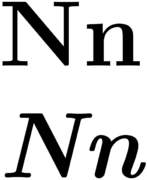 Capital and lowercase versions of N, in normal and italic type
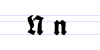 Uppercase and lowercase N in Fraktur
See also
- (Latin script): Aa Bb Cc Dd Ee Ff Gg Hh Ii Jj Kk Ll Mm Nn Oo Pp Qq Rr Sſs Tt Uu Vv Ww Xx Yy Zz
- (Variations of letter N): Ńń Ǹǹ Ňň Ññ Ṅṅ Ņņ Ṇṇ Ṋṋ Ṉṉ N̈n̈ Ɲɲ Ƞƞ ᵰ ᶇ ɳ ȵ ɴ Nn Ŋŋ NJNjnj NJNjnj
- Preceded by apostrophe: 'n
- Hiragana: ん
- な (na), に (ni), ぬ (nu), ね (ne), の (no)
Other representations of N:


Further reading

English
Etymology 1
Pronunciation
- IPA(key): /ɛn/
Audio (US) (file)
Audio (UK) (file)
Letter
n (lower case, upper case N, plural n's)
See also
Number
n (lower case, upper case N)
- The ordinal number fourteenth, derived from this letter of the English alphabet, called en and written in the Latin script.
Etymology 2
Alternative forms
Noun
n
- north
- (grammar) noun
- (grammar) neuter gender
- (organic chemistry) normal
- Neutral
- No
- Shortening of and, used in set phrases like rock-n-roll.
Translations
|
|
Aromanian
Preposition
n
- Alternative form of ãn
Azerbaijani
Pronunciation
- (phoneme) IPA(key): /n/
Letter
n lower case (upper case N)
See also
- (Latin-script letters) hərf; A a, B b, C c, Ç ç, D d, E e, Ə ə, F f, G g, Ğ ğ, H h, X x, I ı, İ i, J j, K k, Q q, L l, M m, N n, O o, Ö ö, P p, R r, S s, Ş ş, T t, U u, Ü ü, V v, Y y, Z z
Chinese
Pronunciation
Numeral
n
- Alternative spelling of N
Dutch
Pronunciation
Audio (file) - Rhymes: -ɛn
- (letter name): IPA(key): /ɛn/
Letter
n (lower case, upper case N)
See also
See also
Egyptian
Etymology 1
Cognate with Hebrew לְ־ (lə-, “to, for, of”), Arabic لِـ (li-, “to, for, belonging to”).[1]
Pronunciation
- (reconstructed) IPA(key): /ni/ → /ni/ → /ne/[2]
- (modern Egyptological) IPA(key): /ɛn/
- Conventional anglicization: en
Preposition
|

Inflection
|
|
||||||||||||
| nj | n | ||||||||||||

Alternative forms
Before a noun it can be written thus:

This should not be confused with the negative particle, which is written identically.
Derived terms
Etymology 2
Pronunciation
- (modern Egyptological) IPA(key): /ɛn/
- Conventional anglicization: en
Adjective
|
- Abbreviation of nj (“of, belonging to (genitival adjective)”).
Etymology 3
Pronunciation
- (modern Egyptological) IPA(key): /ɛn/
- Conventional anglicization: en
Pronoun
|

pl 1. enclitic (‘dependent’) pronoun
Usage notes
This form of pronoun is an enclitic that must directly follow the word it modifies. Its meaning depends on its context:
- When it follows a verb, it indicates the object of the verb.
- In the second and third person when it follows an adjective, it forms the subject of an adjectival sentence.
- When it follows a relative adjective, such as ntj, ntt, or jsṯ, it indicates the subject of the relative clause (usually only in the first person singular and third person common).
- When it follows an imperative, it indicates the object of the verb.
- When it follows a particle like m.k, it indicates the subject of the clause.
- When attached to a preposition, it indicates the object of the preposition.
Inflection
| number | first person | second person | third person | |||
|---|---|---|---|---|---|---|
| masculine | feminine | masculine | feminine | |||
| suffix pronouns | singular | ∅, .j |
.k, .kj1 |
.ṯ, .ṯn |
.f, .fj1 |
.s, .sj1 |
| dual | .nj |
.ṯnj |
.snj | |||
| plural | .n |
.ṯn |
.sn | |||
| enclitic (‘dependent’) pronouns | singular | w, wj, wy |
kw, k, ṯw, ṯ |
ṯm, ṯn |
sw, s |
s |
| dual | — |
ṯnj |
snj | |||
| plural | n |
ṯn |
sn | |||
| stressed (‘independent’) pronouns | singular | jnk |
ṯwt |
ṯmt |
swt |
stt |
| dual | — |
— |
ntsnj | |||
| plural | — |
ntṯn |
ntsn, jntsn | |||
| stative (‘pseudoparticiple’) endings | singular | .kj, .k |
.tj, .t |
∅, .j |
.tj, .t | |
| dual | — | .tjwn |
.wy, .wj |
.ty | ||
| plural | .wn, .nw |
∅, .w, .y, .wy |
.tj, .t | |||
| ||||||
| number | first person | second person | third person | |||
|---|---|---|---|---|---|---|
| masculine | feminine | masculine | feminine | |||
| suffix pronouns | singular | ∅, .j |
.k, .kj1 |
.ṯ, .t |
.f, .fj1 |
.s, .sj1 |
| dual2 | .nj |
.ṯnj, .tnj |
.snj | |||
| plural | .n |
.ṯn, .tn |
.sn, .w3 | |||
| enclitic (‘dependent’) pronouns | singular | wj, w |
ṯw, tw |
ṯn, tn |
sw, st |
sj, s, st |
| plural | n |
ṯn, tn |
sn, st | |||
| stressed (‘independent’) pronouns | singular | jnk |
ntk, ṯwt2 |
ntṯ, ntt, ṯwt2 |
ntf, swt2 |
nts, swt2 |
| plural | jnn3 |
ntṯn, nttn |
ntsn | |||
| stative (‘pseudoparticiple’) endings | singular | .kw |
.tj, .t, .tw3 |
∅, .w |
.tj, .t, .tw3 | |
| plural | .wn, .wjn |
.tjwn, .tjwnj |
∅, .w, .y | |||
| proclitic (‘subject form’) pronouns3 | singular | tw.j |
tw.k |
tw.t |
sw |
sj, st |
| plural | tw.n |
tw.tn |
st | |||
| ||||||
| number | first person | second person | third person | |||
|---|---|---|---|---|---|---|
| masculine | feminine | masculine | feminine | |||
| suffix pronouns | singular | ∅, .j |
.k, .kw |
.t |
.f, .fj |
.s, .st, .sw |
| plural | .n |
.tn, .twn |
.w, .sn1 | |||
| enclitic (‘dependent’) pronouns1 | singular | wj |
tw, tj |
sw, st | ||
| plural | n, wn |
twtn |
sn, st | |||
| stressed (‘independent’) pronouns | singular | jnk |
mntk, mtwk |
mntt, mtwy |
mntf |
mntst, mntjst |
| plural | jnn |
mnttn |
mntw | |||
| stative (‘pseudoparticiple’) endings1 | singular | .kw, .k |
.tj, .tw |
∅, .w, .y |
.tj, .tw | |
| plural | .n |
.tn |
∅, .w, .y | |||
| unmarked (later) | ∅, .tw | |||||
| proclitic (‘subject form’) pronouns | singular | tw.j |
tw.k |
tw.t |
sw |
st, sw |
| plural | tw.n |
tw.tn |
st, sw, swst | |||
| ||||||
Alternative forms
|
|||||||||||
| n | |||||||||||
References
- Allen, James (2010) Middle Egyptian: An Introduction to the Language and Culture of Hieroglyphs, revised second edition, Cambridge: Cambridge University Press, →ISBN
- Faulkner, Raymond (1962) A Concise Dictionary of Middle Egyptian, Oxford: Griffith Institute, →ISBN
Esperanto
Pronunciation
Audio (file)
Letter
n (lower case, upper case N)
See also
- (Latin-script letters) litero; A a, B b, C c, Ĉ ĉ, D d, E e, F f, G g, Ĝ ĝ, H h, Ĥ ĥ, I i, J j, Ĵ ĵ, K k, L l, M m, N n, O o, P p, R r, S s, Ŝ ŝ, T t, U u, Ŭ ŭ, V v, Z z
Faroese
Pronunciation
- IPA(key): /n/
Letter
n (upper case N)
See also
- (Latin-script letters) bókstavur; A a, Á á, B b, D d, Ð ð, E e, F f, G g, H h, I i, Í í, J j, K k, L l, M m, N n, O o, Ó ó, P p, R r, S s, T t, U u, Ú ú, V v, Y y, Ý ý, Æ æ, Ø ø
French
Pronunciation
- (letter name) IPA(key): /ɛn/
Letter
n (lower case, upper case N)
- The fourteenth letter of the French alphabet, written in the Latin script.
- 1837, Louis Viardot, L’Ingénieux Hidalgo Don Quichotte de la Manchefr.Wikisource, translation of El ingenioso hidalgo Don Quijote de la Mancha by Miguel de Cervantes Saavedra, Chapter I:
- Avec ces propos et d’autres semblables, le pauvre gentilhomme perdait le jugement. Il passait les nuits et se donnait la torture pour les comprendre, pour les approfondir, pour leur tirer le sens des entrailles, ce qu’Aristote lui-même n’aurait pu faire, s’il fût ressuscité tout exprès pour cela.
- With these passages and other similar ones, the poor gentleman lost his judgement. He spent his nights and tortured himself to understand them, to consider them more deeply, to take from them their deepest meaning, which Aristotle himself would not have been able to do, had he been resurrected for that very purpose.
-
Fula
Pronunciation
- IPA(key): /n/
Letter
n (lower case, upper case N)
Usage notes
See also
- (Latin-script letters) karfeeje; ', A a, B b, Mb mb, Ɓ ɓ, C c, D d, Nd nd, Ɗ ɗ, E e, F f, G g, Ng ng, Ɠ ɠ, H h, I i, J j, Nj nj, K k, L l, M m, N n, Ŋ ŋ, Ñ ñ, Ɲ ɲ, O o, P p, R r, S s, T t, U u, W w, Y y, Ƴ ƴ
German
Article
n
- Nonstandard form of 'n.
- 1984, Wolfdietrich Schnurre, Ein Unglücksfall: Roman, page 172:
- „Hat uns vorhin so n Mensch von der Dingsbums gebracht.“ „Von der Kultusgemeinde.“ Avrom hebt zwinkernd die Augen vom Buch; er lächelt. Muß ne anrührende Stelle gewesen sein, was er da grade liest. „Was heißt ‚so n Mensch‘.“
- 1999, Regula Schmidlin, Wie Deutschschweizer Kinder schreiben und erzählen lernen:
- […] also die Geschichte hab ich genannt (äh) die Froschsuche weil da war so n Junge und mit em Hund und die haben dauernd ihren Frosch immer angeguckt im Wasser und dann einmal in der Nacht is er weggehüpft […]
- 2012, Gustav Falke, Die Kinder Aus Ohlsens Gang, page 92:
- »Wenn ick de jungen Lüd nich harr und de Kinner – so n Mann, Herr Lehrer, so n Mann! aber ick hev en nu. He schall mi mol Muck seggn. Rut smiet ick em.« »Das lassen Sie nur lieber nach, Frau Krahnstöver. […] «
- 2014, Manuel Mayer, Schwule Akten: Fußballstar und Tennisprofi geoutet (Himmelstürmer Verlag), page 58:
- Und da Sex Sponsoren anzieht, würde so n Kerl ein so großes Medienecho hervorrufen, sodass wir noch Jahrhunderte davon hören würden ...
- 1984, Wolfdietrich Schnurre, Ein Unglücksfall: Roman, page 172:
Haruai
Pronoun
n
References
- Jef Verschueren, Pragmatics at Issue: Selected Papers (1991, →ISBN
- Bernard Comrie, Maria Polinsky, Causatives and Transitivity (1993, →ISBN, page 317: Haruai has a serial verb construction, in which all verbs but the last take no inflections whatsoever (the only instance in Haruai where a verb can appear inflectionless), as in (3): n dw röbö p-n-a I go water get-FUT(-1SG)-DEC
Ido
Pronunciation
Letter
n (upper case N)
See also
- (Latin-script letters) litero; A a, B b, C c, D d, E e, F f, G g, H h, I i, J j, K k, L l, M m, N n, O o, P p, Q q, R r, S s, T t, U u, V v, W w, X x, Y y, Z z
Italian
Noun
n m, f (invariable)
- See under N
Japanese
Romanization
n
Ladin
Article
n
- a (+ masculine noun)
See also
Latvian
Etymology
Proposed in 1908 as part of the new Latvian spelling by the scientific commission headed by K. Mīlenbahs, which was accepted and began to be taught in schools in 1909. Prior to that, Latvian had been written in German Fraktur, and sporadically in Cyrillic.
Pronunciation
- IPA(key): [n]
| (file) |
Letter

n (lower case, upper case N)
See also
- Letters of the Latvian alphabet:
Livonian
Pronunciation
- (phoneme) IPA(key): /n/
Letter
n (upper case N)
See also
- (Latin-script letters) kēratēḑ; A a, Ā ā, Ä ä, Ǟ ǟ, B b, D d, Ḑ ḑ, E e, Ē ē, F f, G g, H h, I i, Ī ī, J j, K k, L l, Ļ ļ, M m, N n, Ņ ņ, O o, Ō ō, Ȯ ȯ, Ȱ ȱ, Õ õ, Ȭ ȭ, P p, R r, Ŗ ŗ, S s, Š š, T t, Ț ț, U u, Ū ū, V v, Z z, Ž ž
Malay
Letter
n (lower case, upper case N)
See also
- (Latin-script letters) A a, B b, C c, D d, E e, F f, G g, H h, I i, J j, K k, L l, M m, N n, O o, P p, Q q, R r, S s, T t, U u, V v, W w, X x, Y y, Z z
Mandarin
Romanization
n
Usage notes
- English transcriptions of Mandarin speech often fail to distinguish between the critical tonal differences employed in the Mandarin language, using words such as this one without the appropriate indication of tone.
Norwegian
Pronunciation
- (letter name): IPA(key): /enː/, /ɛnː/
- (phoneme): IPA(key): /n/, (in rn) /ɳ/, (in ng and nk) /ŋ/
Letter
n
Portuguese
Etymology 1
Pronunciation
Audio (BR) (file)
Letter
n (lower case, upper case N)
See also
Etymology 2
Alternative forms
Adverb
n
- (Internet slang, text messaging) Abbreviation of não (“not”).
Noun
n m (plural n)
- (Internet slang, text messaging) Abbreviation of não (“no”).
Interjection
n
- (Internet slang, text messaging) Abbreviation of não (“no”).
Romanian
Pronunciation
- IPA(key): /ne/, /en/
Letter
n (lowercase, capital N)
- The seventeenth letter of the Romanian alphabet, written in the Latin script. Representing the phoneme /n/. Preceded by m and followed by o.
Serbo-Croatian
Pronunciation
- (phoneme) IPA(key): /n/
Letter
n (Cyrillic spelling н)
Skolt Sami
Pronunciation
- (phoneme) IPA(key): /n/
Letter
n (upper case N)
See also
- (Latin-script letters) bukva; A a, Â â, B b, C c, Č č, Ʒ ʒ, Ǯ ǯ, D d, Đ đ, E e, F f, G g, Ǧ ǧ, Ǥ ǥ, H h, I i, J j, K k, Ǩ ǩ, L l, M m, N n, Ŋ ŋ, O o, Õ õ, P p, R r, S s, Š š, T t, U u, V v, Z z, Ž ž, Å å, Ä ä, ʹ
Spanish
Pronunciation
- (phoneme) IPA(key): /n/
- (letter) IPA(key): /ˈene/
Audio (Spain) (file)
Letter
n (lower case, upper case N)
Turkish
Letter
n (lower case, upper case N)
See also
- (Latin-script letters) harf; A a, B b, C c, Ç ç, D d, E e, F f, G g, Ğ ğ, H h, I ı, İ i, J j, K k, L l, M m, N n, O o, Ö ö, P p, R r, S s, Ş ş, T t, U u, Ü ü, V v, Y y, Z z
Turkmen
Pronunciation
- (phoneme) IPA(key): /n/
Letter
n (upper case N)
See also
- (Latin-script letters) harp; A a, B b, Ç ç, D d, E e, Ä ä, F f, G g, H h, I i, J j, Ž ž, K k, L l, M m, N n, Ň ň, O o, Ö ö, P p, R r, S s, Ş ş, T t, U u, Ü ü, W w, Y y, Ý ý, Z z
Zulu
Letter
n (lower case, upper case N)