bee
English
Pronunciation
- (General American) IPA(key): /bi/
- (UK) enPR: bē, IPA(key): /biː/
Audio (US) (file) - Rhymes: -iː
- Homophones: b, be, Bea
Etymology 1
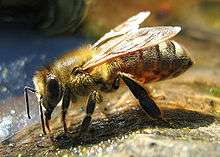
From Middle English bee, from Old English bēo, from Proto-Germanic *bijō (compare West Frisian and Dutch bij, Upper German Beie, Danish and Swedish bi), from Proto-Indo-European *bʰi- (compare Old Irish bech (“bee”), Welsh bydaf (“beehive”), Latin fūcus (“drone”), Latvian bite (“bee”), Russian пчела́ (pčelá, “bee”)).
Noun
bee (plural bees or (dialectal) been)
- A flying insect, of the superfamily Apoidea, known for its organised societies and for collecting pollen and (in some species) producing wax and honey.
- 1499, John Skelton, The Bowge of Courte:
- His face was belymmed as byes had him stounge […].
- 1590, Edmund Spenser, The Faerie Queene, III.12:
- An angry Wasp th'one in a viall had, / Th'other in hers an hony-laden Bee.
- 1603, John Florio, transl.; Michel de Montaigne, The Essayes, […], printed at London: […] Edward Blount […], OCLC 946730821:, II.12:
- Can there be a more formall, and better ordered policie, divided into so severall charges and offices, more constantly entertained, and better maintained, than that of Bees?
- 2012, ‘Subtle poison’, The Economist, 31 March:
- Bees pollinate many of the world’s crops—a service estimated to be worth $15 billion a year in America alone.
- 1499, John Skelton, The Bowge of Courte:
Synonyms
- (flying insect of the order Hymenoptera): king of insects
Derived terms
Translations
|
|


See also
Etymology 2
Possibly from dialectal English bene, been, bean (“help given by neighbours”), from Middle English been, bene (“neighbourly help, prayer, petition, request, extra service given by a tenant to his lord”),[1][2] from Old English bēn (“prayer, request, petition, favour, compulsory service”) from Proto-Germanic *bōniz (“prayer, request, supplication”), from Proto-Indo-European *bʰeh₂- (“to say, speak”). Cognate with Danish bøn (“prayer”), Dutch ban (“curse”), German Bann (“ban”). More at ban.
Noun
bee (plural bees)
- A contest, especially for spelling; see spelling bee.
- geography bee
- A gathering for a specific purpose, e.g. a sewing bee or a quilting bee.
- S. G. Goodrich
- The cellar […] was dug by a bee in a single day.
- 2011, Tim Blanning, "The reinvention of the night", Times Literary Supplement, 21 Sep 2011:
- Particularly resistant, for example, in many parts of northern Europe was the “spinning bee”, a nocturnal gathering of women to exchange gossip, stories, refreshment and – crucially – light and heat, as they spun wool or flax, knitted or sewed.
- S. G. Goodrich
Translations
- The translations below need to be checked and inserted above into the appropriate translation tables, removing any numbers. Numbers do not necessarily match those in definitions. See instructions at Wiktionary:Entry layout#Translations.
|
Etymology 3
(Northern development of) Old English bēah.
Noun
bee (plural bees)
- (obsolete) A ring or torque; a bracelet.
- 1485, Sir Thomas Malory, Le Morte Darthur, Book VII:
- And Kynge Arthure gaff hir a ryche bye of golde; and so she departed.
- 1658, Sir Thomas Browne, Urne-Burial, Penguin 2005, page 16:
- ...restoring unto the world much gold richly adorning his Sword, two hundred Rubies, many hundred Imperial Coynes, three hundred golden Bees, the bones and horseshoe of his horse enterred with him...
- 1485, Sir Thomas Malory, Le Morte Darthur, Book VII:
Etymology 4
Variant spellings.
Verb
bee
Etymology 5
From Middle English, from Old English be, from Latin be (the name of the letter B).
Noun
bee (plural bees)
Translations
|
|
See also
Etymology 6
Probably from Old English bēah (“ring”). Compare bow.
Noun
bee (plural bees)
- (nautical, usually in the plural) Any of the pieces of hard wood bolted to the sides of the bowsprit, to reeve the fore-topmast stays through.
Synonyms
- bee block
References
Anagrams
Aiwoo
Verb
bee
- (intransitive) to grow
References
- Greenhill, S.J., Blust. R, & Gray, R.D. (2008). The Austronesian Basic Vocabulary Database: From Bioinformatics to Lexomics. Evolutionary Bioinformatics, 4:271-283.
Aukan
Etymology
Noun
bee
References
- Aukan-English Dictionary (SIL)
Dumbea
Pronunciation
- IPA(key): /ᵐbe/
Noun
bee
References
- Greenhill, S.J., Blust. R, & Gray, R.D. (2008). The Austronesian Basic Vocabulary Database: From Bioinformatics to Lexomics. Evolutionary Bioinformatics, 4:271-283.
Estonian
Noun
bee (genitive [please provide], partitive [please provide])
Finnish
Pronunciation
- IPA(key): /ˈbeː/
- Rhymes: -eː
Noun
bee
Usage notes
- Speakers often use the corresponding forms of b-kirjain ("letter B, letter b") instead of inflecting this word, especially in plural.
Declension
| Inflection of bee (Kotus type 18/maa, no gradation) | |||
|---|---|---|---|
| nominative | bee | beet | |
| genitive | been | beiden beitten | |
| partitive | beetä | beitä | |
| illative | beehen | beihin | |
| singular | plural | ||
| nominative | bee | beet | |
| accusative | nom. | bee | beet |
| gen. | been | ||
| genitive | been | beiden beitten | |
| partitive | beetä | beitä | |
| inessive | beessä | beissä | |
| elative | beestä | beistä | |
| illative | beehen | beihin | |
| adessive | beellä | beillä | |
| ablative | beeltä | beiltä | |
| allative | beelle | beille | |
| essive | beenä | beinä | |
| translative | beeksi | beiksi | |
| instructive | — | bein | |
| abessive | beettä | beittä | |
| comitative | — | beineen | |
Synonyms
Latin
Pronunciation
- (Classical) IPA(key): /ˈbeː.eː/
Interjection
bēē
- baa (sound of a sheep)
References
- bee in Charlton T. Lewis and Charles Short (1879) A Latin Dictionary, Oxford: Clarendon Press
Mandinka
Pronunciation
- IPA(key): /beː/
Noun
bee
Manx
Pronunciation
- IPA(key): /biː/
Etymology 1
From Old Irish bíad (“food”). Cognate with Irish bia and Scottish Gaelic biadh.
Noun
bee m (genitive singular bee, plural beeghyn)
Derived terms
- bee ny jeeghyn (“ambrosia”)
- bee millish (“sweetmeat, sweet”)
- bee moddee (“dog food”)
Etymology 2
See etymology on the main entry.
Verb
bee
- inflection of ve:
- future
- second-person singular imperative
Mutation
| Manx mutation | ||
|---|---|---|
| Radical | Lenition | Eclipsis |
| bee | vee | mee |
| Note: Some of these forms may be hypothetical. Not every possible mutated form of every word actually occurs. | ||
Navajo
Pronunciation
Audio (NV) (file) - IPA(key): [beː]
Postposition
bee
- with, by means of, by means of it
Inflection
Old Irish
Verb
bee
- second-person singular present subjunctive absolute of at·tá
Tetum

Alternative forms
Etymology
From Proto-Central-Eastern Malayo-Polynesian *waiʀ, from Proto-Malayo-Polynesian *wahiʀ.
Noun
bee
- water (clear liquid H₂O)
Võro
Noun
bee (genitive [please provide], partitive [please provide])
Inflection
This noun needs an inflection-table template.