e
Translingual
 | ||||||||
| ||||||||
Etymology

Pronunciation
IPA (file)
Letter
e (upper case E)
- The fifth letter of the basic modern Latin alphabet.
See also
- (Latin script): Aa Bb Cc Dd Ee Ff Gg Hh Ii Jj Kk Ll Mm Nn Oo Pp Qq Rr Sſs Tt Uu Vv Ww Xx Yy Zz
- (Variations of letter E): Éé Èè Êê Ḙḙ Ěě Ĕĕ Ẽẽ Ḛḛ Ẻẻ Ėė Ëë Ēē Ȩȩ Ęę ᶒ Ɇɇ Ȅȅ Ếế Ềề Ễễ Ểể Ḝḝ Ḗḗ Ḕḕ Ȇȇ Ẹẹ Ệệ ⱸ ᴇ Ee Ææ Ǽǽ Ǣǣ & Œœ ᵫ
- (select similar letters and symbols) ɘ ǝ Ə Ɛ Æ Œ
- (other scripts) ε (e, “epsilon”) е (je)
- See Appendix:Variations of "e"
Symbol
e
- (mathematics) The base of natural logarithms, a transcendental number with a value of approximately 2.718281828459
- (sciences) Symbol separating mantissa from the exponent in scientific notation.
- 1.2566e-6 = 1.2566 × 10⁻⁶
- (IPA) close-mid front unrounded vowel
- (algebra, group theory) identity element
- a ∘ e = e ∘ a = a
- (physics) electron
Synonyms
Gallery
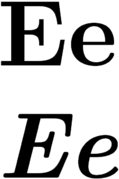
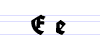
See also
Other representations of E:


English
Etymology
From Middle English and Old English lower case letter e and split of æ, ea, eo, and œ, from five 7th century replacements of Anglo-Saxon Futhorcs by Latin letters:




Pronunciation
- (letter name): IPA(key): /iː/
Audio (UK) (file) Audio (US) (file) - (phoneme): IPA(key): /ɛ/, /iː/, /ə/, /eɪ/
- In addition to the phonemes noted above, "e" can also be silent, representing no sound itself but indicating which phoneme another letter in the word represents. See the article "Silent e" on Wikipedia.
Letter
e (lower case, upper case E, plural e's)
Coordinate terms
Number
e (lower case, upper case E)
Noun
e (plural ees)
- The name of the Latin-script letter E/e.
- (mathematics) the base of the natural logarithm, 2.718281828459045…
Coordinate terms
Translations
|
|
Afar
Letter
e
See also
- (Latin-script letters) A a, B b, T t, S s, E e, C c, K k, X x, I i, D d, Q q, R r, F f, G g, O o, L l, M m, N n, U u, W w, H h, Y y
Afrikaans
Noun
e (plural e's, diminutive e'tjie)
Albanian
Pronunciation
- IPA(key): [ɛ]
Pronoun
e
- Third-person singular accusative-case pronominal clitic (him, her, it)
- S'e di.
- I don't know (it).
- S'e di.
Article
e
- adjectival article for:
- definite masculine singular adjectives in all accusative case
- indefinite feminine singular adjectives in the nominative case
- definite plural and feminine singular adjectives in the nominative and accusative cases
See also
| masculine (gjinia mashkullore) |
feminine (gjinia femërore) |
plural (numri shumës) | ||||||
|---|---|---|---|---|---|---|---|---|
| indefinite (trajta të pashquara) |
definite (trajta të shquara) |
indefinite (trajta të pashquara) |
definite (trajta të shquara) |
indefinite (trajta të pashquara) |
definite (trajta të shquara) | |||
| nominative (emërore) |
i | i | e | e | të | e | ||
| accusative (kallëzore) |
të | e | të | e | të | e | ||
| genitive, dative and ablative (gjinore, dhanore dhe rrjedhore) |
të | të | të | së | të | të | ||
| Note that regardless of the definite state of the noun being described, the definite articles are only used when immediately following a definite-form noun. If two adjectives (or other words that use these articles) come back to back, the second word's article will be indefinite.
Notice that while both adjectives require the adjectival article and the same masculine plural agreement, only the first adjectival article takes its definite form, as the second is not in the immediate environment of the modified definite noun. | ||||||||
Alemannic German
Pronunciation
- IPA(key): /ə/
Article
e f
Declension
| Declension of en | ||||
|---|---|---|---|---|
| masculine | feminine | neuter | plural | |
| nominative/accusative | en | e | es | - |
| dative | emene | enere | emene | - |
Angolar
Pronoun
e
Aromanian
Etymology
Conjunction
e
Synonyms
- (and): shi
Azerbaijani
Pronunciation
- (phoneme) IPA(key): /e/
Letter
e lower case (upper case E)
See also
- (Latin-script letters) hərf; A a, B b, C c, Ç ç, D d, E e, Ə ə, F f, G g, Ğ ğ, H h, X x, I ı, İ i, J j, K k, Q q, L l, M m, N n, O o, Ö ö, P p, R r, S s, Ş ş, T t, U u, Ü ü, V v, Y y, Z z
Breton
Etymology 1
Pronoun
e
Etymology 2
From Proto-Brythonic *ɨn, from Proto-Celtic *eni.
Preposition
e
Usage notes
It contracts with the articles, see el, en and er.
Catalan
Noun
e f (plural es)
Chinese
Pronunciation
Prefix
e
- e- (electronic)
Corsican
Article
e f pl
Related terms
Dalmatian
Etymology
Conjunction
e
Dutch
Pronunciation
Audio (file) - Rhymes: -eː
- (letter name): IPA(key): /eː/
Letter
e (lower case, upper case E)
- The fifth letter of the Dutch alphabet.
See also
Emilian
Etymology
From Latin et, ultimately from Proto-Indo-European *éti.
Pronunciation
- IPA(key): /e/
Conjunction
e
Esperanto
Pronunciation
- (letter name): IPA(key): /e/
- (phoneme): IPA(key): /e/
Audio (file)
Letter
e (lower case, upper case E)
See also
Noun
e (accusative singular e-on, plural e-oj, accusative plural e-ojn)
See also
- (Latin-script letter names) litero; a, bo, co, ĉo, do, e, fo, go, ĝo, ho, ĥo, i, jo, ĵo, ko, lo, mo, no, o, po, ro, so, ŝo, to, u, ŭo, vo, zo
Fala
Conjunction
e
- Alternative form of i
Faroese
Pronunciation
- IPA(key): /eː/
- Rhymes: -eː
Letter
e (upper case E)
See also
- (Latin-script letters) bókstavur; A a, Á á, B b, D d, Ð ð, E e, F f, G g, H h, I i, Í í, J j, K k, L l, M m, N n, O o, Ó ó, P p, R r, S s, T t, U u, Ú ú, V v, Y y, Ý ý, Æ æ, Ø ø
French
Pronunciation
- IPA(key): /ə/, (also) /ø/, /œ/
Noun
e m (plural e)
Friulian
Etymology
Conjunction
e
Fula
Etymology 1
See Translingual section.
Letter
e (lower case, upper case E)
Usage notes
See also
Etymology 2
Conjunction
e
Usage notes
Galician
Etymology
Conjunction
e
Hawaiian
Particle
e
- used to mark the following verb as an infinitive; to
- used before a name, a noun or a phrase to address someone or something
Preposition
e
- by (indicating the agent of a verb in the passive voice)
Hungarian
Etymology 1
From Proto-Uralic *e-. Cognates include Finnish että and Estonian et.[1]
Pronunciation
- IPA(key): [ˈɛ]
Audio (file)
Pronoun
e
Determiner
e (demonstrative)
- this
- E házban lakott Petőfi Sándor - Petőfi Sándor lived in this house.
Usage notes
A rarer substitute of ez, but unlike ez, it does not take the case of the noun it is attached to, and no definite article is used:
- ezen a helyen - e helyen (at this place)
- ebben a házban - e házban (in this house)
Synonyms
Interjection
e
Etymology 2
See Translingual section.
Letter
e (lower case, upper case E)
See also
References
- ↑ Entry #125 in Uralonet, online Uralic etymological database of the Research Institute for Linguistics, Hungarian Academy of Sciences.
Iau
Noun
e
Further reading
- Bill Palmer, The Languages and Linguistics of the New Guinea Area (→ISBN, 2017), page 531, table 95, Comparative basic vocabulary in Lakes Plain Languages
Ido
Pronunciation
- IPA(key): /e/
Letter
e (upper case E)
See also
Conjunction
e
- Apocopic form of ed
Related terms
Indo-Portuguese
Etymology
From Portuguese e (“and”), from Old Portuguese e (“and”), from Latin et (“and”), from Proto-Indo-European *éti (“over”).
Conjunction
e
- and (expresses two elements to be taken together or in addition to each other)
- 1883, Hugo Schuchardt, Kreolische Studien, volume 3:
- Trasê tamêm um vaquinh bem gord e matá par nós comê e par nós regalá
- Bring also a small and very fat cow and kill (it) for us to eat and for us to feast on
- Trasê tamêm um vaquinh bem gord e matá par nós comê e par nós regalá
-
Interlingua
Alternative forms
- (rare) et
Conjunction
e
Istriot
Etymology
Conjunction
e
- and
- 1877, Antonio Ive, Canti popolari istriani: raccolti a Rovigno, volume 5, Ermanno Loescher, page 128:
- Caro, cun quil visito bianco e russo.
- Dear, with that little white and red face.
- Caro, cun quil visito bianco e russo.
- 1877, Antonio Ive, Canti popolari istriani: raccolti a Rovigno, volume 5, Ermanno Loescher, page 128:
Italian
Pronunciation
- IPA(key): /e/
- Rhymes: -e
- Stress: é
- Hyphenation: e
Etymology 1
From Latin ē (the name of the letter E).
Noun
e f (invariable)
See also
Etymology 2
Alternative forms
- (before a vowel) ed
Conjunction
e
See also
References
- ↑ Angelo Prati, "Vocabolario Etimologico Italiano", Torino, 1951
Japanese
Romanization
e
- Rōmaji transcription of え
- Rōmaji transcription of エ
- Rōmaji transcription of へ
- Rōmaji transcription of ヘ
Kosraean
Etymology
From Proto-Oceanic *api, from Proto-Malayo-Polynesian *hapuy, from Proto-Austronesian *Sapuy. Compare Malay api, Malagasy afo, Tsat pui³³, Palauan ngau, Chuukese ááf, Tongan afi, Samoan afi and Hawaiian ahi.
Pronunciation
- IPA(key): /e/
Noun
e
Latin
Etymology 1
Letter
e
- A letter of the Latin alphabet.
Etymology 2
Pronunciation
- (Classical) IPA(key): /eː/
Noun
ē (indeclinable)
- The name of the letter E.
Coordinate terms
References
- e in Charlton T. Lewis (1891) An Elementary Latin Dictionary, New York: Harper & Brothers
- e in Charles du Fresne du Cange’s Glossarium Mediæ et Infimæ Latinitatis (augmented edition, 1883–1887)
- e in Gaffiot, Félix (1934) Dictionnaire Illustré Latin-Français, Hachette
- e in Harry Thurston Peck, editor (1898) Harper's Dictionary of Classical Antiquities, New York: Harper & Brothers
- Arthur E. Gordon, The Letter Names of the Latin Alphabet (University of California Press, 1973; volume 9 of University of California Publications: Classical Studies), part III: “Summary of the Ancient Evidence”, page 32: "Clearly there is no question or doubt about the names of the vowels A, E, I, O, U. They are simply long A, long E, etc. (ā, ē, ī, ō, ū). Nor is there any uncertainty with respect to the six mutes B, C, D, G, P, T. Their names are bē, cē, dē, gē, pē, tē (each with a long E). Or about H, K, and Q: they are hā, kā, kū—each, again, with a long vowel sound."
Etymology 3
Abbreviated from ēx.
Preposition
ē (short form of ex)
- out of, from
- c. 99 BCE – 55 BCE, Lucretius, De rerum natura 6
- ..et ignis semina convolvunt e nubibus.
- ..and the seeds of fire roll from the clouds.
- ..et ignis semina convolvunt e nubibus.
Derived terms
Related terms
Latvian
Etymology
Proposed in 1908 as part of the new Latvian spelling by the scientific commission headed by K. Mīlenbahs, which was accepted and began to be taught in schools in 1909. Prior to that, Latvian had been written in German Fraktur, and sporadically in Cyrillic.
Pronunciation
- IPA(key): [ɛ]
| (file) |
- IPA(key): [æ]
| (file) |
Letter

e (lower case, upper case E)
Usage notes
The letter E/e (like its long counterpart Ē/ē) represent two sounds, [ɛ] — šaurais e (“narrow e”) — and [æ] — platais e (“broad e”). In principle, [ɛ] is used when there is a palatal element (the vowels i, ī, e, ē, the diphthongs ie, ei, and the palatal consonants j, ķ, ģ, ļ, ņ, š, ž, č, dž, and, in the old spelling, ŗ) either in the same or in the following syllable; otherwise, [æ] is used. Unfortunately, some historical changes have obscured this pattern by removing some previously existing palatal elements; as a result of that, for a number of words the actual pronunciation of the letter e — [ɛ] or [æ] — must be memorized.
See also
Pronunciation
- IPA(key): [ɛ]
Noun
e m (invariable)
See also
- (Latin-script letter names) latviešu burtu vārdi; a, garais ā, bē, cē, čē, dē, e, garais ē, ef, gā, ģē, hā, i, garais ī, jē, kā, ķē, el, eļ, em, en, eņ, o, pē, er, es, eš, tē, u, garais ū, vē, zē, žē
Ligurian
Pronunciation
- IPA(key): /e/
Etymology 1
From Latin et, from Proto-Indo-European *éti (“beyond, over”).
Conjunction
e
| Ligurian Definite Articles | ||
|---|---|---|
| singular | plural | |
| masculine | o | i |
| feminine | a | e |
Etymology 2
Article
e f pl (singular a)
Livonian
Pronunciation
- (phoneme) IPA(key): /e/
Letter
e (upper case E)
See also
- (Latin-script letters) kēratēḑ; A a, Ā ā, Ä ä, Ǟ ǟ, B b, D d, Ḑ ḑ, E e, Ē ē, F f, G g, H h, I i, Ī ī, J j, K k, L l, Ļ ļ, M m, N n, Ņ ņ, O o, Ō ō, Ȯ ȯ, Ȱ ȱ, Õ õ, Ȭ ȭ, P p, R r, Ŗ ŗ, S s, Š š, T t, Ț ț, U u, Ū ū, V v, Z z, Ž ž
Lule Sami
Verb
e
- third-person plural present of ij
Malay
Letter
e (lower case, upper case E)
See also
- (Latin-script letters) A a, B b, C c, D d, E e, F f, G g, H h, I i, J j, K k, L l, M m, N n, O o, P p, Q q, R r, S s, T t, U u, V v, W w, X x, Y y, Z z
Mandarin
Romanization
e (Zhuyin ˙ㄜ)
e
- Nonstandard spelling of ē.
- Nonstandard spelling of é.
- Nonstandard spelling of ě.
- Nonstandard spelling of è.
Usage notes
- English transcriptions of Mandarin speech often fail to distinguish between the critical tonal differences employed in the Mandarin language, using words such as this one without the appropriate indication of tone.
Middle English
Noun
e
- Alternative form of æ
Pronoun
e
- Alternative form of I
References
- “ich (pron.)” in MED Online, Ann Arbor, Mich.: University of Michigan, 2007, retrieved 5 May 2018.
Etymology 3
Pronoun
e
- Alternative form of he
References
- “he, pron. (3)” in MED Online, Ann Arbor, Mich.: University of Michigan, 2007, retrieved 12 June 2018.
Navajo
Letter
e
- The eighth letter of the Navajo alphabet:
- e = /ɛ˨/
- ę = /ɛ̃˨/
- é = /ɛ˥/
- ę́ = /ɛ̃˥/
- ee = /ɛː˨˨/
- ęę = /ɛ̃ː˨˨/
- ée = /ɛː˥˨/
- ę́ę = /ɛ̃ː˥˨/
- eé = /ɛː˨˥/
- ęę́ = /ɛ̃ː˨˥/
- éé = /ɛː˥˥/
- ę́ę́ = /ɛ̃ː˥˥/
Neapolitan
Pronunciation
- IPA(key): /e/
Etymology 1
Alternative forms
Preposition
e
- of (used to express ownership)
Etymology 2
Conjunction
e
Norwegian
Pronunciation
- (letter name): IPA(key): /eː/
- (phoneme): IPA(key): /eː/, /e/, /ɛ/, /ə/, /æ/
Etymology 1
See Translingual section.
Letter
e
- The fifth letter of the Norwegian alphabet
Inflection
| indefinite singular | definite singular | indefinite plural | definite plural | |
|---|---|---|---|---|
| Bokmål m | e | e-en | e-er | e-ene |
| Nynorsk m | e | e-en | e-ar | e-ane |
Usage notes
- /ə/ only appears in unstressed syllables.
Etymology 2
Verb
e
Novial
Conjunction
e
Nzadi
Particle
é
- Used to link a possessed noun to its possessor.
Usage notes
This particle accompanies several tonal changes, as well as a simplification or elision of the coda of the possessed noun in some cases. Many nouns can be linked directly in possessive constructions without using this particle, chiefly those that denotes humans or animals when used in the singular, although it is impossible to predict exactly which nouns will follow which pattern based on semantics, ancestral noun class, or morphology.
Further reading
- Crane, Thera; Larry Hyman; Simon Nsielanga Tukumu (2011) A grammar of Nzadi [B.865]: a Bantu language of the Democratic Republic of the Congo, Berkeley, CA: University of California Press, →ISBN
Occitan
Etymology
From Old Occitan e, from Latin et.
Conjunction
e
Old French
Alternative forms
Etymology
Conjunction
e
Old Occitan
Etymology
Conjunction
e
Descendants
- Occitan: e
Old Portuguese
Etymology 1
From Latin et, from Proto-Indo-European *éti.
Alternative forms
Pronunciation
- IPA(key): /e/
Conjunction
e
- and (expresses two elements to be taken together or in addition to each other)
Descendants
Etymology 2
Alternative form of é
Verb
e
- Alternative form of é
- 13th century, attributed to Alfonso X of Castile, Cantigas de Santa Maria, E codex, cantiga 7 (facsimile):
- Eſta e como ſanta Maria liurou a Abadeſſa prenne q̇ adormecera anto ſeu Altar chorando.
- This one is about how Holy Mary acquitted the pregnant abbess who had fallen asleep crying in front of her altar.
- Eſta e como ſanta Maria liurou a Abadeſſa prenne q̇ adormecera anto ſeu Altar chorando.
- 13th century, attributed to Alfonso X of Castile, Cantigas de Santa Maria, E codex, cantiga 7 (facsimile):
Papiamentu
Etymology 1
From Portuguese ele and Spanish él and Kabuverdianu e.
Pronoun
e
Etymology 2
From Portuguese este and Spanish este and Kabuverdianu es.
Article
e
- the (definite article)
Pohnpeian
Etymology 1
Pronoun
e
Etymology 2
Alternative forms
Determiner
e
Etymology 3
Of Onomatopoeic origin.
Interjection
e
- what, in response to being called
Portuguese
Pronunciation
- Hyphenation: e
Letter:
Conjunction:
Noun:
- (Brazil) IPA(key): /ˈe/
Etymology 1
From Old Portuguese e (“and”), from Latin et (“and”), from Proto-Indo-European *éti.
Conjunction
e
- and (connects two clauses indicating that the events occurred together, one after the other or without any special implication)
- Eu vim e eles saíram.
- I came and they left.
- 2007, Lya Wyler (translator), J. K. Rowling (English author), Harry Potter e as Relíquias da Morte (Harry Potter and the Deathly Hallows), Rocco, page 211:
- Mandaram lacrar todas as saídas e não deixar ninguém...
- They ordered me to seal all the exits and not to let anyone...
- Mandaram lacrar todas as saídas e não deixar ninguém...
- and (connects the last and penultimate elements in a list)
- Eu e ele vamos embora.
- He and I are going away.
- Tenho quatro frutas: uma maçã, uma pera, uma laranja e uma uva.
- I have four fruits: an apple, a pear, an orange and a grape.
- (emphatic) and (connects every element of a list)
- 2003, Lya Wyler (translator), J. K. Rowling (English author), Harry Potter e a Ordem da Fênix (Harry Potter and the Order of the Phoenix), Rocco, page 308:
- Você notou os cabelos dela, são negros e brilhantes e macios...
- You noticed her hair, it's dark and brilliant and soft...
- Você notou os cabelos dela, são negros e brilhantes e macios...
- Ela é baixa, e burra, e preguiçosa, e feia.
- She is short, and stupid, and lazy, and ugly.
- 2003, Lya Wyler (translator), J. K. Rowling (English author), Harry Potter e a Ordem da Fênix (Harry Potter and the Order of the Phoenix), Rocco, page 308:
- (logic) and (indicates a conjunction operation)
- Verdadeiro e falso dá falso.
- True and false yields false.
- (in the format “X e X”) and (indicates a great number of something)
- Esperei por anos e anos.
- I waited for years and years.
Quotations
For quotations of use of this term, see Citations:e.
Synonyms
Noun
e m (uncountable)
- (logic) and, conjunction
Quotations
For quotations of use of this term, see Citations:e.
Etymology 2
See Translingual section.
Letter
e (lower case, upper case E)
See also
- (Latin-script letters) letra; A a (Á á, À à, Â â, Ã ã), B b, C c (Ç ç), D d, E e (É é, Ê ê), F f, G g, H h, I i (Í í), J j, K k, L l, M m, N n, O o (Ó ó, Ô ô, Õ õ), P p, Q q, R r, S s, T t, U u (Ú ú), V v, W w, X x, Y y, Z z
- The fifth letter of the Portuguese alphabet, called ê or é and written in the Latin script.
- 2005, Lya Wyler (translator), J. K. Rowling (English author), Harry Potter e o Enigma do Príncipe (Harry Potter and the Half-Blood Prince), Rocco, page 141:
- Quero conversar com os senhores e exijo sua total e absoluta atenção.
- I want to talk with you and I demand your total and absolute attention.
- Quero conversar com os senhores e exijo sua total e absoluta atenção.
- 2005, Lya Wyler (translator), J. K. Rowling (English author), Harry Potter e o Enigma do Príncipe (Harry Potter and the Half-Blood Prince), Rocco, page 141:
Etymology 3
Abbreviation of este
Noun
e m (uncountable)
- Abbreviation of este (east)
Rapa Nui
Particle
e
- agentive particle that marks the subject when a sensing verb is used
Usage notes
Only used with sensing verbs; otherwise use i.
Romagnol
Conjunction
e
Romanian
Etymology 1
See Translingual section.
Pronunciation
Letter
e (lower case, upper case E)
- The seventh letter of the Romanian alphabet.
Usage notes
See E for pronunciation notes and details.
See also
Etymology 2
Interjection
e
- expression of annoyance, irritation
- expression of boredom, indifference
- (when prolonged...eee) surprise, satisfaction, admiration
Etymology 3
Pronunciation
- IPA(key): /je/
audio (file)
Verb
e
- (informal) third-person singular present indicative of fi.
Synonyms
Etymology 4
See et.
Conjunction
e
Synonyms
Samoan
Preposition
e
- by (a person or animate object)
Scottish Gaelic
Etymology
From Old Irish é, hé, from Proto-Indo-European *éy.
Pronunciation
- IPA(key): [ɛ]
Pronoun
e
Related terms
- esan (emphatic)
See also
References
- Faclair Gàidhlig Dwelly Air Loidhne, Dwelly, Edward (1911), Faclair Gàidhlig gu Beurla le Dealbhan/The Illustrated [Scottish] Gaelic-English Dictionary (10th ed.), Edinburgh: Birlinn Limited, →ISBN
- “1 é, hé” in Dictionary of the Irish Language, Royal Irish Academy, 1913–76.
Serbo-Croatian
Etymology 1
See Translingual section.
Alternative forms
- (uppercase): E
Pronunciation
- (phoneme) IPA(key): /e/
Letter
e (Cyrillic spelling е)
Usage notes
Its name is е /e/ and it has the sound of e in net.
Etymology 2
Interjection
e (Cyrillic spelling е)
- (rare) well, now
- (informal, at the beginning of the sentence) hey
- (informal, at the beginning of the sentence) Used to emphasize the sentence
- E, šta ima? ― Hey, what's up?
- (informal, at the beginning of the sentence) Used to express surprise
- E, otkud ti? ― Hey, where did you come from?
- (informal, at the beginning of the sentence) Used to get attention or change the topic of conversation, especially if followed by a (“and; but”)
- E, a vidi ovo. ― And look at this.
Skolt Sami
Pronunciation
- (phoneme) IPA(key): /e/, /ɛ/
Letter
e (upper case E)
See also
- (Latin-script letters) bukva; A a, Â â, B b, C c, Č č, Ʒ ʒ, Ǯ ǯ, D d, Đ đ, E e, F f, G g, Ǧ ǧ, Ǥ ǥ, H h, I i, J j, K k, Ǩ ǩ, L l, M m, N n, Ŋ ŋ, O o, Õ õ, P p, R r, S s, Š š, T t, U u, V v, Z z, Ž ž, Å å, Ä ä, ʹ
Spanish
Pronunciation
Etymology 1
See Translingual section.
Letter
e (lower case, upper case E)
Noun
e f (plural es)
- Name of the letter E.
Etymology 2
Alternative forms
Conjunction
e
- and
- Yo hablo francés e inglés.
- I speak French and English.
Usage notes
Used instead of y when the following word starts with the vowel sound /i/.
See also
Swedish
Etymology 1
See Translingual section.
Pronunciation
- letter name: IPA(key): /eː/
- phoneme: IPA(key): /eː/, /ɛ/, /ɛː/
Letter
e (lower case, upper case E)
See also
Etymology 2
Spelling from internet slang.
Verb
e
- (informal, Internet slang, text messaging) colloquial spelling of är
Tahitian
Particle
e
- indicates that an action is unfinished when inserted before the verb
Teop
Pronoun
e
External links
- https://corpus1.mpi.nl/media-archive/dobes_data/Teop/Info/Teop_Sketch_Grammar_May07.pdf
- http://www.ioling.org/booklets/iol-2012-indiv-sol.en.pdf
Tongan
Preposition
e
Turkish
Letter
e (lower case, upper case E)
See also
Noun
e
See also
- (Latin script letter names) harf; a, be, ce, çe, de, e, fe, ge, yumuşak ge, he, ı, i, je, ke, le, me, ne, o, ö, pe, re, se, şe, te, u, ü, ve, ye, ze
Turkmen
Pronunciation
- (phoneme) IPA(key): /e/
Letter
e (upper case E)
See also
- (Latin-script letters) harp; A a, B b, Ç ç, D d, E e, Ä ä, F f, G g, H h, I i, J j, Ž ž, K k, L l, M m, N n, Ň ň, O o, Ö ö, P p, R r, S s, Ş ş, T t, U u, Ü ü, W w, Y y, Ý ý, Z z
Tuvaluan
Particle
e
- present tense marker, inserted immediately before the relevant verb
Vietnamese
Pronunciation
- (Hà Nội) IPA(key): [ʔɛ˧˧]
- (Huế) IPA(key): [ʔɛ˧˧]
- (Hồ Chí Minh City) IPA(key): [ʔɛ˧˧]
Etymology 1
Borrowed from Portuguese é.
Noun
e
Etymology 2
Verb
- to fear; to be apprehensive, to be afraid
- Tôi e cô ta không đến.
- I am afraid she will not come.
- to be slightly ashamed
Derived terms
- e rằng
Etymology 3
Pronoun
e
- (slang, Internet, text messaging) Abbreviation of em.
References
- "e" in Hồ Ngọc Đức, Free Vietnamese Dictionary Project (details)
- Lê Sơn Thanh, "Nom-Viet.dat", WinVNKey (details)
Vilamovian
Pronunciation
Audio (file)
Noun
e n
Volapük
Alternative forms
- (before a vowel) ed
Conjunction
e
Related terms
Welsh
Pronunciation
- IPA(key): /eː/
Pronoun
e
Usage notes
E is used predominantly in the south of Wales, while o is used in the north. fe and fo are variants of e and o respectively.
Westrobothnian
Etymology 1
From Old Norse æ (“ay, ever, always”), from Proto-Germanic *aiwi (“forever”).
Adverb
e
- ay
- e värr å e värr
- ever worse and worse
- e värr å e värr
Etymology 2
Article
e
- Alternative form of i
Etymology 3
Preposition
e
- Alternative form of i
Zazaki
Interjection
e
Particle
e
Antonyms
Zulu
Letter
e (lower case, upper case E)