en
English
Etymology 1
Abbreviation.
Pronunciation
- (UK) IPA(key): /ɛn/, /i.ɛn/
Noun
en
Etymology 2
The name of the letter comes from Latin en. The typographic sense dates to 1793.
Pronunciation
- (UK, US) enPR: ĕn, IPA(key): /ɛn/
- Rhymes: -ɛn
- (pin–pen merger) IPA(key): /ɪn/
- Homophones: in, inn
Noun
en (plural ens)
- The name of the Latin-script letter N/n.
- The ems and ens at the beginnings and ends.
- (typography) A unit of measurement equal to half an em (half the height of the type in use).
Derived terms
Translations
|
- The translations below need to be checked and inserted above into the appropriate translation tables, removing any numbers. Numbers do not necessarily match those in definitions. See instructions at Wiktionary:Entry layout#Translations.
See also
Etymology 3
From French.
Pronunciation
- (imitating the French pronunciation) IPA(key): [ɑ̃], [õ]
- (anglicised) IPA(key): /ɒn/, /ɑn/
Preposition
en
- Used in various phrases borrowed from French or formed as if borrowed from French (see "Derived terms" below).
Derived terms
|
|
Anagrams
Afrikaans
Etymology
Pronunciation
- IPA(key): /ɛn/
- (unstressed) IPA(key): /ən/
Conjunction
en
Alemannic German
Pronunciation
- IPA(key): /ən/
Article
en m
Declension
| Declension of en | ||||
|---|---|---|---|---|
| masculine | feminine | neuter | plural | |
| nominative/accusative | en | e | es | - |
| dative | emene | enere | emene | - |
Asturian
Etymology
From Latin in, from Proto-Italic *en, from Proto-Indo-European *h₁én (“in”).
Preposition
en
Usage notes
- The preposition en contracts to n' before a word beginning with a vowel or h-: n'Asturies (in Asturias), n'honor (in honor)
Derived terms
Breton
Contraction
en
- e (preposition "in") + un (indefinite article "a(n)")
- e (preposition "in") + an (definite article "the")
Catalan
Pronunciation
- (Central) IPA(key): /ən/
- (Valencian) IPA(key): /en/
Etymology 1
From the final syllable of Latin domine (“Mister”).
Article
en m sg (elided n', feminine na)
- (Eastern Catalan) Personal article used before masculine given names instead of the definite article el.
Usage notes
- While this article (and its feminine counterpart na) is standard in Baleric Catalan, in other Eastern Catalan dialects its use is waning, and the elided of the definite article, l', is used before names beginning with vowels. There is no plural personal article, so the plural definite article els is used in all dialects.
Derived terms
- can (contraction of ca and ne)
Etymology 2
From Old Occitan, from Latin in (“in, inside”), from Proto-Italic *en, from Proto-Indo-European *h₁én (“in”).
Preposition
en
Etymology 3
From Latin inde (“thence”). Compare French en.
Pronoun
en (proclitic, contracted n', enclitic ne, contracted enclitic 'n)
- Represents an indeterminate number or quantity of a given noun.
- Represents a place (associated with the action described by the verb) that would be introduced by the preposition de.
- Replaces a phrase introduced by the preposition de.
- Replaces the object of a causative verb.
Usage notes
- En cannot be used more than once as the object of a given verb.
- While en is usually used to replace phrases beginning with the prepostion de, adverbial phrases (e.g., de pressa) are replaced with hi.
- En is sometimes used instead of ho to replace an adjective or indefinite noun as the predicate of a verb.
- En is sometimes used popularly to add emphasis to a sentence: in this sense, it has no translation in English.
Declension
See also
Further reading
- “en” in Diccionari de la llengua catalana, segona edició, Institut d’Estudis Catalans.
Central Franconian
Etymology 1
From Old High German in.
Alternative forms
Pronunciation
- IPA(key): /en/
Preposition
en
Adverb
en
- (most dialects) in
Etymology 2
From Old High German indi.
Alternative forms
Pronunciation
- IPA(key): /en/
Conjunction
en
- (some western dialects) and
Etymology 3
From Old High German ein.
Alternative forms
- e (neuter and in some dialects masculine, before non-dental consonants)
Pronunciation
- IPA(key): /ən/
Article
en (indefinite)
- (most dialects) feminine nominative and accusative
- (most dialects) neuter nominative and accusative, used before vowels and alternatively before h and dental consonants
- (some dialects) masculine nominative, used before vowels and alternatively before h and dental consonants
- (some dialects) masculine accusative, used before vowels and alternatively before h and dental consonants
Etymology 4
Pronunciation
- IPA(key): /ən/
Pronoun
en (personal, reduced)
- (most dialects) him; masculine accusative
- (some dialects) he; masculine nominative
- (most dialects) them; plural dative
Chuukese
Pronoun
en
- Second-person singular pronoun; you
See also
Determiner
en (plural ekkan)
- this (not in possession of the speaker)
Crimean Tatar
Noun
en
Czech
Pronunciation
- IPA(key): [ˈɛn]
Noun
en n
Further reading
- en in Příruční slovník jazyka českého, 1935–1957
- en in Slovník spisovného jazyka českého, 1960–1971, 1989
Dalmatian
Alternative forms
Etymology
Preposition
en
Related terms
Danish
Etymology
From Old Norse einn, from Proto-Germanic *ainaz (“one, some”), from Proto-Indo-European *óynos (“one”).
Article
en (neuter et)
Numeral
en (neuter et)
Pronoun
en or én (neuter et or ét, definite ene)
Dutch
Alternative forms
- ende (archaic)
Etymology
From Middle Dutch ende, en, from Old Dutch enda, anda, in, from Proto-Germanic *andi, from Proto-Indo-European *h₂entí. Compare Low German un, German und, West Frisian en, English and, Danish end.
Pronunciation
- Rhymes: -ɛn
- Stressed: IPA(key): /ɛn/
- Unstressed: IPA(key): /ən/
audio (file)
Adverb
en
- (obsolete) (en ... niet) not
- "Herr Halewyn", A.H. Hoffmann von Fallersleben, Horae Belgicae, page 41.
- ‘Uw zoon heer Halewyn is gaen jagen, / g’ en ziet hem weêr uw levens dagen.’
- 'Your son Lord Halewyn has gone hunting / you won't see him again for the rest of your life.'
- ...dat aldaer binnen Utrecht niet meer geacht ende respecteert en wordt, ... ― that in Utrecht is no longer valued and respected...
- "Herr Halewyn", A.H. Hoffmann von Fallersleben, Horae Belgicae, page 41.
Conjunction
en
- and
- De oude man en de zee. ― The Old Man and the Sea.
- well, so
- En, hoe gaat het ermee? ― Well, how're you doing?
- En? ― Well?
- En, wat zou dat? ― So what?
- (mathematics) plus, and
- Drie en vier is zeven. ― Three plus four is seven.
Derived terms
|
|
Descendants
- Afrikaans: en
See also
Anagrams
Esperanto
Pronunciation
- IPA(key): /en/
- Hyphenation: en
Preposition
en
- in, within, inside
- Ĝi estas en la domo. ― It is in (within, inside) the house.
- into (when followed by a noun or phrase in the accusative case)
- Li iras en la domon. ― He goes into the house.
Derived terms
Fala
Etymology
From Old Portuguese en, from Latin in (“in”), from Proto-Indo-European *h₁én.
Preposition
en
- in
- 2000, Domingo Frades Gaspar, Vamus a falal: Notas pâ coñocel y platical en nosa fala, Editora regional da Extremadura, Chapter 2: Númerus:
- Cumu to é custión de proporciós, sin que sirva de argumentu por nun fel falta, poemus vel que en a misma Europa hai Estaus Soberarius con menus territoriu que os tres lugaris nossus, cumu: […]
- As everything is a matter of proportions, without its presence being an argument, we can see that even in Europe there are Sovereign States with less territory than our three places, such as: […]
- Cumu to é custión de proporciós, sin que sirva de argumentu por nun fel falta, poemus vel que en a misma Europa hai Estaus Soberarius con menus territoriu que os tres lugaris nossus, cumu: […]
-
Finnish
Pronunciation
- IPA(key): /ˈen/
- Hyphenation: en
Verb
en
- The first-person singular form of the negation verb. The English translations include do not/don’t and not (with auxiliary verbs and be).
Usage notes
- The negative verb is used with the connegative form of the main verb. That form is identical to the second-person singular imperative in the indicative present. The potential mood connegative ends in the marker for the mood, -ne-, and the conditional mood connegative ends in the marker for the mood, -isi-. In the indicative past, conditional past and potential past, the active past participle singular (ending -ut/-yt) is used. The connegative form of the main verb is always used without the personal suffix.
- Usage of en:
- Indicative:
- Conditional:
- Minä näkisin. (I would see.) -> Minä en näkisi. (I would not see.)
- Minä olisin nähnyt. (I would have seen.) -> Minä en olisi nähnyt. (I would not have seen.)
- Potential:
- Minä nähnen. (I probably see.) -> Minä en nähne. (I probably do not see.)
- Minä lienen nähnyt. (I have probably seen.) -> Minä en liene nähnyt. (I have probably not seen.)
Conjugation
- The negative verb has no infinitive form. The negative verb is the same with indicative, conditional and potential mood and, with those moods, it is conjugated only in person. (For the negative verb in the imperative mood, see älä/älköön/älkäämme/älkää/älkööt — the first person singular, naturally, does not have an imperative form. An archaic optative mood has a second-person singular form, ällös.)
| singular | plural | |
| first person | en | emme |
| second person | et | ette |
| third person | ei | eivät |
Anagrams
French
Pronunciation
- IPA(key): /ɑ̃/
audio (file) - Homophone: an
- Rhymes: -ɑ̃
Etymology 1
From Middle French en, from Old French en, from Latin in, from Proto-Italic *en, from Proto-Indo-European *h₁én (“in”).
Preposition
en
- in (used to indicate space)
- J'habite en Angleterre. ― I live in England.
- by (used to indicate means)
- aller en bus ― go by bus
- partir en voiture ― leave by car
- as
- Il me traite en ami. ― He treats me as a friend.
- habillé en père Noël ― dressed as Father Christmas
- at (used to describe an ability)
- fort en histoire ― good at history
- of, made of (used to describe composition)
- une chaise en hêtre ― a chair made of beech/a beech chair
- une fourchette en métal ― a fork made of metal/a metal fork
- in (during the following time (used for months and years))
- en 1993 ― in 1993
- en janvier ― in January
- en septembre 2001 ― in September 2001
- (followed by a gerund) while
- (followed by a gerund) by, in (describing a way of getting something)
- C'est en trichant qu'il est devenu champion. ― It was by cheating that he became champion.
- in (used to describe color)
- une photo en noir et blanc ― a photo in black and white
- in (used to describe feelings)
- en détresse ― in distress
- en bonne humeur ― in a good mood
- in (as part of something)
- en équipe ― on a team
Usage notes
En in the sense of while is often not translated into English.
Further reading
- “en” in le Trésor de la langue française informatisé (The Digitized Treasury of the French Language).
Etymology 2
Pronoun
en
- Used as the object of a verb to indicate an indefinite quantity; of it, of them. Replaces the partitive article (du, de la, etc.)
- Tu as combien de livres ? J'en ai trois.
- How many books do you have? I have three (of them).
- Y a-t-il beaucoup de pièces ? Oui. Il y en a beaucoup.
- Are there many rooms? Yes, there are many (of them).
- Martin a trois sandwichs, mais j'en ai seulement deux.
- Martin has three sandwiches, but I have only two (of them).
- Il y en a combien ?
- How many of them are there?
- Je bois de l'alcool parce que j'en ai besoin
- I drink alcohol because I need (of) it.
- Adverbial preposition indicating movement away from a place already mentioned.
- Est-ce qu'elle vient de Barcelone ? Oui, elle en vient.
- Does she come from Barcelona? Yes, she does.
Related terms
| Number | Person | Gender | Nominative (subject) |
Reflexive | Accusative (direct complement) |
Dative (indirect complement) |
Locative (at) |
Genitive (of) |
Disjunctive (tonic) |
|---|---|---|---|---|---|---|---|---|---|
| Singular | First | — | je, j’ | me, m’ | — | — | moi | ||
| Second | — | tu | te, t’ | — | — | toi | |||
| Third | Masculine | il | se, s’ | le, l’ | lui | y | en | lui, soi | |
| Feminine | elle | la, l’ | elle, soi | ||||||
| — | on | — | — | — | — | soi | |||
| Plural | First | — | nous | nous | — | — | nous | ||
| Second | — | vous | vous | — | — | vous | |||
| Third | Masculine | ils | se, s’ | les | leur | y | en | eux, soi | |
| Feminine | elles | elles, soi | |||||||
Anagrams
Galician
Etymology
From Old Portuguese en, from Latin in, from Proto-Italic *en, from Proto-Indo-European *h₁én (“in”).
Preposition
en
Usage notes
The preposition en contracts to n- before articles, before third-person tonic pronouns, and before the determiners algún and outro.
Derived terms
- na, nas, no, nos
- nalgún, nalgunha, nalgunhas, nalgúns
- nel, nela, nelas, neles
- neste, nesta, nestes, nestas
- noutra, noutras, noutro, noutros
- nun, nunha, nunhas, nuns
German Low German
Alternative forms
Etymology
From Old Saxon ēn, from Proto-Germanic *ainaz, from Proto-Indo-European *óynos. Compare Dutch een, German ein, West Frisian ien, English one.
Pronunciation
- IPA(key): /ˈɛɪ̯n/, /ˈeːn/, /ˈæɪ̯n/, /ˈeːɪ̯n/
Article
en m, n (indefinite article)
Numeral
en
- (in some dialects, including Low Prussian) one (1)
See also
Haitian Creole
Etymology
Numeral
en
Synonyms
- youn
See also
Icelandic
Adverb
en
- how
- Nei, Elín? En gaman að sjá þig! ― Elín? How good to see you!
Conjunction
en
- but
- than (with an adjective in the comparative)
Usage notes
- Sometimes Icelandic uses en where English would use and:
- Jón var sonur hans, en Ása dóttir.
- John was his son, and Ása his daughter.
- "Veðrið var ekki gott framan af: rigning á fjallinu, en þoka í byggð."
- Rannsókn embættis sérstaks saksóknara á meintum innherjasvikum Baldurs Guðlaugssonar stóð yfir í rúmlega ár, en FME kærði málið með bréfi til embættisins hinn 9. júlí á síðasta ári.[1]
- In the sentence
- Hún er skemmtilegri en ég.
- She is more fun than I am.
- the word en (“than”) may be omitted, and the subject (which is ég (“I”) in this example) may be used in the dative case.
- Hún er skemmtilegri mér.
- Now the sentence has the same meaning, only much more formal. In order to make the sentence more casual- one can reposition the subject (in the dative).
- Hún er mér skemmtilegri.
Derived terms
|
References
Ido
Etymology
From French en, Spanish en, from Latin in, inde from Proto-Indo-European *én (“in”).
Pronunciation
- IPA(key): /en/
Preposition
en
Japanese
Romanization
en
Jersey Dutch
Etymology 1
From Middle Dutch een, from Old Dutch ēn, ein, from Proto-Germanic *ainaz, from Proto-Indo-European *óynos.
Article
en
Etymology 2
Cognate to Dutch en (“and”). Compare English and.
Conjunction
en
- and
- 1912, Tijdschrift voor Nederlandsche taal— en letterkunde, volumes 31-32, page 309:
- Hai waz nît tevrêde täus en […]
- He was not content at home and […]
- Hai waz nît tevrêde täus en […]
- 1912, Tijdschrift voor Nederlandsche taal— en letterkunde, volumes 31-32, page 309:
Kott
Etymology
From Proto-Yeniseian *ʔäń (˜x-) ("wave").
Noun
en (plural ēnaŋ)
Noun
en
- plural of ei
Kriol
Etymology
Conjunction
en
Latin
Etymology 1
Pronunciation
- (Classical) IPA(key): /eːn/
Interjection
ēn
Etymology 2
Pronunciation
- (Classical) IPA(key): /en/, [ẽ]
Noun
en (indeclinable)
- The name of the letter N.
Usage notes
- Multiple Latin names for the letter N, n have been suggested. The most common is en or a syllabic n, although there is some evidence which also supports, as names for the letter, nē, ən, nə, and even (in the fourth- or fifth-century first Antinoë papyrus, which gives Greek transliterations of the Latin names of the Roman alphabet’s letters) ιννε (inne).
Coordinate terms
References
- en in Charlton T. Lewis and Charles Short (1879) A Latin Dictionary, Oxford: Clarendon Press
- en in Gaffiot, Félix (1934) Dictionnaire Illustré Latin-Français, Hachette
- Arthur E. Gordon, The Letter Names of the Latin Alphabet (University of California Press, 1973; volume 9 of University of California Publications: Classical Studies), especially pages 30–31, 42–44, and 63
Latvian
Pronunciation
- IPA(key): [ɛn]
| (file) |
Noun
en m (invariable)
See also
- Latvian letter names:
Lule Sami
Verb
en
- first-person dual present of ij
Luxembourgish
Etymology
From Old High German ein, from Proto-Germanic *ainaz.
Pronunciation
- IPA(key): /ən/
- Rhymes: -ən
Article
en m, n
- Indefinite article; a, an
- Ech droen en Hutt wann et reent. ― I wear a hat when it rains.
- Hues du e bloe Stëft? ― Do you have a blue pen?
Declension
| Luxembourgish indefinite articles | ||||
|---|---|---|---|---|
| masculine | feminine | neuter | ||
| nom./acc. | en | eng | en | |
| dative | engem | enger | engem | |
Pronoun
en
- third-person masculine singular, accusative: him
- Hues du e gefrot? ― Have you asked him?
- unstressed form of hien
- unstressed form of hinnen
Declension
| nominative | accusative | dative | reflexive | |||||
|---|---|---|---|---|---|---|---|---|
| str. | unstr. | str. | unstr. | str. | unstr. | |||
| 1st person singular | ech | — | mech | — | mir | mer | mech | |
| 2nd person singular (informal) |
du | de | dech | — | dir | der | dech | |
| 2nd person singular (formal) |
Dir | — | Iech | — | Iech | — | Iech | |
| 3rd person singular (m) | hien | en | en | — | him | em | sech | |
| 3rd person singular (f) | si / hatt | se / et | si / hatt | se / et | hir / him | — / em | sech | |
| 3rd person singular (n) | et | 't | et | 't | him | em | sech | |
| 1st person plural | mir | mer | eis / ons | — | eis / ons | — | eis / ons | |
| 2nd person plural | dir | der | iech | — | iech | — | iech | |
| 3rd person plural | si | — | si | — | hinnen | – | sech | |
Usage notes
- Due to the Eifel Rule, the final -n is lost when the following word begins with a consonant other than <d>, <h>, <n>, <t> or <z>.
Mandarin
Romanization
en
- Nonstandard spelling of ēn.
- Nonstandard spelling of én.
- Nonstandard spelling of ěn.
- Nonstandard spelling of èn.
Usage notes
- English transcriptions of Mandarin speech often fail to distinguish between the critical tonal differences employed in the Mandarin language, using words such as this one without the appropriate indication of tone.
Middle Dutch
Pronunciation
- IPA(key): /en/
Conjunction
en
- Alternative form of ende
Middle English
Preposition
en
- Alternative form of in (“in”)
Middle French
Etymology
From Old French [Term?], from Latin in.
Preposition
en
Descendants
- French: en
Middle Low German
Etymology
From Proto-Germanic *ne (“not”).
Pronunciation
Particle
en m
- not; negates a verb, usage is facultative if it leads to a double negative
- unless
Alternative forms
- ne (older, Eastphalian)
Movima
Verb
en
- to stand
Further reading
- http://webdoc.ubn.ru.nl/mono/h/haude_k/gramofmo.pdf
- http://www.ioling.org/booklets/iol-2007-indiv-prob.en.pdf
Norwegian Bokmål
| < 0 | 1 | 2 > |
|---|---|---|
| Cardinal : en Ordinal : første | ||
Etymology
From Old Norse einn, from Proto-Germanic *ainaz (“one, some”), from Proto-Indo-European *óynos (“one”).
Pronunciation
Article
Numeral
en m (feminine ei, neuter ett, stressed form én)
Derived terms
See also
- ein (Nynorsk)
References
- “en” in The Bokmål Dictionary.
Old French
Alternative forms
- in (10th century)
Etymology
Preposition
en
- in; inside
- 1377, Bernard de Gordon, Fleur de lis de medecine (a.k.a. lilium medicine):
- Et pour ce qu’il se complaint moult de froit et horipilacion, pour ce au commencement on luy doit mettre les piés et les mains en eaue chaulde
- And if he complains about cold and shivers, to start with one must put his feet and is hands in hot water
- Et pour ce qu’il se complaint moult de froit et horipilacion, pour ce au commencement on luy doit mettre les piés et les mains en eaue chaulde
-
- on; upon
- 12th Century, Unknown, Raoul de Cambrai:
- qi en la crois fu mis
- [He] who was put on the cross
- qi en la crois fu mis
-
- in (experiencing an emotion, a feeling, etc.)
- en paine ― in pain
- in (indicates a language)
- en latin ― in Latin
Descendants
Old Frisian
| < 0 | 1 | 2 > |
|---|---|---|
| Cardinal : en | ||
Alternative forms
Etymology
From Proto-Germanic *ainaz.
Numeral
en m
Declension
| Masculine SG | Feminine SG | Neuter SG | |
|---|---|---|---|
| nominative | ēn | ēn | ēn |
| accusative | ēnne | ēne | ēn |
| genitive | ēnes | ēnere | ēnes |
| dative | ēna | ēnere | ēna |
Descendants
Old Latin
Etymology
From Proto-Indo-European *h₁én (“in”).
Preposition
en
Related terms
Descendants
- Latin: in
Old Norse
Conjunction
en
- but
- (as a copulative): and
- than
Synonyms
References
- en in Geir T. Zoëga (1910) A Concise Dictionary of Old Icelandic, Oxford: Clarendon Press
Old Occitan
Pronoun
en
- of it; of them
- 12th century, Bernard de Ventadour, Can vei la lauzeta mover
- Ailas! Tan cuidava saber
D'amor, e tan petit en sai,- Alas! I thought I knew so much
about love, and I know so little [of it]!
- Alas! I thought I knew so much
- Ailas! Tan cuidava saber
- 12th century, Bernard de Ventadour, Can vei la lauzeta mover
Old Portuguese
Etymology
From Latin in (“in”), from Proto-Italic *en, from Proto-Indo-European *h₁én (“in”).
Pronunciation
- IPA(key): /ˈẽ/
Preposition
en
- in
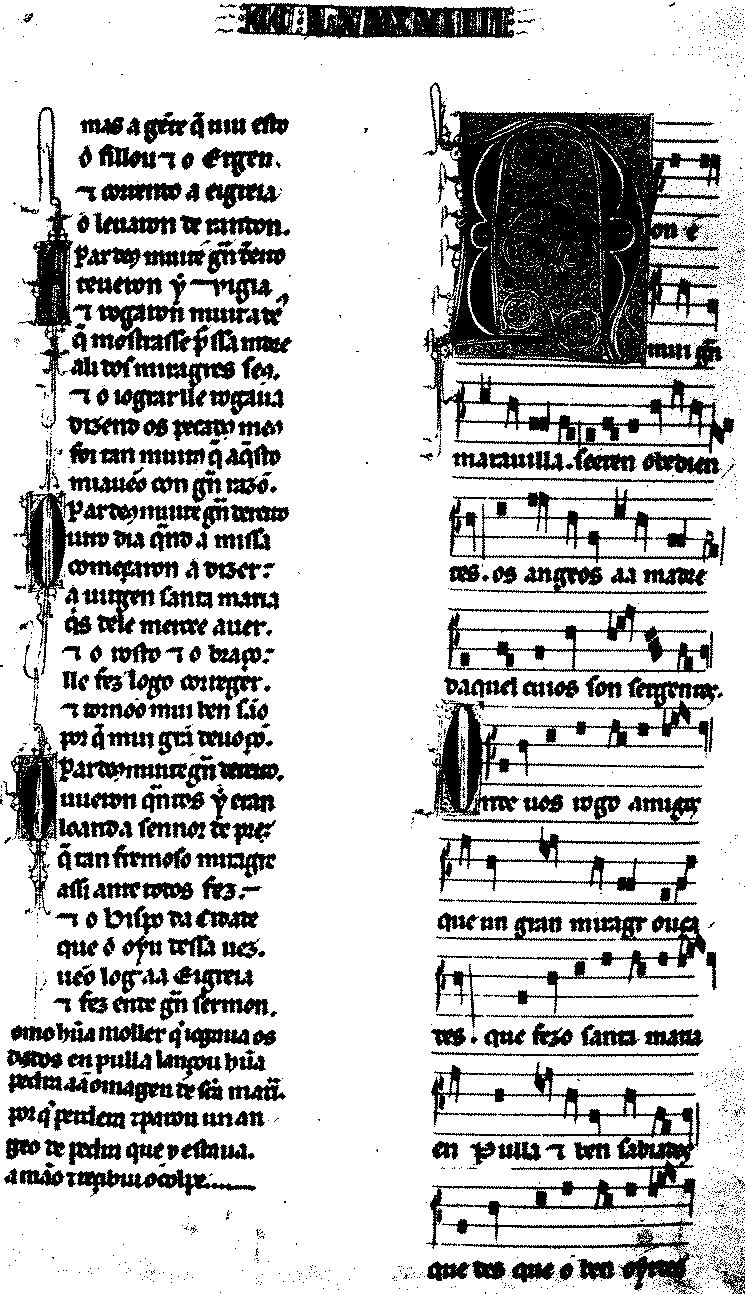
- 13th century, attributed to Alfonso X of Castile, Cantigas de Santa Maria, E codex, cantiga 294 (facsimile):
- Como hũa moller q̇ iogaua os dados en pulla lançou hũa pedra aa omagen de ſ[ant]a mari[a] por q̇ perdera ⁊ parou un angeo de pedra que y eſtava a mão ⁊ reçibiu o colpe.
- How a woman who was playing dice in Apulia threw a stone at the statue of Holy Mary because she had lost, and an angel of stone which was there reached out its hand and received the blow.
- Como hũa moller q̇ iogaua os dados en pulla lançou hũa pedra aa omagen de ſ[ant]a mari[a] por q̇ perdera ⁊ parou un angeo de pedra que y eſtava a mão ⁊ reçibiu o colpe.
- 13th century, attributed to Alfonso X of Castile, Cantigas de Santa Maria, E codex, cantiga 294 (facsimile):
Descendants
Old Saxon
| < 0 | 1 | 2 > |
|---|---|---|
| Cardinal : ēn | ||
Etymology
From Proto-Germanic *ainaz.
Pronunciation
- IPA(key): /ˈɛːn/
Numeral
en m
- one
- thoh uui hēr te meti habdin garu im te geƀanne sō uui mahtin fargelden mēst tueho uuāri is noh than that iro ēnig thar ēnes gināmi(Heliand, verse 2637)
- Though we had food that we should buy to give him. The most doubt is still there that anyone once felt
Article
en m
Declension
| Masculine | Neuter | Feminine | |
|---|---|---|---|
| nominative | ēn | ēn | ēn |
| accusative | ēnana | ēn | ēna |
| genitive | ēnes | ēnes | ēnaro |
| dative | ēnumu | ēnumu | ēnaro |
Descendants
Old Swedish
Etymology
From Old Norse einn, from Proto-Germanic *ainaz, from Proto-Indo-European *óynos.
Numeral
ēn m, f
Pennsylvania German
Etymology
Article
en (indefinite)
Inflection
| masculine | feminine | neuter | |
|---|---|---|---|
| nominative and accusative |
en | en | en |
| dative | me | re | me |
Slovene
| < 0 | 1 | 2 > |
|---|---|---|
Etymology
Contraction of earlier êden, from Proto-Slavic *(j)edinъ, ultimately from Proto-Indo-European *óynos (“one, single”).
Pronunciation
- IPA(key): /ˈɛ́n/
- Tonal orthography: ȅn
Numeral
èn
Usage notes
The form êden is used when the word does not modify a noun directly, but stands in predicate position. When counting or reciting numbers, the feminine form êna is normally used.
Declension
| singular | |||
|---|---|---|---|
| masculine | feminine | neuter | |
| nominative | èn, êden | êna | êno |
| accusative | nominativeinan or genitiveanim | êno | êno |
| genitive | ênega | êne | ênega |
| dative | ênemu | êni | ênemu |
| locative | ênem | êni | ênem |
| instrumental | ênim | êno | ênim |
| dual | |||
| masculine | feminine | neuter | |
| nominative | — | — | — |
| accusative | — | — | — |
| genitive | — | — | — |
| dative | — | — | — |
| locative | — | — | — |
| instrumental | — | — | — |
| plural | |||
| masculine | feminine | neuter | |
| nominative | êni | êne | êna |
| accusative | êne | êne | êna |
| genitive | ênih | ênih | ênih |
| dative | ênim | ênim | ênim |
| locative | ênih | ênih | ênih |
| instrumental | ênimi | ênimi | ênimi |
Derived terms
Spanish
Etymology
From Old Spanish en, from Latin in, from Proto-Italic *en, from Proto-Indo-European *h₁én (“in”).
Pronunciation
- IPA(key): /en/, [ẽn]
- Rhymes: -en
Preposition
en
- in, at, on
- Estoy en casa.
- I'm at home.
- Estoy sentado en la computadora.
- I'm sitting at the computer.
- en esta página
- on this page
- en la caja en la mesa
- in the box on the table
- in (a time)
- en la antigüedad
- in antiquity
- en 1999
- in 1999
- in (a language)
- No conozco esta palabra en francés.
- I don't know this word in French.
- en todos los idiomas
- in all languages
- used after some verbs and translated by various prepositions in English
- Pienso en tí.
- I'm thinking of you.
- in (in various expressions)
- en el sentido
- in the sense
- en nuestro afán
- in our eagerness
Sranan Tongo
Pronoun
en
Swedish
Etymology 1
From Old Swedish ēn, æn, from Old Norse einn, from Proto-Germanic *ainaz (“one, some”), from Proto-Indo-European *óynos (“one”).
Pronunciation
Pronoun
en (genitive ens)
- one; object form of man (=one)
- Det man inte vet skadar en inte
- What one doesn’t know doesn’t hurt one.
- one (see usage notes)
Usage notes
En has in recent years been used as a more gender-conscious alternative to the impersonal pronoun man. The development is in some ways parallel to the gender-neutral pronoun hen. Usage is common among certain speaker groups, but not universally acknowledged in the standard language. Previously it has also been used in some dialects.
Declension
*Not universally accepted.
Numeral
| < 0 | 1 | 2 > |
|---|---|---|
| Cardinal : en Ordinal : första | ||
en (neuter ett)
Related terms
|
|
|
|
Article
en c (neuter ett)
Declension
- en and ett are invariable in the singular, as nominative en konung (a king) and genitive en konungs (a king's).
- The genitive enes and the dative enom are dated.
Etymology 2
From earlier ene (sometimes also ener), from Old Norse einir.
Pronunciation
- IPA(key): /eːn/
Noun
en c
Declension
| Declension of en | ||||
|---|---|---|---|---|
| Singular | Plural | |||
| Indefinite | Definite | Indefinite | Definite | |
| Nominative | en | enen | enar | enarna |
| Genitive | ens | enens | enars | enarnas |
Related terms
References
- han in Elof Hellquist, Svensk etymologisk ordbok (1st ed., 1922)
- en in Svenska Akademiens Ordlista över svenska språket (13th ed., online)
Turkish
Etymology 1
From Old Turkic en, from Proto-Turkic *ēn (“breadth, width”).
Noun
en (definite accusative eni, plural enler)
Declension
| Inflection | ||||||||||||||||||||||||||
|---|---|---|---|---|---|---|---|---|---|---|---|---|---|---|---|---|---|---|---|---|---|---|---|---|---|---|
| Nominative | en | |||||||||||||||||||||||||
| Definite accusative | eni | |||||||||||||||||||||||||
| Singular | Plural | |||||||||||||||||||||||||
| Nominative | en | enler | ||||||||||||||||||||||||
| Definite accusative | eni | enleri | ||||||||||||||||||||||||
| Dative | ene | enlere | ||||||||||||||||||||||||
| Locative | ende | enlerde | ||||||||||||||||||||||||
| Ablative | enden | enlerden | ||||||||||||||||||||||||
| Genitive | enin | enlerin | ||||||||||||||||||||||||
| ||||||||||||||||||||||||||
Etymology 2
From Old Turkic 𐰭 (eŋ), from Proto-Turkic [Term?].
Adverb
en
- Forms the superlative of the following adjective.
Veps
Verb
en
- first-person singular present of ei
West Frisian
Etymology
From Old Frisian and, ende, from Proto-Germanic *andi, from Proto-Indo-European *h₂entí. Compare North Frisian en, English and, Low German un, Dutch en, German und, West Frisian en, Danish end.
Pronunciation
- IPA(key): /ɛn/
Conjunction
en