le
English
Etymology
Pronunciation
- IPA(key): /lə/, /leɪ/
Article
le
- (informal, humorous, chiefly Internet) the
- 2001 June 24, LaManna, “My Weekend...”, in alt.punk, Usenet:
- […] upon arrival, le girlfriend realizes she has left her ID back at my house (a 1 1/2 hour roundtrip on the Metro), […]
- 2002 December 27, Amelia, “Re: Neat things SANTA brought me...”, in alt.fashion, Usenet:
- And then le boyfriend perks up and names around 8 different brands (Stila, MAC, Becca, Nars etc..) - I was *SO* proud of him!! :)
- 2003 January 10, johnny dupe (quoting nowhere man), “Re: I can walk with jezus...”, in alt.fan.wings, Usenet:
- That was always OUR song (me and le girlfriend of the time).
-
Related terms
Anagrams
Breton
Noun
le ? (plural leou)
Dalmatian
Etymology
Article
le f pl
Related terms
Danish
Pronunciation
- IPA(key): /leː/, [leːˀ]
Etymology 1
Noun
le c (singular definite leen, plural indefinite leer)
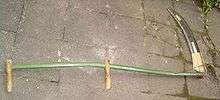
- scythe (farm tool)
Inflection
Etymology 2
From Old Norse hlæja, from Proto-Germanic *hlahjaną.
Verb
le (imperative le, present ler, past lo, past participle leet or let)
- to laugh (show mirth by peculiar movement of the muscles of the face and emission of sounds)
See also

French
Etymology
From Old French le, from Latin illum, by dropping il- and -m. Latin illum is the accusative singular of ille.[1]
Pronunciation
- IPA(key): /lə/
- (between a vowel and a consonant) IPA(key): /l/
audio (file) - Rhymes: -ə
Article
le m (feminine la, masculine and feminine plural les)
- The (definite article).
- [J]e suis le valeureux Don Quichotte de la Manche, le défaiseur de torts et le réparateur d’iniquités.
- I am the valiant Don Quixote of La Mancha, the undoer of wrongs and the repairer of iniquities. (1837, Louis Viardot, L’Ingénieux Hidalgo Don Quichotte de la Manche, translation of El ingenioso hidalgo Don Quijote de la Mancha by Miguel de Cervantes Saavedra, Volume I, Chapter IV)
- Used before abstract nouns; not translated in English.
- (before parts of the body) The; my, your, etc.
- (before units) A, an.
Usage notes
Pronoun
le m (feminine la, masculine and feminine plural les)
- (direct object) Him, it.
- (used to refer to something previously mentioned or implied; not translated in English).
Related terms
| Number | Person | Gender | Nominative (subject) |
Reflexive | Accusative (direct complement) |
Dative (indirect complement) |
Locative (at) |
Genitive (of) |
Disjunctive (tonic) |
|---|---|---|---|---|---|---|---|---|---|
| Singular | First | — | je, j’ | me, m’ | — | — | moi | ||
| Second | — | tu | te, t’ | — | — | toi | |||
| Third | Masculine | il | se, s’ | le, l’ | lui | y | en | lui, soi | |
| Feminine | elle | la, l’ | elle, soi | ||||||
| — | on | — | — | — | — | soi | |||
| Plural | First | — | nous | nous | — | — | nous | ||
| Second | — | vous | vous | — | — | vous | |||
| Third | Masculine | ils | se, s’ | les | leur | y | en | eux, soi | |
| Feminine | elles | elles, soi | |||||||
References
- ↑ Dauzat, Albert; Jean Dubois, Henri Mitterand (1964), “le, la, les”, in Nouveau dictionnaire étymologique (in French), Paris: Librairie Larousse
Further reading
- “le” in le Trésor de la langue française informatisé (The Digitized Treasury of the French Language).
Friulian
Pronoun
le (third person feminine direct object)
Related terms
Galician
Verb
le
- inflection of ler:
- third-person singular present indicative
- second-person singular imperative
Garifuna
Article
le
- masculine definite article
- Mutu le ― The man
Antonyms
Hungarian
Pronunciation
- IPA(key): [ˈlɛ]
Audio (file)
Adverb
le (not comparable)
Ido
Etymology
Pronunciation
- IPA(key): /le/, /lɛ/
Article
le (plural)
- the (used only when there is no other sign of plurality, for example with nominalized adjectives)
- Yen pomi, prenez le bona e lasez le mala.
- Here's apples, take the good ones and leave the bad ones.
Noun
le (plural le-i)
See also
See also
Interlingua
Article
le
Usage notes
Pronoun
le m (plural les)
- him (direct object)
- Io le appella mi amico — I call him my friend.
Irish
Alternative forms
- lé (superseded)
Etymology
From a conflation of two Early Modern Irish prepositions:
- re (“to”), from Old Irish fri, from Proto-Celtic *writ- (compare Welsh wrth, prefix gwrth-), from Proto-Indo-European *wert- (“to turn”) (compare Latin versus (“against”)).
- le (“with”), from Old Irish la, from Proto-Celtic *let-, from Proto-Celtic *letos (“side”) (compare leath, Welsh lled).
Pronunciation
- IPA(key): /lʲɛ/
Preposition
le (plus dative, triggers h-prothesis, before the definite article leis)
- with
- le héadach ― with clothing
- used in conjunction with the copula particle is to indicate possession
- Is liomsa an hata ― The hat is mine; the hat belongs to me
- Is le Cáit an peann luaidhe. ― The pencil is Cáit’s; the pencil belongs to Cáit.
- to (indicating purpose; in this sense triggering eclipsis of ithe (“eating”) and ól (“drinking”))
- rud le n-ithe ― something to eat
- oiriúnach le n-ól ― fit to drink
- ró-the le n-ól ― too hot to drink
- in order to
Inflection
Derived terms
|
|
|
See also
| Basic form | Contracted with | Copular forms | ||||||||
|---|---|---|---|---|---|---|---|---|---|---|
| an (“the sg”) | na (“the pl”) | mo (“my”) | do (“your”) | a (“his, her, their; which (present)”) | ár (“our”) | ar (“which (past)”) | (before consonant) | (present/future before vowel) | (past/conditional before vowel) | |
| de (“from”) | den | de na desna* | de mo dem* | de do ded*, det* | dá | dár | dar | darb | darbh | |
| do (“to, for”) | don | do na dosna* | do mo dom* | do do dod*, dot* | dá | dár | dar | darb | darbh | |
| faoi (“under, about”) | faoin | faoi na | faoi mo | faoi do | faoina | faoinár | faoinar | faoinarb | faoinarbh | |
| i (“in”) | sa, san | sna | i mo im* | i do id*, it* | ina | inár | inar | inarb | inarbh | |
| le (“with”) | leis an | leis na | le mo lem* | le do led*, let* | lena | lenár | lenar | lenarb | lenarbh | |
| ó (“from, since”) | ón | ó na ósna* | ó mo óm* | ó do ód*, ót* | óna | ónár | ónar | ónarb | ónarbh | |
| trí (“through”) | tríd an | trí na | trí mo | trí do | trína | trínár | trínar | trínarb | trínarbh | |
| *Dialectal. | ||||||||||
Further reading
- "le" in Foclóir Gaeilge-Béarla, An Gúm, 1977, by Niall Ó Dónaill.
- “fri” in Dictionary of the Irish Language, Royal Irish Academy, 1913–76.
- “la” in Dictionary of the Irish Language, Royal Irish Academy, 1913–76.
- Entries containing “le” in New English-Irish Dictionary by Foras na Gaeilge.
Italian
Pronunciation
- IPA(key): /le/
- Rhymes: -e
Etymology 1
From Latin illae, which is the nominative plural feminine of ille.[1]
Article
| Italian Definite Articles | ||
|---|---|---|
| singular | plural | |
| masculine | il lo/l' |
i gli |
| feminine | la/l' | le |
le f pl (singular la)
Usage notes
Contrary to la, le does not elide before words that begin with a vowel:
- le amiche ― the girlfriends
Pronoun
le f pl (masculine li, singular la)
- (accusative) them (third-person plural feminine)
- Le ho viste. ― I saw them.
Usage notes
See also
| Number | Person | Gender | Nominative | Reflexive | Accusative | Dative | Locative | Genitive | Disjunctive |
|---|---|---|---|---|---|---|---|---|---|
| Singular | first | — | io | mi, m' | — | me | |||
| second | — | tu | ti, t' | te | |||||
| third | m | lui | si,2 s' | lo, l' | gli | ci, c', vi, v' (formal) |
ne, n' | lui, sé | |
| f 1 | lei, Lei | la, l', La | le,3 Le | lei, Lei, sé | |||||
| Plural | first | — | noi | ci, c' | — | noi | |||
| second | — | voi | vi, v' | voi | |||||
| third | m | loro, Loro | si, s' | li | gli, loro (formal), Loro |
ci, c', vi, v' (formal) |
ne, n' | loro, Loro, sé | |
| f 1 | le | ||||||||
| 1 | The feminine gender forms are also used as formal terms of address, often capitalised as Lei, Loro etc. to distinguish them. | ||||||||
| 2 | Also used as indefinite pronoun meaning “one”, and to form the passive. | ||||||||
| 3 | In informal speech sometimes replaced with gli (nonstandard). | ||||||||
Etymology 2
Pronoun
le f (plural gli)
- (dative) her, to her
- Le ho detto che la amo. ― I told her that I love her.
- Le ho dato la lettera. ― I gave her the letter.
- (dative) you, to you (term of respect)
- Non le ho detto il mio nome. ― I didn't tell you my name.
- Le ho dato la lettera. ― I gave you the letter.
Usage notes
Alternative forms
See also
| Number | Person | Gender | Nominative | Reflexive | Accusative | Dative | Locative | Genitive | Disjunctive |
|---|---|---|---|---|---|---|---|---|---|
| Singular | first | — | io | mi, m' | — | me | |||
| second | — | tu | ti, t' | te | |||||
| third | m | lui | si,2 s' | lo, l' | gli | ci, c', vi, v' (formal) |
ne, n' | lui, sé | |
| f 1 | lei, Lei | la, l', La | le,3 Le | lei, Lei, sé | |||||
| Plural | first | — | noi | ci, c' | — | noi | |||
| second | — | voi | vi, v' | voi | |||||
| third | m | loro, Loro | si, s' | li | gli, loro (formal), Loro |
ci, c', vi, v' (formal) |
ne, n' | loro, Loro, sé | |
| f 1 | le | ||||||||
| 1 | The feminine gender forms are also used as formal terms of address, often capitalised as Lei, Loro etc. to distinguish them. | ||||||||
| 2 | Also used as indefinite pronoun meaning “one”, and to form the passive. | ||||||||
| 3 | In informal speech sometimes replaced with gli (nonstandard). | ||||||||
References
- ↑ Patota, Giuseppe (2002) Lineamenti di grammatica storica dell'italiano (in Italian), Bologna: il Mulino, →ISBN, page 127
Maltese
Etymology
Adverb
le
See also
Mandarin
Romanization
le (Zhuyin ˙ㄌㄜ)
le
Usage notes
- English transcriptions of Mandarin speech often fail to distinguish between the critical tonal differences employed in the Mandarin language, using words such as this one without the appropriate indication of tone.
Meriam
Etymology
From Rotuman.
Noun
le
Middle French
Article
le m (feminine la, masculine and feminine plural les)
Descendants
- French: le
Neapolitan
Pronunciation
- IPA(key): /le/
- Rhymes: -e
Pronoun
le
- Alternative form of 'e
Coordinate terms
| Number | Person | Nominative | Accusative | Dative | Reflexive | Possessive | Prepositional |
|---|---|---|---|---|---|---|---|
| singular | first-person | io (i') | me | mìo, mìa, mieje, meje | me, méne | ||
| second-person, familiar | tu | te | tùjo, tòja, tùoje, tòje | te, téne | |||
| second-person, formal | vuje | ve | vuósto, vósta, vuóste, vóste | vuje | |||
| third-person, masculine | ìsso | 'o, 'u (lo, lu) | 'i, 'e (li, le) | se | sùjo, sòja, sùoje, sòje | ìsso | |
| third-person, feminine | éssa | 'a (la) | 'e (le) | éssa | |||
| plural | first-person | nuje | ce | nuósto, nòsta, nuóste, nòste | nuje | ||
| second-person, plural | vuje | ve | vuósto, vòsta, vuóste, vòste | vuje | |||
| third-person, masculine | ìsse | 'i, 'e (li, le) | llòro | se | llòro (invariable) | llòro | |
| third-person, feminine | llòro | 'e (le) | |||||
Norwegian Bokmål
Etymology 1
Adjective
- le (indeclinable)
Noun
le n
Etymology 2
From Old Norse hlæja (“to laugh”), from Proto-Germanic *hlahjaną, from Proto-Indo-European *klek-, *kleg- (“to shout”).
Verb
le (imperative le, present tense ler, passive -, simple past lo, past participle ledd, present participle leende)
- to laugh
References
- “le” in The Bokmål Dictionary.
Norwegian Nynorsk
Pronunciation
- IPA(key): /leː/
Etymology 1
From Old Norse hlé. Akin to English lee.
Adjective
- le (indeclinable)
Noun
le n
Etymology 2
From Old Norse hlæja (“to laugh”), from Proto-Germanic *hlahjaną, from Proto-Indo-European *klek-, *kleg- (“to shout”). Akin to English laugh.
Verb
le (present tense ler, past tense lo, past participle ledd or lett, present participle leande, imperative le)
- to laugh
References
- “le” in The Nynorsk Dictionary.
Novial
Pronoun
le
Related terms
Old French
Alternative forms
- lo (9th century in The Sequence of Saint Eulalia and 10th century in La Vie de Saint Léger)
Article
le
- the (masculine singular oblique definite article)
- (Picardy, Anglo-Norman) the (feminine singular definite article)
Inflection
Pronoun
le
- it (masculine singular object pronoun)
Romanian
Etymology
Pronunciation
- Rhymes: -e
Pronoun
le m (unstressed dative form of ei)
- (indirect object, third-person masculine plural) to them (all-male or mixed group)
Pronoun
le f (unstressed dative form of ele)
- (indirect object, third-person feminine plural) to them (all-female group)
Pronoun
le m (unstressed accusative form of ele)
- (direct object, third-person feminine plural) them (all-female group)
Related terms
- lor (stressed dative of ei and ele)
- ele (stressed accusative of ele)
- îl (unstressed dative of el (singular))
- îi (unstressed dative of ea (singular) and unstressed accusative of ei (masculine))
- o (unstressed accusative of ea (singular))
Samoan
Article
le
- the (the definite article)
Usage notes
Only in the singular. Sometimes used where the indefinite article would be used in English.
See also
Scottish Gaelic
Pronunciation
- IPA(key): /lʲɛ/, /le/
Preposition
le
- with
- by
- down
- thuit e leis a' chreig - he fell down the rock
- deòir a' ruith leis a h-aodann - tears running down her face
Usage notes
- This form is used before nouns without the definite article; before the definite article the form leis is used.
Derived terms
- leis an t-sruth
- The following prepositional pronouns:
| Person | Number | Prepositional pronoun | Prepositional pronoun (emphatic) |
|---|---|---|---|
| Singular | 1st | leam | leamsa |
| 2nd | leat | leatsa | |
| 3rd m | leis | leis-san | |
| 3rd f | leatha | leathase | |
| Plural | 1st | leinn | leinne |
| 2nd | leibh | leibhse | |
| 3rd | leotha | leothasan |
Serbo-Croatian
Adverb
le (Cyrillic spelling ле)
- (archaic) only
- 1556, Hanibal Lucić, U vrime ko čisto
- Nego se varteći dugo tuj zamani,
- Goro, le htih reći, zbogome ostani.
- 1556, Hanibal Lucić, U vrime ko čisto
Related terms
Slovene
Pronunciation
- IPA(key): /ˈlɛ́/
- Tonal orthography: lȅ
Adverb
lè
Spanish
Etymology
Pronoun
le
- To him, for him (dative of él)
- Mi mamá va a escribirle una carta a mi hermano. — My mom is going to write a letter to my brother.
- To her, for her (dative of ella)
- Le dio un beso a Ana. — He gave Ana a kiss.
- To it, for it (dative of ello)
- ¡Ponle esfuerzo! — Put some effort into it!
- To you, for you (formal; dative of usted)
- ¿A usted le gustan los caballos? — Do you like horses?
Usage notes
- Though le is usually the indirect object form of the direct object pronouns lo/la, it is often used as a direct object as well...e.g., «yo le amo» (I love him). This phenomenon is known as leísmo.
- Note that when a sentence contains a noun that is an indirect object, a redundant indirect object le (or its plural form les) is also required; for example «yo le daré el libro a Jorge» (literally, "I him will give the book to Jorge"), where him/le corresponds to Jorge. This type of pronoun is obligatory. Both of the object pronouns le and les become se when followed by the direct object lo/la/los/las; hence, «yo se lo daré» (I will give it to him/her/them) rather than «yo le/les lo daré».
See also
| nominative | dative | accusative | disjunctive | ||||
|---|---|---|---|---|---|---|---|
| first person | singular | yo | me | mí1 | |||
| plural | masc. | nosotros | nos | nosotros | |||
| fem. | nosotras | nosotras | |||||
| second person | singular | tuteo | tú | te | ti1 | ||
| voseo | vos | vos | |||||
| formal2 | usted | le | lo/la3 | usted | |||
| plural | familiar4 | masc. | vosotros | os | vosotros | ||
| fem. | vosotras | vosotras | |||||
| formal/general2 | ustedes | les | los/las3 | ustedes | |||
| third person | singular | masc. | él | le | lo | él | |
| fem. | ella | la | ella | ||||
| neut. | ello5 | lo/la3 | ello | ||||
| plural | masc. | ellos | les | los | ellos | ||
| fem. | ellas | las | ellas | ||||
| sing. & pl. | reflexive | — | se | sí1 | |||
- Like other masculine Spanish words, masculine Spanish pronouns can be used when the gender of the subject is unknown or when the subject is plural and of mixed gender.
- If le or les precedes lo, la, los, or las in a clause, it is replaced with se (e.g., "Se lo dije" instead of "Le lo dije")
Swahili
Adjective
-le (declinable)
- that (distal demonstrative adjective)
Inflection
See also
Swedish
Etymology
From Old Swedish lēia, lea, from Old Norse hlæja (“to laugh”), from Proto-Germanic *hlahjaną.
Pronunciation
- IPA(key): /leː/
audio (file) - Rhymes: -eː
Verb
le
Conjugation
Derived terms
- småle
- leende
Related terms
Tarantino
Alternative forms
Article
le m pl, f pl
Turkish
Noun
le
See also
- (Latin-script letter names) harf; a, be, ce, çe, de, e, fe, ge, yumuşak ge, he, ı, i, je, ke, le, me, ne, o, ö, pe, re, se, şe, te, u, ü, ve, ye, ze
Vietnamese
Pronunciation
- (Hà Nội) IPA(key): [lɛ˧˧]
- (Huế) IPA(key): [lɛ˧˧]
- (Hồ Chí Minh City) IPA(key): [lɛ˧˧]
Etymology 1
Noun
(classifier cây) le
Etymology 2
Verb
le
- (Central Vietnam, Southern Vietnam) Alternative form of lè (“to loll (tongue); to put out”)
Etymology 3
Adverb
le
Etymology 4
Conjunction
le
Derived terms
Welsh
Noun
le
- Soft mutation of lle.
Xhosa
Etymology 1
Pronoun
le
- these; class 4 proximal demonstrative.
Etymology 2
Pronoun
le
- this; class 9 proximal demonstrative.
Zulu
Pronunciation
- IPA(key): /lé/
Etymology 1
Pronoun
le
- these; class 4 proximal demonstrative.
Inflection
| Stem -lé | ||
|---|---|---|
| Full form | lé | |
| Locative | kule | |
| Full form | lé | |
| Locative | kule | |
| Copulative | yile | |
| Possessive forms | ||
| Modifier | Substantive | |
| Class 1 | wale | owale |
| Class 2 | bale | abale |
| Class 3 | wale | owale |
| Class 4 | yale | eyale |
| Class 5 | lale | elale |
| Class 6 | ale | awale |
| Class 7 | sale | esale |
| Class 8 | zale | ezale |
| Class 9 | yale | eyale |
| Class 10 | zale | ezale |
| Class 11 | lwale | olwale |
| Class 14 | bale | obale |
| Class 15 | kwale | okwale |
| Class 17 | kwale | okwale |
Etymology 2
Pronoun
le
- this; class 9 proximal demonstrative.
Inflection
| Stem -lé | ||
|---|---|---|
| Full form | lé | |
| Locative | kule | |
| Full form | lé | |
| Locative | kule | |
| Copulative | yile | |
| Possessive forms | ||
| Modifier | Substantive | |
| Class 1 | wale | owale |
| Class 2 | bale | abale |
| Class 3 | wale | owale |
| Class 4 | yale | eyale |
| Class 5 | lale | elale |
| Class 6 | ale | awale |
| Class 7 | sale | esale |
| Class 8 | zale | ezale |
| Class 9 | yale | eyale |
| Class 10 | zale | ezale |
| Class 11 | lwale | olwale |
| Class 14 | bale | obale |
| Class 15 | kwale | okwale |
| Class 17 | kwale | okwale |
References
- C. M. Doke; B. W. Vilakazi (1972), “le”, in Zulu-English Dictionary, →ISBN: “le (2)”