ar
English
Pronunciation
- (Received Pronunciation) IPA(key): /ɑː/
- (General American) IPA(key): /ɑɹ/
- (AAVE) IPA(key): /ˈɑɹə/
Noun
ar (plural ars)
Translations
|
|
See also
Interjection
ar
- (Britain, West Country, West Midlands) Alternative form of arr
Derived terms
Particle
ar
- (Britain, West Country, West Midlands) Alternative form of arr
Anagrams
Albanian
Etymology
Noun
ar m (definite singular ari)
Declension
Aromanian
Alternative forms
Etymology
Verb
ar (third-person singular present indicative arã, past participle aratã)
- I plough.
Related terms
Basque
Noun
ar
Breton
Article
ar
See also
Chuukese
Determiner
ar
- third person plural general possessive; their
Related terms
| Small objects, concepts | Large objects, living things | Suffix | ||
|---|---|---|---|---|
| Singular | First person | ai | nei | -ei |
| Second person | omw, om | noum | -om | |
| Third person | an | noun | -an | |
| Plural | First person | äm (exclusive) ach (inclusive) | nöu̇m (exclusive) nöüch (inclusive) | -em (exclusive) -ach (inclusive) |
| Second person | ämi, ami | noumi | -emi | |
| Third person | ar | nour | -er |
Cimbrian
Etymology 1
Noun
ar m (plural [please provide])
References
- Umberto Patuzzi, ed., (2013) Ünsarne Börtar, Luserna: Comitato unitario delle linguistiche storiche germaniche in Italia / Einheitskomitee der historischen deutschen Sprachinseln in Italien
Etymology 2
Pronoun
ar
- shortening of èar
References
- “ar” in Umberto Martello Martalar, Alfonso Bellotto, Dizionario della lingua Cimbra dei Setti Communi vicentini, 1st edition, 1974.
Czech
Noun
ar m
- are (unit of area approximately equal to 100 square metres)
Related terms
Further reading
- ar in Příruční slovník jazyka českého, 1935–1957
- ar in Slovník spisovného jazyka českého, 1960–1971, 1989
Danish
Pronunciation
- IPA(key): /ɑːr/, [ɑːˀ]
- Rhymes: -aːˀr
Etymology 1
From Old Norse ørr.
Noun
ar n (singular definite arret, plural indefinite ar)
Inflection
Derived terms
Verb
ar
- imperative of arre
Etymology 2
From French are, from Latin ārea (“open space”).
Noun
ar c (singular definite aren, plural indefinite ar)
- are (square decametre, 100 m²)
Inflection
Further reading

Dutch
Etymology
Back-formation from arrenslee. (see there for further etymology)
Pronunciation
Audio (file)
Noun
ar m, f (plural arren, diminutive arretje n)
- (obsolete) sledge
Related terms
Galician
Etymology
From Old Portuguese, from Latin aēr.
Noun
ar m (plural ares)
Hausa
Pronunciation
- Hyphenation: ar̃
Interjection
ar
Irish
Etymology 1
From a conflation of three Old Irish prepositions:
- ar (“for”) (triggering lenition), from Proto-Celtic *ɸare (“in front of”), from Proto-Indo-European *pr̥H-. Cognates include Ancient Greek παρά (pará, “beside”) and English fore.
- for (“on”) (triggering no mutation), from Proto-Celtic *uɸor (“over, on”) (compare Welsh ar), from Proto-Indo-European *upér (compare Latin super, Ancient Greek ὑπέρ (hupér), Old English ofer).
- íar (“after”) (triggering eclipsis), from Proto-Celtic *eɸirom (“after, behind”), from Proto-Indo-European *h₁epi.
Pronunciation
- IPA(key): /ɛɾʲ/
Preposition
ar (plus dative, triggers no mutation in general references but lenition in qualified or particularized references, triggers eclipsis in a few fixed expressions)
- on
- Used with a variety of nouns to indicate feelings and minor medical conditions
- Tá áthas orm.
- I am glad. (lit. ‘Joy is on me’)
- Tá ocras orm.
- I am hungry. (lit. ‘Hunger is on me’)
- Tá slaghdán orm.
- I have a cold. (lit. ‘A cold is on me’)
- Used with a verbal noun to indicate a state
- ar crith ― trembling
- ar foluain ― hovering
- ar díol ― for sale
- upon (with a verbal noun plus personal form of do indicating the subject of the verb)
- ar éirí dom ― when I get/got up; upon my rising
- upon (with a (“his, her, their”)—indicating the subject of an intransitive verb or the object of a transitive verb—plus verbal noun to indicate completion of an action)
- ar a theacht or arna theacht ― when he comes/came; on his coming
- ar a chríochnú dom or arna chríochnú dom ― when I (had) completed it; upon my completion of it
- ar a theacht or
- (in conjunction with the verb bí) must, have to
- Bhí orainn anailís a dhéanamh ar bhlúirí a bhí bainte as téacs.
- We had to analyse fragments abstracted from a text.
Inflection
Derived terms
|
|
|
Etymology 2
Particle
ar (triggers lenition except of past autonomous forms; used only in the past tense of regular and some irregular verbs)
- Used to form direct and indirect questions
- Ar chuala tú mé? ― Did you hear me?
- Níl a fhios agam ar chas sé an t-amhrán. ― I don’t know if/whether he sang the song.
- Ar ól an cat an bainne? ― Did the cat drink the milk?
- Ar cuireadh an síol? ― Was the seed sown?
- Used to form direct and indirect copular questions; used before consonants
- Ar mhúinteoir tú? ― Were you a teacher?
Related terms
- an (used in non-past tenses and in the past tense of some irregular verbs)
Etymology 3
Particle
ar (triggers lenition except of past autonomous forms; used only in the past tense of regular and some irregular verbs)
- Introduces an indirect relative clause
- an chathaoir ar shuigh an gasúr air ― the chair the boy sat on
- an cailín ar ól a cat an bainne ― the girl whose cat drank the milk
- an gort ar cuireadh an síol ann ― the field the seed was sown in
Related terms
- a (form used with non-past tenses and with the past of some irregular verbs)
Particle
ar (copular form used before consonants and nouns beginning with vowels; triggers lenition in the past/conditional)
- Introduces an indirect relative clause; present/future tense
- an fear ar múinteoir a mhac ― the man whose son is a teacher
- an fear ar iascaire a mhac ― the man whose son is a fisherman
- Introduces an indirect relative clause; past/conditional tense
- an fear ar mhúinteoir a mhac ― the man whose son was a teacher
- Introduces a direct or indirect interrogative; past/conditional tense
- Ar mhaith leat cupán tae?
- Would you like a cup of tea?
- Níl a fhios agam ar mhaith léi cupán tae.
- I don’t know if she would like a cup of tea.
Related terms
Simple copular forms
|
Compound copular forms
| |||||||||||||||||||||||||||||||||||||||||||||||||||||||||||||||||||||||||||||||||||||||||||||||||||||
| v Used before vowel sounds | ||||||||||||||||||||||||||||||||||||||||||||||||||||||||||||||||||||||||||||||||||||||||||||||||||||||
Pronoun
ar (triggers lenition except of past autonomous forms; used only in the past tense of regular and some irregular verbs)
- all that, whatever
- Sin ar chonnaic mé ann. ― That’s all that I saw there.
- Ar thuig tú ar canadh? ― Did you understand all that was sung?
- Cheannaigh mé ar íoc tú as. ― I bought whatever you paid for.
Related terms
- a (form used with non-past tenses and with the past of some irregular verbs)
Etymology 4
Verb
ar (used only with 3rd-person pronouns, usually emphatic)
- said, says
- “Tar isteach,” ar seisean.
- “Come in,” he said.
- “Ní thuigim,” ar sise.
- “I don’t understand,” she says.
- “Cén fáth?” ar siadsan.
- “Why?” they said.
Related terms
- arsa (used with other persons and with full nouns)
Etymology 5
Noun
ar m (genitive singular air)
- verbal noun of air (“plough”)
- (literary, agriculture) tillage
Declension
First declension
|
Bare forms (no plural of this noun)
|
Forms with the definite article:
|
Mutation
| Irish mutation | |||
|---|---|---|---|
| Radical | Eclipsis | with h-prothesis | with t-prothesis |
| ar | n-ar | har | t-ar |
| Note: Some of these forms may be hypothetical. Not every possible mutated form of every word actually occurs. | |||
Further reading
- "ar" in Foclóir Gaeilge-Béarla, An Gúm, 1977, by Niall Ó Dónaill.
- Entries containing “ar” in English-Irish Dictionary, An Gúm, 1959, by Tomás de Bhaldraithe.
- Entries containing “ar” in New English-Irish Dictionary by Foras na Gaeilge.
Kalasha
Etymology
From Sanskrit आरा (ārā), from Proto-Indo-European *h₁óleh₂ (“awl”). Cognate with German Ahle, English awl.
Noun
ar
Kurdish
Noun
ar ?
- flour
- Synonym: ard
- fire
- Synonym: agir
- shame, disgrace
- Synonym: 'ar
- are (square decametre, 100 m²)
- Abbreviation of argon.
Latvian
Preposition
ar (with instrumental)
Verb
ar
- 2nd person singular present indicative form of art
- 3rd person singular present indicative form of art
- 3rd person plural present indicative form of art
- 2nd person singular imperative form of art
- (with the particle lai) 3rd person singular imperative form of art
- (with the particle lai) 3rd person plural imperative form of art
Lithuanian
Conjunction
ar
- interrogative particle, prefaces a sentence to mark it as a question
- whether (if (in indirect questions))
This Lithuanian entry was created from the translations listed at whether. It may be less reliable than other entries, and may be missing parts of speech or additional senses. Please also see ar in the Lithuanian Wiktionary. This notice will be removed when the entry is checked. (more information) February 2010
See also
- czy (word with the same function in Polish, which has significant historical presence in Lithuania)
Middle English
Determiner
ar
- (chiefly West Midland and Kentish dialectal) Alternative form of here (“their”)
References
- “her(e (pron.)” in MED Online, Ann Arbor, Mich.: University of Michigan, 2007, retrieved 12 June 2018.
Middle Welsh
Alternative forms
Pronunciation
- IPA(key): /ar/
Etymology 1
Preposition
ar (triggers lenition)
- on, upon
- over, of (of a ruler with respect to the area ruled)
Inflection
Derived terms
Descendants
- Welsh: ar
Etymology 2
Pronoun
ar
- he/she who, whoever
- Pwyll Pendeuic Dyuet:
- Ar ny del yn uuyd, kymmeller o nerth cledyueu.
- Whoever does not come with obedience shall be compelled by the force of swords.
- Ar ny del yn uuyd, kymmeller o nerth cledyueu.
- Pwyll Pendeuic Dyuet:
- that which, whatever
- Pwyll Pendeuic Dyuet:
- Pa amgen uedwl yssyd yndaw ef heno noc ar a uu yr blwydyn y heno?
- What is the different mind that is in him tonight than that which has been since a year ago tonight?
- Pa amgen uedwl yssyd yndaw ef heno noc ar a uu yr blwydyn y heno?
- Pwyll Pendeuic Dyuet:
Old English
Pronunciation
- IPA(key): /ɑːr/
Etymology 1
From Proto-Germanic *aizō (“respect, honour”), from Proto-Indo-European *h₂eys- (“to honour, respect, revere”).
Noun
ār f
- honor, glory, grace
- He sundor lif ƿæs foreberende eallum ðam arum.
- He preferred a private life to all honours.
Declension
Derived terms
- ārstafas (“help, kindness”)
Descendants
Etymology 2
From Proto-Germanic *aiz. Cognate with Old Norse eir (“brass, copper”), German ehern (“of metal, of iron”), Gothic 𐌰𐌹𐌶 (aiz, “ore”), from Proto-Indo-European *áyos, h₂éyos. Compare Dutch oer (“iron-holding earth”). Confer Latin aes (“bronze, copper”), Avestan 𐬀𐬌𐬌𐬀𐬵 (aiiah), Sanskrit अयस् (áyas, “copper, iron”).
Noun
ār n
Declension
Descendants
Etymology 3
From Proto-Germanic *airō (“oar”). Cognate with Old Norse ár, Danish åre, Swedish åra.
Noun
ār f
Declension
Etymology 4
From Proto-Germanic *airuz. Cognate with Old Saxon ēru, Old Norse árr, Gothic 𐌰𐌹𐍂𐌿𐍃 (airus).
Noun
ār m
- messenger, herald
- 8th-11th century, Beowulf, ll. 335-6:
- Ic eom Hroðgares ar ond ombiht.
- I am Hrothgar's herald and officer.
- Ic eom Hroðgares ar ond ombiht.
-
- angel
- missionary
Declension
Old Irish
Etymology
From Proto-Celtic *ɸare (“in front of”), from Proto-Indo-European *pr̥H-. Cognates include Ancient Greek παρά (pará, “beside”) and English fore.
Preposition
ar
- for, for the sake of, because of
- c. 800, Würzburg Glosses on the Pauline Epistles, published in Thesaurus Palaeohibernicus (reprinted 1987, Dublin Institute for Advanced Studies), edited and with translations by Whitley Stokes and John Strachan, vol. I, pp. 499–712, Wb. 12c29
- Ní ar formut frib-si as·biur-sa inso.
- It is not because of envy towards you that I say this.
- c. 800, Würzburg Glosses on the Pauline Epistles, published in Thesaurus Palaeohibernicus (reprinted 1987, Dublin Institute for Advanced Studies), edited and with translations by Whitley Stokes and John Strachan, vol. I, pp. 499–712, Wb. 12c29
Inflection
| Person | Normal | Emphatic |
|---|---|---|
| 1st person sing. | airium, erum, erumm, erom | |
| 2d person sing. | airiut, erut, ærut, airut | |
| 3d sing. masc./neut., dative | airiu | |
| 3d sing. masc./neut., accusative | airi | |
| 3d sing. fem. | ||
| 1st person pl. | airiund, erunn, erund, erond, airriun, airund | |
| 2d person pl. | airib | airibsi, airiubsi, airiuibsi, eruibsi |
| 3d person pl., dative | airib, airaib | |
| 3d person pl., accusative | airiu, erru, erriu, erro, airriu, erthu, airthiu, airtho |
Descendants
References
- “1 ar” in Dictionary of the Irish Language, Royal Irish Academy, 1913–76.
Old Portuguese
Alternative forms
Etymology
Pronunciation
- IPA(key): /ˈaɾ/
Adverb
ar
- also
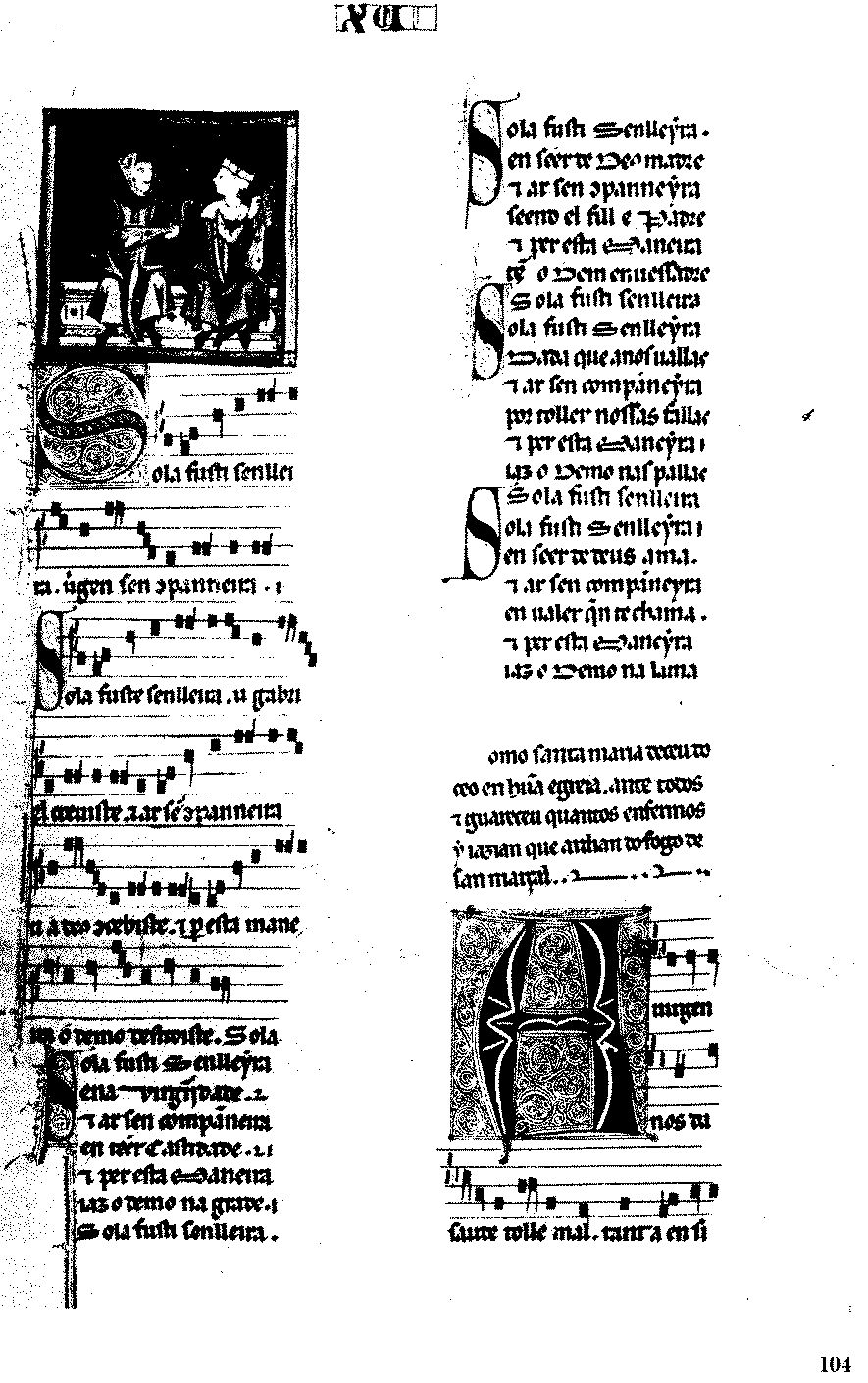
- 13th century, attributed to Alfonso X of Castile, Cantigas de Santa Maria, E codex, cantiga 90 (facsimile):
- & ar ſẽ (com)panneira u a de(us) (con)cebiſte
- and also without equal when you conceived God
- & ar ſẽ (com)panneira u a de(us) (con)cebiſte
- 13th century, attributed to Alfonso X of Castile, Cantigas de Santa Maria, E codex, cantiga 90 (facsimile):
- again
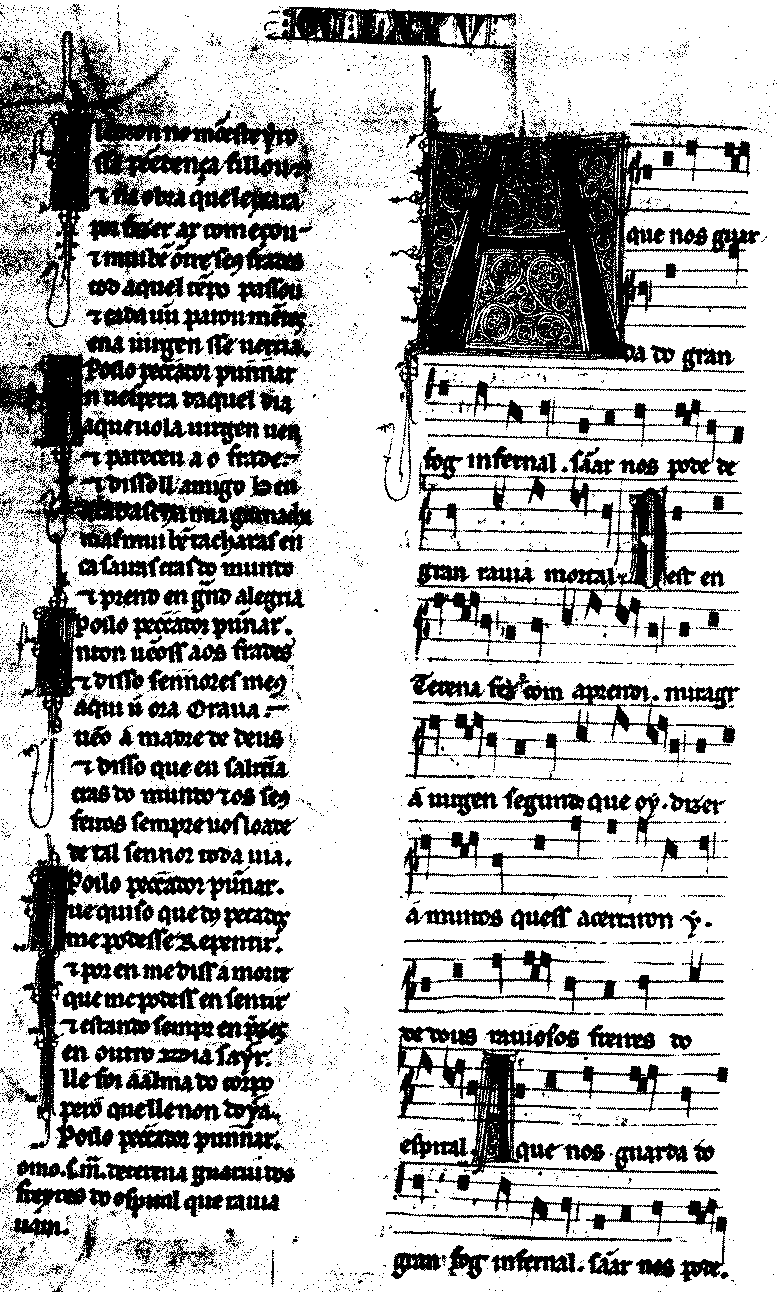
- 13th century, attributed to Alfonso X of Castile, Cantigas de Santa Maria, E codex, cantiga 274 (facsimile):
- na obra que leyxara / por fazer ar começou
- (He) started working again on his unfinished work
- na obra que leyxara / por fazer ar começou
- 13th century, attributed to Alfonso X of Castile, Cantigas de Santa Maria, E codex, cantiga 274 (facsimile):
Descendants
- Portuguese: er
Old Swedish
Etymology
From Old Norse ár, from Proto-Germanic *jērą.
Noun
ār n
Declension
Descendants
Polish
Pronunciation
- IPA(key): /ar/
Audio (file)
Noun
ar m inan (abbreviation a)
- are (square decametre, 100 m²)
Declension
Noun
ar f pl
- genitive plural of ara
Further reading
- ar in Polish dictionaries at PWN
Portuguese
Etymology
From Old Portuguese aar, aire, aere, from Latin āēr, from Ancient Greek ἀήρ (aḗr, “air”), from Proto-Indo-European *h₂weh₁- (“to blow”).
Pronunciation
Noun
ar m (plural ares)
Quotations
For quotations of use of this term, see Citations:ar.
Derived terms
Related terms
Romanian
Etymology 1
From older Romanian ară, are, presumably from Latin habēret (for the singular) and habērent (for the plural). See also are.
Verb
(el/ea) ar (modal auxiliary, third-person singular form of avea, used with infinitives to form conditional tenses)
- (he/she) would
Verb
(ele/ei) ar (modal auxiliary, third-person plural form of avea, used with infinitives to form conditional tenses)
- (they) would
Related terms
Etymology 2
Verb
ar
Scottish Gaelic
Adjective
ar
- our
- Tha ar nighean ruadh.
- Our daughter is red-haired.
Usage notes
Verb
ar (defective)
Usage notes
- Only has the present and past tense, which both have the same form ar.
- Always followed by the preposition le or a prepositional pronoun:
- ar le mòran nach fhaod seo a bhith ― many thought this can't be
- ar leam gun... ― it seems/seemed to me that...
Serbo-Croatian
Noun
ar m (Cyrillic spelling ар)
- are (square decametre, 100 m²)
Declension
Swedish
Etymology 1
Ultimately from Latin area, probably via French are. This etymology is incomplete. You can help Wiktionary by elaborating on the origins of this term.
Noun
ar c, n
- are (square decametre, 100 m²)
Declension
| Declension of ar | ||||
|---|---|---|---|---|
| Singular | Plural | |||
| Indefinite | Definite | Indefinite | Definite | |
| Nominative | ar | aren | ar | aren |
| Genitive | ars | arens | ars | arens |
| Declension of ar | ||||
|---|---|---|---|---|
| Singular | Plural | |||
| Indefinite | Definite | Indefinite | Definite | |
| Nominative | ar | aret | ar | aren |
| Genitive | ars | arets | ars | arens |
Related terms
Etymology 2
Ultimately from Proto-Germanic *arô.
Noun
ar m
- (dialectal) eagle
References
- ar in Svenska Akademiens ordlista över svenska språket (8th ed., 1923)
- ar in Svenska Akademiens Ordlista över svenska språket (13th ed., online)
Turkish
Etymology
Noun
ar (definite accusative arı, plural arlar)
- feeling of shame
- are (unit of area)
Welsh
Pronunciation
- IPA(key): /ar/
Preposition
ar (triggers soft mutation)
- on
- about to (with a verbal noun)
- 1993, Gareth King, Modern Welsh: A Comprehensive Grammar, London: Routledge, →ISBN, p. 131:
- Brysiwch, mae’r trên ar fynd!
- Hurry up, the train’s about to leave!
- 1993, Gareth King, Modern Welsh: A Comprehensive Grammar, London: Routledge, →ISBN, p. 131:
Inflection
Westrobothnian
Etymology 1
From Old Norse ǫrn, from Proto-Germanic *arô.
Pronunciation
- IPA(key): [ɑ́ːɾ], [áːɾ] (example of pronunciation)
- Rhymes: -ɑ́ːr, -áːr
Noun
ar m (definite singular aren)
Pronoun
ar
References
- ↑ Rietz, Johan Ernst, “AR 2”, in Svenskt dialektlexikon: ordbok öfver svenska allmogespråket [Swedish dialectal lexicon: a dictionary for the Swedish lects] (in Swedish), 1962 edition, Lund: C. W. K. Gleerups Förlag, published 1862–1867, page 12
- ↑ Stenberg, Pehr, Widmark, Gusten Ordbok över Umemålet [Dictionary of the Umeå speech], →ISBN, page 7