elle
Danish
Noun
elle c
- plural indefinite of el
French
Pronunciation
Etymology 1
From Old French ele, from Latin illa, feminine of ille.
Pronoun
elle f (plural elles)
- she
- Je crois qu'elle est partie.
- I think she left.
- it (feminine gender third-person singular subject pronoun)
- disjunctive form of elle; her; à elle = hers
- C’est à elle.
- It's hers.
Synonyms
- cézigue (argot)
Related terms
French personal pronouns
| Number | Person | Gender | Nominative (subject) |
Reflexive | Accusative (direct complement) |
Dative (indirect complement) |
Locative (at) |
Genitive (of) |
Disjunctive (tonic) |
|---|---|---|---|---|---|---|---|---|---|
| Singular | First | — | je, j’ | me, m’ | — | — | moi | ||
| Second | — | tu | te, t’ | — | — | toi | |||
| Third | Masculine | il | se, s’ | le, l’ | lui | y | en | lui, soi | |
| Feminine | elle | la, l’ | elle, soi | ||||||
| — | on | — | — | — | — | soi | |||
| Plural | First | — | nous | nous | — | — | nous | ||
| Second | — | vous | vous | — | — | vous | |||
| Third | Masculine | ils | se, s’ | les | leur | y | en | eux, soi | |
| Feminine | elles | elles, soi | |||||||
Etymology 2
Noun
elle m (plural elles)
Further reading
- “elle” in le Trésor de la langue française informatisé (The Digitized Treasury of the French Language).
Italian
Etymology 1
From Latin el (the name of the letter L).
Pronunciation
- IPA(key): /ˈɛl.le/, [ˈɛl̺l̺e]
- Stress: èlle
- Hyphenation: el‧le
Noun
elle f (invariable)
See also
Etymology 2
From Latin illae, nominative feminine plural of ille.
Pronunciation
- IPA(key): /ˈel.le/, [ˈel̺l̺e]
- Stress: élle
- Hyphenation: el‧le
Pronoun
elle f pl
Derived terms
See also
Italian personal pronouns (alternate)
| Number | Person | Gender | Nominative | Reflexive | Accusative | Dative | Locative | Genitive | Disjunctive |
|---|---|---|---|---|---|---|---|---|---|
| Singular | third | m | esso1, egli, elli3 | si, s' | lo, l' | gli | vi, v' | ne, n' | esso, sé |
| f | essa, ella, Ella2 | la, l' | le, ella3 | essa, sé | |||||
| Plural | third | m | essi, eglino3, ellino3, elli3 | si, s' | li | loro | vi, v' | ne, n' | essi, sé |
| f | esse, elle3, elleno3 | le | esse, elle,3 sé | ||||||
| 1 | Refers predominantly to non-humans. | ||||||||
| 2 | Highly elevated variant of Lei. | ||||||||
| 3 | Archaic. | ||||||||
Latvian
Elle
Etymology
Borrowed from Middle Dutch elle or Middle Low German helle (compare German Hölle, English hell). It is mentioned already in 16th-century literature and 17th-century dictionaries.[1]
Noun
elle f (5th declension)
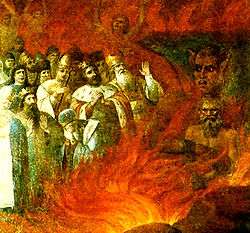
- (theology) hell (in many religions, the place where some or all souls go after death)
- (Christianity) hell (where the souls of sinners go after death to be punished by devils)
- nonākt ellē ― to end up in hell
- elles krāsns ― the furnace of hell
- elles mocības ― the torments of hell
- (figuratively) infernal (very intense, tough, terrible, horrible)
- elles karstums ― infernal heat
- elles troksnis ― infernal noise
- elles darbs ― infernal, terrible, toughwork
- elles mokas ― infernal, horrible suffering
Declension
Declension of elle (5th declension)
Synonyms
References
- ↑ Karulis, Konstantīns (1992), “elle”, in Latviešu Etimoloģijas Vārdnīca (in Latvian), Rīga: AVOTS, →ISBN
Middle French
Pronoun
elle f
Northern Sami
Pronunciation
- (Kautokeino) IPA(key): /ˈeːlle/
Verb
ēlle
- inflection of eallit:
- first-person dual present indicative
- third-person plural past indicative
Portuguese
Pronoun
elle m (feminine ella, plural elles, feminine plural ellas)
- Obsolete spelling of ele
Spanish
Noun
elle f (plural elles)
Synonyms
- doble ele
Turkish
Etymology
Adverb
elle
Verb
elle
- second-person singular imperative of ellemek
This article is issued from
Wiktionary.
The text is licensed under Creative Commons - Attribution - Sharealike.
Additional terms may apply for the media files.