á
| ||||||||||
Translingual
Letter
á (upper case Á)
- The letter a with an acute accent.
See also
- (Latin script): Aa Bb Cc Dd Ee Ff Gg Hh Ii Jj Kk Ll Mm Nn Oo Pp Qq Rr Sſs Tt Uu Vv Ww Xx Yy Zz
- (Variations of letter A): Áá Àà Ââ Ǎǎ Ăă Ãã Ảả Ȧȧ Ạạ Ää Åå Ḁḁ Āā Ąą ᶏ Ⱥⱥ Ȁȁ Ấấ Ầầ Ẫẫ Ẩẩ Ậậ Ắắ Ằằ Ẵẵ Ẳẳ Ặặ Ǻǻ Ǡǡ Ǟǟ Ȁȁ Ȃȃ Ɑɑ ᴀ Ɐɐ ɒ Aa Ææ Ǽǽ Ǣǣ Ꜳꜳ Ꜵꜵ Ꜷꜷ Ꜹꜹ Ꜻꜻ
- (Letters using acute accent or double acute accent): Áá Ắắ Ấấ Ǻǻ Ćć Ḉḉ Éé Ếế Ǵǵ Íí Ḯḯ Ḱḱ Ĺĺ Ḿḿ Ńń Óó Őő Ớớ Ṍṍ Ǿǿ Ṕṕ Ŕŕ Śś Úú Űű Ứứ Ẃẃ Ýý Źź Ǽǽ
Czech
Letter
á (lower case, upper case Á)
Faroese
Pronunciation
Etymology 1
Long Old Norse /a/. Often written as ā or normalized á or even aa, compare Swedish, Danish, Norwegian å.[2]
Noun
á (upper case Á)
See also
Etymology 2
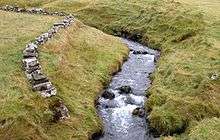
From Old Norse á (“river”), Svabo: Aa,[3] from Proto-Germanic *ahwō, from Proto-Indo-European *h₂ekʷeh₂ (“water”).
Noun
á f (genitive singular áar, plural áir)
Usage notes
- (poetry):
- áirnar standa á svølgi ― the rivers stand on deep water(= it's raining a lot) (compare áarføri)
- (= to travel a long way)
- (= to look for unnecessary struggle)
- (= it was very easy)
- [3] (described in Føroysk orðabók 1998 as local usage in the island of Vágar about fishing trouts in a lake[4])
Declension
| Declension of á | ||||
|---|---|---|---|---|
| f2 (á) | singular | plural | ||
| indefinite | definite | indefinite | definite | |
| nominative | á | áin | áir | áirnar |
| accusative | á | ánna | áir | áirnar |
| dative | á | ánni | áum | áunum |
| genitive | áar | áarinnar | áa | áanna |
Synonyms
- (brook): løkur
Etymology 3
From Old Norse á (“on, onto, in, at”). [5]
Preposition
á
- (with accusative) on, onto, to, near, beside
- (with accusative, fjords, bays, harbours) to
- (with dative) on, in, at
- (with dative, place names) in
- (with dative, fjords, bays, harbours) at, in
- (with dative, seafaring and fishery) at
Usage notes
The preposition 'á' is used with accusative case if the verb shows movement from one place to another, whereas it is used with dative case if the verb shows location. This is the same usage as with German auf:
- Governing accusative
- skriva á talvuna ― to write on the blackboard
- with fjords, bays, harbours
- skipið kom á Vestmanna ― the ship came to Vestmanna
- skipið kom á Havnina ― the ship came to Tórshavn
- Governing dative
- bókin liggur á borðinum ― the book is on the table
- hann er umborð á skipinum ― he is aboard the ship
- vera á fjalli ― to be in the mountains(in order to roundup the sheep[5])
- Place names (antonym: av)
- á Eiði ― in Eiði
- á Glyvrum ― in Glyvrar
- á Húsum ― in Húsar
- á Kirkju ― in Kirkja
- á Skála ― in Skáli
- á Velbastað ― in Velbastaður
- á bygd ― in the village (countryside)
- with fjords, bays, harbours
- skipið lá á Havnini ― the ship lays in Tórshavn
- with seafaring and fishery
- vera á útróðri ― to be fishing (with a rowing boat)[5]
Etymology 4
Interjection
á!
Etymology 5
From Old Norse [Term?].
Verb
á
- archaic third-person present of eiga
References
- ↑ V. U. Hammershaimb: Færøsk Anthologi. Copenhagen 1891, 3rd edition Tórshavn 1991 (volume 2, page 2, entry á1, 2)
- ↑ Vibeke Sandersen: „Om bogstavet å“ in Nyt fra Sprognævnet 2002/3 September.
- 1 2 Aa1 in: Jens Christian Svabo: Dictionarium Færoense : Færøsk-dansk-latinsk ordbog. (ed. Christian Matras after manuscripts from late 18th century). Copenhagen: Munksgaard, 1966. (p. 1)
- ↑ Jóhan Hendrik W. Poulsen, et al.: Føroysk orðabók. Tórshavn: Føroya Fróðskaparfelag 1998. (Entry á2)
- 1 2 3 aa2 in: Jens Christian Svabo: Dictionarium Færoense : Færøsk-dansk-latinsk ordbog. (ed. Christian Matras after manuscripts from late 18th century). Copenhagen: Munksgaard, 1966. (p. 1f.)
Galician
Etymology 1
From contraction of preposition a (“to, towards”) + feminine definite article a (“the”)
Contraction
á f (masculine ao, masculine plural aos, feminine plural ás)
Etymology 2
From Old Portuguese aa, from Latin ala. Compare Portuguese á. Doublet of ala.
Noun
á f (plural ás)
Icelandic
Pronunciation
- IPA(key): /auː/
- Rhymes: -auː
Etymology 1
From Old Norse á (“river”), from Proto-Germanic *ahwō, from Proto-Indo-European *h₂ekʷeh₂ (“water”). Compare Danish å, Norwegian å, Swedish å.
Noun
á f (genitive singular ár, nominative plural ár)
Declension
Etymology 2
Inflection of á.
Noun
á f
Etymology 3
Inflection of ær.
Noun
á f
Etymology 4
Conjugation of eiga.
Verb
á
Etymology 5
Interjection
á!
Etymology 6
From Old Norse á, from Proto-Norse ᚨᚾ (an), from Proto-Germanic *ana.
Preposition
á
Derived terms
|
Irish
Pronunciation
- IPA(key): /ɑː/
Etymology 1
From dhá, lenited variant of dá.
Pronoun
á (triggers lenition in the masculine singular, h-prothesis in the feminine singular, and eclipsis in the plural)
- him, her, it, them (used before the verbal noun in the progressive to indicate a third person direct object)
- Táim á bhualadh. ― I am hitting him.
- Táim á ól.
- I am drinking it (referring to a masculine noun, e.g. bainne (“milk”)).
- Táim á bualadh. ― I am hitting her.
- Táim á hól.
- I am drinking it (referring to a feminine noun, e.g. bláthach (“buttermilk”)).
- Táim á mbualadh. ― I am hitting them.
- Táim á n-ól. ― I am drinking them.
- used as a quasi-reflexive pronoun in a sentence with passive semantics
- Tá an buachaill á bhualadh.
- The boy is being hit (literally ‘The boy is at his hitting’).
- Tá an chloch á tógáil ag Séamas.
- The stone is being lifted by Séamas (literally ‘The stone is at its lifting by Séamas’).
Alternative forms
- agá, ’gá, ’ghá (obsolete)
Related terms
Contraction
á
- Alternative form of dá
- This term needs a translation to English. Please help out and add a translation, then remove the text
{{rfdef}}.
Etymology 2
Interjection
á!
- ah!
Etymology 3
Letter
á
- This term needs a translation to English. Please help out and add a translation, then remove the text
{{rfdef}}.
Further reading
- "á" in Foclóir Gaeilge-Béarla, An Gúm, 1977, by Niall Ó Dónaill.
- Entries containing “á” in English-Irish Dictionary, An Gúm, 1959, by Tomás de Bhaldraithe.
- Entries containing “á” in New English-Irish Dictionary by Foras na Gaeilge.
Mandarin
Romanization
á (Zhuyin ㄚˊ)
Min Nan
Conjunction
á (POJ)
- introduces an alternative or a word that explains or means the same
Particle
á (POJ, traditional and simplified 仔)
- a diminutive suffix for nouns, adjectives or quantities
- a suffix that converts a verb or adjective into a noun
- a suffix placed after a name or title, used endearingly, humorously or pejoratively
Synonyms
- (Mandarin) 子 (zǐ)
Old Irish
Determiner
á (3rd person possessive) (triggers lenition in the masculine and neuter singular, an unwritten prothetic /h/ in the feminine singular, and eclipsis in the plural)
- Alternative form of a
- c. 875, Milan Glosses on the Psalms, published in Thesaurus Palaeohibernicus (reprinted 1987, Dublin Institute for Advanced Studies), edited and with translations by Whitley Stokes and John Strachan, vol. I, pp. 7–483, Ml. 90b12
- Mad·genatar á thimthirthidi.
- Blessed are his servants.
- c. 875, Milan Glosses on the Psalms, published in Thesaurus Palaeohibernicus (reprinted 1987, Dublin Institute for Advanced Studies), edited and with translations by Whitley Stokes and John Strachan, vol. I, pp. 7–483, Ml. 144d3
- Nach torbatu coitchenn ro·boí indib fri denum n-uilc at·rubalt tar hesi á pectha.
- Every common advantage that had been in them for doing evil has perished for their sin.
- c. 875, Milan Glosses on the Psalms, published in Thesaurus Palaeohibernicus (reprinted 1987, Dublin Institute for Advanced Studies), edited and with translations by Whitley Stokes and John Strachan, vol. I, pp. 7–483, Ml. 90b12
Particle
á (triggers lenition)
- Alternative form of a
- c. 875, Milan Glosses on the Psalms, published in Thesaurus Palaeohibernicus (reprinted 1987, Dublin Institute for Advanced Studies), edited and with translations by Whitley Stokes and John Strachan, vol. I, pp. 7–483, Ml. 53c11
- in tan as·mbeir, Tait, á maccu
- when he says, "Come, O sons"
- c. 875, Milan Glosses on the Psalms, published in Thesaurus Palaeohibernicus (reprinted 1987, Dublin Institute for Advanced Studies), edited and with translations by Whitley Stokes and John Strachan, vol. I, pp. 7–483, Ml. 53c11
Etymology 3
From Proto-Indo-European *h₃éh₁os.
Noun
á
Mutation
| Old Irish mutation | ||
|---|---|---|
| Radical | Lenition | Nasalization |
| á | unchanged | n-á |
| Note: Some of these forms may be hypothetical. Not every possible mutated form of every word actually occurs. | ||
References
“á” in Dictionary of the Irish Language, Royal Irish Academy, 1913–76.
Old Norse
Alternative forms
Etymology 1
From Proto-Germanic *ahwō (“water, stream”), from Proto-Indo-European *h₂ekʷeh₂ (“water”). Cognate with Old English ēa, Old Frisian ā, ē, Old Saxon aha, Old High German aha, Gothic 𐌰𐍈𐌰 (aƕa).
Noun
Declension
Descendants
Etymology 2
From Proto-Norse ᚨᚾ (an), from Proto-Germanic *ana (“on, onto”). Cognate with Old English on, Old Frisian on, Old Saxon ana, an, Old Dutch ana, an, in, Old High German ana, an, Gothic 𐌰𐌽𐌰 (ana).
Preposition
á
- (with dative) on
- Þeir eru á hólmi.
- They are on an island.
- (with dative) in
- Ek bý á Islandi.
- I live in Iceland.
Descendants
Etymology 3
Probably related to Old Norse æ (“always”)
Adverb
á (not comparable)
Etymology 4
An imitation of a cry of pain.
Interjection
á
Descendants
- Icelandic: á
Etymology 5
Verb
á
- first-person singular present indicative of eiga: ‘I own’.
- third-person singular present indicative of eiga: ‘he owns’.
Old Portuguese
Alternative forms
Etymology
Pronunciation
- IPA(key): /a/
Article
á
- feminine singular of o
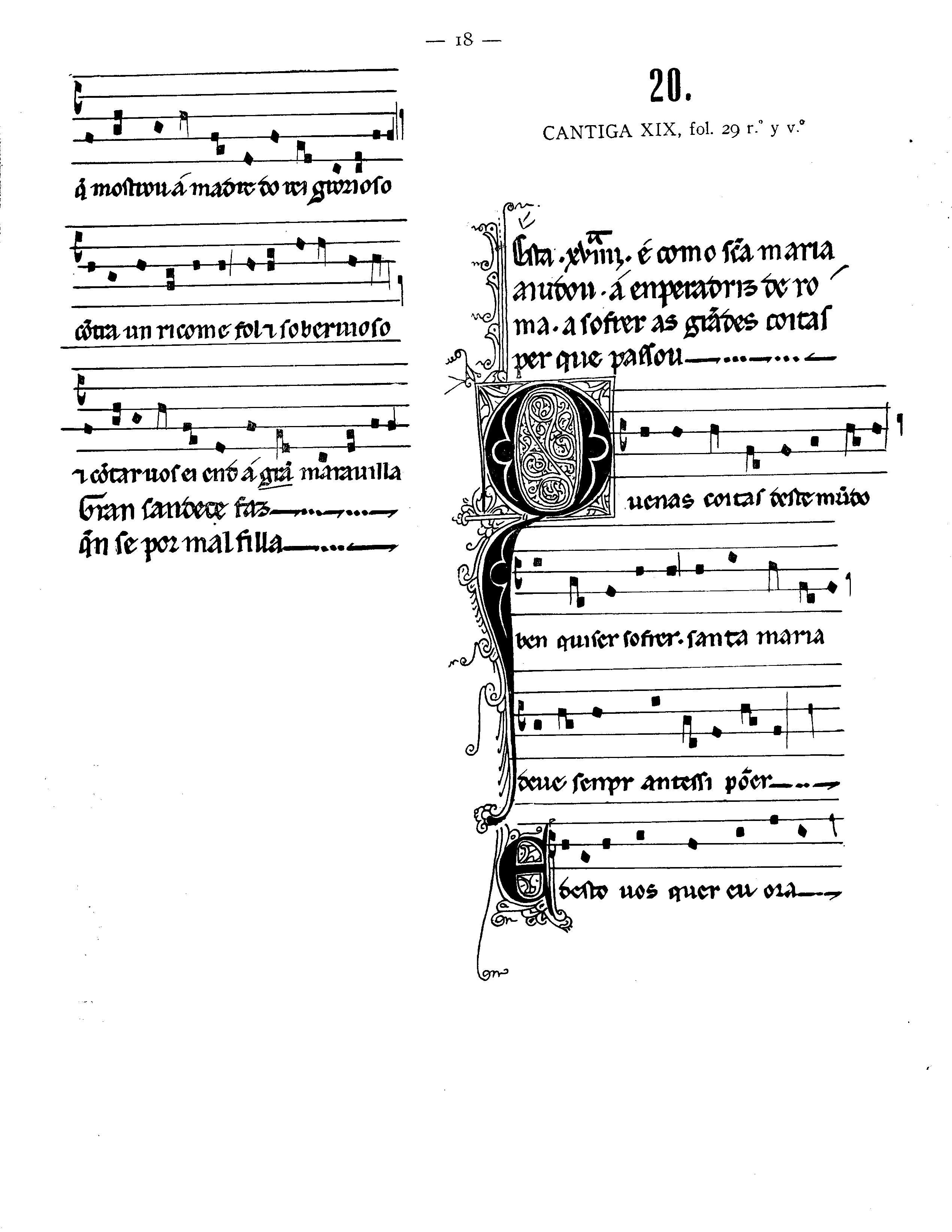
- 13th century, attributed to Alfonso X of Castile, Cantigas de Santa Maria, To codex, cantiga 5 (facsimile):
- Eſta ·xviiii· é como ſṫa maria aiudou · á emperadriz de roma · a ſofrer as grãdes coitaſ per que paſſou.
- This 19th is (about) how Holy Mary helped the empress of Rome suffer through the great pains she underwent.
- Eſta ·xviiii· é como ſṫa maria aiudou · á emperadriz de roma · a ſofrer as grãdes coitaſ per que paſſou.
- 13th century, attributed to Alfonso X of Castile, Cantigas de Santa Maria, To codex, cantiga 5 (facsimile):
Descendants
Portuguese
Pronunciation
Etymology 1
Alternative forms
Noun
á m (plural ás)
Derived terms
Etymology 2
From Old Portuguese aa (“wing”), from Latin āla (“wing”). Cognate with Galician á, Spanish ala, Catalan ala, Occitan ala, French aile, Italian ala and Ligurian âa. Doublet of ala, which was a borrowing.
Noun
á f (plural ás)
Synonyms
References
- “aa” in Dicionario de dicionarios do galego medieval.
Spanish
Preposition
á
- Obsolete spelling of a
Vietnamese
Pronunciation
- (Hà Nội) IPA(key): [ʔaː˧˦]
- (Huế) IPA(key): [ʔaː˨˩˦]
- (Hồ Chí Minh City) IPA(key): [ʔaː˦˥]
Noun
á