nj
| ||||||||
Translingual
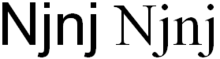
Nj in upper- and lowercase
Letter
nj (mixed case Nj, upper case NJ)
See also
- (Latin script): Aa Bb Cc Dd Ee Ff Gg Hh Ii Jj Kk Ll Mm Nn Oo Pp Qq Rr Sſs Tt Uu Vv Ww Xx Yy Zz
- (Variations of letter J): Ĵĵ Ɉɉ J̌ǰ ȷ ϳ ʝ ɟ ʄ ᴊ Jj IJij IJij LJLjlj LJLjlj NJNjnj NJNjnj
- (Variations of letter N): Ńń Ǹǹ Ňň Ññ Ṅṅ Ņņ Ṇṇ Ṋṋ Ṉṉ N̈n̈ Ɲɲ Ƞƞ ᵰ ᶇ ɳ ȵ ɴ Nn Ŋŋ NJNjnj NJNjnj
Egyptian
Pronunciation
- (modern Egyptological) IPA(key): /ni/
- Conventional anglicization: ni
Etymology 1
n (“to, for”) + -j (“nisba ending”)
Adjective
|

Usage notes
This genitival adjective can be used to express the indirect genitive. In this case, it indicates that the noun preceding it, with which it agrees in gender and number, is possessed by the noun which follows it.
Inflection
Declension of nj (nisba adjective)


Alternative forms
Alternative hieroglyphic writings of nj
Derived terms
Etymology 2
n (“to, for”) + -j (“adverbializing suffix”).
Adverb
|
Alternative forms
Alternative hieroglyphic writings of nj
Derived terms
Etymology 3
Preposition
|

- Variant form (before a noun) of n (“to, for”)
Etymology 4
Cognate to Arabic لَا (lā, “no, not”), Hebrew לֹא (lō, “no, not”), Aramaic לָא (lā, “no, not”).
Particle
|
proclitic
- (Old Egyptian) not; negates any sentence
- (Middle and later Egyptian) not; negates a nominal sentence, an adjectival sentence of possession, or the rheme of an emphatic clause (used with js; see Usage Notes below)
- no, not any; negates an individual noun
- not; negates other individual words
Usage notes
- When used alone, nj negates the individual word following it.
- When negating (nonverbal) nominal sentences, adjectival sentences of possession (which start with the genitival adjective n(j)
), and rhemes of emphatic clauses, this particle is typically followed by the first element of the negated clause and then the negative particle js. In Middle Egyptian it cannot negate adjectival sentences which do not indicate possession, nor adverbial sentences, which are instead negated by nn. It also cannot negate verbal sentences that are not emphatic, so the presence of a verb between nj and js always indicates an emphatic clause.
- nj combines with a number of other words to form negative particles with more specialised meanings, for which see the next section.
Derived terms
References
- Allen, James (2010) Middle Egyptian: An Introduction to the Language and Culture of Hieroglyphs, revised second edition, Cambridge: Cambridge University Press, →ISBN
- Hoch, James (1997) Middle Egyptian Grammar, Mississauga: Benben Publications, →ISBN, page 117–118
Fula
Pronunciation
- IPA(key): /ⁿdʒ/
Letter
nj (lower case, upper case Nj)
Usage notes
See also
- (Latin-script letters) karfeeje; ', A a, B b, Mb mb, Ɓ ɓ, C c, D d, Nd nd, Ɗ ɗ, E e, F f, G g, Ng ng, Ɠ ɠ, H h, I i, J j, Nj nj, K k, L l, M m, N n, Ŋ ŋ, Ñ ñ, Ɲ ɲ, O o, P p, R r, S s, T t, U u, W w, Y y, Ƴ ƴ
Serbo-Croatian
Alternative forms
- (uppercase): Nj
Pronunciation
- (phoneme) IPA(key): /ɲ/
Letter
nj (Cyrillic spelling њ)
Pronoun
nj (Cyrillic spelling њ)
Declension
Inflection of 3rd-person pronouns
| Singular | Plural | |||||
|---|---|---|---|---|---|---|
| Masculine | Feminine | Neuter | Masculine | Feminine | Neuter | |
| nominative | ȏn | òna | òno | òni | òne | òna |
| genitive | njȅga, ga | njȇ, je | njȅga, ga | njȋh, ih | njȋh, ih | njȋh, ih |
| dative | njȅmu, mu | njȏj, joj | njȅmu, mu | njȉma, im | njȉma, im | njȉma, im |
| accusative | njȅga, ga, nj | njȗ, ju, je, nju | njȅga, ga, nj | njȋh, ih | njȋh, ih | njȋh, ih |
| vocative | — | — | — | — | — | — |
| locative | njȅm, njȅmu | njȏj | njȅm, njȅmu | njȉma | njȉma | njȉma |
| instrumental | njȋm, njíme | njȏm, njóme | njȋm, njíme | njȉma | njȉma | njȉma |
This article is issued from
Wiktionary.
The text is licensed under Creative Commons - Attribution - Sharealike.
Additional terms may apply for the media files.