é
See also: Appendix:Variations of "e"
| ||||||||||
Translingual
Letter
é (upper case É)
- The letter e with an acute accent.
See also
- (Latin script): Aa Bb Cc Dd Ee Ff Gg Hh Ii Jj Kk Ll Mm Nn Oo Pp Qq Rr Sſs Tt Uu Vv Ww Xx Yy Zz
- (Variations of letter E): Éé Èè Êê Ḙḙ Ěě Ĕĕ Ẽẽ Ḛḛ Ẻẻ Ėė Ëë Ēē Ȩȩ Ęę ᶒ Ɇɇ Ȅȅ Ếế Ềề Ễễ Ểể Ḝḝ Ḗḗ Ḕḕ Ȇȇ Ẹẹ Ệệ ⱸ ᴇ Ee Ææ Ǽǽ Ǣǣ & Œœ ᵫ
- (Letters using acute accent or double acute accent): Áá Ắắ Ấấ Ǻǻ Ćć Ḉḉ Éé Ếế Ǵǵ Íí Ḯḯ Ḱḱ Ĺĺ Ḿḿ Ńń Óó Őő Ớớ Ṍṍ Ǿǿ Ṕṕ Ŕŕ Śś Úú Űű Ứứ Ẃẃ Ýý Źź Ǽǽ
English
Letter
é (lower case, upper case É, plural é's)
- Found chiefly in words borrowed from other languages. When it occurs as the last letter of the word, it indicates that the e is not silent.
Czech
Letter
é (lower case, upper case É)
Fala
Verb
é
- third-person singular present indicative of sel
Galician
Etymology
Pronunciation
- IPA(key): /ˈɛ/
Verb
é
Hungarian
Etymology
The standard Latin letter e with the addition of the acute accent which indicates both modified sound and extended length.
Letter
é
- A letter of the Hungarian alphabet, long e.
Irish
Etymology
From Old Irish é, from Proto-Indo-European *éy.
Pronunciation
- IPA(key): /eː/, /ə/
Pronoun
é (emphatic form eisean, disjunctive)
See also
Irish personal pronouns
| Number | Person (and gender) | Conjunctive (emphatic) |
Disjunctive (emphatic) |
Possessive determiner |
|---|---|---|---|---|
| Singular | First | mé (mise) |
mo L m' before vowel sounds | |
| Second | tú (tusa) |
thú (thusa) |
do L d' before vowel sounds | |
| Third masculine | sé (seisean) |
é (eisean) |
a L | |
| Third feminine | sí (sise) |
í (ise) |
a H | |
| Plural | First | muid, sinn (muidne, muide), (sinne) |
ár E | |
| Second | sibh (sibhse) |
bhur E | ||
| Third | siad (siadsan) |
iad (iadsan) |
a E | |
Mutation
| Irish mutation | |||
|---|---|---|---|
| Radical | Eclipsis | with h-prothesis | with t-prothesis |
| é | n-é | hé | not applicable |
| Note: Some of these forms may be hypothetical. Not every possible mutated form of every word actually occurs. | |||
Ligurian
Verb
é
Mandarin
Pronunciation
Audio (file)
Romanization
é (Zhuyin ㄜˊ)
- Pinyin transcription of 俄
- Pinyin transcription of 吪
- Pinyin transcription of 哦
- Pinyin transcription of 囫
- Pinyin transcription of 娥
- Pinyin transcription of 峨
- Pinyin transcription of 峩
- Pinyin transcription of 枙
- Pinyin transcription of 涐
- Pinyin transcription of 珴
- Pinyin transcription of 皒
- Pinyin transcription of 睋
- Pinyin transcription of 硪
- Pinyin transcription of 磀
- Pinyin transcription of 莪
- Pinyin transcription of 蛾
- Pinyin transcription of 訛
- Pinyin transcription of 誐
- Pinyin transcription of 譌
- Pinyin transcription of 讹
- Pinyin transcription of 迗
- Pinyin transcription of 鈋
- Pinyin transcription of 鋧
- Pinyin transcription of 锄
- Pinyin transcription of 隲
- Pinyin transcription of 頟
- Pinyin transcription of 額
- Pinyin transcription of 额
- Pinyin transcription of 騀
- Pinyin transcription of 魤
- Pinyin transcription of 鵝
- Pinyin transcription of 鵞
- Pinyin transcription of 鹅
References
Min Nan
| For pronunciation and definitions of é – see 矮 (“short; low”). (This character, é, is the Pe̍h-ōe-jī form of 矮.) |
Old Irish
Alternative forms
- hé
- hǽ
Pronunciation
- IPA(key): /eː/
Etymology 1
From Proto-Celtic *es or *ēs, from Proto-Indo-European *éy.
Pronoun
- he
- c. 800, Würzburg Glosses on the Pauline Epistles, published in Thesaurus Palaeohibernicus (reprinted 1987, Dublin Institute for Advanced Studies), edited and with translations by Whitley Stokes and John Strachan, vol. I, pp. 499–712, Wb. 4c3
- Is hé as airchinnech inna n-uile.
- It is he who is the chief of all.
- Is hé as airchinnech inna n-uile.
- c. 800, Würzburg Glosses on the Pauline Epistles, published in Thesaurus Palaeohibernicus (reprinted 1987, Dublin Institute for Advanced Studies), edited and with translations by Whitley Stokes and John Strachan, vol. I, pp. 499–712, Wb. 4c3
- it (referring to a masculine noun)
- c. 800, Würzburg Glosses on the Pauline Epistles, published in Thesaurus Palaeohibernicus (reprinted 1987, Dublin Institute for Advanced Studies), edited and with translations by Whitley Stokes and John Strachan, vol. I, pp. 499–712, Wb. 5b28
- Ní tú nod·n-ail, acht is hé not·ail.
- It is not you that nourishes it, but it that nourishes you.
- Ní tú nod·n-ail, acht is hé not·ail.
- c. 800, Würzburg Glosses on the Pauline Epistles, published in Thesaurus Palaeohibernicus (reprinted 1987, Dublin Institute for Advanced Studies), edited and with translations by Whitley Stokes and John Strachan, vol. I, pp. 499–712, Wb. 5b28
Related terms
- ésom (emphatic)
Descendants
Etymology 2
From Proto-Celtic *ēs (compare Middle Welsh wy), from nominative *eyes or accusative *ens, from Proto-Indo-European *éy.
Pronoun
é
- they
- c. 800, Würzburg Glosses on the Pauline Epistles, published in Thesaurus Palaeohibernicus (reprinted 1987, Dublin Institute for Advanced Studies), edited and with translations by Whitley Stokes and John Strachan, vol. I, pp. 499–712, Wb. 4a8
- Nitat pecthi collnidi híccatar and ind echt so cebtar hé riam.
- It is not fleshly sins that are paid for there now, though it was they before.
- Nitat pecthi collnidi híccatar and ind echt so cebtar hé riam.
- c. 800, Würzburg Glosses on the Pauline Epistles, published in Thesaurus Palaeohibernicus (reprinted 1987, Dublin Institute for Advanced Studies), edited and with translations by Whitley Stokes and John Strachan, vol. I, pp. 499–712, Wb. 4a8
Old Portuguese
Pronunciation
- IPA(key): /ˈɛ/
Verb
é
- third-person singular present indicative of seer
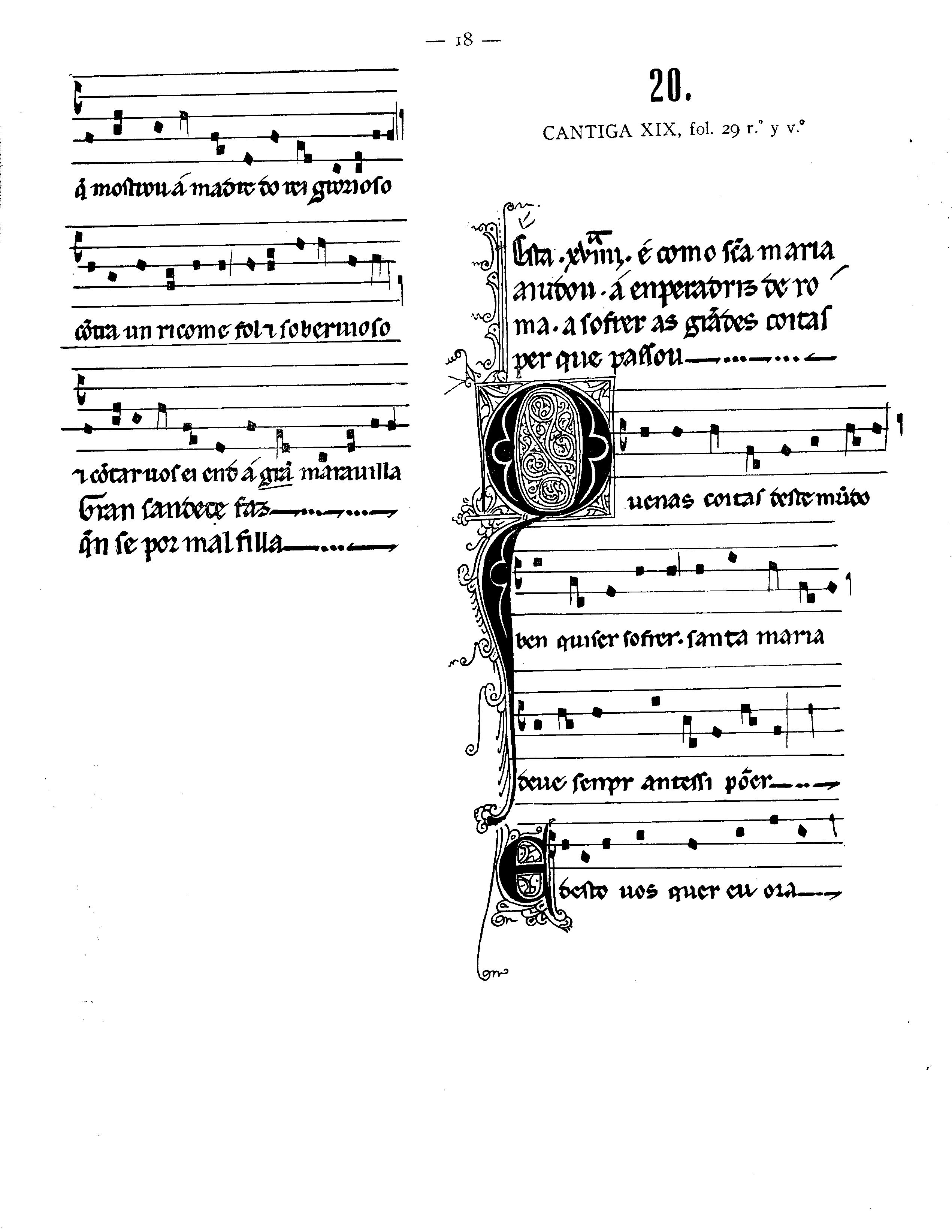
- 13th century, attributed to Alfonso X of Castile, Cantigas de Santa Maria, To codex, cantiga 5 (facsimile):
- Eſta ·xviiii· é como ſṫa maria aiudou · á emperadriz de roma · a ſofrer as grãdes coitaſ per que paſſou.
- This 19th is about how Holy Mary helped the empress of Rome suffer through the great pains she underwent.
- Eſta ·xviiii· é como ſṫa maria aiudou · á emperadriz de roma · a ſofrer as grãdes coitaſ per que paſſou.
- 13th century, attributed to Alfonso X of Castile, Cantigas de Santa Maria, To codex, cantiga 5 (facsimile):
Old Spanish
Alternative forms
Etymology
Pronunciation
- IPA(key): /e/
Conjunction
é
Descendants
Portuguese
Alternative forms
Verb and interjection:
Noun:
Interjection used in hesitant speech:
Pronunciation
- IPA(key): /ˈɛ/
- Rhymes: -ɛ
Verb
é
Noun
é m (plural és)
- e (name of the letter E, e)
Interjection
é
Spanish
Conjunction
é
- Obsolete spelling of e
This article is issued from
Wiktionary.
The text is licensed under Creative Commons - Attribution - Sharealike.
Additional terms may apply for the media files.