tu
Albanian
Etymology
Unknown.
Noun
tu ?
Aromanian
Etymology 1
From Latin tū, from Proto-Italic *tū, from Proto-Indo-European *túh₂.
Pronoun
tu
- (second-person singular) you (singular)
Related terms
See also
Etymology 2
Compare tru.
Preposition
tu
Synonyms
Asturian
Etymology
Pronoun
tu
- you (singular)
Bambara
Noun
tu
Verb
tu
- to spit (out)
Batuley
Etymology
Borrowed from Indonesian tua.
Adjective
tu
References
- Greenhill, S.J., Blust. R, & Gray, R.D. (2008). The Austronesian Basic Vocabulary Database: From Bioinformatics to Lexomics. Evolutionary Bioinformatics, 4:271-283.
Breton
Noun
tu m
Catalan
Etymology
From Old Occitan tu, from Latin tū, from Proto-Italic *tū, from Proto-Indo-European *túh₂.
Pronunciation
Pronoun
tu
Declension
See also
Chipewyan
Noun
tu
References
- Eung-Do Cook, A grammar of Dëne Sųłiné (Chipewyan) (2004), page 350
Coatecas Altas Zapotec
Numeral
tu
References
- SIL Zapotec Basic Vocabulary, page 52
Cornish
Adjective
tu
Czech
Pronunciation
- IPA(key): /tu/
Audio (file)
Adverb
tu
- (informal or dialectal) here
Synonyms
Pronoun
tu
- Feminine accusative singular of ten
Further reading
- tu in Příruční slovník jazyka českého, 1935–1957
- tu in Slovník spisovného jazyka českého, 1960–1971, 1989
Ewe
Noun
tu (plural tuwo)
Verb
tu
French
Pronunciation
Etymology 1
From Old French tu, from Latin tū, from Proto-Italic *tū, from Proto-Indo-European *túh₂.
Pronoun
tu (second person informal singular, possessive determiner ton)
Usage notes
Inflection
Derived terms
Related terms
- vous (plural form and polite singular form)
| Number | Person | Gender | Nominative (subject) |
Reflexive | Accusative (direct complement) |
Dative (indirect complement) |
Locative (at) |
Genitive (of) |
Disjunctive (tonic) |
|---|---|---|---|---|---|---|---|---|---|
| Singular | First | — | je, j’ | me, m’ | — | — | moi | ||
| Second | — | tu | te, t’ | — | — | toi | |||
| Third | Masculine | il | se, s’ | le, l’ | lui | y | en | lui, soi | |
| Feminine | elle | la, l’ | elle, soi | ||||||
| — | on | — | — | — | — | soi | |||
| Plural | First | — | nous | nous | — | — | nous | ||
| Second | — | vous | vous | — | — | vous | |||
| Third | Masculine | ils | se, s’ | les | leur | y | en | eux, soi | |
| Feminine | elles | elles, soi | |||||||
Etymology 2
Verb
tu m (feminine singular tue, masculine plural tus, feminine plural tues)
- past participle of taire
Etymology 3
From t-il.
Particle
tu
- (Quebec, informal) question marker
- C'est-tu possible ?
- Is it possible?
Further reading
- “tu” in le Trésor de la langue française informatisé (The Digitized Treasury of the French Language).
Anagrams
Friulian
Etymology
From Latin tū, from Proto-Indo-European *túh₂.
Pronoun
tu
See also
Gaulish
Etymology
From Proto-Celtic *tū, from Proto-Indo-European *túh₂.
Pronoun
tū
Inflection
| Number | Singular | Plural |
|---|---|---|
| Nominative | tū | suīs |
| Accusative | te | suīs |
| Genitive | tou | suesron |
| Dative | toi | umē |
| Ablative | te | ume |
| Instrumental | toi | ? |
| Locative | toi | umē |
German
Pronunciation
- IPA(key): /tuː/
- Rhymes: -uː
Verb
tu
- Imperative singular of tun.
Ido
Etymology
Borrowed from English thou, French tu, German du, Italian tu, Spanish tú, Russian ты (ty), all ultimately from Proto-Indo-European *túh₂ with + -u.
Pronunciation
- IPA(key): /tu/
Pronoun
tu (second-person singular)
Synonyms
- vu (formal)
Derived terms
See also
 |
Singular | Plural | |||||
|---|---|---|---|---|---|---|---|
| Nominative | Possessive | Nominative | Possessive | ||||
| Singular | Plural | Singular | Plural | ||||
| First person | me | mea | mei | ni | nia | nii | |
| Second person | Formal | vu | vua | vui | vi | via | vii |
| Familiar | tu | tua | tui | ||||
| Third person | Masculine | ilu, il | ilua | ilui | ili | ilia | ilii |
| Feminine | elu, el | elua | elui | eli | elia | elii | |
| Neuter | olu, ol | olua | olui | oli | olia | olii | |
| Pangender | lu | lua | lui | li | lia | lii | |
| Reflexive | su | sua | sui | su | sua | sui | |
| Indefinite | onu, on | onua | onui | onu, on | onua | onui | |
| Notes | |||||||
| The possessive plurals are seldom used. | |||||||
| The shortened forms are preferred. | |||||||
| The pangendered forms are preferred to the gendered or neuter forms in most scenarios. | |||||||
Interlingua
Etymology
Pronunciation
- IPA(key): /tu/
Pronoun
tu (second person singular)
Inflection
| subject | tu |
|---|---|
| object | te |
| reflexive | te |
| possessive | tu, tue |
Determiner
tu
- (possessive) your
Italian
Etymology
From Latin tū, from Proto-Italic *tū, from Proto-Indo-European *túh₂.
Pronunciation
- IPA(key): /t̪u/
Audio (file) - Rhymes: -u
Pronoun
tu (second person singular)
See also
| Number | Person | Gender | Nominative | Reflexive | Accusative | Dative | Locative | Genitive | Disjunctive |
|---|---|---|---|---|---|---|---|---|---|
| Singular | first | — | io | mi, m' | — | me | |||
| second | — | tu | ti, t' | te | |||||
| third | m | lui | si,2 s' | lo, l' | gli | ci, c', vi, v' (formal) |
ne, n' | lui, sé | |
| f 1 | lei, Lei | la, l', La | le,3 Le | lei, Lei, sé | |||||
| Plural | first | — | noi | ci, c' | — | noi | |||
| second | — | voi | vi, v' | voi | |||||
| third | m | loro, Loro | si, s' | li | gli, loro (formal), Loro |
ci, c', vi, v' (formal) |
ne, n' | loro, Loro, sé | |
| f 1 | le | ||||||||
| 1 | The feminine gender forms are also used as formal terms of address, often capitalised as Lei, Loro etc. to distinguish them. | ||||||||
| 2 | Also used as indefinite pronoun meaning “one”, and to form the passive. | ||||||||
| 3 | In informal speech sometimes replaced with gli (nonstandard). | ||||||||
Japanese
Romanization
tu
Kalasha
Pronoun
tu
- you (2nd-person personal pronoun)
See also
Kurdish
Etymology
From Proto-Iranian [Term?], from Proto-Indo-Iranian [Term?], from Proto-Indo-European *túh₂. Compare Persian تو (to), Pashto ته (tə), Avestan 𐬙𐬏𐬨 (tūm).
Pronoun
tu (second person singular)
Related terms
See also
Latin
Etymology
From Proto-Italic *tū, from Proto-Indo-European *túh₂ or *tū. Cognates include Ancient Greek σύ (sú), Sanskrit त्वम् (tvám), Old English þū, Old Persian 𐎬𐎺𐎶 (tuvam).
Pronunciation
- (Classical) IPA(key): /tuː/
Pronoun
tū (second person singular, possessive adjective tuus)
Usage notes
When used in the plural genitive, vestrī is used when it is the object of an action, especially when used with a gerund or gerundive. When used in such a construction, the gerund or gerundive takes on the masculine genitive singular. Vestrum is used as a partitive genitive, used in constructions such as (one of you).
Inflection
Personal pronoun declension.
| Singular | First-person | Second-person | Reflexive |
|---|---|---|---|
| nominative | ego/egō | tū | — |
| genitive | meī | tuī | suī |
| dative | mihi/mihī, mī | tibi | sibi |
| accusative | mē | tē | sē, sēsē |
| ablative | mē | tē | sē, sēsē |
| vocative | egō | tū | — |
| possessive | meus | tuus | suus |
| Plural | First-person | Second-person | Reflexive |
| nominative | nōs | vōs | — |
| genitive | nostrī, nostrum | vestrī, vestrum | suī |
| dative | nōbīs | vōbīs | sibi |
| accusative | nōs | vōs | sē, sēsē |
| ablative | nōbīs | vōbīs | sē, sēsē |
| vocative | nōs | vōs | — |
| possessive | noster | vester, voster | suus |
Quotations
- For quotations of use of this term, see Citations:tu.
Derived terms
- tecum
- tute
- tutemet
- tutimet
- tepte
- tete
- quid tibi est?
Descendants
- Aromanian: tu
- Corsican: tù
- Dalmatian: te
- Friulian: tu
- Istro-Romanian: tú
- Italian: tu
- Ladin: tu
- Megleno-Romanian: tu
- Mozarabic: tu
- Navarro-Aragonese: tu
- Aragonese: tu
- Neapolitan: tu
- Old French: tu
See also
| Number | Person | Gender | Nominative | Genitive | Dative | Accusative | Ablative | Possessive |
|---|---|---|---|---|---|---|---|---|
| Singular | First | — | ego | meī | mihi | mē | meus, -a, -um | |
| Second | — | tū | tuī | tibi | tē | tuus, -a, -um | ||
| Reflexive third | — | — | suī | sibi | sē, sēsē | suus, -a, -um | ||
| Third | Masculine | is | eius | eī | eum | eō | eius | |
| Feminine | ea | eam | eā | |||||
| Neuter | id | id | eō | |||||
| Plural | First | — | nōs | nostrī, nostrum | nōbīs | nōs | nōbīs | noster, -tra, -trum |
| Second | — | vōs | vestrī, vestrum | vōbīs | vōs | vōbīs | vester, -tra, -trum | |
| Reflexive third | — | — | suī | sibi | sē, sēsē | suus, -a, -um | ||
| Third | Masculine | eī, iī | eōrum | eīs | eōs | eīs | eōrum | |
| Feminine | eae | eārum | eās | eārum | ||||
| Neuter | ea | eōrum | ea | eōrum | ||||
References
- tu in Charlton T. Lewis and Charles Short (1879) A Latin Dictionary, Oxford: Clarendon Press
- tu in Charlton T. Lewis (1891) An Elementary Latin Dictionary, New York: Harper & Brothers
- Carl Meissner; Henry William Auden (1894) Latin Phrase-Book, London: Macmillan and Co.
- I will refuse you nothing: nihil tibi a me postulanti recusabo
- I wish you all success in the matter: bene id tibi vertat!
- to be in every one's mouth: in ore omnium or omnibus (hominum or hominibus, but only mihi, tibi, etc.) esse
- convince yourself of this; rest assured on this point: persuade tibi
- convince yourself of this; rest assured on this point: velim tibi ita persuadeas
- (ambiguous) convince yourself of this; rest assured on this point: sic volo te tibi persuadere
- I put myself at your disposal as regards advice: consilii mei copiam facio tibi
- what do you mean to do: quid tibi vis?
- to play the flute: tibiis or tibiā canere
- what sort of humour are you in: quid tibi animi est?
- I drink your health: propīno tibi hoc (poculum, salutem)
- (ambiguous) your health: bene tibi or te!
- my best wishes for your welfare: tibi plurimam salutem
- what is your opinion: quid censes? quid tibi videtur?
- do you think so? are you in earnest: ain tu?
- (ambiguous) I have not seen you for five years: quinque anni sunt or sextus annus est, cum te non vidi
- (ambiguous) everything depends on you: in te omnia sunt
- (ambiguous) the decision of the question rests with you: penes te arbitrium huius rei est
- (ambiguous) I blame this in you; I censure you for this: hoc in te reprehendo (not ob eam rem)
- (ambiguous) convince yourself of this; rest assured on this point: sic volo te tibi persuadere
- (ambiguous) we expect a great deal from a man of your calibre: magna est exspectatio ingenii tui
- (ambiguous) the matter speaks for itself: res ipsa (pro me apud te) loquitur
- (ambiguous) be brave: fortem te praebe
- (ambiguous) your health: bene tibi or te!
- (ambiguous) a word with you: paucis te volo
- (ambiguous) a word with you: tribus verbis te volo
- (ambiguous) I bid you good-bye, take my leave: te valere iubeo
- (ambiguous) good luck to you: macte virtute (esto or te esse iubeo)
- I will refuse you nothing: nihil tibi a me postulanti recusabo
Latvian
Etymology
From Proto-Balto-Slavic *tū, Proto-Indo-European *túh₂, *tū, *tu, genitive *tewe, dative *toy, *tebʰ(y)e, accusative *t(w)e. The Latvian tevis comes from *tevens, with an -en-increased form showing an additional s by analogy with other genitive plurals. The dative form was originally closer to Old Prussian tebbei; the current form tev has a v due to influence from other declension forms, and the ending was reduced. The accusative tevi comes from *teven, with n by analogy to the accusative form of other words. The locative tevī was formed by analogy with i-stem nouns. Cognates include Lithuanian tù, Old Prussian tū, thu, toū, thou, tau, Sudovian tu, Old Church Slavonic, Belarusian, Russian ты (ty), Ukrainian, Bulgarian ти (ti), Czech, Polish ty, Gothic 𐌸𐌿 (þū), Old High German þū, Old Norse þú, Old English þū, German du, English thou, Old Irish tú, Hittite zik, zikka (from *tega, from *te + *egō), -du- (“to you”) (from *tu), Sanskrit त्वम् (tvám), Avestan 𐬙𐬏 (tū), (Doric) Ancient Greek τύ (tú), (Ionic) σύ (sú), Latin tū, Tocharian A tu, Tocharian B twe, tuwe, Ossetian ду (du), ды (dy).[1]
Pronunciation
- IPA(key): [tu]
Pronoun
tu (personal, 2nd person singular)
- (informal in the singular) you; (dated) thou; second person pronoun, referring to the addressee
- vai tu nāksi man līdzi? ― are you coming with me?
- pieder tautai, tad tauta piederēs tev! ― belong to the people, and then the people will belong to you!
- būt uz tu ar kādu ― to be on intimate terms (lit. to be on thou) with someone
- (in the expression “ak tu...”) used to strengthen the meaning of a word or expression
- “ak tu to skaļo gaiļa rīkli!” māte priecājas ― “oh you loud rooster throat!” mother said happily
- ak tu mūžs! cūka izlauzusies no aizgalda! ― ah (you) life! the pig escaped from the pen!
Usage notes
The form tavs is a possessive pronoun ('your'), while tevis is a true genitive form ('of you'). The dative form tevim is used only optionally, with prepositions.
Declension
Related terms
- tavējs
See also
References
- ↑ Karulis, Konstantīns (1992), “tu”, in Latviešu Etimoloģijas Vārdnīca (in Latvian), Rīga: AVOTS, →ISBN
Lithuanian
Etymology
From Proto-Balto-Slavic *tuˀ (“you”), compare Latvian tu, Old Prussian tu, toū, Proto-Slavic *ty. From Proto-Indo-European *tuH; compare Ancient Greek σύ (sú), Sanskrit त्वम् (tvám), Proto-Germanic *þū. The oblique stem tav- has been generalized from the Proto-Indo-European genitive *téwe; compare (Doric) Ancient Greek τέος (téos) < *tewos, Sanskrit तव (táva). For a discussion of the case endings, see àš (“I”).
Pronunciation
- IPA(key): /tʊ/
Pronoun
tù
- you (singular)
Declension
Derived terms
See also
| singular (vienaskaita) | dual (dviskaita) | plural (daugiskaita) | reflexive (sangrąžiniai) | ||||||||||||||||
|---|---|---|---|---|---|---|---|---|---|---|---|---|---|---|---|---|---|---|---|
| 1st person (pirmasis asmuo) |
2nd person (antrasis asmuo) |
3rd person (trečiasis asmuo) |
1st person | 2nd person | 3rd person | 1st person | 2nd person | 3rd person | |||||||||||
| m | f | m | f | m | f | m | f | m | f | ||||||||||
| nominative (vardininkas) |
àš | tù | jìs, jisaĩ |
jì, jinaĩ |
mùdu | mùdvi | jùdu | jùdvi | juõdu, jiẽdu |
jiẽdvi | mẽs | jū̃s | jiẽ | jõs | - | ||||
| genitive (kilmininkas) |
manę̃s | tavę̃s | jõ | jõs | mùdviejų | jùdviejų | jų̃dviejų | mū́sų | jū́sų | jų̃ | savę̃s | ||||||||
| dative (naudininkas) |
mán | táu | jám | jái | mùdviem | jùdviem | jõdviem | mùms | jùms | jíems | jóms | sáu | |||||||
| accusative (galininkas) |
manè | tavè | jį̃ | ją̃ | mùdu | mùdvi | jùdu | jùdvi | juõdu | jiẽdvi | mùs | jùs | juõs | jàs | savè | ||||
| instrumental (įnagininkas) |
manimì, manim̃ | tavimì, tavim̃ | juõ | jà | mùdviem | jùdviem | jõdviem | mumìs | jumìs | jaĩs | jomìs | savimì, savim̃ | |||||||
| locative (vietininkas) |
manyjè, manỹ | tavyjè, tavỹ | jamè | jojè | mùdviese | jùdviese | jiẽdviese | mumysè | jumysè | juosè | josè | savyjè, savỹ | |||||||
| possessive (savybiniai) |
màno | tàvo | jõ | jõs | mùdviejų | jùdviejų | jų̃dviejų | mū́sų | jū́sų | jų̃ | sàvo | ||||||||
Lower Sorbian
Pronunciation
- IPA(key): [tu]
Determiner
tu
- accusative feminine singular of ten
Lower Tanana
Noun
tu
References
- James Kari, Lower Tanana Athabaskan Listening and Writing Exercises (1991)
Malay
Alternative forms
Etymology
Shortened form of itu, from Proto-Malayic *(i)tu(ʔ), from Proto-Malayo-Polynesian *(i-)tu, from Proto-Austronesian *(i-)Cu.
Pronunciation
- IPA(key): /tu/
- Rhymes: -tu, -u
Determiner
tu
- that (what is being indicated)
Pronoun
tu
- that (that thing)
Mandarin
Romanization
tu
- Nonstandard spelling of tū.
- Nonstandard spelling of tú.
- Nonstandard spelling of tǔ.
- Nonstandard spelling of tù.
Usage notes
- English transcriptions of Mandarin speech often fail to distinguish between the critical tonal differences employed in the Mandarin language, using words such as this one without the appropriate indication of tone.
Middle English
Pronoun
tu
- Alternative form of þou
References
- “thou, (pron.)” in MED Online, Ann Arbor, Mich.: University of Michigan, 2007, retrieved 5 May 2018.
Mozarabic
Etymology
From Latin tū, from Proto-Italic *tū, from Proto-Indo-European *túh₂
Pronoun
tu (second person singular)
Inflection
| nominative | tu |
|---|---|
| prepositional | tíbe |
| object, reflexive | te |
| possessive | tew, ta, tewš, taš |
Neapolitan
Etymology
Pronunciation
- IPA(key): /t̪u/
Pronoun
tu
Nigerian Pidgin
Etymology 1
Adverb
tu
Etymology 2
Numeral
tu
North Frisian
Preposition
tu
- (Mooring Dialect) to
- 1867, Kleine Mittheilungen. Zur Sammlung der Sagen, Märchen und Lieder, der Sitten und Gebräuche der Herzogthümer Schleswig, Holstein und Lauenburg. Nachträge, herausgegeben von Dr. Handelmann in Jahrbücher für die Landeskunde der Herzogthümer Schleswig, Holstein und Lauenburg herausgegeben von der S. H. L. Gesellschaft für vaterländische Geschichte. Band IX., p. 126 (Von der Insel Amrum. Mitgetheilt von Chr. Johansen)
- Gung am tu Sam
Am an Tram;
- Gung am tu Sam
- 1867, Kleine Mittheilungen. Zur Sammlung der Sagen, Märchen und Lieder, der Sitten und Gebräuche der Herzogthümer Schleswig, Holstein und Lauenburg. Nachträge, herausgegeben von Dr. Handelmann in Jahrbücher für die Landeskunde der Herzogthümer Schleswig, Holstein und Lauenburg herausgegeben von der S. H. L. Gesellschaft für vaterländische Geschichte. Band IX., p. 126 (Von der Insel Amrum. Mitgetheilt von Chr. Johansen)
Novial
Particle
tu
Usage notes
- Put in front of a verb to make it infinitive.
Pronoun
tu (accusative tum)
- (demonstrative) that (which is genderless)
Related terms
Occitan
Etymology
From Old Occitan tu, from Latin tū.
Pronunciation
- IPA(key): /ty/
Pronoun
tu
- you (singular)
Old English
Etymology
From Proto-Germanic [Term?]. Etymon of Modern English two and cognate with Swedish två. Also related to the Romance cognates: French deux, Spanish dos and Latin duo; the Hellenic: Greek δύο (dýo); and the Slavic: Russian два (dva).
Numeral
tu
- neuter of tweġen
Old Portuguese
Etymology
From Latin tū (“you”), from Proto-Indo-European *túh₂ (“you”).
Pronunciation
- IPA(key): /ˈtu/
Pronoun
tu
- thou, you (singular second person pronoun)
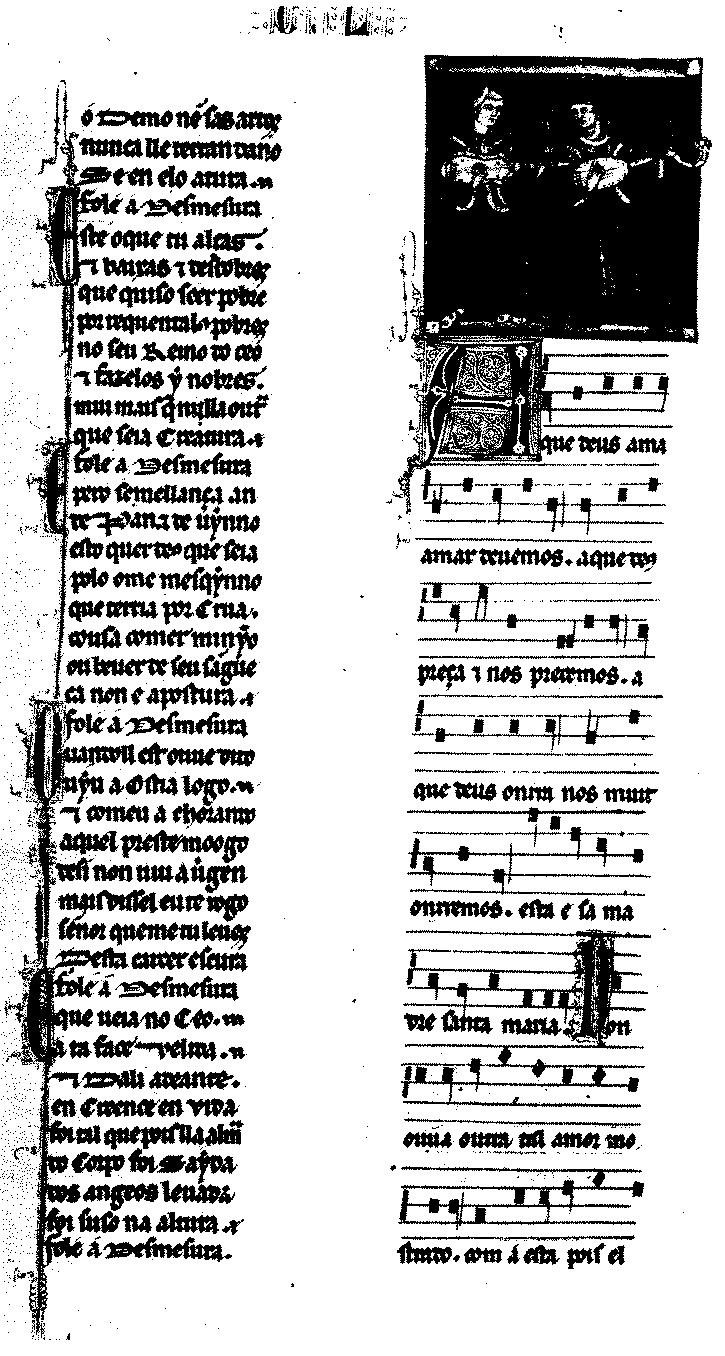
- 13th century, attributed to Alfonso X of Castile, Cantigas de Santa Maria, E codex, cantiga 149 (facsimile):
- eu te rogo / ſeñor que me tu leues Deſta carcer eſcura / E que ueia no Ceo a ta face velida.
- Lady, I beg you, please take me out of this dark prison and let me see your beautiful face in Heaven.
- eu te rogo / ſeñor que me tu leues Deſta carcer eſcura / E que ueia no Ceo a ta face velida.
- 13th century, attributed to Alfonso X of Castile, Cantigas de Santa Maria, E codex, cantiga 149 (facsimile):
Descendants
Polish
Etymology
From Proto-Slavic *tu.
Pronunciation
- IPA(key): /tu/
Audio (file)
Pronoun
tu
Synonyms
Further reading
- tu in Polish dictionaries at PWN
Portuguese
Pronunciation
Etymology 1
From Old Portuguese tu, from Latin tū (“you”), from Proto-Italic *tū, from Proto-Indo-European *túh₂ (“you”).
Pronoun
tu (second person singular, masculine possessive adjective teu, feminine possessive adjective tua)
- (informal in Portugal, literary, archaic or regional in Brazil) you; thou (singular second person pronoun)
Usage notes
- tu has fallen out of use in some regions of Brazil, including most of the Southeast and the Center-west, where “você” has taken its place. It’s still very commonly used in various regions of the country though, such as most of Santa Catarina and Rio Grande do Sul, parts of Paraná, Rio de Janeiro city and most of the Northeast and North regions. It should be noted that, in Rio de Janeiro, the pronoun is frequently employed interchangeably with você. Despite the media's preference for "você", the usage of "tu" seems to have been gaining ground throughout the last few decades in Rio (see , a linguistic research on the topic in Portuguese), being most frequent among youngsters.
- According to grammars, tu should always take second person singular verbs, as is the case in Portugal and some parts of Brazil. However, in many Brazilian dialects which employ tu, it now takes third person singular verbs, like você.
Synonyms
See also
| Portuguese personal pronouns (edit) | |||||||||||||
|---|---|---|---|---|---|---|---|---|---|---|---|---|---|
| Number | Person | Nominative (subject) |
Accusative (direct object) |
Dative (indirect object) |
Prepositional | Prepositional with com |
Non-declining | ||||||
| m | f | m | f | m and f | m | f | m | f | m | f | |||
| Singular | First | eu | me | mim | comigo | ||||||||
| Second | tu | te | ti | contigo | você | ||||||||
| o senhor | a senhora | ||||||||||||
| Third | ele | ela | o (lo, no) |
a (la, na) |
lhe | ele | ela | com ele | com ela | o mesmo | a mesma | ||
| se (reflexive) | si (reflexive) | consigo (reflexive) | |||||||||||
| Plural | First | nós | nos | nós | connosco (Portugal) conosco (Brazil) |
a gente | |||||||
| Second | vós | vos | vós | convosco | vocês | ||||||||
| os senhores | as senhoras | ||||||||||||
| Third | eles | elas | os (los, nos) |
as (las, nas) |
lhes | eles | elas | com eles | com elas | os mesmos | as mesmas | ||
| se (reflexive) | si (reflexive) | consigo (reflexive) | |||||||||||
| Indefinite | se (reflexive) | si (reflexive) | consigo (reflexive) | ||||||||||
Etymology 2
Interjection
tu
- (onomatopoeia) the sound produced by a telephone after one of the callers hangs up
Romani
Etymology
From Hindi तू (tū). Ultimately from Proto-Indo-European *túh₂.
Pronoun
tu (personal)
- you (singular)
Romanian
Etymology
From Latin tū, from Proto-Italic *tū, from Proto-Indo-European *túh₂.
Pronunciation
- IPA(key): /tu/
Pronoun
tu
Declension
Synonyms
- dumneata (semi-polite form)
- dumneavoastră (polite form)
See also
Scottish Gaelic
Etymology
Pronunciation
- IPA(key): /t̪u/
Pronoun
tu
- you (singular, informal)
Usage notes
- The more usual form today is thu, while tu is the form used in certain constructions, for instance in the conditional tense.
Synonyms
Derived terms
See also
Serbo-Croatian
Etymology
From Proto-Slavic *tu.
Adverb
tȗ (Cyrillic spelling ту̑)
Synonyms
- (Croatia) tuj
Related terms
Sicilian
Alternative forms
Etymology
Pronunciation
- IPA(key): /tu/
Pronoun
tu (second person singular)
Inflection
| nominative | tu |
|---|---|
| prepositional | tia |
| object, reflexive | ti |
Slovene
Pronunciation
- IPA(key): /ˈtú/
- Tonal orthography: tȕ
Adverb
tù
- here, in this place
Synonyms
South Slavey
Noun
tu
References
- Eung-Do Cook, Keren D. Rice, Athapaskan Linguistics: Current Perspectives on a Language Family (1989), page 247
Spanish
Etymology
From Latin tuus, from Proto-Indo-European *towos.
Pronunciation
- IPA(key): /tu/
- Homophones: tú (“you”)
- Rhymes: -u
Adjective
tu (second person singular possessive of singular, of plural tus)
Usage notes
The forms tu and tus are only used before and within the noun phrase of the modified noun. In other positions, a form of tuyo is used instead:
- Son tus libros. ― [They] are your books.
- Son los libros tuyos. ― [They] are your books.(“...the books of yours.”)
Synonyms
- (parts of Central and South America) su
Related terms
| possessor | preposed | postposed or standalone | |||||
|---|---|---|---|---|---|---|---|
| possessee | possessee | ||||||
| singular | plural | singular | plural | ||||
| masculine | feminine | masculine | feminine | ||||
| First person: | singular: | mi | mis | mío | mía | míos | mías |
| plural: | (same as postposed/standalone) | nuestro | nuestra | nuestros | nuestras | ||
| Second person (informal): |
singular: | tu | tus | tuyo | tuya | tuyos | tuyas |
| plural: | (same as postposed/standalone) | vuestro | vuestra | vuestros | vuestras | ||
| Third person: | su | sus | suyo | suya | suyos | suyas | |
See also
Sranan Tongo
Number
tu
Swahili
Adverb
tu
Prefix
tu
- Marks a verb's object as 1st person plural.
- ninatuona
- I see us
- ninatuona
Swedish
Pronunciation
- Rhymes: -ʉː
Numeral
tu
Synonyms
Related terms
- ett, tu, tre
- itu
- på tu man hand
Tanacross
Noun
tu
References
- Jeff Leer, Proto-Athabaskan verb stem variation (1979), page 83
Tejalapan Zapotec
Numeral
tu
References
- SIL Zapotec Basic Vocabulary, page 53
Timbe
Noun
tu
References
- Michael Foster, Timbe grammar sketch - cohesion in Timbe texts (1981, online 2009), page 10
Tocharian A
Etymology
From Proto-Tocharian [Term?], from Proto-Indo-European *túh₂. Cognate with Tocharian B tuwe.
Pronoun
tu
Tok Pisin
Etymology 1
Numeral
tu
Usage notes
Used when counting; see also tupela.
Etymology 2
Adverb
tu
- too; also; as well
- 1989, Buk Baibel long Tok Pisin, Bible Society of Papua New Guinea, Genesis 1:15 (translation here):
- God i mekim kamap tupela bikpela lait. Bikpela em san bilong givim lait long de, na liklik em mun bilong givim lait long nait. Na God i mekim kamap ol sta tu.
- 1989, Buk Baibel long Tok Pisin, Bible Society of Papua New Guinea, Genesis 1:15 (translation here):
Upper Kuskokwim
Noun
tu
References
- Raymond L. Collins, Betty Petruska, Dinak'i (our Words): Upper Kuskokwim Athabaskan Junior Dictionary (1979)
Vietnamese
Pronunciation
- (Hà Nội) IPA(key): [tu˧˧]
- (Huế) IPA(key): [tʊw˧˧]
- (Hồ Chí Minh City) IPA(key): [tʊw˧˧]
Verb
tu
- (intransitive) to isolate oneself from other people to follow rules in a philosophy or religion
- (transitive) to drink directly from a bottle by holding bottle mouth in one's mouth
Related terms
- nhà tu
- đi tu
Volapük
Etymology
Pronunciation
- IPA(key): /tu/
Adverb
tu
- (degree) too, excessively.
Derived terms
- tumödo
Welsh
Etymology
From Proto-Brythonic *tʉβ, from Proto-Celtic *toibos, whence also Old Irish táeb and Irish taobh. Cognate with Breton tu, Cornish tu.
Pronunciation
- (North Wales) IPA(key): /tɨː/
- (South Wales) IPA(key): /tiː/
- Homophone: tŷ; (South Wales) ti
Noun
tu m (uncountable)
Derived terms
- tu allan (“outside”)
- tu hwnt (“beyond”)
- tu mewn (“inside”)
- tu ôl (“behind”)
Preposition
tu
Mutation
| Welsh mutation | |||
|---|---|---|---|
| radical | soft | nasal | aspirate |
| tu | du | nhu | thu |
| Note: Some of these forms may be hypothetical. Not every possible mutated form of every word actually occurs. | |||
Further reading
- “tu”, in Geiriadur Prifysgol Cymru Online (in Welsh), University of Wales Centre for Advanced Welsh & Celtic Studies, 2014
Yale
Noun
tu
References
- Carl Campbell, Jody Campbell, Yale Grammar Essentials (1987), page 4