hem
English
Etymology 1
A sound uttered in imitation of clearing the throat (onomatopoeia)
Pronunciation
- IPA(key): /hɛm/
- (pin–pen merger) IPA(key): /hɪm/
Audio (US) (file) - Rhymes: -ɛm
- Homophone: him (pin-pen merger)
Interjection
hem
- Used to fill in the gap of a pause with a vocalized sound.
Noun
hem (plural hems)
- An utterance or sound of the voice like "hem", often indicative of hesitation or doubt, sometimes used to call attention.
- Spectator
- his morning hems
- Spectator
Verb
hem (third-person singular simple present hems, present participle hemming, simple past and past participle hemmed)
- To make the sound expressed by the word hem; to hesitate in speaking.
- Shakespeare
- Hem, and stroke thy beard.
- Shakespeare
Derived terms
Translations
See also
Etymology 2
From Middle English hem, hemm, in turn from Old English hemm and related to Middle High German hemmen (“to hem in”), Old Norse hemja (“to hem in, restrain”). The Proto-Indo-European root gave rise also to Armenian քամել (kʿamel, “to press, wring”) and Russian ком (kom, “lump”).
The verb is from Middle English hemmen, from Old English *hemman, from Proto-Germanic *hamjaną, or alternatively derived from the noun.
Noun
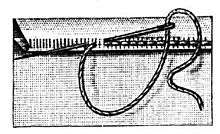
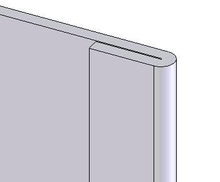
hem (plural hems)
- (sewing) The border of an article of clothing doubled back and stitched together to finish the edge and prevent it from fraying.
- A rim or margin of something.
- Shakespeare
- hem of the sea
- Shakespeare
- In sheet metal design, a rim or edge folded back on itself to create a smooth edge and to increase strength or rigidity.
Derived terms
Translations
|
|
Verb
hem (third-person singular simple present hems, present participle hemming, simple past and past participle hemmed)
- (intransitive) (in sewing) To make a hem.
- (transitive): To put hem on an article of clothing, to edge or put a border on something.
- (transitive): To surround something or someone in a confining way.
Translations
Derived terms
Etymology 3
From Middle English hem, from Old English heom (“them”, dative), originally a dative plural form but in Middle English coming to serve as an accusative plural as well. More at 'em.
Pronoun
hem
- Obsolete form of 'em.
- William Caxton (1481)
- And wente to the kinge and to the queene, and said to hem with a glad cheer.
- William Caxton (1485)
- For eyther of hem mayntened.
- Nisbet, M (1520-1535)
- He prayis hem to lyue releg[ious] lyff[is] and to luk waraly for the cummyng of the lord.
- John Florio (1578)
- ‘What thinke you of this English, tel me I pray you.’ ‘It is a language that wyl do you good in England but passe Dover, it is woorth nothing.’ ‘Is it not used then in other countreyes?’ ‘No sir, with whom wyl you that they speake?’ ‘With English marchants.’ ‘English marchantes, when they are out of England, it liketh hem not, and they doo not speake it.
- Edmund Spenser (1579)
- Tho to the greene wood they speeden hem all.
- Ben Jonson (1598)
- Except we make hem such.
- John Marston (1605)
- They go forth on Holydays and gather hem by the seashore.
- Andrew Marvell (1661)
- The mayor and alderman or any six of hem.
- William Caxton (1481)
Anagrams
Bislama
Alternative forms
Etymology
From English him
Pronoun
hem
Catalan
Verb
hem
- first-person plural present indicative form of haver
Dutch
Etymology
From Middle Dutch hem, from Old Dutch himo, from Proto-Germanic *himmai.
Pronunciation
- IPA(key): /ɦɛm/
Audio (file)
Pronoun
hem
- (personal) Third-person singular, masculine, objective: him.
- Stuur dat maar naar hem.
- Send that to him.
- (personal) The tagger in a game of tag: it.
Inflection
| subject | object | possessive | reflexive | genitive5 | |||||
|---|---|---|---|---|---|---|---|---|---|
| singular | full | unstr. | full | unstr. | full | unstr. | pred. | ||
| 1st person | ik | 'k1 | mij | me | mijn | m'n1 | mijne | me | mijner |
| 2nd person | jij | je | jou | je | jouw | je | jouwe | je | jouwer |
| 2nd person archaic or regiolectal | gij | ge | u | – | uw | – | uwe | u | uwer |
| 2nd person formal | u | – | u | – | uw | – | uwe | zich | uwer |
| 3rd person masculine | hij | ie1 | hem | 'm1 | zijn | z'n1 | zijne | zich | zijner |
| 3rd person feminine | zij | ze | haar | h'r1, 'r1, d'r1 | haar | h'r1, 'r1, d'r1 | hare | zich | harer |
| 3rd person neuter | het | 't1 | het | 't1 | zijn | z'n1 | zijne | zich | zijner |
| plural | |||||||||
| 1st person | wij | we | ons | – | ons, onze2 | – | onze | ons | onzer |
| 2nd person | jullie | je | jullie | je | jullie | je | – | je | – |
| 2nd person archaic or regiolectal6 | gij | ge | u | – | uw | – | uwe | u | uwer |
| 2nd person formal | u | – | u | – | uw | – | uwe | zich | uwer |
| 3rd person | zij | ze | hen3, hun4 | ze | hun | – | hunne | zich | hunner |
| 1) Not as common in written language. 2) Inflected as an adjective. 3) In prescriptivist use, used only as direct object (accusative). 4) In prescriptivist use, used only as indirect object (dative). |
5) Archaic. Nowadays used for formal, literary or poetic purposes, and in fixed expressions. 6) To differentiate from the singular gij, and in a similar vein to "you lot" or "you guys" in English, it is common to use gijlui ("you people") or gijlieden ("you people") or one of their contracted variants, and their corresponding objects, possessives and reflexives, in the plural. | ||||||||
Icelandic
Verb
hem (weak)
Kurdish
Conjunction
hem
See also
- herwiha
- û
Latin
Pronunciation
- (Classical) IPA(key): /hem/, [hẽ]
Interjection
hem
Related terms
References
- hem in Charlton T. Lewis and Charles Short (1879) A Latin Dictionary, Oxford: Clarendon Press
- hem in Charlton T. Lewis (1891) An Elementary Latin Dictionary, New York: Harper & Brothers
Middle Dutch
Etymology 1
From Old Dutch himo, from Proto-Germanic *himmai.
Pronoun
hem
Etymology 2
From Old Dutch hin, from Proto-Germanic *himaz.
Pronoun
hem
- inflection of si (“they”):
- accusative
- dative
Middle English
Alternative forms
Etymology 1
From Old English heom, from Proto-Germanic *himaz, masculine and neuter dative plural of *hiz.
Pronoun
hem (nominative he)
- Third-person plural accusative pronoun: them.
- 14th c. Geoffrey Chaucer, The Canterbury Tales. General Prologue: 9–11.
- And smale foweles maken melodye,
- That slepen al the nyght with open eye-
- (So priketh hem Nature in hir corages);
- And many little birds make melody
- That sleep through all the night with open eye
- (So Nature pricks them on to ramp and rage)
- 1407, The Testimony of William Thorpe, pages 40–41
- And with alle these men I was ofte homli and I comownede with hem long tyme and fele, and so bifore alle othir men I chees wilfulli to be enformed bi hem and of hem, and speciali of Wiclef himsilf, as of the moost vertuous and goodlich wise man that I herde of owhere either knew.
- 14th c. Geoffrey Chaucer, The Canterbury Tales. General Prologue: 9–11.
- (reflexive) themselves.
Descendants
See also
References
- “hem, (pron.)” in MED Online, Ann Arbor, Mich.: University of Michigan, 2007, retrieved 12 June 2018.
Etymology 2
Pronoun
hem
- Alternative form of him
References
- “him, (pron.)” in MED Online, Ann Arbor, Mich.: University of Michigan, 2007, retrieved 6 May 2018.
Norwegian Bokmål
Verb
hem
- imperative of hemme
Pijin
Alternative forms
Etymology
Pronoun
hem
See also
Portuguese
Interjection
hem
- Rare form of hein.
Swedish
Etymology
From Old Norse heim < heimr, from Proto-Germanic *haimaz.
Pronunciation
audio (file)
Adverb
hem
- home; to one's home
- Det är dags att gå hem.
- It is time to go home.
Noun
hem n
- a home; one's dwelling place, as in a house or a more general geographical place; the abiding place of the affections.
- a home; an institution
Declension
| Declension of hem | ||||
|---|---|---|---|---|
| Singular | Plural | |||
| Indefinite | Definite | Indefinite | Definite | |
| Nominative | hem | hemmet | hem | hemmen |
| Genitive | hems | hemmets | hems | hemmens |
Related terms
|
|
|
|
|
|
References
- hem in Svenska Akademiens Ordlista över svenska språket (13th ed., online)
Turkish
Etymology
Pronunciation
- IPA(key): /hem/
Adverb
hem
Conjunction
hem