ek
Afrikaans
Etymology
From Dutch ik, from Proto-Germanic *ek, from Proto-Indo-European *éǵh₂om (“I”).
Pronunciation
- IPA(key): /ɛk/
Pronoun
- I (subject)
See also
| subjective | objective | possessive | ||||
|---|---|---|---|---|---|---|
| singular | 1st | ek | my | |||
| 2nd | jy | jou | ||||
| 2nd, formal | u | |||||
| 3rd, masc | hy | hom | sy | |||
| 3rd, fem | sy | haar | ||||
| 3rd, neut | dit | sy | ||||
| plural | 1st | ons | ||||
| 2nd | julle | julle / jul1 | ||||
| 3rd | hulle | hulle / hul1 | ||||
| 1. In the second and third persons plural, the usual possessive forms are julle and hulle (like the subjective and objective forms), but jul and hul are sometimes used instead when the sentence would otherwise be ambiguous. | ||||||
Esperanto
Etymology
From ek-.
Interjection
ek
Fiji Hindi
Etymology
From Hindi एक (ek), from Sanskrit एक (éka) (or a closely related Old-Indo-Aryan language, through Prakrit), from Proto-Indo-Iranian *Haykas (compare Persian یک (yek)), from Proto-Indo-European *(H)óykos (“one, single”).
Numeral
ek
References
- Fiji Hindi Dictionary
- Siegel, Jeff (1977) Say it in Fiji Hindi, Australia: Pacific Publications, →ISBN, page 28
Icelandic
Etymology 1
From Old Norse ek, from Proto-Norse ᛖᚲ (ek), from Proto-Germanic *ek, from Proto-Indo-European *éǵh₂.
Alternative forms
Pronoun
ek
- (archaic) I
Declension
| Icelandic personal pronouns | ||||||
| singular | first person | second person | third person masculine | third person feminine | third person neuter | |
| nominative | ég, eg†, ek† | þú | hann | hún, hon†, hón† | það, þat† | |
| accusative | mig, mik† | þig, þik† | hann | hana | það, þat† | |
| dative | mér | þér | honum, hánum† | henni | því | |
| genitive | mín | þín | hans | hennar | þess | |
| plural | first person | second person | third person masculine | third person feminine | third person neuter | |
| nominative | við | þið, þit† | þeir | þær | þau | |
| accusative | okkur | ykkur | þá | þær | þau | |
| dative | okkur | ykkur | þeim | þeim | þeim | |
| genitive | okkar | ykkar | þeirra | þeirra | þeirra | |
Etymology 2
Inflected form of aka (“to drive”).
Verb
ek
- first-person singular active present indicative of aka
Ido
Etymology
Borrowed from Ancient Greek ἐκ (ek). Also seen as a borrowing from Latin ex, with the x changed to just k so not to interfere with ex-, which shares the same origin.
Pronunciation
- IPA(key): /ɛk/
Preposition
ek
- (general sense) out
- (indicating motion) out, out of, out from, from
- Adportez stulo ek ta chambro ― Bring a chair out of that room.
- Lu prenis ca folio ek la tir-kesto ― He took this leaf from the drawer.
- (of materials) of, made from, made of
- Ek quo esas ta tasi? ― What are the cups made of?
- Li esas ek porcelano. ― They are made of china.
- (mathematics) (indication fractional parts) out of
- Nonadek ek cent. ― Ninety out of a hundred (90%).
- En ca armeo, 5 ek 100 esas ocidita, 10 ek 100 vundita.
- In this army, five out of (every) 100 were killed, and ten per cent were wounded.
Derived terms
Related terms
Kalasha
Etymology
From Sanskrit एक (eka), from Proto-Indo-Iranian *Háykas. Compare Hindi, Konkani, Nepali and Marathi एक (ek).
Numeral
ek
Marshallese
Pronunciation
- MED phonemes: {yẹk}
- IPA(key): /jɘk/, [e̯e͡ɤk]
Noun
ek
- fish.
References
Middle English
Alternative forms
Etymology
From Old English ēac, from Proto-Germanic *auk.
Adverb
ek
Related terms
Descendants
Middle Low German
Pronunciation
- IPA(key): /ɛk/, /ek/
Pronoun
ek
- Alternative form of ik.
North Frisian
Etymology
From Old Norse ekki. Cognate with Danish ikke, Faroese ikki, Norwegian Nynorsk ikkje.
Adverb
ek
- (Sylt) not
- "Di rocht Saaken ken di Oogen ek se", sair di Litji Prins, fuar höm dit tö morki.
- "The important things can't be seen with the eyes," said the Little Prince, so he would remember this.
Novial
Preposition
ek
Old Frisian
Noun
ēk f
References
- Köbler, Gerhard, Altfriesisches Wörterbuch, (6. Auflage) 2014
Old Norse
Alternative forms
Etymology
From Proto-Norse ᛖᚲ (ek), from Proto-Germanic *ek, from Proto-Indo-European *éǵh₂.
Pronoun
ek
- I (first-person singular pronoun)
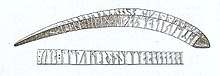
- 150–350, inscription on the Lindholm amulet:
- ᛖᚳᛖᚱᛁᛚᚨᛉᛋᚨᚹᛁᛚᚨᚷᚨᛉᚺᚨᛏᛖᚳᚨ
- ek erilaz sa[w]ilagaz hateka
- I [am an] earl, Sawilagaz hight I
- ek erilaz sa[w]ilagaz hateka
- ᛖᚳᛖᚱᛁᛚᚨᛉᛋᚨᚹᛁᛚᚨᚷᚨᛉᚺᚨᛏᛖᚳᚨ
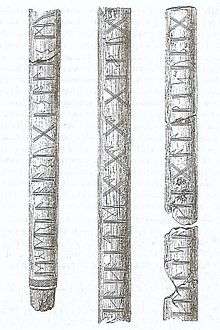
- 200–475, inscription on the Kragehul I spear-shaft:
- ᛖᚳᛖ⁀ᚱᛁᛚᚨ⁀ᛉ...
- ek e⁀rila⁀z asugisalas m⁀uh⁀a h⁀aite […]
- I, earl of Asugisalaz, hight Muha, […]
- ek e⁀rila⁀z asugisalas m⁀uh⁀a h⁀aite […]
- ᛖᚳᛖ⁀ᚱᛁᛚᚨ⁀ᛉ...
- circa 1000, Vǫluspá, verse 1, line 1:
- Hliods bið ec allar... (Codex Regius, circa 1270)
- Hlioðs bið ek allar... (Hauksbók, circa 1306)
- Hljóðs bið ek allar... (normalised orthography)
- For silence I ask all...
- 1220-1240, Egils saga, chapter 3, line 16:
- "Þótt þetta vandræði hafi nú borit oss at hendi, þá mun eigi langt til, at sama vandræði mun til yðvar koma, því at Haraldr, ætla ek, at skjótt mun hér koma, þá er hann hefir alla menn þrælkat ok áþját, sem hann vill, á Norðmæri ok í Raumsdal." (Norse)
- translation by William Charles Green:
- Though this danger now touches us, before long the same will come to you; for Harold, as I ween, will hasten hither when he has enthralled and oppressed after his will all in North Mæra and Raumsdale.
- translation by Hallvard Lie:
- Though this trouble have now lighted on our hand, 'twill not be long ere the same trouble shall come upon you; for Harald, I ween, will shortly hither come, soon as he hath all men thralled and enslaved, according to this will, in Northmere and Raumsdale.
- translation by William Charles Green:
- "Þótt þetta vandræði hafi nú borit oss at hendi, þá mun eigi langt til, at sama vandræði mun til yðvar koma, því at Haraldr, ætla ek, at skjótt mun hér koma, þá er hann hefir alla menn þrælkat ok áþját, sem hann vill, á Norðmæri ok í Raumsdal." (Norse)
- 150–350, inscription on the Lindholm amulet:
Declension
| number | first person | second person | reflexive | third person | ||
|---|---|---|---|---|---|---|
| case | singular | singular masculine | singular feminine | singular neuter | ||
| nominative | ek | þú | hann | hon, hón | þat | |
| accusative | mik | þik | sik | hann | hana, hána | þat |
| dative | mér | þér | sér | hánum, honum, hónum | henni | því |
| genitive | mín | þín | sín | hans | hennar | þess |
| case | dual | |||||
| nominative | vit | it, þit | ||||
| accusative | okr, okkr | ykr, ykkr | sik | |||
| dative | okr, okkr | ykr, ykkr | sér | |||
| genitive | okkar | ykkar | sín | |||
| case | plural | plural masculine | plural feminine | plural neuter | ||
| nominative | vér | ér, þér | þeir | þær | þau | |
| accusative | oss | yðr | sik | þá | þær | þau |
| dative | oss | yðr | sér | þeim | þeim | þeim |
| genitive | vár | yðar, yðvar | sín | þeirra | þeirra | þeirra |
Descendants
References
- ek in Geir T. Zoëga (1910) A Concise Dictionary of Old Icelandic, Oxford: Clarendon Press
Old Saxon
Etymology
From Proto-Germanic *aiks.
Pronunciation
- IPA(key): /ˈɛːk/
Noun
ēk f
Declension
Descendants
Rohingya
| < 0 | 1 | 2 > |
|---|---|---|
| Cardinal : ek | ||
Etymology
Numeral
ek
Swedish
Etymology
From Old Norse eik, from Proto-Germanic *aiks, from Proto-Indo-European *h₂eyǵ- (“oak”).
Pronunciation
audio (file)
Noun
ek c
Declension
| Declension of ek | ||||
|---|---|---|---|---|
| Singular | Plural | |||
| Indefinite | Definite | Indefinite | Definite | |
| Nominative | ek | eken | ekar | ekarna |
| Genitive | eks | ekens | ekars | ekarnas |
Tocharian B
Etymology
From Proto-Tocharian *ëk, from Late Proto-Indo-European *okʷs, from *h₃okʷ-, *h₃ekʷ- (“eye; to see”). Compare Tocharian A ak.
Noun
ek
- eye
- eśane klausane ṣeycer-me kartstse yolo lkātsi klyaussisa
- "you had eyes and ears to see and hear good and evil"
Turkish
Noun
ek (definite accusative eki, plural ekler)
Declension
| Inflection | ||||||||||||||||||||||||||
|---|---|---|---|---|---|---|---|---|---|---|---|---|---|---|---|---|---|---|---|---|---|---|---|---|---|---|
| Nominative | ek | |||||||||||||||||||||||||
| Definite accusative | eki | |||||||||||||||||||||||||
| Singular | Plural | |||||||||||||||||||||||||
| Nominative | ek | ekler | ||||||||||||||||||||||||
| Definite accusative | eki | ekleri | ||||||||||||||||||||||||
| Dative | eke | eklere | ||||||||||||||||||||||||
| Locative | ekte | eklerde | ||||||||||||||||||||||||
| Ablative | ekten | eklerden | ||||||||||||||||||||||||
| Genitive | ekin | eklerin | ||||||||||||||||||||||||
| ||||||||||||||||||||||||||
| ||||||||||||||||||||||||||
Hyponyms
Verb
ek
- second-person singular imperative of ekmek
Volapük
Pronoun
ek
Declension
West Frisian
Etymology
From Old Frisian āk, from Proto-Germanic *auk. Compare Middle English eek (archaic English eke), Dutch ook, German auch.
Adverb
ek