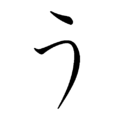
う
 | ||||||||
Japanese
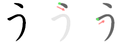
| Stroke order | |||
|---|---|---|---|
 | |||
Pronunciation
- IPA(key): [ɯ̟ᵝ]
-
Audio (file)
Etymology 1
Derived in the Heian period from writing the man'yōgana kanji 宇 in the cursive sōsho style.
Syllable
う (romaji u)
- The hiragana syllable う (u). Its equivalent in katakana is ウ (u). It is the third syllable in the gojūon order; its position is あ行う段 (a-gyō u-dan, “row a, section u”).
See also
Etymology 2
Kana spelling of various words.
Noun
う (rōmaji u)
Etymology 3
From the older auxiliary verb む.
Verb
う (rōmaji u)
- (auxiliary) Expressing one's will to do something.
- そろそろ帰ろう。
- Sorosoro kaerō.
- I'll return before long.
- 手伝おうか。
- Tetsudaō ka.
- Shall I help?
- 誕生日ケーキを作ろうと思っています。
- Tanjōbi kēki o tsukurō to omotte imasu.
- I'm thinking about baking a birthday cake.
- 誕生日ケーキを作ろうとしています。
- Tanjōbi kēki o tsukurō to shite imasu.
- I'm trying to bake a birthday cake.
- そろそろ帰ろう。
- (auxiliary) Inducing or stimulating other person to do something.
- 明日一緒に学校に行こう。
- Ashita issho ni gakkō ni ikō.
- Let's go to school together tomorrow.
- 明日一緒に学校に行こう。
- (auxiliary, archaic) Presenting a supposition.
- そんなことはなかろう。
- Sonna koto wa nakarō.
- There's probably no such thing.
- そんなことはなかろう。
Usage notes
Synonyms
- (supposition): だろう (darō)
This article is issued from
Wiktionary.
The text is licensed under Creative Commons - Attribution - Sharealike.
Additional terms may apply for the media files.