ie
See also: Appendix:Variations of "ie"
English
Abbreviation
ie
- See i.e.
Anagrams
Acehnese
Etymology
Compare Indonesian air (“water”).
Noun
ie
- water
- ie bit — real water
References
- Mark Durie, A Grammar of Acehnese: On the Basis of a Dialect of North Aceh (1985)
Aromanian
Interjection
ie
Antonyms
Dutch
Etymology 1
Likely from earlier Middle Dutch hi.
Pronunciation
- IPA(key): /i/
-
Audio (file)
Pronoun
ie
Usage notes
Generally, this form is not used in Flanders, and in the Netherlands it is largely restricted to spoken language.
Inflection
Dutch personal pronouns
| subject | object | possessive | reflexive | genitive5 | |||||
|---|---|---|---|---|---|---|---|---|---|
| singular | full | unstr. | full | unstr. | full | unstr. | pred. | ||
| 1st person | ik | 'k1 | mij | me | mijn | m'n1 | mijne | me | mijner |
| 2nd person | jij | je | jou | je | jouw | je | jouwe | je | jouwer |
| 2nd person archaic or regiolectal | gij | ge | u | – | uw | – | uwe | u | uwer |
| 2nd person formal | u | – | u | – | uw | – | uwe | zich | uwer |
| 3rd person masculine | hij | ie1 | hem | 'm1 | zijn | z'n1 | zijne | zich | zijner |
| 3rd person feminine | zij | ze | haar | h'r1, 'r1, d'r1 | haar | h'r1, 'r1, d'r1 | hare | zich | harer |
| 3rd person neuter | het | 't1 | het | 't1 | zijn | z'n1 | zijne | zich | zijner |
| plural | |||||||||
| 1st person | wij | we | ons | – | ons, onze2 | – | onze | ons | onzer |
| 2nd person | jullie | je | jullie | je | jullie | je | – | je | – |
| 2nd person archaic or regiolectal6 | gij | ge | u | – | uw | – | uwe | u | uwer |
| 2nd person formal | u | – | u | – | uw | – | uwe | zich | uwer |
| 3rd person | zij | ze | hen3, hun4 | ze | hun | – | hunne | zich | hunner |
| 1) Not as common in written language. 2) Inflected as an adjective. 3) In prescriptivist use, used only as direct object (accusative). 4) In prescriptivist use, used only as indirect object (dative). |
5) Archaic. Nowadays used for formal, literary or poetic purposes, and in fixed expressions. 6) To differentiate from the singular gij, and in a similar vein to "you lot" or "you guys" in English, it is common to use gijlui ("you people") or gijlieden ("you people") or one of their contracted variants, and their corresponding objects, possessives and reflexives, in the plural. | ||||||||
Etymology 2
Adverb
ie
- (obsolete) always, every time, continuously
- (obsolete) ever, sometime, at some point
Usage notes
Was entirely replaced by words like altijd ("always, every time") and ooit ("ever, sometime, at some point") by the late 16th century.
Anagrams
Esperanto
Etymology
From i- (indeterminate correlative prefix) + -e (correlative suffix of place).
Pronunciation
-
Audio (file)
Adverb
ie (accusative ien)
- somewhere (indeterminate correlative of place)
Derived terms
Japanese
Romanization
ie
Ladin
Verb
ie
Middle French
Alternative forms
Pronoun
ie
- I (first-person singular subject pronoun)
See also
Old Occitan
Pronoun
ie
- Alternative form of eu
Romanian
Alternative forms
- iie (nonstandard)
Pronunciation
- IPA(key): /ˈije/
Etymology 1
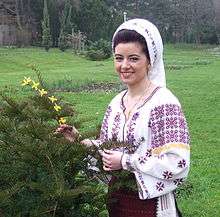
Woman wearing a ie
From Latin (vestis) līnea. Doublet of linie, a later borrowing.
Noun
ie f (plural ii)
- traditional Romanian embroidered blouse
Declension
See also
Etymology 2
From Latin īlia, plural of īle.
Noun
ie f (plural ii) (rare, archaic)
- the lower part of the abdomen or belly, especially in animals such as livestock
- the skin that hangs down from the belly of an ox
- the pastern on a horse
- guts, bowels, or entrails
Declension
Synonyms
See also
Welsh
Adverb
ie
This article is issued from
Wiktionary.
The text is licensed under Creative Commons - Attribution - Sharealike.
Additional terms may apply for the media files.