hare
English
Pronunciation
- IPA(key): /hɛɚ/, /heɹ/, /heə/
Audio (US) (file) - Homophone: hair
Etymology 1
From Middle English hare, from Old English hara (“hare”), from Proto-Germanic *hasô (compare West Frisian hazze, Dutch haas, German Hase, Norwegian and Swedish hare, Icelandic heri), from Proto-Germanic *haswaz (“grey”) (compare Old English hasu, Middle High German heswe (“pale, dull”)), from Proto-Indo-European *ḱh₂s-én- (compare Welsh cannu (“to whiten”), ceinach (“hare”), Latin cānus (“white”), cascus (“old”), Old Prussian sasnis (“hare”), Pashto سوی (soe, “hare”) and Sanskrit शश (śaśa, “hare”)).
Noun
hare (plural hares)
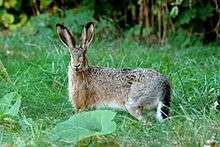
- Any of several plant-eating animals of the family Leporidae, especially of the genus Lepus, similar to a rabbit, but larger and with longer ears.
- The player in a paperchase, or hare and hounds game, who leaves a trail of paper to be followed.
Derived terms
Translations
|
|
Verb
hare (third-person singular simple present hares, present participle haring, simple past and past participle hared)
- (intransitive) To move swiftly.
Synonyms
See also
- form (hare's home)
- leveret (young hare)
- jackrabbit (type of hare)
Etymology 2
From Middle English harren, harien (“to drag by force, ill-treat”), of uncertain origin. Compare harry, harass.
Alternative forms
Verb
hare (third-person singular simple present hares, present participle haring, simple past and past participle hared)
- (obsolete) To excite; to tease, or worry; to harry.
- John Locke, Some Thoughts Concerning Education.
- To hare and rate them thus at every turn, is not to teach them, but to vex, and torment them to no purpoſe.
- John Locke, Some Thoughts Concerning Education.
Etymology 3
From Middle English hore, from Old English hār (“hoar, hoary, grey, old”), from Proto-Germanic *hairaz (“grey”). Cognate with German hehr (“noble, sublime”).
Alternative forms
Adjective
hare
References
Anagrams
Afrikaans
Etymology
Pronoun
hare
- hers (that or those of her)
- Sy het my hemp aangehad en ek hare.
- She wore my shirt and I wore hers.
- Sy het my hemp aangehad en ek hare.
Danish
Etymology
Pronunciation
- IPA(key): /haːrə/, [ˈhɑːɑ]
Noun
hare c (singular definite haren, plural indefinite harer)
Inflection
See also

Dutch
Etymology
From Middle Dutch hare. This etymology is incomplete. You can help Wiktionary by elaborating on the origins of this term.
Pronunciation
- IPA(key): /ˈɦaː.rə/
Audio (file) - Hyphenation: ha‧re
- Rhymes: -aːrə
Determiner
hare
- non-attributive form of haar (English: hers)
- Normally used in conjunction with the definite article de or het depending on the gender of what is being referred to.
- Die auto is de hare. — That car is her one. That car is hers.
- Dat huis is het hare. — That house is her one. That house is hers.
- Dat is de/het hare. — That is her one. That is hers.
- Normally used in conjunction with the definite article de or het depending on the gender of what is being referred to.
- (archaic) inflected form of haar
Derived terms
Japanese
Romanization
hare
Middle Dutch
Determiner
hāre
- inflection of hāer:
- feminine nominative and accusative singular
- nominative and accusative plural
Middle English
Etymology 1
Determiner
hare
- Alternative form of hire
Pronoun
hare
- Alternative form of hire
References
- “hir, (pron.1)” in MED Online, Ann Arbor, Mich.: University of Michigan, 2007, retrieved 10 May 2018.
Etymology 2
Pronoun
hare
- Alternative form of hire
References
- “hir(e), pron (2)” in MED Online, Ann Arbor, Mich.: University of Michigan, 2007, retrieved 10 June 2018.
Etymology 3
From Old English hēr.
Noun
hare
- Alternative form of her (“hair”)
Etymology 4
Determiner
hare
- (chiefly West Midland and Kentish dialectal) Alternative form of here (“their”)
References
- “her(e (pron.)” in MED Online, Ann Arbor, Mich.: University of Michigan, 2007, retrieved 12 June 2018.
Norwegian Bokmål
Etymology
From Old Norse *heri, from Proto-Germanic *háswa-. Compare with German Hase, Swedish hare.
Pronunciation
Noun
hare m (definite singular haren, indefinite plural harer, definite plural harene)
- a hare
References
- “hare” in The Bokmål Dictionary.
Norwegian Nynorsk
Etymology
From Old Norse *heri, from Proto-Germanic *háswa-. Akin to English hare.
Pronunciation
Noun
hare m (definite singular haren, indefinite plural harar, definite plural harane)
- a mountain hare, Lepus timidus
- a hare, a small animal of the genus Lepus
References
- “hare” in The Nynorsk Dictionary.
Rapa Nui
Etymology
From Proto-Polynesian *fale.
Noun
hare
Derived terms
Swedish
Etymology
From Old Swedish hari, hæri, from Old Norse *hari, heri, from Proto-Germanic *hasô.
Pronunciation
audio (file)
Noun
hare c
Declension
| Declension of hare | ||||
|---|---|---|---|---|
| Singular | Plural | |||
| Indefinite | Definite | Indefinite | Definite | |
| Nominative | hare | haren | harar | hararna |
| Genitive | hares | harens | harars | hararnas |
Tetum
Noun
hare
- unpicked rice