thee
English
Etymology 1
From Middle English thee, the, from Old English þē (“thee”, originally dative, but later also accusative), from Proto-Germanic *þiz (“thee”), from Proto-Indo-European *te (“second-person singular pronoun”). Cognate with German Low German di (“thee”), German dir (“thee”, dative pron.), Icelandic þér (“thee”). More at thou.
Pronunciation
- enPR: thē, IPA(key): /ðiː/
Audio (US) (file) - Rhymes: -iː
- Homophone: the (when stressed)
Pronoun
thee (second-person singular, objective case, nominative thou, reflexive thyself)
- (archaic, literary) Objective case of thou.
- 1598, Shakespeare, Henry IV part 1, 1.2.49-50:
- Prince Henry: Did I ever call for thee to pay thy part?
- Falstaff: No; I'll give thee thy due, thou hast paid all there.
- 1742, Charles Wesley (music), “Come, O Thou Traveler Unknown”:
- Come, O thou Traveller unknown, / Whom still I hold, but cannot see! / My company before is gone, / And I am left alone with Thee; / With Thee all night I mean to stay, / And wrestle till the break of day.
- 1598, Shakespeare, Henry IV part 1, 1.2.49-50:
- (Quaker, Amish, Pennsylvania Dutch English, West Country) Thou.
- Thee is a little strange, I think.
Usage notes
When used in place of the nominative thou, thee uses the third-person singular form of verbs (see example above).
Derived terms
Translations
|
Verb
thee (third-person singular simple present thees, present participle theeing, simple past and past participle theed)
- (transitive) To address (somebody) as "thee"; to thou.
See also
| personal pronoun | possessive pronoun | possessive determiner | |||||
|---|---|---|---|---|---|---|---|
| subjective | objective | reflexive | |||||
| first person | singular | I | me | myself | mine | my mine (before vowels, archaic) | |
| plural | we | us | ourselves ourself | ours | our | ||
| second person | singular | standard | you | you | yourself | yours yourn (obsolete outside dialects) | your |
| archaic, informal | thou | thee | thyself theeself | thine | thy thine (before vowels) | ||
| plural | standard | you you all ye (archaic) | you you all | yourselves | yours yourn (obsolete outside dialects) | your | |
| informal / dialectal | (see list of dialectal forms at you and inflected forms in those entries) | ||||||
| third person | singular | masculine | he | him | himself hisself (archaic) | his hisn (obsolete outside dialects) | his |
| feminine | she | her | herself | hers hern (obsolete outside dialects) | her | ||
| neuter | it | it | itself | its his (archaic) | its his (archaic) | ||
| genderless | they | them | themself, themselves | theirs | their | ||
| genderless, nonspecific (formal) |
one | one | oneself | – | one's | ||
| plural | they | them | themselves | theirs theirn (obsolete outside dialects) | their | ||
Etymology 2
From Middle English theen (“to increase, prosper, flourish”), from Old English þēon (“to thrive, prosper, flourish, grow”), from Proto-Germanic *þinhaną (“to thrive, succeed”), from Proto-Indo-European *tenk-, *tenkh- (“to succeed, turn out well”). Cognate with Dutch gedijen (“to flourish, thrive, prosper, succeed”), German gedeihen (“to thrive”), Gothic 𐌲𐌰𐌸𐌴𐌹𐌷𐌰𐌽 (gaþeihan, “to increase, thrive”).
Pronunciation
- enPR: thē, IPA(key): /θiː/
- Rhymes: -iː
Alternative forms
- the (Scotland)
Verb
thee (third-person singular simple present thees, present participle theeing, simple past and past participle theed)
- (intransitive, Britain, obsolete) To thrive; prosper.
- Spenser
- Well mote thee, as well can wish your thought.
- Spenser
Derived terms
Etymology 3
From Pitman zee, which it is related to phonetically and graphically, and the sound it represents.
Noun
thee (plural thees)
- The letter ⟨(⟩, which stands for the th sound /ð/ in Pitman shorthand.
Related terms
Anagrams
Acehnese
Etymology
From Proto-Chamic *thɔw, from Proto-Malayo-Chamic, from Proto-Malayo-Sumbawan, from Proto-Sunda-Sulawesi, from Proto-Malayo-Polynesian *taqu, from Proto-Austronesian *Caqu.
Verb
thee
- to be informed
Dutch
Etymology
Borrowing from Min Nan 茶 (tê) through Malay teh. The "-h-" is a faux-Greek spelling (compare Greek τσάι (tsái)).
Pronunciation
Audio (file) - Rhymes: -eː
- IPA(key): /teː/
Noun
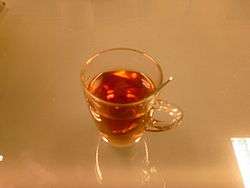
Filled tea glass
thee m (plural theeën, diminutive theetje n)
Derived terms
Anagrams
Middle English
Pronoun
thee
- Alternative form of þe.
References
- “the, (pron.2)” in MED Online, Ann Arbor, Mich.: University of Michigan, 2007, retrieved 5 May 2018.
Old Irish
Adjective
thee
Scots
Etymology
From Old English þēoh, from Proto-Germanic *þeuhą, ultimately from Proto-Indo-European *tewk-.
Pronunciation
- IPA(key): /θiː/
Noun
thee (plural thees)