風
| ||||||||
Translingual
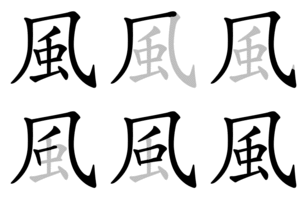
| Stroke order | |||
|---|---|---|---|
 | |||
Han character
風 (radical 182, 風+0, 9 strokes, cangjie input 竹弓竹中戈 (HNHLI) or 竹弓一中戈 (HNMLI), four-corner 77210, composition ⿵𠘨䖝)
Derived characters
Descendants
References
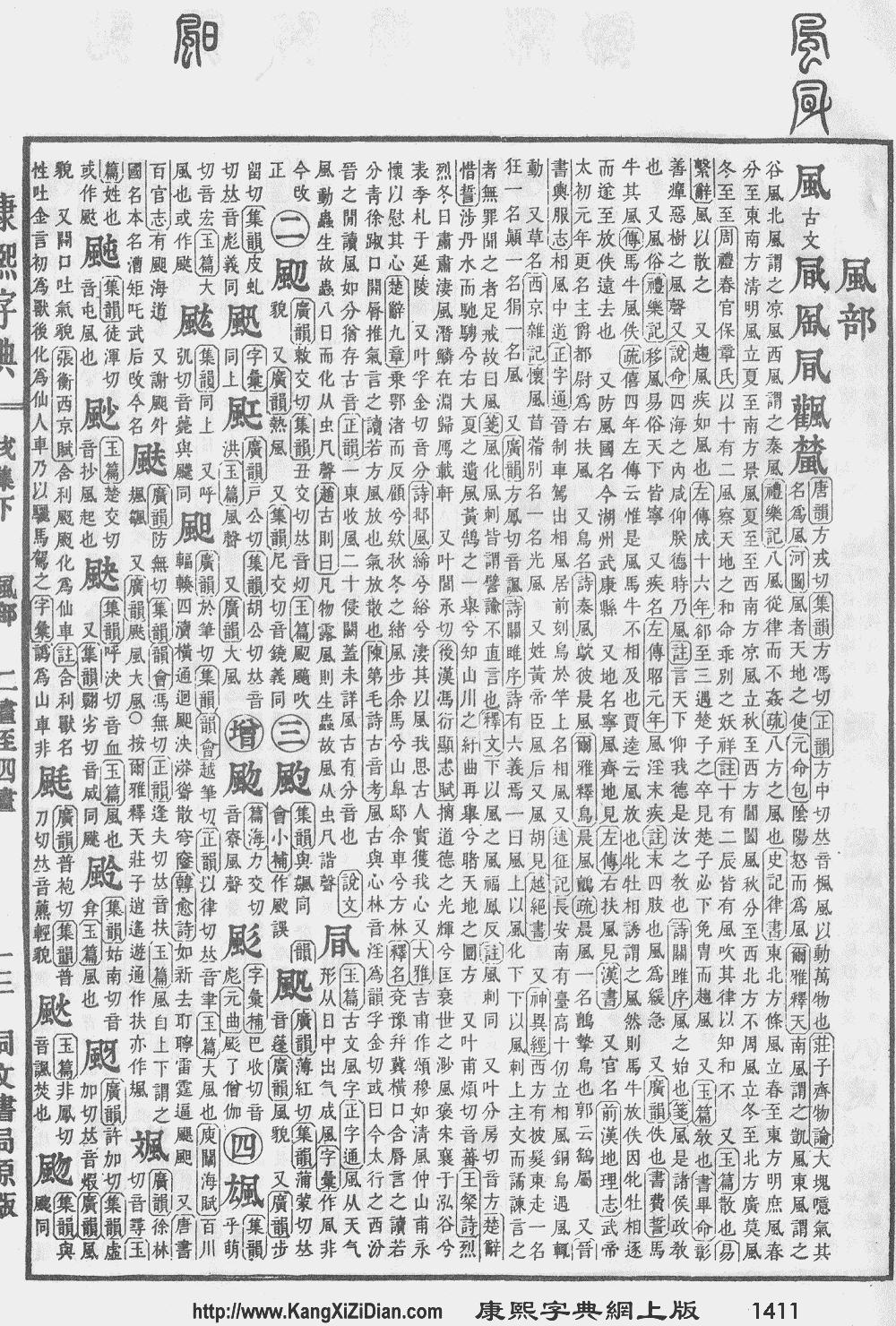
- KangXi: page 1411, character 1
- Dai Kanwa Jiten: character 43756
- Dae Jaweon: page 1930, character 20
- Hanyu Da Zidian: volume 7, page 4480, character 1
- Unihan data for U+98A8
Chinese
| trad. | 風 | |
|---|---|---|
| simp. | 风 | |
| alt. forms | 𠙊 凬 凨 | |
Glyph origin
| Historical forms of the character 風 | ||||||
|---|---|---|---|---|---|---|
| Shang | Western Zhou | Warring States | Shuowen Jiezi (compiled in Han) | Liushutong (compiled in Ming) | ||
| Oracle bone script | Bronze inscriptions | Chu Slip and silk script | Qin slip script | Ancient script | Small seal script | Transcribed ancient scripts |
 |
 |
 |
 |
 |
 |
 |
| Characters in the same phonetic series (凡) (Zhengzhang, 2003) | |
|---|---|
| Old Chinese | |
| 嵐 | *b·ruːm |
| 葻 | *b·uːm |
| 釩 | *pʰomʔ |
| 汎 | *pʰoms, *bum |
| 凡 | *bom |
| 帆 | *bom, *boms |
| 颿 | *bom, *boms |
| 軓 | *bomʔ |
| 梵 | *bloms, *bum |
| 芃 | *boːŋ, *bum |
| 風 | *plum, *plums |
| 飌 | *plum |
| 楓 | *plum |
| 猦 | *plum |
| 偑 | *plum |
| 檒 | *plum |
| 瘋 | *plum |
| 諷 | *plums |
| 堸 | *blum |
| 渢 | *blum |
| 鳳 | *bums |
Phono-semantic compound (形聲, OC *plum, *plums) : phonetic 凡 (OC *bom) + semantic 虫 (“insects”). Ancient Chinese thought insects appear with wind. (Insects refer to any kind of animal, such as tigers (大蟲)).
Etymology
Unknown. Pronunciations 1 and 2 are cognate, and pronunciation 3 appears to be cognate as well. The Old Chinese form for "wind" was *prəm, which is thought to be related to Proto-Tai *C̬.lɯmᴬ (“wind”), Korean 바람 (baram, “wind”) and Tibetan རླུང (rlung, “wind”). This word has a wide range of extended meanings, and interestingly many of these have exact parallels in the Korean cognate. Compare Chinese 風流, 風騷 - Korean 바람둥이 (baramdung-i).
Cognate with:
- 飛廉 (OC *pɯl ɡ·rem, “wind god”)
- 蜚蠊 (OC *pɯlʔ/bɯls ɡ·rem, “cockroach”) (note the preservation of the -r- infix in Old Chinese through disyllabification, also 嵐 (OC *b·ruːm), 葻 (OC *b·uːm))
- 瘋 (OC *plum, “mad, insane”)
- 諷 (OC *plums, “to mock, to advise”)
- 帆 (OC *bom, *boms, “sail”)
The development from Old Chinese to Middle Chinese was irregular, driven by dissimilation of the initial and coda bilabial consonants.
Pronunciation 1
Definitions
風
- wind
- 蘀兮蘀兮,風其吹女。叔兮伯兮,倡予和女。 [Classical Chinese, trad.]
- From: The Classic of Poetry, circa 11th – 7th centuries BCE, translated based on James Legge's version
- 蘀 xī 蘀 xī, fēng qí chuī nǚ. Shū xī bó xī, chàng yǔ hé nǚ. [Pinyin]
- Ye withered leaves! Ye withered leaves! How the wind is blowing you away! O ye uncles, Give us the first note, and we will join in with you.
蘀兮蘀兮,风其吹女。叔兮伯兮,倡予和女。 [Classical Chinese, simp.]- 寢不尸,居不容。見齊衰者,雖狎,必變。見冕者與瞽者,雖褻,必以貌。凶服者式之。式負版者。有盛饌,必變色而作。迅雷風烈,必變。 [Classical Chinese, trad.]
- From: The Analects of Confucius, circa 475 – 221 BCE, translated based on James Legge's version
- Qǐn bù shī, jū bù róng. Jiàn qí shuāi zhě, suī xiá, bì biàn. Jiàn miǎn zhě yǔ gǔ zhě, suī xiè, bì yǐ mào. Xiōng fú zhě shì zhī. Shì fù bǎn zhě. Yǒu shèngzhuàn, bì biàn sè ér zuò. Xùnléi fēngliè, bì biàn. [Pinyin]
- In bed, he did not lie like a corpse. At home, he did not put on any formal deportment. When he saw any one in a mourning dress, though it might be an acquaintance, he would change countenance; when he saw any one wearing the cap of full dress, or a blind person, though he might be in his undress, he would salute him in a ceremonious manner. To any person in mourning he bowed forward to the crossbar of his carriage; he bowed in the same way to any one bearing the tables of population. When he was at an entertainment where there was an abundance of provisions set before him, he would change countenance and rise up. On a sudden clap of thunder, or a violent wind, he would change countenance.
寝不尸,居不容。见齐衰者,虽狎,必变。见冕者与瞽者,虽亵,必以貌。凶服者式之。式负版者。有盛馔,必变色而作。迅雷风烈,必变。 [Classical Chinese, simp.]
- † air; atmosphere
- † general mood; custom
- 王曰:「嗚呼!說,四海之內,咸仰朕德,時乃風。股肱惟人,良臣惟聖。」 [Classical Chinese, trad.]
- From: The Book of Documents, circa 7th – 4th centuries BCE
- Wáng yuē: “Wūhū! Shuō, sìhǎi zhī nèi, xián yǎng zhèn dé, shí nǎi fēng. Gǔgōng wéi rén, liáng chén wéi shèng.” [Pinyin]
- The king said, "Oh! Yue, that all within the four seas look up to my virtue is owing to you. As his legs and arms form the man, so does a good minister form the sage (king)."
王曰:“呜呼!说,四海之内,咸仰朕德,时乃风。股肱惟人,良臣惟圣。” [Classical Chinese, simp.]
- † demeanour
- † cultivation; moralisation
- 風教 / 风教 ― fēngjiào ― cultivation
- style; manner
- † conduct; discipline
- 風惠 / 风惠 ― fēnghuì ― favour
- † power
- 風掃 / 风扫 ― fēngsǎo ― to sweep
- † news; information
- 風訊 / 风讯 ― fēngxùn ― news
- 聞風而動 / 闻风而动 ― wénfēng'érdòng ― to act at once on hearing the news
- † love; affection; to become sexually attracted; to copulate
- 馬牛其風,臣妾逋逃,勿敢越逐,祗復之,我商賚汝。乃越逐不復,汝則有常刑!無敢寇攘,逾垣牆,竊馬牛,誘臣妾,汝則有常刑! [Classical Chinese, trad.]
- From: The Book of Documents, circa 7th – 4th centuries BCE
- Mǎ niú qí fēng, chénqiè būtáo, wù gǎn yuè zhú, zhī fù zhī, wǒ shāng lài rǔ. Nǎi yuè zhú bù fù, rǔ zé yǒu chángxíng! Wúgǎn kòurǎng, yú yuánqiáng, qiè mǎ niú, yòu chénqiè, rǔ zé yǒu chángxíng! [Pinyin]
- When the horses or cattle are seeking one another, or when your followers, male or female, abscond, presume not to leave the ranks to pursue them. But let them be carefully returned. I will reward you (among the people) who return them according to their value. But if you leave your places to pursue them, or if you who find them do not restore them, you shall be dealt with according to the regular punishments. And let none of you presume to commit any robbery or detain any creature that comes in your way, to jump over enclosures and walls to steal (people's) horses or oxen, or to decoy away their servants or female attendants. If you do so, you shall be dealt with according to the regular punishments.
马牛其风,臣妾逋逃,勿敢越逐,祗复之,我商赉汝。乃越逐不复,汝则有常刑!无敢寇攘,逾垣墙,窃马牛,诱臣妾,汝则有常刑! [Classical Chinese, simp.]
- † dissolute; promiscuous
- † ungrounded; baseless
- 風言 / 风言 ― fēngyán ― rumour
- 風謠 / 风谣 ― fēngyáo ― ballad song
- † Alternative form of 瘋/疯 (fēng, “mad; insane”).
- 風病 / 风病 ― fēngbìng ― psychiatric illness
- † (traditional Chinese medicine) One of the causes of diseases in traditional Chinese medicine.
- † epilepsy
- 風癡 / 风痴 ― fēngchī ― insanity
- 風眩 / 风眩 ― fēngxuàn ― epilepsy
- A surname. Feng; Fung
Compounds
|
|
|
Descendants
Pronunciation 2
Definitions
風
- † to blow; to fan
- † to influence; to reform a misguided person through persuasion
- 風民 / 风民 ― fēngmín ― to cultivate the masses
Compounds
|
|
|
Pronunciation 3
Definitions
風
- † Alternative form of 諷/讽 (fěng, “to mock; to ridicule; to satire”).
- † Alternative form of 諷/讽 (fěng, “to advise in mild tone”).
- 風勸 / 风劝 ― fēngquàn ― to advise
- 風諭 / 风谕 ― fēngyù ― to advise in mild tone
Japanese
Kanji
Readings
Compounds
Etymology 1
| Kanji in this term |
|---|
| 風 |
| かぜ Grade: 2 |
| kun’yomi |
Pronunciation
Noun
Etymology 2
| Kanji in this term |
|---|
| 風 |
| ふう Grade: 2 |
| on’yomi |
From Middle Chinese 風 (pjuwng, “wind”).
Pronunciation
Noun
Etymology 3
| Kanji in this term |
|---|
| 風 |
| ふり Grade: 2 |
| Irregular |
The 連用形 (ren'yōkei, “continuative or stem form”) of verb 振る (furu, “to swing”).
Pronunciation
Alternative forms
Noun
References
Korean
Hanja
風 • (pung)
Vietnamese
Han character
- This term needs a translation to English. Please help out and add a translation, then remove the text
{{rfdef}}.