か
 | ||||||||
Japanese
| Stroke order | |||
|---|---|---|---|
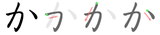 | |||
Pronunciation
- IPA(key): [ka̠]
Audio (file)
Etymology 1
Derived in the Heian period from writing the man'yōgana kanji 加 in the cursive sōsho style. Variants include those derived by similar process from 可, 閑, 家, 我, 駕, 賀, 歌, 謌, 哥, 佳, 香, 嘉, 歟 and 荷.
Syllable
か (romaji ka)
- The hiragana syllable か (ka). Its equivalent in katakana is カ (ka). It is the sixth syllable in the gojūon order; its position is か行あ段 (ka-gyō a-dan, “row ka, section a”).
Derived terms
- が (ga)
See also
Etymology 2
Counter
か (rōmaji -ka)
Particle
か (rōmaji ka)
- final interrogative particle, similar to a question mark ("?").
- お元気ですか。
- O-genki desu ka.
- How are you? [How is your health?]
- お元気ですか。
- particle marking alternatives in a list; "or"
- これか、それか、どっちか選んでよ。
- Kore ka, sore ka, dotchika erande yo.
- This or that, choose one of them.
- これか、それか、どっちか選んでよ。
- whether (or not)
- 行くか知らない。
- Iku ka shiranai.
- I don't know whether he'll go.
- 行くか知らない。
- indication of doubt
- 行くかと思いますが……
- Iku ka to omoimasu ga……
- I think he'll go (but I'm not sure)....
- 行くかと思いますが……
See also
- ね (ne)
Noun
か (rōmaji ka)
- 香: aroma, scent, fragrance
- 蚊: mosquito
- 鹿: deer
- 火: fire; one of the five classical elements in traditional Chinese philosophy and medicine: see the "Wu Xing" entry on Wikipedia; under the old Ritsuryō system of ancient Japan, a military grouping, consisting of 10 soldiers: a squad
- 可: passable
- 科: family (biological classification)
Prefix
か (rōmaji ka-)
Suffix
か (rōmaji -ka)
This article is issued from
Wiktionary.
The text is licensed under Creative Commons - Attribution - Sharealike.
Additional terms may apply for the media files.