說
| ||||||||
| ||||||||
| ||||||||
Translingual
| Traditional | 說 |
|---|---|
| Shinjitai | 説 |
| Simplified | 说 |
Han character
說 (radical 149, 言+7, 14 strokes, cangjie input 卜口金口山 (YRCRU), four-corner 08616, composition ⿰言兌)
Derived characters
- 𡁾, 𧭚
Related characters
- 説 (Traditional form used in Hong Kong, mainland China and Japan)
- 说 (Simplified Chinese)
References
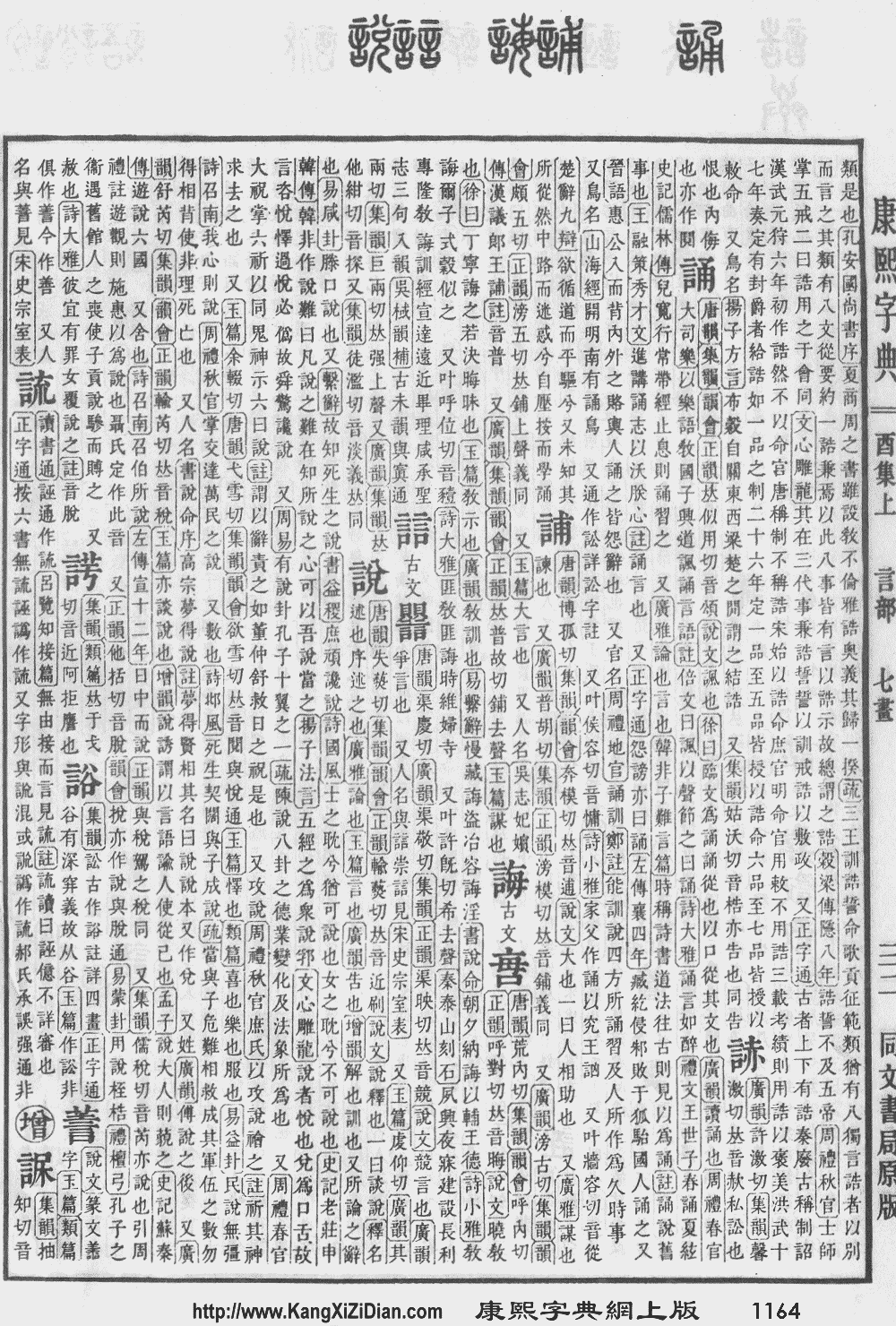
- KangXi: page 1164, character 8
- Dai Kanwa Jiten: character 35556
- Dae Jaweon: page 1629, character 14
- Hanyu Da Zidian: not present, would follow volume 6, page 3979, character 3
- Unihan data for U+8AAA
Chinese
| trad. | 說/説 | |
|---|---|---|
| simp. | 说 | |
| alt. forms | ⿰言兊 | |
Glyph origin
| Historical forms of the character 說 | |
|---|---|
| Warring States | Shuowen Jiezi (compiled in Han) |
| Chu Slip and silk script | Small seal script |
 |
 |
| Characters in the same phonetic series (兌) (Zhengzhang, 2003) | |
|---|---|
| Old Chinese | |
| 毤 | *l̥ʰoːds |
| 蛻 | *l'oːds, *l̥ʰoːds, *hljods, *lod, *lod |
| 娧 | *l̥ʰoːds, *lod |
| 駾 | *l̥ʰoːds |
| 裞 | *l̥ʰoːds, *hljods |
| 兌 | *l'oːds |
| 綐 | *l'oːds |
| 銳 | *l'oːds, *lods |
| 帨 | *stʰods, *hljods |
| 稅 | *hljods |
| 說 | *hljods, *hljod, *lod |
| 涚 | *hljods |
| 䫄 | *rtʰoːd |
| 脫 | *l̥ʰoːd, *l'oːd |
| 侻 | *l̥ʰoːd |
| 挩 | *l̥ʰoːd, *l'oːd |
| 莌 | *l̥ʰoːd, *l'oːd |
| 梲 | *l̥ʰoːd, *ʔljod, *l̥ʰuːd |
| 鮵 | *l'oːd |
| 敓 | *l'oːd |
| 痥 | *l'oːd |
| 悅 | *lod, *lod |
| 閱 | *lod |
Phono-semantic compound (形聲, OC *hljods, *hljod, *lod) : semantic 言 + phonetic 兌 (OC *l'oːds).
Pronunciation 1
Definitions
說
- to say; to speak
- to explain
- to refer to
- to discuss
- to introduce; to bring parties together
- to criticize; to scold; to upbraid
- theory; explanation
Synonyms
| Dialectal synonyms of 說 (“to say, to speak”) [map] | ||
|---|---|---|
| Variety | Location | Words |
| Classical Chinese | 言、云、曰 | |
| Formal (Written Standard Chinese) | 說 | |
| Mandarin | Beijing | 說 |
| Taiwan | 說 | |
| Tianjin | 說 | |
| Jinan | 說 | |
| Xi'an | 說 | |
| Wuhan | 說 | |
| Chengdu | 說 | |
| Hefei | 講 | |
| Cantonese | Guangzhou | 講、話 |
| Hong Kong | 講、話 | |
| Yangjiang | 講、話 | |
| Gan | Nanchang | 話 |
| Hakka | Meixian | 講、話 |
| Miaoli (N. Sixian) | 講 | |
| Liudui (S. Sixian) | 講 | |
| Hsinchu (Hailu) | 講 | |
| Dongshi (Dabu) | 講 | |
| Zhuolan (Raoping) | 講 | |
| Yunlin (Zhao'an) | 講 | |
| Jin | Taiyuan | 說 |
| Min Bei | Jian'ou | 話 |
| Min Dong | Fuzhou | 講 |
| Min Nan | Xiamen | 講 |
| Quanzhou | 說 | |
| Zhangzhou | 講 | |
| Taipei | 講 | |
| Chaozhou | 呾 | |
| Wu | Shanghai | 講 |
| Suzhou | 講、說 | |
| Wenzhou | 講 | |
| Xiang | Changsha | 講 |
| Shuangfeng | 曰、講 | |
Compounds
Derived terms from 說
|
|
|
Pronunciation 2
Definitions
說
Compounds
Pronunciation 3
Definitions
說
Compounds
Derived terms from 說
|
Pronunciation 4
Definitions
說
- † Alternative form of 脫/脱 (tuō, “to free; to relieve”).
- 此宜無罪,女反收之;彼宜有罪,女覆說之。 [Classical Chinese, trad.]
- From: The Classic of Poetry, circa 11th – 7th centuries BCE, translated based on James Legge's version
- Cǐ yí wú zuì, rǔ fǎn shōu zhī; bǐ yí yǒu zuì, rǔ fù tuō zhī. [Pinyin]
- Here is one who ought to be held guiltless,
But you snare him [in the net of crime].
There is one who ought to be held guilty,
But you let him escape [from it].
此宜无罪,女反收之;彼宜有罪,女覆说之。 [Classical Chinese, simp.]
Compounds
Derived terms from 說
|
Japanese
Kanji
說
Readings
Usage notes
This character lacks essential JIS support and is not used in Japanese. The character 説 (U+8AAC) is used instead.
Korean
Hanja
說 • (seol, se, yeol) (hangeul 설, 세, 열)
Vietnamese
Han character
說 (thuyết)
- This term needs a translation to English. Please help out and add a translation, then remove the text
{{rfdef}}.
This article is issued from
Wiktionary.
The text is licensed under Creative Commons - Attribution - Sharealike.
Additional terms may apply for the media files.