予
| ||||||||
Translingual
Han character
予 (radical 6 亅+3, 4 strokes, cangjie input 弓戈弓弓 (NINN), four-corner 17202, composition ⿱龴𠄐)
Derived characters
References
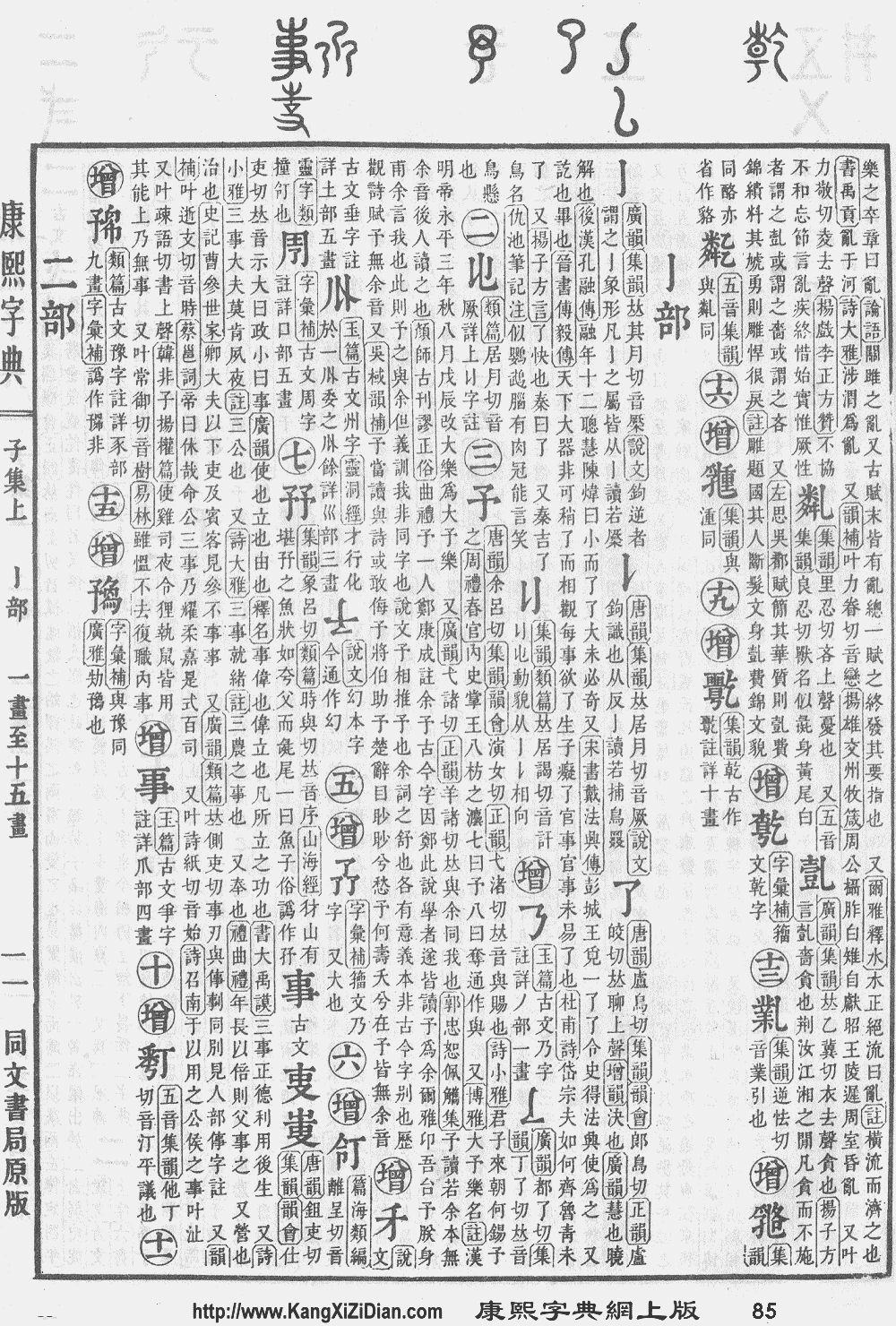
- KangXi: page 85, character 16
- Dai Kanwa Jiten: character 231
- Dae Jaweon: page 174, character 6
- Hanyu Da Zidian: volume 1, page 52, character 2
- Unihan data for U+4E88
Chinese
Glyph origin
| Historical forms of the character 予 | |||||||||||||||
|---|---|---|---|---|---|---|---|---|---|---|---|---|---|---|---|
| Shuowen Jiezi (compiled in Han) | |||||||||||||||
| Small seal script | |||||||||||||||
 | |||||||||||||||
|
References: Mostly from Richard Sears' Chinese Etymology site (authorisation),
|


| Characters in the same phonetic series (予) (Zhengzhang, 2003) | |
|---|---|
| Old Chinese | |
| 野 | *laːʔ, *ɦljaʔ |
| 壄 | *laːʔ |
| 序 | *ljaʔ |
| 抒 | *ljaʔ, *hlja, *ɦljaʔ |
| 芧 | *l'aʔ |
| 杼 | *l'aʔ, *ɦljaʔ |
| 墅 | *ɦljaːʔ |
| 舒 | *hlja |
| 紓 | *hlja, *ɦljaʔ |
| 妤 | *la |
| 伃 | *la |
| 予 | *la, *laʔ |
| 預 | *las |
| 忬 | *las |
| 豫 | *las |
| 蕷 | *las |
| 澦 | *las |
Etymology 1
From Proto-Sino-Tibetan *g-la.
Pronunciation 1
| simp. and trad. |
予 | |
|---|---|---|
Definitions
予
Compounds
Pronunciation 2
| simp. and trad. |
予 | |
|---|---|---|
| alt. forms | 互 乎 與/与 度 Quanzhou | |
Definitions
予
(Hokkien)
Synonyms
| Dialectal synonyms of 給 (“to give”) [map] | ||
|---|---|---|
| Variety | Location | Words |
| Classical Chinese | 予 | |
| Formal (Written Standard Chinese) | 給 | |
| Mandarin | Beijing | 給 |
| Taiwan | 給 | |
| Tianjin | 給 | |
| Jinan | 給 | |
| Xi'an | 給 | |
| Wuhan | 把、把得、給 | |
| Chengdu | 給 | |
| Yangzhou | 把、給 | |
| Hefei | 給 | |
| Cantonese | Guangzhou | 畀 |
| Hong Kong | 畀 | |
| Taishan | 畀 | |
| Yangjiang | 畀 | |
| Gan | Nanchang | 把 |
| Hakka | Meixian | 分 |
| Miaoli (N. Sixian) | 分 | |
| Liudui (S. Sixian) | 分 | |
| Hsinchu (Hailu) | 分 | |
| Dongshi (Dabu) | 分 | |
| Zhuolan (Raoping) | 分 | |
| Yunlin (Zhao'an) | 得 | |
| Jin | Taiyuan | 給 |
| Min Bei | Jian'ou | 吶 |
| Min Dong | Fuzhou | 乞 |
| Min Nan | Xiamen | 予 |
| Quanzhou | 予 | |
| Zhangzhou | 予 | |
| Taipei | 予 | |
| Kaohsiung | 予 | |
| Tainan | 予 | |
| Taichung | 予 | |
| Hsinchu | 予 | |
| Lukang | 予 | |
| Sanxia | 予 | |
| Yilan | 予 | |
| Kinmen | 予 | |
| Magong | 予 | |
| Chaozhou | 分、乞 | |
| Wu | Shanghai | 撥 |
| Suzhou | 撥 | |
| Wenzhou | 匄 | |
| Xiang | Changsha | 把 |
Etymology 2
| simp. and trad. |
予 | |
|---|---|---|
Pronunciation
Definitions
予
Compounds
|
|
|
Etymology 3
| For pronunciation and definitions of 予 – see 豫 (“relaxed; comfortable; at ease; etc.”). (This character, 予, is the second-round simplified and variant form of 豫.) |
Notes:
|
Etymology 4
| For pronunciation and definitions of 予 – see 預 (“beforehand; to take part in; etc.”). (This character, 予, is the second-round simplified form of 預.) |
Notes:
|
Japanese
| 予 | |
| 豫 |
Kanji
予
(grade 3 “Kyōiku” kanji, shinjitai kanji, kyūjitai form 豫)
- beforehand, in advance
Readings
- Goon: よ (yo, Jōyō); しょ (sho)←しよ (syo, historical); じょ (jo)←ぢよ (dyo, historical)
- Kan’on: よ (yo, Jōyō); しょ (sho)←しよ (syo, historical); ちょ (cho)←ちよ (tyo, historical)
- Kun: あらかじめ (arakajime, 予め); あたえる (ataeru, 予える)←あたへる (ataferu, historical); かねて (kanete, 予て)
Compounds
Etymology
Alternative forms
Pronunciation
- IPA(key): [jo]
Pronoun
予 (shinjitai kanji, kyūjitai kanji 豫, hiragana よ, rōmaji yo)
- first-person personal pronoun; I, me
- 1802-1814: Tōkaidōchū Hizakurige (volume 1)
- 予此街道に毫をはせて膝栗毛の書を著す。
- 1802-1814: Tōkaidōchū Hizakurige (volume 1)
References
- Asō, Isoji (1958) Nihon Koten Bungaku Taikei 62: Tōkaidōchū Hizakurige (in Japanese), Tōkyō: Iwanami Shoten, →ISBN
Korean
Hanja
予 • (yeo) (hangeul 여, revised yeo, McCune–Reischauer yŏ)
- This term needs a translation to English. Please help out and add a translation, then remove the text
{{rfdef}}.
Vietnamese
Han character
- This term needs a translation to English. Please help out and add a translation, then remove the text
{{rfdef}}.
References
This article is issued from
Wiktionary.
The text is licensed under Creative Commons - Attribution - Sharealike.
Additional terms may apply for the media files.