越
| ||||||||
Translingual
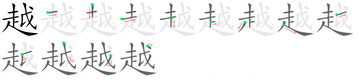
| Stroke order | |||
|---|---|---|---|
 | |||
Han character
越 (radical 156, 走+5, 12 strokes, cangjie input 土人戈女 (GOIV), four-corner 43805, composition ⿺走戉)
Derived characters
References
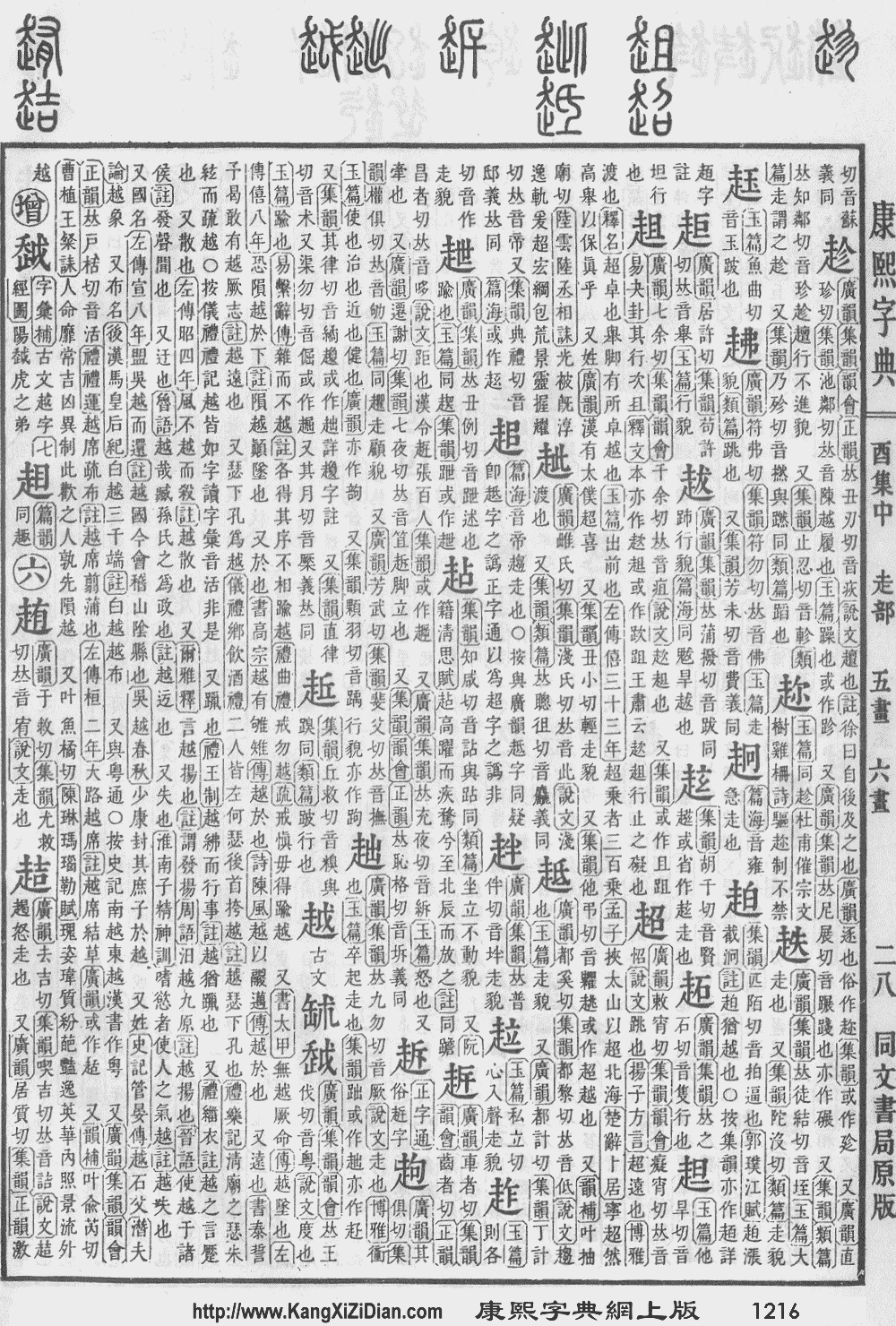
- KangXi: page 1216, character 28
- Dai Kanwa Jiten: character 37110
- Dae Jaweon: page 1686, character 11
- Hanyu Da Zidian: volume 5, page 3480, character 2
- Unihan data for U+8D8A
Chinese
| simp. and trad. |
越 | |
|---|---|---|
Glyph origin
| Characters in the same phonetic series (戉) (Zhengzhang, 2003) | |
|---|---|
| Old Chinese | |
| 泧 | *qʰʷaːd, *kʰʷad, *ɢʷad |
| 眓 | *qʰʷaːd |
| 越 | *ɢʷaːd, *ɢʷad |
| 狘 | *kʰʷad |
| 戉 | *ɢʷad |
| 鉞 | *ɢʷad |
| 樾 | *ɢʷad |
| 怴 | *qʰʷrɯd |
Phono-semantic compound (形聲, OC *ɢʷaːd, *ɢʷad) : semantic 走 (“to walk or run”) + phonetic 戉 (OC *ɢʷad) — to go over; to cross.
Etymology

- “to go over; to surpass; to overstep; to turn”
- Related to 𨒋 (“to go over”), 䟠 (“to go beyond; to transgress”) (Wang, 1982) and perhaps 于 (OC *ɢʷa, “to go”) (Schuessler, 2007).
- “Yue; Viet; State of Yue”
- Related to 粵 (OC *ɢʷad, “Yue; Cantonese”).
- This is a general name for numerous indigenous tribes in ancient southern China, which are collectively called Baiyue. The ancient State of Yue during the Zhou dynasty of China was initially written as 戉 (OC *ɢʷad, “large battle-axe”) — alternatively written as 𫑛 — and it is commonly believed the name Yue originates from this instrument, which was widely found in neolithic cultures of southeastern China and served as a symbol of authority and royalty.
- See 戉 (OC *ɢʷad) for more on the etymology.
Pronunciation 1
Definitions
越
- to pass over; to cross; to cross over
- to go over; to climb over; to jump over
- (of time) to pass; to go through
- (figuratively) to go outside of; to exceed; to surpass; to overstep; to transgress
- to propagate; to spread; to publicise
- to disperse; to scatter; to fade away
- to fall; to relax; to become loosened
- to rob; to seize by force
- (Min Nan) to turn; to turn around
- more; -er
- 越……越…… ― yuè...... yuè...... ― the more ..., the more ...
- Ancient meaningless sentence-initial modal particle.
- (~人, ~族) The Yue or Viet: collective name for numerous ancient non-Han tribes in southern China and northern Vietnam; Baiyue.
- (historical) (~國) The State of Yue: ancient state during the Spring and Autumn and Warring States periods of Chinese history, in the modern provinces of Zhejiang, Shanghai, and Jiangsu.
- General name for the region of southern China, especially the Guangxi and Guangdong provinces.
- Name for the Zhejiang province of China, especially the eastern parts of the province or areas in the vicinity of Shaoxing city.
- Short for 越南 (“Vietnam”).
- A surname.
Compounds
Derived terms from 越
|
|
|
Pronunciation 2
Definitions
越
- † (music) small hole at the bottom of a se, a traditional Chinese musical instrument
- † to bore a hole; to drill a hole
Japanese
Kanji
越
Readings
- Goon: えち (echi)←ゑち (weti, historical); おち (ochi)←をち (woti, historical); がち (gachi)←ぐわち (gwati, historical)
- Kan’on: えつ (etsu, Jōyō)←ゑつ (wetu, historical); かつ (katsu)←くわつ (kwatu, historical)
- Kun: こえる (koeru, 越える, Jōyō)←こえる (koeru, historical); こす (kosu, 越す, Jōyō)←こす (kosu, historical)
Compounds
Korean
Hanja
越 • (wol, hwal)
- This term needs a translation to English. Please help out and add a translation, then remove the text
{{rfdef}}.
Vietnamese
Han character
越 (việt, vát, vẹt, vượt, nhông, vác, vệt, vót)
- This term needs a translation to English. Please help out and add a translation, then remove the text
{{rfdef}}.
Compounds
- Việt Nam (越南)
- tiếng Việt (㗂越)
- Hán-Việt (漢越)
This article is issued from
Wiktionary.
The text is licensed under Creative Commons - Attribution - Sharealike.
Additional terms may apply for the media files.