東
| ||||||||
Translingual
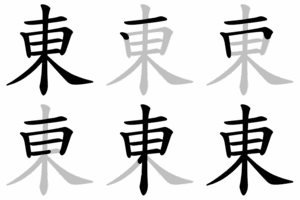
| Stroke order | |||
|---|---|---|---|
 | |||
Han character
東 (radical 75, 木+4, 8 strokes, cangjie input 木田 (DW), four-corner 50906, composition ⿻束一)
Descendants
References
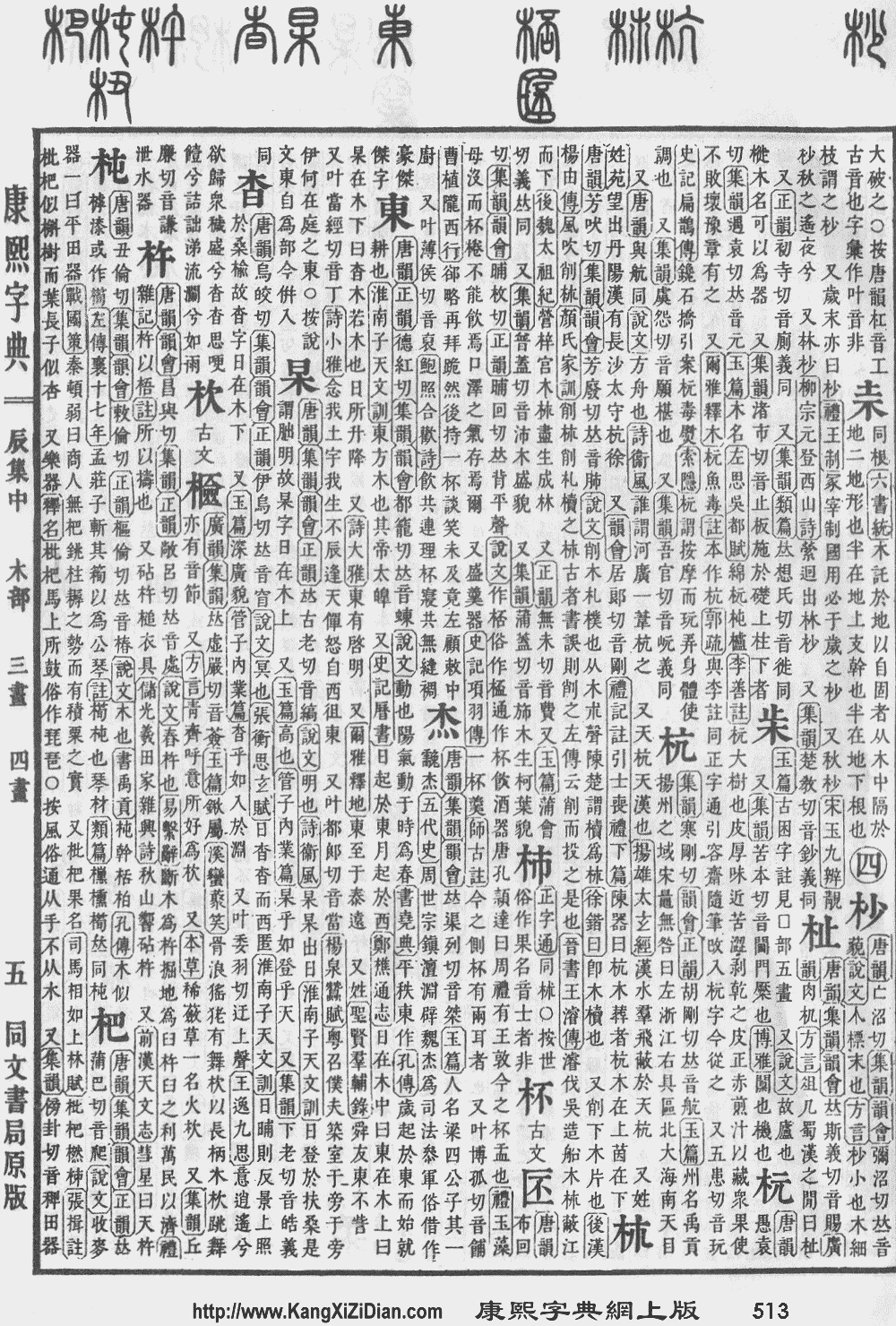
- KangXi: page 513, character 12
- Dai Kanwa Jiten: character 14499
- Dae Jaweon: page 899, character 8
- Hanyu Da Zidian: volume 2, page 1165, character 4
- Unihan data for U+6771
Chinese
| trad. | 東 | |
|---|---|---|
| simp. | 东 | |
Glyph origin
| Historical forms of the character 東 | ||||
|---|---|---|---|---|
| Shang | Western Zhou | Warring States | Shuowen Jiezi (compiled in Han) | Liushutong (compiled in Ming) |
| Oracle bone script | Bronze inscriptions | Chu Slip and silk script | Small seal script | Transcribed ancient scripts |
 |
 |
 |
 |
 |
| Characters in the same phonetic series (東) (Zhengzhang, 2003) | |
|---|---|
| Old Chinese | |
| 東 | *toːŋ |
| 菄 | *toːŋ |
| 鶇 | *toːŋ |
| 倲 | *toːŋ |
| 涷 | *toːŋ, *toːŋs |
| 蝀 | *toːŋ, *toːŋʔ |
| 凍 | *toːŋ, *toːŋs |
| 鯟 | *toːŋ |
| 崠 | *toːŋ |
| 埬 | *toːŋ |
| 棟 | *toːŋs |
Phonetic borrowing – originally represented a bag tied at both ends (like a cellophane-wrapped candy with the ends twisted), and was later borrowed phonetically to mean “east”. This borrowing may have been influenced by reinterpreting the character as the sun (日) rising behind a tree (木), which is the traditional (though incorrect) etymology, as given in Shuowen.
Pronunciation
Definitions
東
Coordinate terms
Compounds
|
|
|
Japanese
Kanji
Readings
Compounds
- 東方 (tōhō, “eastern direction”)
- 東南 (tōnan, “southeast”)
- 東亜 (Tōa, “East Asia”)
- 東洋 (tōyō, “Orient”)
- 東部 (tōbu, “eastern part”)
- 東西南北 (tōzainanboku, “east, west, south, and north”)
- 関東 (Kantō)
- 東風 (tōfū, “spring wind blowing from the east”)
- 中東 (Chūtō, “Middle East”)
- 東京 (Tōkyō, “Tokyo”)
- 東上 (tōjō, “going to Tokyo”)
- 東名高速道路 (Tō-Mei kōsoku dōro, “Tokyo-Nagoya Expressway”)
Etymology 1
| Kanji in this term |
|---|
| 東 |
| とう Grade: 2 |
| on’yomi |
From Middle Chinese 東 (MC tuŋ).
The kan'on reading, so likely a later borrowing.
Pronunciation
Proper noun
東 (hiragana とう, rōmaji Tō)
- a surname
- Abbreviation of 関東 (Kantō): the Kantō region of Japan
- Abbreviation of 東国 (Tōgoku): a historical administrative division of Japan, corresponding to the modern Kantō and Tōkai regions
Etymology 2
| Kanji in this term |
|---|
| 東 |
| ひむかし Grade: 2 |
| kun’yomi |
*/pimukasi/ → /fimukasi/ → /himukaɕi/
From Old Japanese. Found in the Man'yōshū dated 759 CE, but consistently spelled with the single kanji rather than in man'yōgana, thus leaving the reading unspecified.[1] Compound of 日 (hi, “sun”) + 向か (muka, “facing, direction”, the 未然形 (mizenkei, “incomplete form”) of verb 向く (muku, “to face a direction”)) + 風 (shi, “wind, direction”).[2][3]
Pronunciation
Noun
東 (hiragana ひむかし, rōmaji himukashi)
- (obsolete) east
Etymology 3
| Kanji in this term |
|---|
| 東 |
| ひんがし Grade: 2 |
| kun’yomi |
/pimukasi/ → /pimuɡasi/ → /fimuɡasi/ → /finɡasi/ → /hinɡaɕi/
Sound shift from earlier pimukasi.[2][3] Attested in The Tale of Genji, no later than 1021 CE.
Pronunciation
Noun
東 (hiragana ひんがし, rōmaji hingashi)
- (obsolete) east
- 10th century, Ise Monogatari (chapter 4, page 82)[4]
- むかし、東(ひんがし)の五条に大后の宮おはしましける、西の対に住む人有けり。
- 10th century, Ise Monogatari (chapter 4, page 82)[4]
Etymology 4
| Kanji in this term |
|---|
| 東 |
| ひがし Grade: 2 |
| kun’yomi |
/finɡasi/ → /hiɡaɕi/
Sound shift from earlier hingashi. Now the standard word for east.[2][3]
Pronunciation
Noun
東 (hiragana ひがし, rōmaji higashi)
- east
- Antonym: 西 (nishi)
- wind blowing from the east
- Synonym: 東風 (ayu, kochi, kochikaze, tōfū, higashikaze)
- (sumo) higher-ranked wrestlers listed on the right of a banzuke
- Antonym: 西 (nishi)
- (historical) an Eastern Bloc country
- Kamakura and historical Edo, as opposed to Kyoto and Osaka
- Antonym: 西 (nishi)
- (theater) This term needs a translation to English. Please help out and add a translation, then remove the text
{{rfdef}}.
Derived terms
Proper noun
東 (hiragana ひがし, rōmaji Higashi)
- (historical) a red-light district in Edo, where it is today in Fukagawa, Kōtō Ward (as it was located east of Edo Castle)
- a surname
- a place name
Etymology 5
| Kanji in this term |
|---|
| 東 |
| あずま Grade: 2 |
| kun’yomi |
/aduma/ → /ad͡zuma/ → /azuma/
From Old Japanese.[2][3] Ultimate derivation unknown. A speculative origin might be a compound of 天 (ama, “sky, heavens”) + 端 (tsuma, “edge, beginning”), but the elision of the ma in ama does not follow normal patterns.
Pronunciation
Alternative forms
- 吾妻, 吾嬬
Noun
Proper noun
東 (hiragana あずま, rōmaji Azuma, historical hiragana あづま)
- a female given name
- a surname
- any of various places in Japan
東 (hiragana あづま, rōmaji Azuma)
- a female given name
- a surname
Etymology 6
| Kanji in this term |
|---|
| 東 |
| とん Grade: 2 |
| Irregular |
Borrowed from Chinese 東, borrowed specifically as mahjong terminology. Compare Wu 東 (ton), Hakka 東 (tûng), Min Nan 東 (tong).
Pronunciation
Noun
- (mahjong) east wind (mahjong tile)
- Hypernym: 風牌 (kazehai, fanpai)
- (mahjong) a 役 (yaku, “winning hand”) with a triplet or quad of east wind tiles; depending on wind round and player's seat wind, it is worth either 1 or 2 翻 (han, “doubles”)
- Hypernym: 役牌 (yakuhai, yaku-pai)
Derived terms
- 東風戦 (tonpūsen, “east-round game”)
See also
- 風牌 (kazehai, “wind tiles”): 東 (ton, “east wind”), 南 (nan, “south wind”), 西 (shā, “west wind”), 北 (pē, “north wind”)
Proper noun
- A surname.
Etymology 7
Other various nanori readings.
Proper noun
東 (hiragana あきら, rōmaji Akira)
- A surname.
- A male given name
東 (hiragana あず, rōmaji Azu)
- A female given name
- A surname.
東 (hiragana あずきよ, rōmaji Azukiyo)
- A female given name
東 (hiragana こちざき, rōmaji Kochizaki)
- A surname.
東 (hiragana さき, rōmaji Saki)
- A female given name
東 (hiragana たかとう, rōmaji Takatō)
- A surname.
- A surname.
東 (hiragana とうはま, rōmaji Tōhama)
- A surname.
東 (hiragana のぼる, rōmaji Noboru)
- A male given name
東 (hiragana はじめ, rōmaji Hajime)
- A surname.
- A male given name
東 (hiragana ひがしつる, rōmaji Higashitsuru)
- A surname.
References
- ↑ c. 759, Man'yōshū (book 1, poem 48), text here
- 1 2 3 4 1988, 国語大辞典(新装版) (Kokugo Dai Jiten, Revised Edition) (in Japanese), Tōkyō: Shogakukan
- 1 2 3 4 5 6 7 2006, 大辞林 (Daijirin), Third Edition (in Japanese), Tōkyō: Sanseidō, →ISBN
- ↑ Horiuchi, Hideaki; Ken Akiyama (1997) Taketori Monogatari, Ise Monogatari, Tōkyō: Iwanami Shoten, →ISBN
- 1 2 3 1998, NHK日本語発音アクセント辞典 (NHK Japanese Pronunciation Accent Dictionary) (in Japanese), Tōkyō: NHK, →ISBN
Korean
Hanja
東 • (dong)
Compounds
- 정동 (征東, jeongdong)
- 정동 (正東, jeongdong)
- 정동방 (正東方, jeongdongbang)
- 제동야인 (齊東野人, jedong-yain)
- 동대문 (東大門, dongdaemun)
Okinawan
Kanji
東
Readings
- Native: く (ku), くち (kuchi), あがり (agari)
- Nonnative: とー (tō), とぅ (tu)
Compounds
Etymology
From 上り (agari, “ascent, rise”) in reference to the direction where the sun rises, ascends.
Pronunciation
- IPA(key): /ʔaɡaɾi/
Noun
東 (hiragana あがり, romaji agari)
Vietnamese
Han character
Yoron
Kanji
東
Readings
- Native: あがり (agari)
Etymology
From 上り (agari, “ascent, rise”) in reference to the direction where the sun rises, ascends.
Pronunciation
- IPA(key): /ʔaɡaɾi/