fan
English
Pronunciation
Etymology 1
From Middle English fan, from Old English fann (“a winnowing, fan”), from Latin vannus (“fan for winnowing grain”), from Proto-Indo-European *h₂weh₁- (“to blow”). Cognate with Latin ventus (“wind”), Dutch wan (“fan”), German Wanne, Swedish vanna (“a fan for winnowing”), Old English windwian (“to fan, winnow”). More at winnow.
Noun
fan (plural fans)
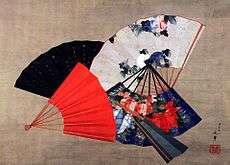
- A hand-held device consisting of concertinaed material, or slats of material, gathered together at one end, that may be opened out into the shape of a sector of a circle and waved back and forth in order to move air towards oneself and cool oneself.
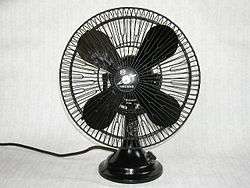
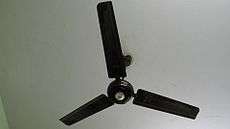
- An electrical or mechanical device for moving air, used for cooling people, machinery, etc.
- Anything resembling a hand-held fan in shape, e.g., a peacock’s tail.
- An instrument for winnowing grain, by moving which the grain is tossed and agitated, and the chaff is separated and blown away.
- 1611, Bible (King James Version), Isaiah 30:24:
- The oxen likewise and the yong asses that eare the ground, shall eate cleane prouender which hath bene winnowed with the shouell and with the fanne.
- 1611, Bible (King James Version), Matthew 3:12:
- Whose fanne is in his hand, and he will throughly purge his floore, and gather his wheat into the garner: but wil burne vp the chaffe with vnquenchable fire.
-
- A small vane or sail, used to keep the large sails of a smock windmill always in the direction of the wind.
- (mathematics) A section of a tree having a finite number of branches
Derived terms
- ceiling fan
- cooling fan
- desk fan
- exhaust fan
- extractor fan
- fan palm
- hit the fan
- pedestal fan
- wall fan
Translations
|
|
|
|
- The translations below need to be checked and inserted above into the appropriate translation tables, removing any numbers. Numbers do not necessarily match those in definitions. See instructions at Wiktionary:Entry layout#Translations.
|
Verb
fan (third-person singular simple present fans, present participle fanning, simple past and past participle fanned)
- (transitive) To blow air on (something) by means of a fan (hand-held, mechanical or electrical) or otherwise.
- We enjoyed standing at the edge of the cliff, being fanned by the wind.
- 1865, Lewis Carroll, “The Pool of Tears”, in Alice's Adventures in Wonderland, London: MacMillan and Co., published 1866, page 19:
- Alice took up the fan and gloves, and, as the hall was very hot, she kept fanning herself all the time she went on talking.
- (transitive) To slap (a behind, especially).
- 1934, Rex Stout, Fer-de-Lance, Bantam, published 1992, →ISBN, page 148:
- Part of it was that as much as I respected filial devotion and as much as I liked Sarah Barstow, it would have been a real satisfaction to put her across my knees and pull up her skirts and giver[sic] her a swell fanning, for not taking a look at that driver.
-
- (intransitive, usually to fan out) To move or spread in multiple directions from one point, in the shape of a hand-held fan.
- A maneuver done by flicking the top rear of an old style gun.
- 2011, Hans-Christoan Vortisch, GURPS Tactical Shooting, page 14:
- To fan a single action revolver, hold down the trigger and strike the hammer repeatedly with a free hand.
-
Derived terms
Related term
- (to firing a revolver by holding trigger and hitting hammer) thumbing
Translations
|
|
Etymology 2

.jpg)
.jpg)
Clipping of fanatic. Possibly influenced by fancy (“group of sport or hobby enthusiasts”).
Noun
- An admirer or aficionado, especially of a sport or performer; someone who is fond of something or someone.
- I am a big fan of libraries.
Usage notes
The plural fen is only used within science fiction fandom. See fen, etymology 2, for more information.
Synonyms
- For semantic relationships of this term, see fan in the Thesaurus.
Antonyms
Derived terms
- acafan
- actifan
- anti-fan
- anti-fandom
- BNF (“Big Name Fan”)
- eofan
- confan
- crifanac
- faan
- fake fan
- fakefan
- fan base
- fan club
- fan fiction
- fan mail
- fan page
- fan translation
- fanac
- fanart
- fanblog
- fanne (“female fan of science fiction”)
- fanboy
- fancast
- fancruft
- fandemonium
- fandom
Translations
|
|
References
- “fan” in Douglas Harper, Online Etymology Dictionary, 2001–2018, retrieved 1 January 2017: “1889, American English, originally of baseball enthusiasts, probably a shortening of fanatic, but it may be influenced by the fancy, a collective term for followers of a certain hobby or sport (especially boxing)”.
Anagrams
Bambara
Pronunciation
- IPA(key): [fã˦ã˨]
Noun
fan
References
- 2007. The UCLA Phonetics Lab Archive. Los Angeles, CA: UCLA Department of Linguistics.
Catalan
Pronunciation
- Rhymes: -an
Verb
fan
- third-person plural present indicative form of fer
Chuukese
Noun
fan
- church (building)
- Ka mochen fiti fan? ― Do you want to attend church?
- time (instance or occurrence)
- 2010, Ewe Kapasen God, United Bible Societies, →ISBN, Matthew 26:34, page 55:
- Jesus a apasa ngeni Peter, "Upwe apasa ngonuk pwe non ei chok pwinin me mwen ewe chukȯ epwe kökkö, fan unungat kopwe apasa pwe kose sinei ei."
- Jesus said to Peter, "I tell you that in this night before the chicken calls, three times you will say that you don't know me."
- Jesus a apasa ngeni Peter, "Upwe apasa ngonuk pwe non ei chok pwinin me mwen ewe chukȯ epwe kökkö, fan unungat kopwe apasa pwe kose sinei ei."
-
Preposition
fan
Dutch
Pronunciation
- (Belgium) IPA(key): /fɑn/
- (Netherlands) IPA(key): /fɛn/
Audio (file)
Noun
fan m (plural fans, diminutive fannetje n)
- fan (admirer)
Synonyms
Finnish
Noun
fan
Declension
| Inflection of fan (Kotus type 5/risti, no gradation) | |||
|---|---|---|---|
| nominative | fan | fanit | |
| genitive | fanin | fanien | |
| partitive | fania | faneja | |
| illative | faniin | faneihin | |
| singular | plural | ||
| nominative | fan | fanit | |
| accusative | nom. | fan | fanit |
| gen. | fanin | ||
| genitive | fanin | fanien | |
| partitive | fania | faneja | |
| inessive | fanissa | faneissa | |
| elative | fanista | faneista | |
| illative | faniin | faneihin | |
| adessive | fanilla | faneilla | |
| ablative | fanilta | faneilta | |
| allative | fanille | faneille | |
| essive | fanina | faneina | |
| translative | faniksi | faneiksi | |
| instructive | — | fanein | |
| abessive | fanitta | faneitta | |
| comitative | — | faneineen | |
Synonyms
French
Etymology 1
Borrowed from English fan, 1920s.
Pronunciation
- IPA(key): /fan/
Noun
fan m, f (plural fans)
- fan (admirer, supporter)
Etymology 2
Pronunciation
- IPA(key): /fan/
Noun
fan f (plural fans)
Further reading
- “fan” in le Trésor de la langue française informatisé (The Digitized Treasury of the French Language).
Friulian
Etymology
Noun
fan f
Related terms
- famâ
Galician
Verb
fan
- third-person plural present indicative of facer
Hungarian
Pronunciation
- IPA(key): [ˈfɒn]
- Hyphenation: fan
Noun
fan (plural fanok)
- (obsolete) pubis
Usage notes
Today it is used only in compounds.
Declension
This noun needs an inflection-table template.
Derived terms
References
- fan at A Pallas Nagy Lexikona, Pallas Irodalmi és Nyomdai Rt., Budapest, 1897
- László Országh, Hungarian-English Dictionary, Akadémiai Kiadó, Budapest, 1977
Irish
Etymology
Pronunciation
- IPA(key): /fˠanˠ/
Verb
fan (present analytic fanann, future analytic fanfaidh, verbal noun fanacht, past participle fanta)
Conjugation
| singular | plural | relative | autonomous | ||||||
|---|---|---|---|---|---|---|---|---|---|
| first | second | third | first | second | third | ||||
| indicative | present | fanaim | fanann tú; fanair† |
fanann sé, sí | fanaimid | fanann sibh | fanann siad; fanaid† |
a fhanann; a fhanas / a bhfanann*; a bhfanas* |
fantar |
| past | d'fhan mé; d'fhanas / fhan mé‡; fhanas‡ |
d'fhan tú; d'fhanais / fhan tú; fhanais‡ |
d'fhan sé, sí / fhan sé, sí‡ |
d'fhanamar; d'fhan muid / fhanamar; fhan muid‡ |
d'fhan sibh; d'fhanabhair / fhan sibh; fhanabhair‡ |
d'fhan siad; d'fhanadar / fhan siad; fhanadar‡ |
a d'fhan / ar fhan* |
fanadh | |
| past habitual | d'fhanainn / fhanainn‡ |
d'fhantá / fhantᇠ|
d'fhanadh sé, sí / fhanadh sé, sí‡ |
d'fhanaimis; d'fhanadh muid / fhanaimis; fhanadh muid‡ |
d'fhanadh sibh / fhanadh sibh‡ |
d'fhanaidís; d'fhanadh siad / fhanaidís; fhanadh siad‡ |
a d'fhanadh / ar fhanadh* |
d'fhantaí / fhantaí‡ | |
| future | fanfaidh mé; fanfad |
fanfaidh tú; fanfair† |
fanfaidh sé, sí | fanfaimid; fanfaidh muid |
fanfaidh sibh | fanfaidh siad; fanfaid† |
a fhanfaidh; a fhanfas / a bhfanfaidh*; a bhfanfas* |
fanfar | |
| conditional | d'fhanfainn / fhanfainn‡ |
d'fhanfá / fhanfᇠ|
d'fhanfadh sé, sí / fhanfadh sé, sí‡ |
d'fhanfaimis; d'fhanfadh muid / fhanfaimis; fhanfadh muid‡ |
d'fhanfadh sibh / fhanfadh sibh‡ |
d'fhanfaidís; d'fhanfadh siad / fhanfaidís; fhanfadh siad‡ |
a d'fhanfadh / ar fhanfadh* |
d'fhanfaí / fhanfaí‡ | |
| subjunctive | present | go bhfana mé; go bhfanad† |
go bhfana tú; go bhfanair† |
go bhfana sé, sí | go bhfanaimid; go bhfana muid |
go bhfana sibh | go bhfana siad; go bhfanaid† |
— | go bhfantar |
| past | dá bhfanainn | dá bhfantá | dá bhfanadh sé, sí | dá bhfanaimis; dá bhfanadh muid |
dá bhfanadh sibh | dá bhfanaidís; dá bhfanadh siad |
— | dá bhfantaí | |
| imperative | fanaim | fan | fanadh sé, sí | fanaimis | fanaigí; fanaidh† |
fanaidís | — | fantar | |
| verbal noun | fanacht | ||||||||
| past participle | fanta | ||||||||
* Indirect relative
† Archaic or dialect form
‡Dependent form
Mutation
| Irish mutation | ||
|---|---|---|
| Radical | Lenition | Eclipsis |
| fan | fhan | bhfan |
| Note: Some of these forms may be hypothetical. Not every possible mutated form of every word actually occurs. | ||
Istriot
Etymology
Noun
fan
Italian
Etymology
Noun
fan m, f (plural fans)
- fan (admirer or follower)
Kanuri
Verb
fàn+
Mandarin
Romanization
fan
- Nonstandard spelling of fān.
- Nonstandard spelling of fán.
- Nonstandard spelling of fǎn.
- Nonstandard spelling of fàn.
Usage notes
- English transcriptions of Mandarin speech often fail to distinguish between the critical tonal differences employed in the Mandarin language, using words such as this one without the appropriate indication of tone.
Occitan
Verb
fan
- third-person plural present indicative of faire
Old Dutch
Etymology
From Proto-Germanic *fana, *funa (“from”), from Proto-Indo-European *pone, *pana (“from”), from *apo-, *pā- (“off, of”). Cognate with Old Saxon fana, fan (“from”), Old Frisian fan, fon (“from”), Old High German fona, fon (“from”).
Preposition
fan
Descendants
Old Saxon
Alternative forms
Etymology
From Proto-Germanic *afana, whence also Old High German fon.
Pronunciation
- IPA(key): /fan/
Preposition
fan
Polish
Etymology
Pronunciation
- IPA(key): /fan/
Audio (file)
Noun
fan m pers (feminine fanka)
- fan (“admirer”)
Declension
Synonyms
- (admirer): entuzjasta, wielbiciel, miłośnik, zapaleniec
Related terms
- fanklub
- fandom
- fanzin
- fanowski
Further reading
- fan in Polish dictionaries at PWN
Rohingya
Noun
fan
- betel leaf
Scottish Gaelic
Etymology
Verb
fan (past dh'fhan, future fanaidh, verbal noun fantail or fantainn or fanachd)
Synonyms
Spanish
Noun
fan m, f (plural fans)
Synonyms
Swedish
Etymology 1
From Late Old Norse fendinn, perhaps from Old Frisian fandiand, present participle of fandia (“tempt”), from Proto-Germanic *fandōną (“seek, search for, examine”).
Pronunciation 1
- IPA(key): /ˈfaːn/, /ˈfaːˌaːn/, /ˈfɑːn/, /ˈfɑːˌɑːn/
Noun
fan c
Interjection
fan
- damn (referring to the devil)
- Fan! Jag glömde nycklarna.
- Damn! I forgot my keys.
- Fan! Jag glömde nycklarna.
See also
Etymology 2
Borrowed from English fan, short for fanatic, related to the Swedish words fanatisk and fanatiker.
Pronunciation 2
- IPA(key): /ˈfɛːn/
- Homophone: fän
Noun
fan c, n
- fan (admirer)
- jag är ett stort fan av saffransbullar
- I'm a huge fan of saffron buns
- jag är ett stort fan av saffransbullar
Declension
| Declension of fan | ||||
|---|---|---|---|---|
| Singular | Plural | |||
| Indefinite | Definite | Indefinite | Definite | |
| Nominative | fan | fanet | fans | fansen |
| Genitive | fans | fanets | fans | fansens |
Etymology 3
Borrowed from Low German fan, used since 1772, closely related to Swedish fana (“flag”).
Noun
fan n
Declension
| Declension of fan | ||||
|---|---|---|---|---|
| Singular | Plural | |||
| Indefinite | Definite | Indefinite | Definite | |
| Nominative | fan | fanet | fan | fanen |
| Genitive | fans | fanets | fans | fanens |
Tboli
Noun
fan
Uzbek
Etymology
Noun
fan (plural fanlar)
Synonyms
Welsh
Etymology 1
Noun
fan f (plural faniau)
Etymology 2
Noun
fan
- Soft mutation of man.
Mutation
| Welsh mutation | |||
|---|---|---|---|
| radical | soft | nasal | aspirate |
| man | fan | unchanged | unchanged |
| Note: Some of these forms may be hypothetical. Not every possible mutated form of every word actually occurs. | |||
References
- “fan”, in Geiriadur Prifysgol Cymru Online (in Welsh), University of Wales Centre for Advanced Welsh & Celtic Studies, 2014
West Frisian
Etymology
Pronunciation
- IPA(key): /fɔn/
Preposition
fan