楓
| ||||||||
Translingual
Han character
楓 (radical 75 木+9, 13 strokes, cangjie input 木竹弓戈 (DHNI), four-corner 47910, composition ⿰木風)
References
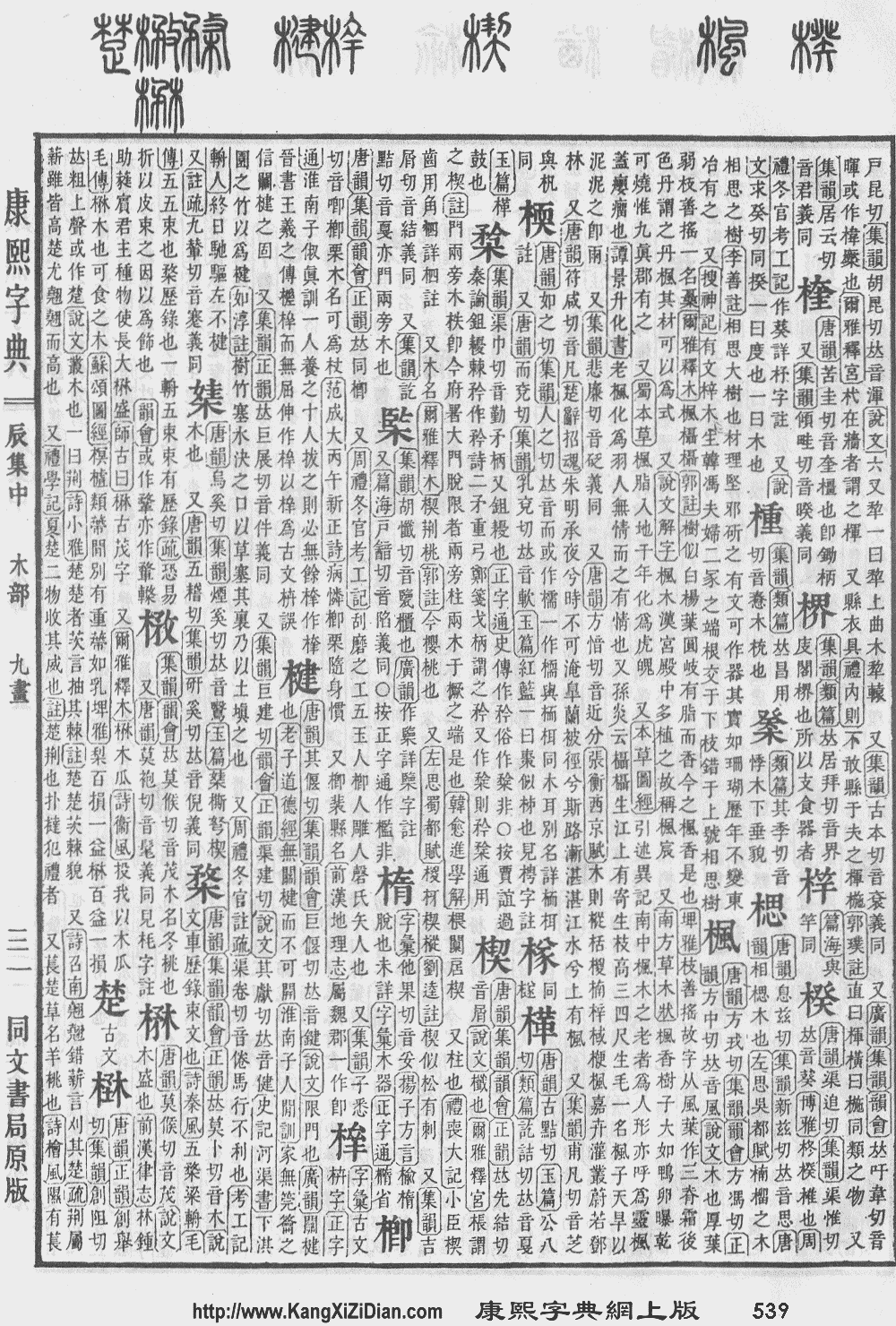
- KangXi: page 539, character 8
- Dai Kanwa Jiten: character 15126
- Dae Jaweon: page 926, character 21
- Hanyu Da Zidian: volume 2, page 1253, character 8
- Unihan data for U+6953
Chinese
| trad. | 楓 | |
|---|---|---|
| simp. | 枫 | |
Glyph origin
| Characters in the same phonetic series (凡) (Zhengzhang, 2003) | |
|---|---|
| Old Chinese | |
| 嵐 | *b·ruːm |
| 葻 | *b·uːm |
| 釩 | *pʰomʔ |
| 汎 | *pʰoms, *bum |
| 凡 | *bom |
| 帆 | *bom, *boms |
| 颿 | *bom, *boms |
| 軓 | *bomʔ |
| 梵 | *bloms, *bum |
| 芃 | *boːŋ, *bum |
| 風 | *plum, *plums |
| 飌 | *plum |
| 楓 | *plum |
| 猦 | *plum |
| 偑 | *plum |
| 檒 | *plum |
| 瘋 | *plum |
| 諷 | *plums |
| 堸 | *blum |
| 渢 | *blum |
| 鳳 | *bums |
Pronunciation
Definitions
楓
Compounds
|
Japanese
Kanji
(“Jinmeiyō” kanji used for names)
Readings
Compounds
Kun'yomi:
- 楓科 (kaedeka): the maple family, Aceraceae
- 楓棚 (kaededana): a type of shelf in a tokonoma or study, with four legs and eight shelves
- 楓鳥 (kaedechō), カエデチョウ (kaedechō): the black-rumped waxbill, a type of estrildid finch common in Africa and introduced to Japan in the 1960s
- 楓鳥科 (kaedechōka), かえでちょうか: genus Estrilda
- 楓紅葉 (kaede momiji): maple leaves that have turned red in autumn; a style of layered clothing with light yellow-green on the outside and yellow or orange-red on the inside
On'yomi:
- 楓蚕 (fūsan): alternate for 天蚕蛾 (tegusuga, “Japanese silkworm moth, Antheraea yamamai”)
- 風樹 (fūju): the Formosan gum tree; the maple
- 楓糖 (fūtō): maple syrup
- 楓葉 (fūyō): maple leaves that have turned red in autumn
Etymology 1
| Kanji in this term |
|---|
| 楓 |
| かえで Jinmeiyō |
| kun’yomi |
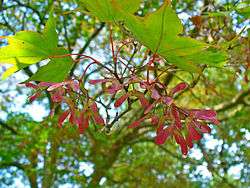
Originally a compound of 蛙 (kaeru, “frog”) + 手 (te, “hand”), with the te changing to de due to rendaku (連濁), and the ru dropping out over time. From the way the palmate leaves resemble a frog's foot.[1][2]
Pronunciation
Alternative forms
Noun
楓 (hiragana かえで, rōmaji kaede, historical hiragana かへで)
- the maple tree
- a color scheme for 襲 (kasane, “layered kimono”, literally “layering”), where both the outer and inner layers are light green
- a kind of 家紋 (kamon, “family crest”), featuring a maple-leaf design
- (term of endearment) a child's hand (from the resemblance in shape between a hand with splayed fingers and a maple leaf)
Usage notes
As with many terms that name organisms, this term is often spelled in katakana, especially in biological contexts, as カエデ.
Derived terms
- 楓の木 (kaede no ki), 楓の樹 (kaede no ki): a maple tree
- 楓の間 (Kaede no Ma): the Maple Room, one of the shogun sitting rooms in Edo Castle
Proper noun
楓 (hiragana かえで, rōmaji Kaede)
- A female given name.
Etymology 2
| Kanji in this term |
|---|
| 楓 |
| かいで Jinmeiyō |
| kun’yomi |
Shift in pronunciation of kaede.[1]
Pronunciation
Noun
楓 (hiragana かいで, rōmaji kaide)
- (uncommon) alternative for kaede above: the maple tree
Etymology 3
| Kanji in this term |
|---|
| 楓 |
| かつら Jinmeiyō |
| kun’yomi |
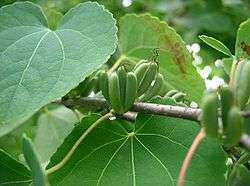
From Old Japanese. Less common spelling for 桂 (katsura).[1]
Pronunciation
Noun
楓 (hiragana かつら, rōmaji katsura)
- 桂: the katsura tree, Cercidiphyllum japonicum
- 桂: (Chinese mythology) the kind of tree that grows on the moon
Usage notes
As with many terms that name organisms, this term is often spelled in katakana, especially in biological contexts, as カツラ.
The katsura reading is rare for this kanji. When referring to the katsura tree, the 桂 spelling is used more often to avoid confusion.
Etymology 4
| Kanji in this term |
|---|
| 楓 |
| おかつら Jinmeiyō |
| kun’yomi |
From Old Japanese. Alternate spelling for 男桂 (okatsura, “male katsura”), an archaic name for the katsura tree.[1] Compare 女桂 (mekatsura, “female katsura: the cinnamon tree”). Appears with this reading in the 和名類聚抄 (Wamyō Ruijushō), a Japanese dictionary of Chinese characters completed in 938.
Pronunciation
Noun
楓 (hiragana おかつら, rōmaji okatsura, historical hiragana をかつら) (alternative reading hiragana おかづら, romaji okazura)
- (obsolete) the katsura tree, Cercidiphyllum japonicum
Etymology 5
| Kanji in this term |
|---|
| 楓 |
| ふう Jinmeiyō |
| on’yomi |
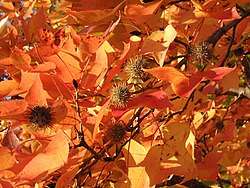
From Middle Chinese 楓 (biung).
Pronunciation
Noun
Usage notes
As with many terms that name organisms, this term is often spelled in katakana, especially in biological contexts, as フウ.
Idioms
- 楓呉江に落つ (fū Gokō ni otsu): “the fū leaves falling in Wujiang” → being disappointed in the reality of something after having lofty ideas about it; from a story in the New Book of Tang about an inspiring poem from an otherwise uninspiring poet
- 楓葉衰えて盧橘花開く (fūyō otoroete rokitsu hana hiraku): “the red sweetgum/maple leaves fade, and the kumquat flowers open” → a metaphor for the turning of the seasons
References
Korean
Hanja
楓 • (pung) (hangeul 풍, revised pung, McCune–Reischauer p'ung, Yale phung)
- This term needs a translation to English. Please help out and add a translation, then remove the text
{{rfdef}}.
Vietnamese
Han character
楓 (phong)
- This term needs a translation to English. Please help out and add a translation, then remove the text
{{rfdef}}.