方
| ||||||||
Translingual
| Stroke order | |||
|---|---|---|---|
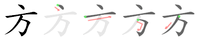 | |||
| Stroke order | |||
|---|---|---|---|
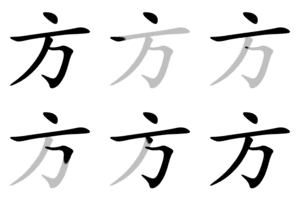 | |||
| Stroke order (alternative) | |||
|---|---|---|---|
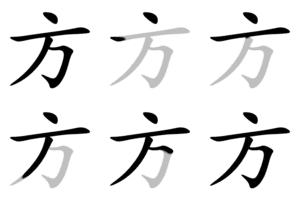 | |||
Han character
方 (radical 70, 方+0, 4 strokes, cangjie input 卜竹尸 (YHS), four-corner 00227, composition ⿱丶万)
- Kangxi radical #70, ⽅.
Derived characters
References
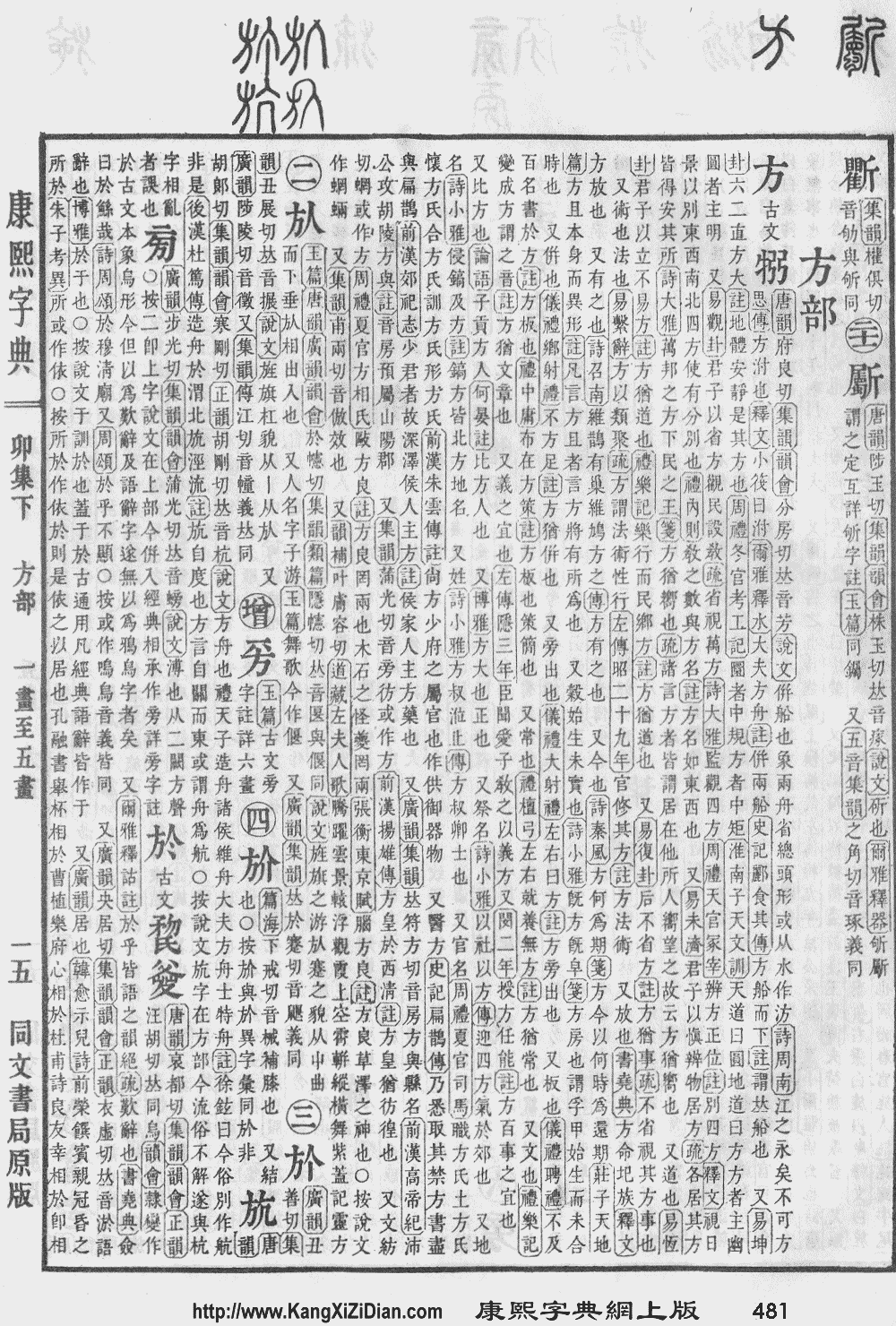
- KangXi: page 481, character 3
- Dai Kanwa Jiten: character 13620
- Dae Jaweon: page 842, character 5
- Hanyu Da Zidian: volume 3, page 2172, character 1
- Unihan data for U+65B9
Chinese
| simp. and trad. |
方 | |
|---|---|---|
Glyph origin
| Historical forms of the character 方 | ||||
|---|---|---|---|---|
| Shang | Western Zhou | Warring States | Shuowen Jiezi (compiled in Han) | Liushutong (compiled in Ming) |
| Oracle bone script | Bronze inscriptions | Chu Slip and silk script | Small seal script | Transcribed ancient scripts |
 |
 |
 |
 |
 |
| Characters in the same phonetic series (方) (Zhengzhang, 2003) | |
|---|---|
| Old Chinese | |
| 縍 | *paːŋ |
| 榜 | *paːŋʔ, *praːŋs, *braːŋ |
| 蒡 | *paːŋʔ, *braːŋ |
| 牓 | *paːŋʔ |
| 螃 | *paːŋʔ, *paːŋs, *baːŋ |
| 搒 | *paːŋs, *braːŋ |
| 舫 | *paːŋs, *paŋs |
| 謗 | *paːŋs |
| 雱 | *pʰaːŋ |
| 磅 | *pʰaːŋ, *pʰraːŋ |
| 霶 | *pʰaːŋ |
| 滂 | *pʰaːŋ |
| 鎊 | *pʰaːŋ |
| 髈 | *pʰaːŋʔ, *baːŋ |
| 彷 | *baːŋ, *pʰaŋʔ |
| 趽 | *baːŋ, *paŋ, *paŋs |
| 房 | *baːŋ, *baŋ |
| 篣 | *baːŋ, *braːŋ |
| 騯 | *baːŋ, *praːŋ, *braːŋ |
| 傍 | *baːŋ, *baːŋs |
| 膀 | *baːŋ |
| 旁 | *baːŋ |
| 徬 | *baːŋs |
| 閍 | *praːŋ |
| 祊 | *praːŋ |
| 嗙 | *praːŋ |
| 方 | *paŋ, *baŋ |
| 汸 | *paŋ |
| 坊 | *paŋ, *baŋ |
| 邡 | *paŋ, *pʰaŋs |
| 枋 | *paŋ |
| 鈁 | *paŋ |
| 蚄 | *paŋ |
| 肪 | *paŋ, *baŋ |
| 鴋 | *paŋ, *baŋ |
| 牥 | *paŋ |
| 昉 | *paŋʔ |
| 瓬 | *paŋʔ |
| 放 | *paŋʔ, *paŋs |
| 倣 | *paŋʔ |
| 芳 | *pʰaŋ |
| 淓 | *pʰaŋ |
| 妨 | *pʰaŋ, *pʰaŋs |
| 紡 | *pʰaŋʔ |
| 仿 | *pʰaŋʔ |
| 髣 | *pʰaŋʔ |
| 鶭 | *pʰaŋʔ |
| 訪 | *pʰaŋs |
| 防 | *baŋ, *baŋs |
| 魴 | *baŋ |
Ideogrammic compound (會意) : 一 + 刀 (“sword”) – blade; tip of a blade. Original form of 芒 (OC *maːŋ, *maŋ, “awn (of cereal); tip (of blade)”); later borrowed to mean “side”. Other theories regarding the origin of this character also exist.
It is unrelated to 㫃 (“fluttering flag”), from which characters like 旗 (OC *ɡɯ, “flag”) and 旅 (OC *ɡ·raʔ, “troops”) are derived.
Etymology 1
Compare:
- 旁 (OC *baːŋ), 傍 (OC *baːŋ, *baːŋs) ("side")
- 舫 (OC *paːŋs, *paŋs), 艕 ("boat")
- 甫 (OC *paʔ) ("to begin")
- 放 (OC *paŋʔ, *paŋs), 仿 (OC *pʰaŋʔ) ("to imitate")
Pronunciation 1
Definitions
方
- † parallel; side by side
- † parallel boats
- † raft made of bamboo
- † to match; to be equal to
- † to compare; to set side by side
- † to differentiate; to discriminate
- † to occupy; to take up
- (mathematics) square; rectangle; cube
- side; aspect; party
- place; region; locality
- orientation; direction
- all sides; all directions
- law; rule; reason
- method; way
- sort; category; kind
- moral principle and knowledge; learning
- earth; solid earth; ground
- (traditional Chinese medicine) prescription
- (mathematics) power
- (mathematics) Short for 平方米 (píngfāngmǐ, “Classifier for square metre.”).
- (mathematics) Short for 立方米 (lìfāngmǐ, “Classifier for cubic metre.”).
- circumference; perimeter
- upright; honest; irreproachable
- just; just when; at the time when; just now; now
- just; only
- at (a specific time)
- A surname.
Compounds
|
|
|
Pronunciation 2
Definitions
方
Etymology 2
| For pronunciation and definitions of 方 – see 仿 (“to imitate; to resemble; to be similar; etc.”). (This character, 方, is a variant form of 仿.) |
Etymology 3
Pronunciation
Definitions
方
- Only used in 方羊.
- Only used in 方洋.
- Only used in 方皇.
- Alternative form of 旁 (páng).
Etymology 4
Pronunciation
Definitions
方
- Only used in 方良.
Etymology 5
Pronunciation
Definitions
方
- phon (unit of apparent loudness)
Japanese
Kanji
Readings
Compounds
Etymology 1
| Kanji in this term |
|---|
| 方 |
| ほう Grade: 2 |
| on’yomi |
From Middle Chinese 方 (pjang).
Pronunciation
Noun
Etymology 2
| Kanji in this term |
|---|
| 方 |
| かた Grade: 2 |
| kun’yomi |
Pronunciation
Noun
- (polite) person
- あの方。
- Ano kata.
- That person. (polite)
- あの方はどなたですか。
- Ano kata wa donata desu ka.
- Who is that gentleman? (formal)
- あの方。
Synonyms
- (plain) 人 (hito)
Suffix
方 (hiragana かた, rōmaji -kata)
- way, method (of doing)
- 書き方
- kakikata
- way of writing something; how to write something
- 使い方
- tsukaikata
- way of using something; how to use something
- 書き方
See also
Etymology 3
pe > ɸe > we > e.
Suffix
方 (hiragana え, rōmaji -e, historical hiragana へ)
- a suffix expressing location, direction, or time
Derived terms
Etymology 4
| Kanji in this term |
|---|
| 方 |
| さま Grade: 2 |
| Irregular |
From Old Japanese. Originally a compound of さ (sa, “that”, pronominal indicating a person, place, thing, or direction in the middle distance) + ま (ma, “likeness, way, similarity”, suffix indicating a quality).[3]
Pronunciation
Alternative forms
Noun
References
Korean
Hanja
方 • (bang)
- This term needs a translation to English. Please help out and add a translation, then remove the text
{{rfdef}}.
Vietnamese
Han character
- This term needs a translation to English. Please help out and add a translation, then remove the text
{{rfdef}}.