egg
English
Pronunciation
- enPR: ĕg, IPA(key): /ɛɡ/
- (also) enPR: āg, IPA(key): /eɪɡ/ (some Canadian and US accents)
Audio (US) (file) - Rhymes: -ɛɡ
Etymology 1
From Middle English egge, from Old Norse egg (“egg”), from Proto-Germanic *ajją (“egg”) (by Holtzmann's Law), from Proto-Indo-European *h₂ōwyóm (“egg”). Cognate with Icelandic egg (“egg”), Norwegian egg (“egg”), Swedish ägg (“egg”), Danish æg (“egg”). The native English ey (plural eyren), akin to Dutch ei (plural eieren) and German Ei (plural Eier) and ultimately from the same Proto-Germanic root, survived into the 16th century before being fully displaced by egg. More at ey.
Noun
egg (plural eggs)
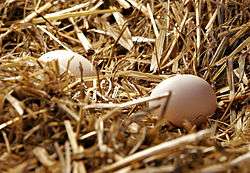
- (zoology, countable) An approximately spherical or ellipsoidal body produced by birds, reptiles, insects and other animals, housing the embryo during its development.
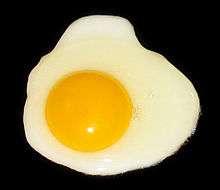
- (countable, uncountable) The egg of a domestic fowl (especially a hen) or its contents, used as food.
- I also determine the minimal amount of egg required to make good mayonnaise.
- We made a big omelette with three eggs.
- The farmer offered me some fresh eggs, but I told him I was allergic to egg.
- (biology, countable) The female primary cell, the ovum.
- 2013 May-June, Katrina G. Claw, “Rapid Evolution in Eggs and Sperm”, in American Scientist, volume 101, number 3:
- Many genes with reproductive roles also have antibacterial and immune functions, which indicate that the threat of microbial attack on the sperm or egg may be a major influence on rapid evolution during reproduction.
-
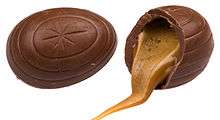
- Anything shaped like an egg, such as an Easter egg or a chocolate egg.
- A swelling on one's head, usually large or noticeable, associated with an injury.
- (mildly pejorative, slang, ethnic slur), (potentially offensive) A person of Caucasian (Western) ancestry, who has a strong desire to learn about and immerse themself in East Asian culture, and/or such a person who is perceived as behaving as if they were Asian (from the "white" outside and "yellow" inside).
- (New Zealand, pejorative) A foolish or obnoxious person.
- Shut up, you egg!
- (informal) A person, fellow.
- good egg
- bad egg
- tough egg
Derived terms
|
|
|
Translations
Verb
egg (third-person singular simple present eggs, present participle egging, simple past and past participle egged)
- To throw eggs at.
- To dip in or coat with beaten egg (cooking).
- To distort a circular cross-section (as in a tube) to an elliptical or oval shape, either inadvertently or intentionally.
- After I cut the tubing, I found that I had slightly egged it in the vise.
Translations
|
See also
Etymology 2
From Middle English eggen, from Old Norse eggja (“to incite”), from egg (“edge”).
Verb
egg (third-person singular simple present eggs, present participle egging, simple past and past participle egged)
- (transitive, obsolete except in egg on) To encourage, incite.
- 14th c., William Langland, Piers Plowman, Passus 1,
- Þerinne wonieth a wiȝte · þat wronge is yhote
- Fader of falshed · and founded it hym-selue
- Adam and Eue · he egged to ille
- Conseilled caym · to kullen his brother
- 1571, Arthur Golding, The Psalmes of David and others. With M. John Calvins Commentaries, “Epistle Dedicatorie,”
- […] yit have wee one thing in our selves and of our selves (even originall sinne, concupiscence or lust) which never ceaseth too egge us and allure us from God […]
- 14th c., William Langland, Piers Plowman, Passus 1,
Derived terms
Translations
Anagrams
Faroese
Pronunciation
- IPA(key): [ɛkː]
Etymology 1
From Old Norse egg, from Proto-Germanic *ajją, from Proto-Indo-European *h₂ōwyóm.
Noun
egg n (genitive singular egs, plural egg)
Declension
| n23 | Singular | Plural | ||
| Indefinite | Definite | Indefinite | Definite | |
| Nominative | egg | eggið | egg | eggini |
| Accusative | egg | eggið | egg | eggini |
| Dative | eggi | egginum | egg(j)um | egg(j)unum |
| Genitive | egs | egsins | eggja | eggjanna |
Derived terms
|
|
|
Etymology 2
From the Old Norse egg, from Proto-Germanic *agjō, from Proto-Indo-European *h₂eḱ- (“sharp, pointed”).
Noun
egg f (genitive singular eggjar, plural eggjar)
Declension
| f8 | Singular | Plural | ||
| Indefinite | Definite | Indefinite | Definite | |
| Nominative | egg | eggin | eggjar | eggjarnar |
| Accusative | egg | eggina | eggjar | eggjarnar |
| Dative | egg | eggini | eggjum | eggjunum |
| Genitive | eggjar | eggjarinnar | eggja | eggjanna |
German
Verb
egg
Icelandic
Pronunciation
- IPA(key): /ˈɛkː/
- Rhymes: -ɛkː
Etymology 1
From Old Norse egg, from Proto-Germanic *ajją, from Proto-Indo-European *h₂ōwyóm. Cognate with Old English ǣġ (obsolete English ey); Swedish ägg; Old High German ei (German Ei).
Noun
egg n (genitive singular eggs, nominative plural egg)
Declension
Synonyms
- (ovum): eggfruma f
Derived terms
|
|
Etymology 2
From Old Norse egg, from Proto-Germanic *agjō, from Proto-Indo-European *h₂eḱ- (“sharp, pointed”).
Cognates include Old Frisian egg, Old Saxon eggia, Dutch egge; Old English ecg (English edge); Old High German egga (German Ecke); Swedish egg.
The Indo-European root is also the source of Latin aciēs (“edge, sharpness”), Ancient Greek ἀκίς (akís, “point”).
Noun
egg f (genitive singular eggjar, nominative plural eggjar)
Declension
Synonyms
- (sharp edge): blað
- (mountain): fjallsegg
Derived terms
- fjallsegg
- með oddi og egg/með oddi og eggju
Norwegian Bokmål
Etymology
From Old Norse egg, from Proto-Germanic *ajją, from Proto-Indo-European *h₂ōwyóm.
Noun
egg n (definite singular egget, indefinite plural egg, definite plural egga or eggene)
- an egg
- et kokt egg ― a boiled egg
Derived terms
References
- “egg” in The Bokmål Dictionary.
Norwegian Nynorsk
Pronunciation
- IPA(key): /ɛɡː/
Etymology 1
From Old Norse egg, from Proto-Germanic *ajją, from Proto-Indo-European *h₂ōwyóm. Akin to English egg.
Noun
egg n (definite singular egget, indefinite plural egg, definite plural egga)
- an egg
Derived terms
Etymology 2
Noun
egg f, m (definite singular egga or eggen, indefinite plural egger or eggar, definite plural eggene or eggane)
- an edge (the thin cutting side of the blade of an instrument, such as an ax, knife, sword, or scythe)
References
- “egg” in The Nynorsk Dictionary.
Old Norse
Etymology 1
From Proto-Germanic *ajją, from Proto-Indo-European *h₂ōwyóm.
Noun
egg n (genitive eggs, plural egg)
Descendants
Etymology 2
From Proto-Germanic *agjō
Noun
egg f (genitive eggjar, plural eggjar)
- edge (of a blade)
Descendants
References
Swedish
Etymology
From Old Norse egg, from Proto-Germanic *agjō, from Proto-Indo-European *h₂eḱ- (“sharp, pointed”).
Pronunciation
- IPA(key): /ɛɡː/
- Homophone: ägg
Noun
egg c
- The sharp edge of a cutting tool.
Declension
| Declension of egg | ||||
|---|---|---|---|---|
| Singular | Plural | |||
| Indefinite | Definite | Indefinite | Definite | |
| Nominative | egg | eggen | eggar | eggarna |
| Genitive | eggs | eggens | eggars | eggarnas |
Related terms
|
|
|
References
- egg in Svenska Akademiens Ordlista över svenska språket (13th ed., online)