子
| ||||||||
Translingual
| Stroke order | |||
|---|---|---|---|
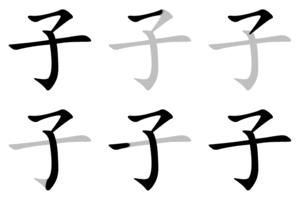 | |||
Han character
子 (radical 39, 子+0, 3 strokes, cangjie input 弓木 (ND), four-corner 17407, composition ⿻了一)
- Kangxi radical #39, ⼦.
Derived characters
- Index:Chinese radical/子
- 孝
Related characters
References
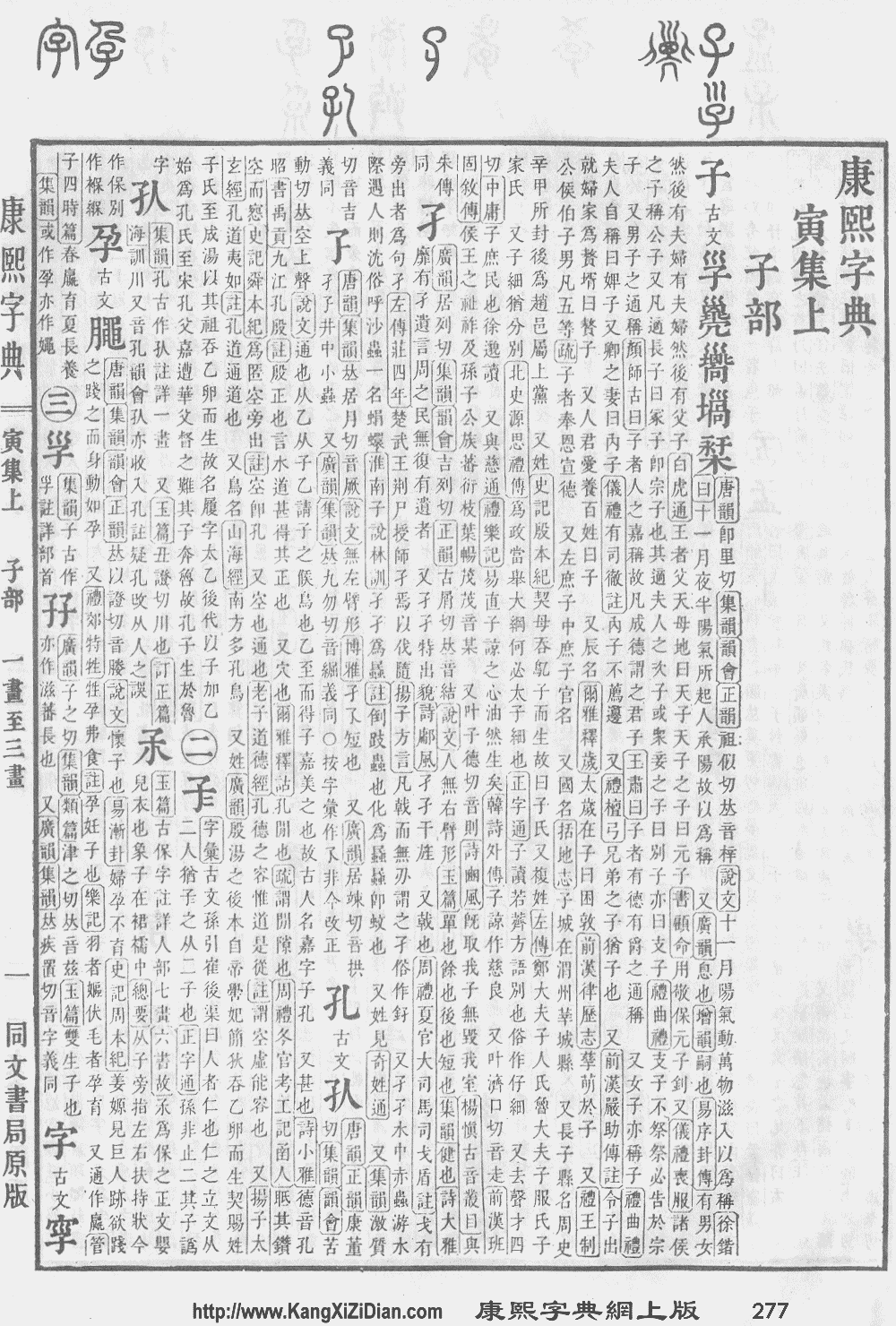
- KangXi: page 277, character 1
- Dai Kanwa Jiten: character 6930
- Dae Jaweon: page 543, character 15
- Hanyu Da Zidian: volume 2, page 1006, character 6
- Unihan data for U+5B50
Chinese
| simp. and trad. |
子 | |
|---|---|---|
Glyph origin
| Historical forms of the character 子 | ||||
|---|---|---|---|---|
| Shang | Western Zhou | Warring States | Shuowen Jiezi (compiled in Han) | Liushutong (compiled in Ming) |
| Oracle bone script | Bronze inscriptions | Chu Slip and silk script | Small seal script | Transcribed ancient scripts |
 |
 |
 |
 |
 |
| Characters in the same phonetic series (子) (Zhengzhang, 2003) | |
|---|---|
| Old Chinese | |
| 孜 | *ʔslɯ |
| 仔 | *ʔslɯ, *ʔslɯʔ |
| 孖 | *ʔslɯ, *zlɯs |
| 子 | *ʔslɯʔ |
| 虸 | *ʔslɯʔ |
| 耔 | *ʔslɯʔ |
| 秄 | *ʔslɯʔ |
| 杍 | *ʔslɯʔ |
| 籽 | *ʔslɯʔ |
| 字 | *zlɯs |
| 茡 | *zlɯs |
| 芓 | *zlɯs |
| 牸 | *zlɯs |
| 李 | *rɯʔ |
Pictogram (象形) – an image of a baby, with a large head and spread arms. The legs are wrapped in a blanket. Compare with 了, where the arms are wrapped.
The big seal script form is much more elaborate, showing a baby with hair on a head (囟) and arms on the two sides of the body, sitting on a stool (几).
Etymology 1
From Proto-Sino-Tibetan *tsa ~ za (“child, offspring, relatives; to come forth (as child at birth); to love; loving”).
Cognate with 字 (OC *zlɯs, “character; letter”), 慈 (OC *zɯ, “loving; kind”), 滋 (OC *ʔsɯ, “to grow, to breed, to propagate, to bring about, to increase”), 孳 (OC *ʔsɯ, *zɯs, “to breed, to propagate”).
Pronunciation 1
Definitions
子
- † child; offspring
- † son
- † descendant; posterity
- † person
- † master; teacher
- † A respectful suffix for teachers, usually attached to their surnames.
- † you
- Alternative form of 籽 (zǐ, “seed”).
- 葵花子 ― kuíhuāzǐ ― sunflower seed
- † egg
- young; tender; small
- Prefix attached to nouns, denoting "a part of", "belonging to" or "individual". sub-
- (astrology) First earthly branch: rat in the Chinese zodiac, 11th solar month, midnight (11:00 pm to 1:00 am)
- Viscount, fourth of five ranks of Chinese aristocracy under the Zhou dynasty.
- (physics, biology) -on
Synonyms
Coordinate terms
Compounds
|
|
|
Pronunciation 2
Definitions
子
- Suffix for small objects or general diminutive suffix.
Synonyms
| Dialectal synonyms of 子 (“general diminutive suffix”) [map] | ||
|---|---|---|
| Variety | Location | Words |
| Formal (Written Standard Chinese) | 子 | |
| Mandarin | Beijing | 子 |
| Taiwan | 子 | |
| Cantonese | Guangzhou | 仔 |
| Hong Kong | 仔 | |
| Hakka | Meixian | 仔 |
| Miaoli (N. Sixian) | 仔 | |
| Liudui (S. Sixian) | 仔 | |
| Hsinchu (Hailu) | 仔 | |
| Min Dong | Fuzhou | 囝 |
| Min Nan | Xiamen | 仔 |
Compounds
|
|
|
Pronunciation 3
Definitions
子
(Hokkien)
Etymology 2
| For pronunciation and definitions of 子 – see 籽 (“seed”). (This character, 子, is the second-round simplified form of 籽.) |
Notes:
|
Japanese
Kanji
Readings
Compounds
Etymology 1
| Kanji in this term |
|---|
| 子 |
| こ Grade: 1 |
| kun’yomi |
From Old Japanese.[1] Seen in the Kojiki and the Man'yōshū, two of the oldest examples of written Japanese. Cognate with 蚕 (ko, “silkworm”). Also possibly cognate with 小 (ko, “little”, diminutive prefix).
Pronunciation
Alternative forms
Noun
子 (counter 人, hiragana こ, rōmaji ko)
- a child
- 男の子 — おとこのこ — otoko no ko — male child: a boy
- いい子 — いいこ — ii ko — good boy; good girl
- 2007 October 20, Hiroshi, Izawa; Kotaro, Yamada, “最終話 それぞれの道へ [Final Chapter: Epilog]”, in ファイアーエムブレム 覇者の剣 [Fire Emblem: Sword of Champions], volume 5 (fiction, in Japanese), Jump Remix edition, Tokyo: Shueisha, →ISBN, page 355:
- 後にラグナのセルディアと結ばれ8人の子を儲けた
- Nochi ni Raguna no Serudia to musubare hachi-nin no ko o mōketa
- He later had 8 children with Serdia of Ragna
- 後にラグナのセルディアと結ばれ8人の子を儲けた
- (figuratively) a girl, especially a dear or desired one (compare use of English baby, babe)
- c. 759, Man'yōshū (book 7, poem 1266); text here
- 大舟乎 荒海尓榜出 八船多氣 吾見之兒等之 目見者知之母
- 大船を 荒海に漕ぎ出で や船たけ 我が見し子らが まみはしるしも
- おほぶねを あるみにこぎで やふねたけ わがみしこらが まみはしるしも
- Ōbune o / arumi ni kogi de / ya fune take / waga mishi kora ga / mami wa shirushi mo
- Rowing the big boat into the rough seas, putting our backs into it, the looks of those girls I saw are clear [in my mind]
- 大舟乎 荒海尓榜出 八船多氣 吾見之兒等之 目見者知之母
- c. 759, Man'yōshū (book 7, poem 1266); text here
- a smaller or younger version of a bigger object
- きのこ — kinoko — a "tree's child / little one": a mushroom
- 竹の子 — たけのこ — takenoko — a "bamboo's child / little one": a bamboo shoot
Derived terms
- お子さん (okosan): child (when addressing or referring to someone else's)
- 子供 (kodomo): a child, children
- 子守 (komori): a babysitter, a nurse; babysitting
- 子守歌 (komori uta): a lullaby, a nursery song
- 間の子 (ai no ko), 合いの子 (ai no ko): a child of racially different parents; a hybrid organism; something with the qualities of two other things, a combination
- 豕 (inoko), 猪子 (inoko), 猪の子 (inoko): a wild pig; a wild piglet
- 芋の子 (imo no ko): a smaller tuber branching from another potato
- 茸 (kinoko): a mushroom
- 筍 (takenoko): a bamboo shoot
- 彦 (hiko)
- 男 (otoko)
- 息子 (musuko)
Prefix
- an object which has a subservient or derivative role relative to another object
- 子会社 こがいしゃ — kogaisha — a subsidiary
- 子犬 — こいぬ — koinu — a puppy
Derived terms
- 子犬 (koinu): a puppy
- 子会社 (kogaisha): a subsidiary
Suffix
- suffix used in female given names, such as 智子 (ともこ, Tomoko), 英子 (えいこ, Eiko), 秀子 (ひでこ, Hideko), 美奈子 (みなこ, Minako)
- (rare) suffix used in male given names
- an object having a particular state or property (sometimes diminutive)
- 振子 — ふりこ — furiko — an object that swings: a pendulum
- roe (only when preceded by a fish name, or fish-related prefix)
- 明太子 — めんたいこ — mentaiko — pollock roe
- 飛子 — とびこ — tobiko — flying fish roe
Derived terms
- 穴子 (anago): conger eel
- 団子 (dango): a dango, a kind of dumpling
- 糠子 (nukago): biting midge
- 愛子 (manago): beloved child
Etymology 2
| Kanji in this term |
|---|
| 子 |
| す Grade: 1 |
| on’yomi |
| Kanji in this term |
|---|
| 子 |
| し Grade: 1 |
| on’yomi |
From Middle Chinese 子 (tsiX). Compare modern Mandarin 子 (zǐ).
The goon reading of shi is likely the original borrowing. The tōon reading su appears later, and only shows up in certain set terms borrowed from Chinese, where it seems to serve as a kind of nominalizing suffix.
Pronunciation
Affix
子 (hiragana し, rōmaji shi) (alternative reading hiragana す, romaji su)
- a child
- an object which has a subservient or derivative role relative to another object
- an object having a particular state or property (sometimes diminutive)
Usage notes
- This affix is never used in isolation. It is only used in on'yomi compounds.
- In some kanji compounds, 子 is part of the word but does not carry much meaning in Japanese, as in 椅子 (isu, “chair”). Possibly because of this erosion of meaning, spelling out 子 in some compounds has become optional, as in 椰子 vs. 椰 (yashi, “a palm tree”), or 柚子 vs. 柚 (yuzu, “an aromatic citron”).
- In some compounds, the shi or su reading becomes voiced as ji or zu due to rendaku.
Derived terms
- 音子 (onshi): phonon
- 光子 (kōshi): photon
- 子院 (shiin): a branch temple
- 子音 (shion): a consonant
- 子器 (shiki): the reproductive organ of fungi in phylum Ascomycota: the ascocarp
- 子宮 (shikyū): the uterus, the womb
- 子午 (shigo): running north and south
- 子細 (shisai): a detail, a particular; a circumstance
- 子史 (shishi):
- 子実層 (shijitsusō): the hymenium of certain fungi
- 子実体 (shijitsutai): the sporocarp or fruiting body of certain fungi
- 子爵 (shishaku): a viscount
- 子女 (shijo): children; a girl, a daughter
- 子銭 (shisen): interest earned on a loan
- 子息 (shisoku): a boy, a son
- 子孫 (shison): a descendant
- 子弟 (shitei): children, young people
- 子道 (shidō): one's duty to one's children
- 子嚢 (shinō): the ascus or pericarp of certain fungi
- 子婦 (shifu): a daughter-in-law
- 子母銭 (shibosen): money, principal and interest
- 子母沢 (Shimowaza): a surname
- 子法 (shihō): a law based on a law in another country
- 子房 (shibō): an ovary
- 子本 (shihon): principal and interest
- 子夜 (shiya): midnight
- 子葉 (shiyō): the cotyledon or seed leaf, the first leaf of a sprouting plant
- 晶子 (shōshi): crystallite
- 松子 (shōshi): pinecone
- 硝子 (shōshi): glass
- 喞子 (shokushi): piston
- 子来 (shirai): the love of the populace for a just ruler
- 子癇 (shikan): eclampsia
- 烏帽子 (eboshi): the formal black peaked cap worn by nobility
- 菓子 (kashi): candy
- 精子 (seishi): spermatozoon
- 卓子 (takushi): (rare) a table
- 中性子 (chūseishi): a neutron
- 電子 (denshi): an electron
- 螺子 (neji), 捻子 (neji), 捩子 (neji): a screw
- 胞子 (hōshi): a spore
- 烽子 (hōshi): a courier or messenger in ancient Japan
- 亡子 (bōshi): a dead child
- 帽子 (bōshi): a hat, a cap
- 眸子 (bōshi): the pupil of the eye (rare)
- 鋩子 (bōshi): the tip of a sword or knife
- 拍子 (hyōshi): rhythm
- 椅子 (isu): a chair
- 茄子 (nasu): eggplant
- 様子 (yōsu): appearances, the situation, circumstances
- 卵子 (ranshi): ovum
- 利子 (rishi): interest
- 量子 (ryōshi): quantum
Proper noun
- the Rat, the first of the twelve Earthly Branches
Etymology 3
| Kanji in this term |
|---|
| 子 |
| ね Grade: 1 |
| kun’yomi |
Contracted from 鼠 (nezumi, “rat; mouse”)
Pronunciation
Proper noun
- the Rat, the first of the twelve Earthly Branches
References
Korean
Hanja
Compounds
- 子女 (자녀, ja-nyeo) : children
- 女子 (여자, yeo-ja) : woman, female
- 男子 (남자, nam-ja) : man, male
- 子孫 (자손, ja-son) : descendant
- 孫子 (손자, son-ja) : grandson, grandchild
- 子正 (자정, ja-jeong) : midnight
- 遺傳子 (유전자, yu-jeon-ja) : gene
Vietnamese
Han character
子 (tử, tý)
- This term needs a translation to English. Please help out and add a translation, then remove the text
{{rfdef}}.