leaf
English

Etymology
From Middle English leef, from Old English lēaf, from Proto-Germanic *laubą (“leaf”) (compare West Frisian leaf, Low German Loov, Dutch loof, German Laub, Danish løv, Swedish löv, Norwegian Nynorsk lauv), from Proto-Indo-European *lewbʰ- (“leaf, rind”)[1] (compare Irish luibh (“herb”), Latin liber (“bast; book”), Lithuanian lúoba (“bark”), Albanian labë (“rind”), Latvian luba (“plank, board”), Russian луб (lub, “bast”)).
Pronunciation
- enPR: lēf, IPA(key): /liːf/
Audio (US) (file) - Rhymes: -iːf
- Homophone: lief
Noun
leaf (plural leaves)
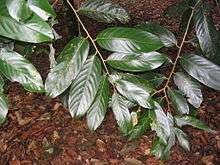
- The usually green and flat organ that represents the most prominent feature of most vegetative plants.
- 2013 May-June, William E. Conner, “An Acoustic Arms Race”, in American Scientist, volume 101, number 3, page 206-7:
- Earless ghost swift moths become “invisible” to echolocating bats by forming mating clusters close (less than half a meter) above vegetation and effectively blending into the clutter of echoes that the bat receives from the leaves and stems around them.
-
- Anything resembling the leaf of a plant.
- A sheet of any substance beaten or rolled until very thin.
- gold leaf
- A sheet of a book, magazine, etc (consisting of two pages, one on each face of the leaf).
- (in the plural) Tea leaves.
- A flat section used to extend the size of a table.
- A moveable panel, e.g. of a bridge or door, originally one that hinged but now also applied to other forms of movement.
- The train car has one single-leaf and two double-leaf doors per side.
- (botany) A foliage leaf or any of the many and often considerably different structures it can specialise into.
- (computing, mathematics) In a tree, a node that has no descendants.
- 2011, John Mongan, Noah Kindler, Eric Giguère, Programming Interviews Exposed
- The algorithm pops the stack to obtain a new current node when there are no more children (when it reaches a leaf).
- 2011, John Mongan, Noah Kindler, Eric Giguère, Programming Interviews Exposed
- The layer of fat supporting the kidneys of a pig, leaf fat.
- One of the teeth of a pinion, especially when small.
Meronyms
- (moveable panel of a bridge or door): stile
Derived terms
Translations
|
|
|
|
Verb
leaf (third-person singular simple present leafs, present participle leafing, simple past and past participle leafed)
- (intransitive) To produce leaves; put forth foliage.
- (transitive) To divide (a vegetable) into separate leaves.
- The lettuce in our burgers is 100% hand-leafed.
Synonyms
- leave (verb)
Derived terms
Translations
See also
Further reading

References
- ↑ De Vaan, Michiel (2008) Etymological Dictionary of Latin and the other Italic Languages (Leiden Indo-European Etymological Dictionary Series; 7), Leiden, Boston: Brill, page 337
Anagrams
Old English
Pronunciation
- IPA(key): /ˈlæːɑf/
Etymology 1
From Proto-Germanic *laubō. Cognate with Old High German *louba (German Laube).
Noun
lēaf f (nominative plural lēafe)
Descendants
- English: leave
Etymology 2
From Proto-Germanic *laubą, perhaps from Proto-Indo-European *lewp- (“to peel, break off”). Cognate with West Frisian leaf, Old Saxon lōf (Low German Loov), Dutch loof, Old High German loup (German Laub), Old Norse lauf (Danish løv, Swedish löv), Gothic 𐌻𐌰𐌿𐍆𐍃 (laufs).
Noun
lēaf n
Inflection
Descendants
Scots
Etymology
From Old English lēaf.
Noun
leaf (plural leafs)
West Frisian
Pronunciation
- IPA(key): /lɪːf/
 |
This entry needs pronunciation information. If you are familiar with the IPA then please add some! Particularly: “Is this pronunciation correct for West Frisian ?” |
Etymology 1
From Old Frisian lāf, from Proto-Germanic *laubą, perhaps from Proto-Indo-European *lewp- (“peel off, break off”).
Noun
leaf n (plural leaven)
Etymology 2
Adjective
leaf (plural leave)
Adverb
leaf