里
| ||||||||
Translingual
| Stroke order | |||
|---|---|---|---|
 | |||
Han character
里 (radical 166, 里+0, 7 strokes, cangjie input 田土 (WG), four-corner 60104, composition ⿱田土)
- Kangxi radical #166, ⾥.
Derived characters
References
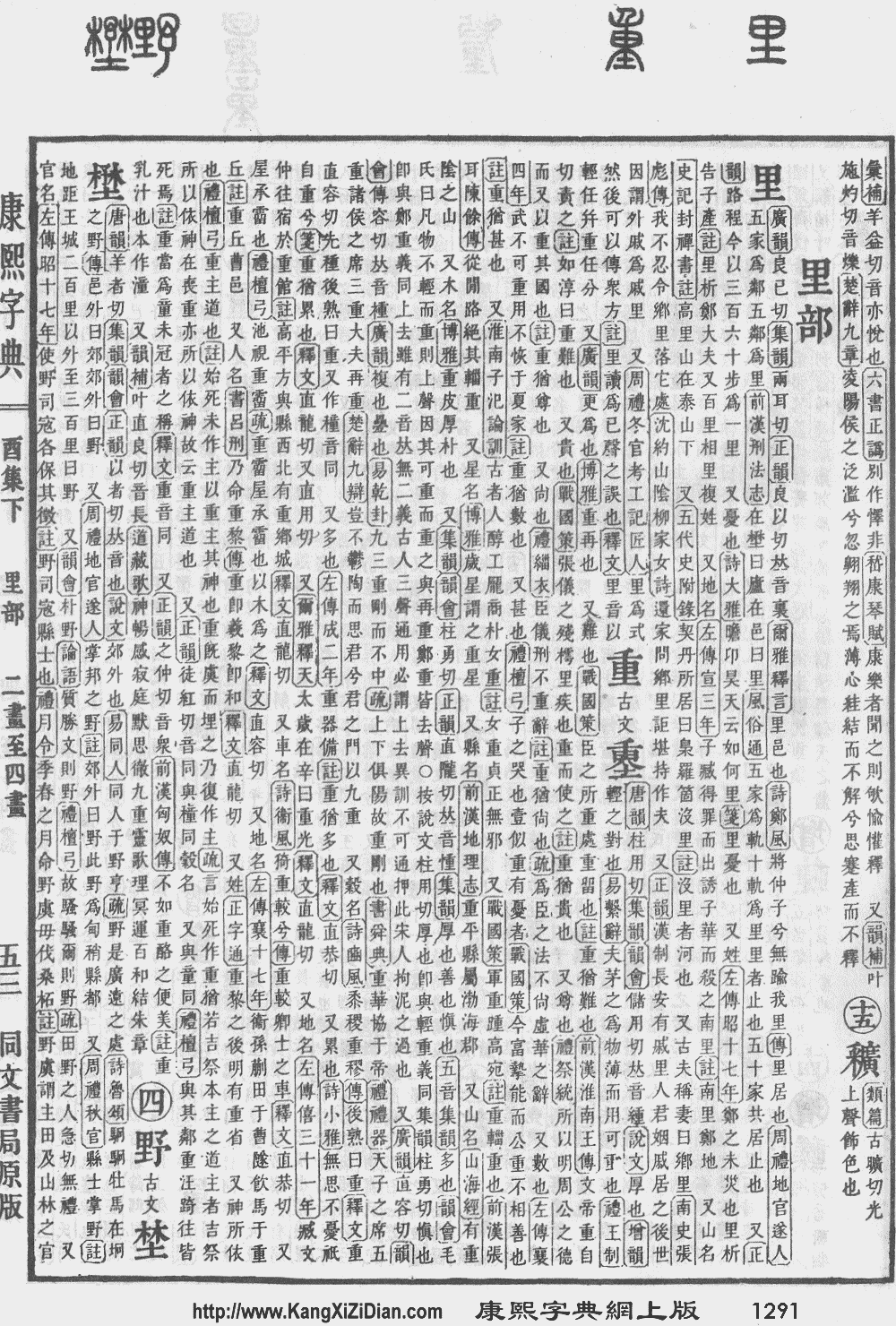
- KangXi: page 1291, character 2
- Dai Kanwa Jiten: character 40131
- Dae Jaweon: page 1791, character 6
- Hanyu Da Zidian: volume 6, page 3680, character 1
- Unihan data for U+91CC
Chinese
Glyph origin
| Historical forms of the character 里 |
|---|
| Shuowen Jiezi (compiled in Han) |
| Small seal script |
 |
| Characters in the same phonetic series (里) (Zhengzhang, 2003) | |
|---|---|
| Old Chinese | |
| 埋 | *mrɯː |
| 霾 | *mrɯː |
| 薶 | *mrɯː |
| 榸 | *ʔr'ɯː |
| 厘 | *rɯ |
| 狸 | *rɯ |
| 貍 | *p·rɯ |
| 梩 | *rɯ |
| 艃 | *rɯ |
| 里 | *rɯʔ |
| 理 | *rɯʔ |
| 鯉 | *rɯʔ |
| 俚 | *rɯʔ |
| 悝 | *rɯʔ, *km̥ʰlɯː |
| 娌 | *rɯʔ |
| 裏 | *rɯʔ |
| 荲 | *r̥ʰɯɡ, *l̥ʰuɡ, *hluɡ |
Ideogrammic compound (會意) : 田 (“field”) + 土 (“soil; earth”) – a measure of land and fields; mile; place.
Etymology 1
| simp. and trad. |
里 | |
|---|---|---|
Pronunciation
Definitions
里
- li (a unit of distance equal to half a kilometre in modern China)
- village (an administrative unit in the Republic of China)
- lane (a type of road in Hong Kong)
- A surname.
Compounds
Derived terms from 里
|
|
|
Etymology 2
| For pronunciation and definitions of 里 – see 裡 (“in; inside; during; within; etc.”). (This character, 里, is the simplified form of 裡.) |
Notes:
|
Japanese
Kanji
里
Readings
Compounds
Etymology 1
| Kanji in this term |
|---|
| 里 |
| さと Grade: 2 |
| kun’yomi |
/sato1/ invalid IPA characters (1) → /sato/
From Old Japanese.[1] Ultimately derivation unknown.
Pronunciation
Alternative forms
Adjective
里 (-na inflection, hiragana さと, rōmaji sato)
Inflection
Inflection of 里
| Stem forms | |||
|---|---|---|---|
| Imperfective (未然形) | 里だろ | さとだろ | sato daro |
| Continuative (連用形) | 里で | さとで | sato de |
| Terminal (終止形) | 里だ | さとだ | sato da |
| Attributive (連体形) | 里な | さとな | sato na |
| Hypothetical (仮定形) | 里なら | さとなら | sato nara |
| Imperative (命令形) | 里であれ | さとであれ | sato de are |
| Key constructions | |||
| Informal negative | 里ではない 里じゃない |
さとではない さとじゃない |
sato de wa nai sato ja nai |
| Informal past | 里だった | さとだった | sato datta |
| Informal negative past | 里ではなかった 里じゃなかった |
さとではなかった さとじゃなかった |
sato de wa nakatta sato ja nakatta |
| Formal | 里です | さとです | sato desu |
| Formal negative | 里ではありません 里じゃありません |
さとではありません さとじゃありません |
sato de wa arimasen sato ja arimasen |
| Formal past | 里でした | さとでした | sato deshita |
| Formal negative past | 里ではありませんでした 里じゃありませんでした |
さとではありませんでした さとじゃありませんでした |
sato de wa arimasen deshita sato ja arimasen deshita |
| Conjunctive | 里で | さとで | sato de |
| Conditional | 里なら(ば) | さとなら(ば) | sato nara (ba) |
| Provisional | 里だったら | さとだったら | sato dattara |
| Volitional | 里だろう | さとだろう | sato darō |
| Adverbial | 里に | さとに | sato ni |
| Degree | 里さ | さとさ | satosa |
Noun
- village
- country house
- one's hometown
- the country, the countryside
- the original home of a household member (such as a wife, adoptee, or other person who has joined the household from outside)
- a separate home or boarding situation to which one's own children are sent for upbringing or education
- a red-light district
- one's birth, parentage, origins
- (slang, red-light district) boorishness, hickishness
- the lay world (as opposed to life within a temple)
- (obsolete) in ancient times, a unit of area for regional administration
- The ri reading below was more common for this.
- (obsolete) in ancient times, a unit of distance
- The ri reading below was more common for this.
Synonyms
Derived terms
Derived terms
- 里芋 (satoimo, “taro”)
- 里親 (satooya, “foster parent”)
- 里子 (satogo, “foster child”)
- 里山 (satoyama, “satoyama”)
- 古里 (furusato, “old hometown”)
Proper noun
- a place name
- a surname.
- a female given name
里 (hiragana ざと, rōmaji Zato)
Etymology 2
| Kanji in this term |
|---|
| 里 |
| り Grade: 2 |
| on’yomi |
From Middle Chinese 里 (MC lɨX). Compare modern Chinese 里 (lǐ).
Pronunciation
Noun
- A unit of distance defined as equal to 129,600⁄33 meters: approximately 3.927 kilometers or 2.44 miles.
Derived terms
Etymology 3
Various nanori readings.
Proper noun
里 (hiragana さとし, rōmaji Satoshi)
- a male given name
References
Korean
Hanja
里 • (ri>i) (hangeul 리>이, McCune–Reischauer ri>i, Yale li>i)
Vietnamese
Han character
- This term needs a translation to English. Please help out and add a translation, then remove the text
{{rfdef}}.
This article is issued from
Wiktionary.
The text is licensed under Creative Commons - Attribution - Sharealike.
Additional terms may apply for the media files.