精
| ||||||||
| ||||||||
Translingual
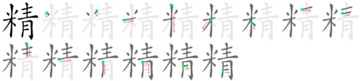
| Stroke order | |||
|---|---|---|---|
 | |||
Han character
精 (radical 119, 米+8, 14 strokes, cangjie input 火木手一月 (FDQMB), four-corner 95927, composition ⿰米青(GHTJV) or ⿰米靑(K or U+FA1D))
Derived characters
References
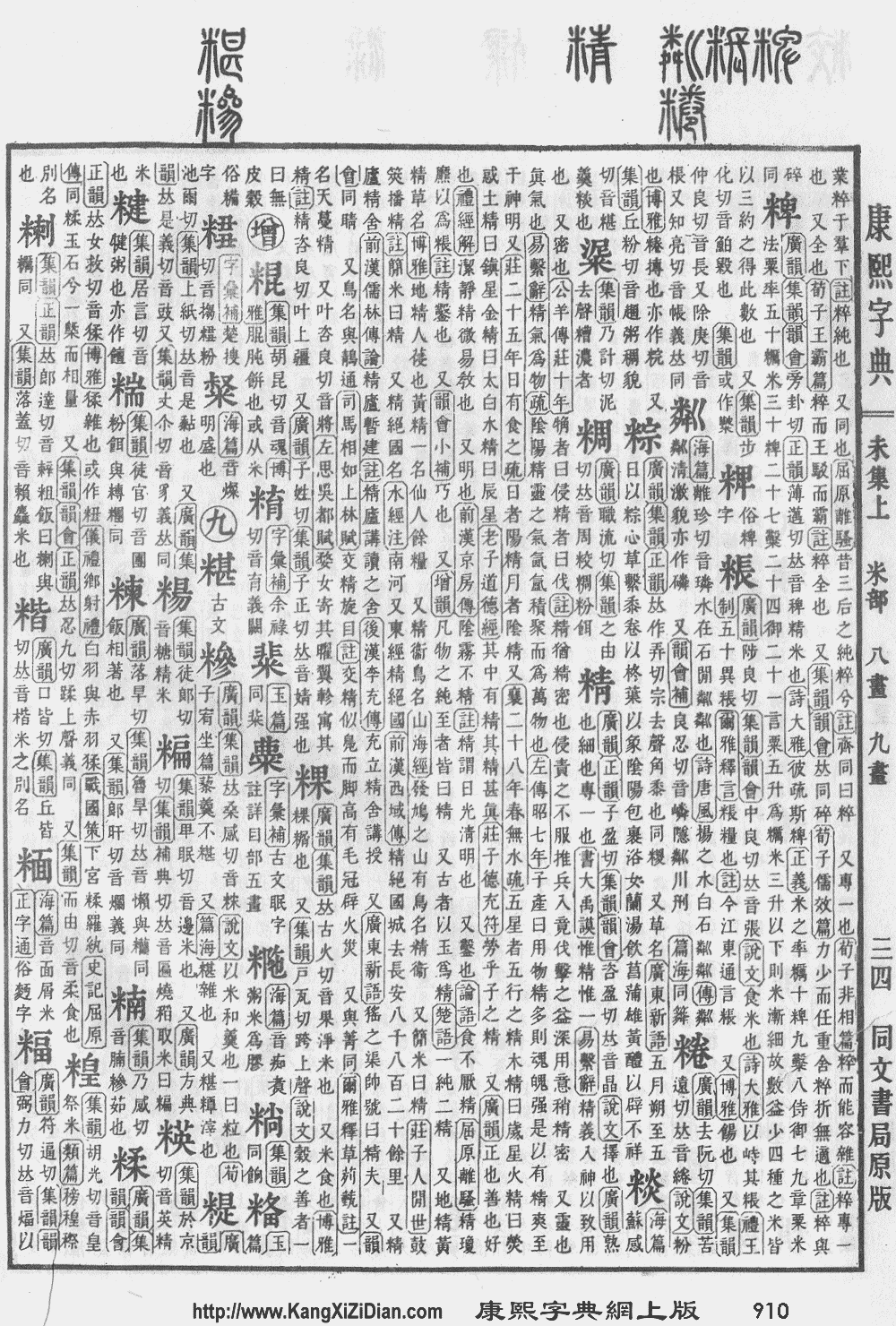
- KangXi: page 910, character 10
- Dai Kanwa Jiten: character 26997
- Dae Jaweon: page 1336, character 8
- Hanyu Da Zidian: volume 5, page 3150, character 11
- Unihan data for U+7CBE
Chinese
| simp. and trad. |
精 | |
|---|---|---|
Glyph origin
| Characters in the same phonetic series (生) (Zhengzhang, 2003) | |
|---|---|
| Old Chinese | |
| 猜 | *sʰlɯː |
| 輤 | *sʰleːns |
| 綪 | *sʰleːns, *ʔsreːŋ |
| 倩 | *sʰleːns, *sʰleŋs |
| 棈 | *sʰleːns |
| 蒨 | *sʰeːns |
| 篟 | *sʰeːns |
| 生 | *sʰleːŋ, *sreŋs |
| 牲 | *sreŋ |
| 笙 | *sreŋ |
| 甥 | *sreŋ |
| 鉎 | *sreŋ, *sleːŋ |
| 珄 | *sreŋ |
| 鼪 | *sreŋ, *sreŋs |
| 猩 | *sreŋ, *seːŋ |
| 狌 | *sreŋ |
| 眚 | *sreŋʔ |
| 貹 | *sreŋs |
| 崝 | *zreːŋ |
| 精 | *ʔsleŋ, *ʔsleŋs |
| 菁 | *ʔsleŋ |
| 鶄 | *ʔsleŋ, *sʰleːŋ |
| 蜻 | *ʔsleŋ, *sʰleːŋ |
| 鼱 | *ʔsleŋ |
| 婧 | *ʔsleŋ, *zleŋs, *zleŋʔ |
| 睛 | *ʔsleŋ, *sʰleŋʔ |
| 箐 | *ʔsleŋ |
| 聙 | *ʔsleŋ |
| 旌 | *ʔsleŋ |
| 清 | *sʰleŋ |
| 圊 | *sʰleŋ |
| 請 | *sʰleŋʔ, *zleŋs, *zleŋ |
| 凊 | *sʰleŋs |
| 䝼 | *zleŋs, *zleŋ |
| 靚 | *zleŋs |
| 情 | *zleŋ |
| 晴 | *zleŋ |
| 夝 | *zleŋ |
| 靜 | *zleŋʔ |
| 靖 | *zleŋʔ |
| 睲 | *seŋʔ, *seːŋs |
| 惺 | *seŋʔ, *seːŋ |
| 性 | *sleŋs |
| 姓 | *sleŋs |
| 靗 | *l̥ʰeŋs |
| 鯖 | *ʔljeŋ, *sʰleːŋ |
| 青 | *sʰleːŋ |
| 靘 | *sʰleːŋ, *sʰleːŋs |
| 掅 | *sʰleːŋs |
| 胜 | *sleːŋ |
| 曐 | *sleːŋ |
| 星 | *sleːŋ |
| 鮏 | *sleːŋ |
| 腥 | *seːŋ, *seːŋs |
| 鯹 | *seːŋ |
| 醒 | *seːŋ, *seːŋʔ, *seːŋs |
| 篂 | *seːŋ |
Phono-semantic compound (形聲, OC *ʔsleŋ, *ʔsleŋs) : semantic 米 (“rice”) + phonetic 青 (OC *sʰleːŋ) – polished rice.
Pronunciation 1
Definitions
精
- polished rice
- essence; energy
- spirit; energy; vigour
- seminal fluid; semen
- spirit; soul
- essence; concentrate
- demon; goblin
- (dialectal, of meat) lean
- fine; refined
- pure; unmixed
- concentrated; sincere
- clear; bright
- exquisite; profound
- extremely; very
- to be proficient; to be expert at
- to expose; to be bare
- (Cantonese) smart; clever
- Alternative form of 睛 (level tone)
Synonyms
| Dialectal synonyms of 精液 (“semen”) [map] | ||
|---|---|---|
| Variety | Location | Words |
| Classical Chinese | 精 | |
| Formal (Written Standard Chinese) | 精液 | |
| Mandarin | Beijing | 㞞 |
| Harbin | 㞞 | |
| Jinan | 㞞 | |
| Muping | 㞞 | |
| Luoyang | 㞞 | |
| Jiedian | 㞞 | |
| Xi'an | 㞞 | |
| Xining | 㞞 | |
| Xuzhou | 㞞 | |
| Yinchuan | 㞞 | |
| Ürümqi | 㞞 | |
| Wuhan | 漿 | |
| Chengdu | 精水、精液、頭兒油、化豬油、豬油 | |
| Guiyang | 精水 | |
| Liuzhou | 精水 | |
| Yangzhou | 㞞 | |
| Nanjing | 㞞 | |
| Cantonese | Hong Kong | 精液、精 |
| Dongguan | 精液 | |
| Kuala Lumpur | 精液 | |
| Gan | Lichuan | 精 |
| Hakka | Meixian | 膦屎 |
| Yudu | 卵屎 | |
| Miaoli (N. Sixian) | 膦屎 | |
| Liudui (S. Sixian) | 膦屎 | |
| Hsinchu (Hailu) | 膦屎 | |
| Dongshi (Dabu) | 膦屎 | |
| Zhuolan (Raoping) | 膦屎 | |
| Yunlin (Zhao'an) | 漦 | |
| Hong Kong | 膦屎 | |
| Senai | 膦屎 | |
| Huizhou | Shexian | 㞞 |
| Tunxi | 精、㞞 | |
| Jixi | 㞞、鳥漿 | |
| Jin | Xinzhou | 㞞、㞞糊子 |
| Min Dong | Fuzhou | 精 |
| Min Nan | Xiamen | 潲 |
| Quanzhou | 潲 | |
| Zhangzhou | 潲 | |
| Taipei | 潲 | |
| Kaohsiung | 潲 | |
| Tainan | 潲 | |
| Taichung | 潲 | |
| Wuqi | 潲 | |
| Hsinchu | 潲 | |
| Taitung | 精 | |
| Lukang | 潲 | |
| Yilan | 潲 | |
| Magong | 潲 | |
| Penang | 潲 | |
| Haifeng | 潲 | |
| Johor Bahru | 精 | |
| Haikou | 精 | |
| Pinghua | Nanning | 精、𨳍水 |
| Wu | Shanghai | 精、白脫油、白脫 |
| Suzhou | 精 | |
| Hangzhou | 㞞、陽水 | |
| Wenzhou | 頹漿 | |
| Chongming | 㞞 | |
| Danyang | 㞞 | |
| Jinhua | 㞞 | |
| Ningbo | 卵漿、漿水 | |
| Xiang | Changsha | 卵漿、精子 |
| Loudi | 卵水、水、漿 | |
Compounds
Derived terms from 精
|
|
|
Pronunciation 2
Definitions
精
Pronunciation 3
| For pronunciation and definitions of 精 – see 晴 (“clear; fine”). (This character, 精, is a variant form of 晴.) |
Japanese
Kanji
精
Readings
Compounds
Etymology 1
| Kanji in this term |
|---|
| 精 |
| せい Grade: 5 |
| on’yomi |
From Middle Chinese 精 (t͡siᴇŋ, “essence, energy”). Compare modern Mandarin reading jīng.
Pronunciation
Adjective
精 (-na inflection, hiragana せい, rōmaji sei)
Inflection
Inflection of 精
| Stem forms | |||
|---|---|---|---|
| Imperfective (未然形) | 精だろ | せいだろ | sei daro |
| Continuative (連用形) | 精で | せいで | sei de |
| Terminal (終止形) | 精だ | せいだ | sei da |
| Attributive (連体形) | 精な | せいな | sei na |
| Hypothetical (仮定形) | 精なら | せいなら | sei nara |
| Imperative (命令形) | 精であれ | せいであれ | sei de are |
| Key constructions | |||
| Informal negative | 精ではない 精じゃない |
せいではない せいじゃない |
sei de wa nai sei ja nai |
| Informal past | 精だった | せいだった | sei datta |
| Informal negative past | 精ではなかった 精じゃなかった |
せいではなかった せいじゃなかった |
sei de wa nakatta sei ja nakatta |
| Formal | 精です | せいです | sei desu |
| Formal negative | 精ではありません 精じゃありません |
せいではありません せいじゃありません |
sei de wa arimasen sei ja arimasen |
| Formal past | 精でした | せいでした | sei deshita |
| Formal negative past | 精ではありませんでした 精じゃありませんでした |
せいではありませんでした せいじゃありませんでした |
sei de wa arimasen deshita sei ja arimasen deshita |
| Conjunctive | 精で | せいで | sei de |
| Conditional | 精なら(ば) | せいなら(ば) | sei nara (ba) |
| Provisional | 精だったら | せいだったら | sei dattara |
| Volitional | 精だろう | せいだろう | sei darō |
| Adverbial | 精に | せいに | sei ni |
| Degree | 精さ | せいさ | seisa |
Noun
- polishing, refining
- care, conscientiousness
- something polished or refined, particularly polished white rice
- vim and vigor, energy in doing things
- life force, vitality, the energy of living
- one's emotions, mind, or soul
- the soul or spirit of a thing, particularly when appearing on its own; a fairy, a sprite
- semen
Synonyms
Etymology 2
| Kanji in this term |
|---|
| 精 |
| しらげ Grade: 5 |
| kun’yomi |
Noun stem of verb 精げる (shirageru, “to polish, to refine”), itself derived from 白 (shira, “white”, form used in compounds, usually shiro on its own) + ぐ (gu, verbalizing suffix), originally just meaning to whiten something.
Pronunciation
Noun
精 (hiragana しらげ, rōmaji shirage)
Synonyms
References
Korean
Hanja
精 • (jeong) (hangeul 정, revised jeong, McCune–Reischauer chŏng, Yale ceng)
- This term needs a translation to English. Please help out and add a translation, then remove the text
{{rfdef}}.
Vietnamese
Han character
精 (tinh, tênh)
- This term needs a translation to English. Please help out and add a translation, then remove the text
{{rfdef}}.
This article is issued from
Wiktionary.
The text is licensed under Creative Commons - Attribution - Sharealike.
Additional terms may apply for the media files.