ovum
English
Etymology
Pronunciation
Noun
ovum (plural ova)
Synonyms
Hypernyms
Coordinate terms
Related terms
Translations
gamete
|
|
See also
Japanese
Romanization
ovum
Latin
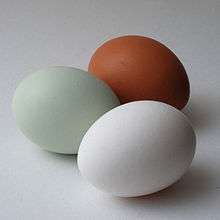
ōva gallīnārum (hens' eggs).
Etymology
From Proto-Italic *ōwom, from Proto-Indo-European *h₂ōwyóm (“egg”), likely a derivative of *h₂éwis (“bird”) (whence also Latin avis (“bird”)). Cognates include Ancient Greek ᾠόν (ōión), Old Church Slavonic аице (aice), Persian خایه (ḵẖāya), Old Norse egg, Old English ǣġ.
Pronunciation
- (Classical) IPA(key): /ˈoː.wum/, [ˈoː.wũ]
Noun
ōvum n (genitive ōvī); second declension
Inflection
Second declension.
| Case | Singular | Plural |
|---|---|---|
| nominative | ōvum | ōva |
| genitive | ōvī | ōvōrum |
| dative | ōvō | ōvīs |
| accusative | ōvum | ōva |
| ablative | ōvō | ōvīs |
| vocative | ōvum | ōva |
Derived terms
Descendants
References
- ovum in Charlton T. Lewis and Charles Short (1879) A Latin Dictionary, Oxford: Clarendon Press
- ovum in Charlton T. Lewis (1891) An Elementary Latin Dictionary, New York: Harper & Brothers
- ovum in Charles du Fresne du Cange’s Glossarium Mediæ et Infimæ Latinitatis (augmented edition, 1883–1887)
- ovum in Gaffiot, Félix (1934) Dictionnaire Illustré Latin-Français, Hachette
- Carl Meissner; Henry William Auden (1894) Latin Phrase-Book, London: Macmillan and Co.
- (ambiguous) from beginning to end: ab ovo usque ad mala (proverb.)
- (ambiguous) from beginning to end: ab ovo usque ad mala (proverb.)
- ovum in Harry Thurston Peck, editor (1898) Harper's Dictionary of Classical Antiquities, New York: Harper & Brothers
Malay
Alternative forms
Etymology
Borrowed from English ovum, from Latin ōvum, from Proto-Indo-European *h₂ōwyóm, likely a derivative of *h₂éwis.
Pronunciation
- IPA(key): [ovom]
- Rhymes: -vom, -om
Noun
ovum (Jawi spelling اوۏوم, plural ovum-ovum)
This article is issued from
Wiktionary.
The text is licensed under Creative Commons - Attribution - Sharealike.
Additional terms may apply for the media files.