dead
See also: déad
English
Etymology
From Middle English ded, deed, from Old English dēad, from Proto-Germanic *daudaz. Compare West Frisian dead, dea, Dutch dood, German tot, Danish, Norwegian død, Norwegian Nynorsk daud.
Pronunciation
- enPR: dĕd, IPA(key): /dɛd/
Audio (US) (file) - Rhymes: -ɛd
- (New Zealand) Homophone: did
Adjective
dead (comparative deader, superlative deadest)
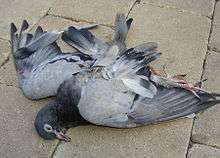
A dead pigeon
- (not comparable) No longer living.
- All of my grandparents are dead.
- (hyperbolic) Figuratively, not alive; lacking life.
- 1600, William Shakespeare, As You Like It, Act III, Scene 3:
- When a man's verses cannot be understood, nor a man's good wit seconded with the forward child, understanding, it strikes a man more dead than a great reckoning in a little room.
-
- (of another person) So hated that they are absolutely ignored.
- He is dead to me.
- I will think of you as dead, until my husband makes you that way. Then I will think of you no longer. - Mary, Rob Roy
- Without emotion.
- She stood with dead face and limp arms, unresponsive to my plea.
- Stationary; static.
- the dead load on the floor
- a dead lift
- Without interest to one of the senses; dull; flat.
- dead air
- a dead glass of soda.
- Unproductive.
- dead time
- dead fields
- (not comparable, of a machine, device, or electrical circuit) Completely inactive; without power; without a signal.
- OK, the circuit's dead. Go ahead and cut the wire.
- Now that the motor's dead you can reach in and extract the spark plugs.
- (not comparable) Broken or inoperable.
- That monitor is dead; don’t bother hooking it up.
- (not comparable) No longer used or required.
- There are several dead laws still on the books regulating where horses may be hitched.
- Is this beer glass dead?
- (engineering) Not imparting motion or power.
- the dead spindle of a lathe
- (not comparable, sports) Not in play.
- Once the ball crosses the foul line, it's dead.
- (not comparable, golf, of a golf ball) Lying so near the hole that the player is certain to hole it in the next stroke.
- (not comparable, baseball, slang, 1800s) Tagged out.
- (not comparable) Full and complete.
- dead stop
- dead sleep
- dead giveaway
- dead silence
- (not comparable) Exact.
- dead center
- dead aim
- a dead eye
- a dead level
- Experiencing pins and needles (paresthesia).
- After sitting on my hands for a while, my arms became dead.
- (informal) (Certain to be) in big trouble.
- "You come back here this instant! Oh, when I get my hands on you, you're dead, mister!"
- Constructed so as not to transmit sound; soundless.
- a dead floor
- (obsolete) Bringing death; deadly.
- (Can we find and add a quotation of Shakespeare to this entry?)
- (law) Cut off from the rights of a citizen; deprived of the power of enjoying the rights of property.
- A person who is banished or who becomes a monk is civilly dead.
Usage notes
- In Middle and Early Modern English, the phrase is dead was more common where the present perfect form has died is common today. Example:
- 1611, King James Bible
- I do not frustrate the grace of God: for if righteousness come by the law, then Christ is dead in vain. (Gal. 2:21)
Synonyms
- See also Thesaurus:dead
Antonyms
Derived terms
Translations
no longer alive
|
|
figuratively, not alive
fully and completely motionless
|
|
without emotion
of a device: completely inactive; without power
broken or inoperable
no longer used or required
|
sports: not in play
Adverb
dead (not comparable)
- (degree) Exactly right.
- dead right; dead level; dead flat; dead straight; dead left
- He hit the target dead in the centre.
- (degree) Very, absolutely, extremely, suddenly.
- dead wrong; dead set; dead serious; dead drunk; dead broke; dead earnest; dead certain; dead slow; dead sure; dead simple; dead honest; dead accurate; dead easy; dead scared; dead solid; dead black; dead white; dead empty;
- As if dead.
- dead tired; dead quiet; dead asleep; dead pale; dead cold; dead still
- (Can we date this quote?) Charles Dickens
- I was tired of reading, and dead sleepy.
Translations
Exactly right
Very, absolutely, extremely, suddenly
Noun
dead
- (uncountable, singular only, often with "the") Time when coldness, darkness, or stillness is most intense.
- The dead of night. The dead of winter.
- (plural, with "the", a demonstrative, or a possessive) Those who have died.
- Have respect for the dead.
- The villagers are mourning their dead.
Synonyms
- (those who have died): deceased
Translations
time when coldness, darkness, or stillness is most intense
those who have died
|
|
- The translations below need to be checked and inserted above into the appropriate translation tables, removing any numbers. Numbers do not necessarily match those in definitions. See instructions at Wiktionary:Entry layout#Translations.
Verb
dead (third-person singular simple present deads, present participle deading, simple past and past participle deaded)
- (transitive) To prevent by disabling; stop.
- 1826, The Whole Works of the Right Rev. Edward Reynolds, Lord Bishop of Norwich, collected by Edward Reynolds, Benedict Riveley, and Alexander Chalmers. pp. 227. London: B. Holdsworth.
- “What a man should do, when finds his natural impotency dead him in spiritual works”
- 1826, The Whole Works of the Right Rev. Edward Reynolds, Lord Bishop of Norwich, collected by Edward Reynolds, Benedict Riveley, and Alexander Chalmers. pp. 227. London: B. Holdsworth.
- (transitive) To make dead; to deaden; to deprive of life, force, or vigour.
- Chapman
- Heaven's stern decree, / With many an ill, hath numbed and deaded me.
- Chapman
- (Britain, transitive, slang) To kill.
- 2006, Leighanne Boyd, Once Upon A Time In The Bricks (page 178)
- This dude at the club was trying to kill us so I deaded him, and then I had to collect from Spice.
- 2008, Marvlous Harrison, The Coalition (page 106)
- “What, you was just gonna dead him because if that's the case then why the fuck we getting the money?” Sha asked annoyed.
- 2006, Leighanne Boyd, Once Upon A Time In The Bricks (page 178)
Related terms
Derived terms
Terms derived from the adjective, adverb, noun, or verb dead
Anagrams
Old English
Etymology
From Proto-Germanic *daudaz, from Proto-Indo-European *dʰautós, originally a past participle. Cognate with Old Frisian dād (West Frisian dead), Old Saxon dōd, Dutch dood, Old High German tōt (German tot), Old Norse dauðr (Swedish död), Gothic 𐌳𐌰𐌿𐌸𐍃 (dauþs).
Pronunciation
- IPA(key): /dæːɑ̯d/
Adjective
dēad
Declension
| Weak | Strong | ||||||||||||
|---|---|---|---|---|---|---|---|---|---|---|---|---|---|
| case | singular | plural | case | singular | plural | ||||||||
| m | n | f | m | n | f | m | n | f | |||||
| nominative | dēada | dēade | dēade | dēadan | nom. | dēad | dēade | dēad | dēada, -e | ||||
| accusative | dēadan | dēade | dēadan | acc. | dēadne | dēad | dēade | dēade | dēad | dēada, -e | |||
| genitive | dēadan | dēadra, dēadena | gen. | dēades | dēades | dēadre | dēadra | ||||||
| dative | dēadan | dēadum | dat. | dēadum | dēadum | dēadre | dēadum | ||||||
| instrumental | dēade | ||||||||||||
Derived terms
Related terms
Descendants
See also
Volapük
Etymology
Borrowed from English dead or death (with the "th" changed to "d").
Pronunciation
- IPA(key): [deˈad]
Noun
dead (plural deads)
Declension
declension of dead
| singular | plural | |
|---|---|---|
| nominative | dead | deads |
| genitive | deada | deadas |
| dative | deade | deades |
| accusative | deadi | deadis |
| predicative | deadu | deadus |
| vocative | o dead! | o deads! |
Derived terms
This article is issued from
Wiktionary.
The text is licensed under Creative Commons - Attribution - Sharealike.
Additional terms may apply for the media files.