小
| ||||||||
Translingual
| Stroke order | |||
|---|---|---|---|
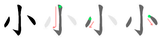 | |||
| Stroke order | |||
|---|---|---|---|
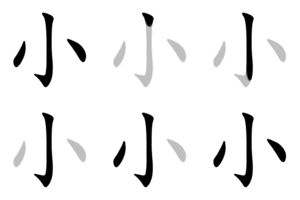 | |||
Han character
小 (radical 42, 小+0, 3 strokes, cangjie input 弓金 (NC), four-corner 90000, composition ⿻亅八)
- Kangxi radical #42, ⼩.
- Shuōwén Jiězì radical №15
Derived characters
References
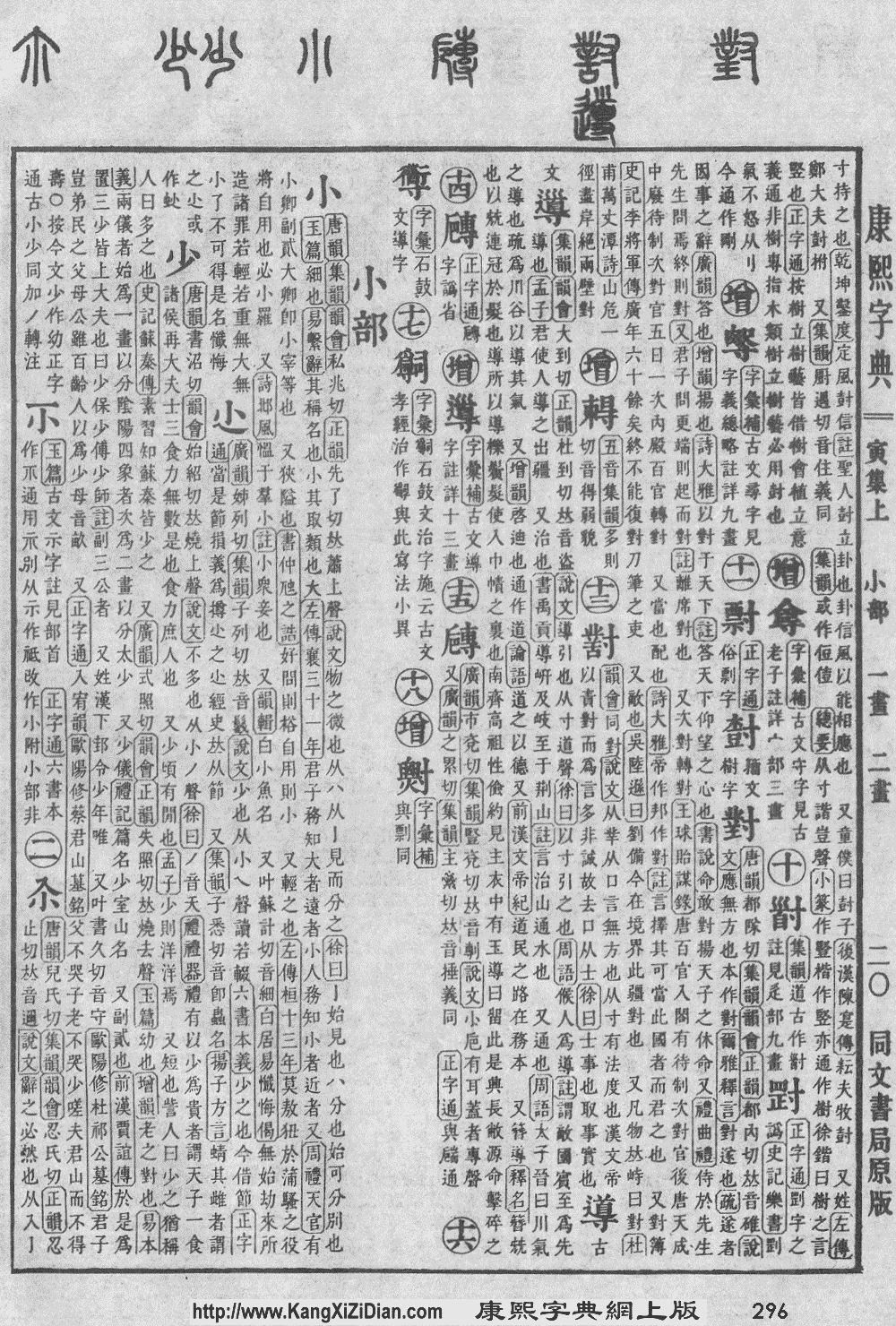
- KangXi: page 296, character 18
- Dai Kanwa Jiten: character 7473
- Dae Jaweon: page 587, character 8
- Hanyu Da Zidian: volume 1, page 560, character 12
- Unihan data for U+5C0F
Chinese
| simp. and trad. |
小 | |
|---|---|---|
Glyph origin
| Historical forms of the character 小 | ||||
|---|---|---|---|---|
| Shang | Western Zhou | Warring States | Shuowen Jiezi (compiled in Han) | Liushutong (compiled in Ming) |
| Oracle bone script | Bronze inscriptions | Qin slip script | Small seal script | Transcribed ancient scripts |
 |
 |
 |
 |
 |
| Characters in the same phonetic series (小) (Zhengzhang, 2003) | |
|---|---|
| Old Chinese | |
| 觘 | *sm̥ʰreːw, *sm̥ʰreːws |
| 抄 | *sm̥ʰreːw, *sm̥ʰreːws |
| 鈔 | *sm̥ʰreːw, *sm̥ʰreːws |
| 訬 | *sm̥ʰreːw, *mewʔ |
| 炒 | *sʰroːʔ |
| 吵 | *sm̥ʰreːwʔ, *mewʔ |
| 耖 | *sm̥ʰreːws |
| 仯 | *sm̥ʰreːws |
| 眇 | *mewʔ |
| 渺 | *mewʔ |
| 杪 | *mewʔ |
| 秒 | *mewʔ |
| 篎 | *mewʔ, *mews |
| 妙 | *mews |
| 玅 | *mews |
| 釥 | *sm̥ʰewʔ |
| 小 | *smewʔ |
| 少 | *hmjewʔ, *hmjews |
| 麨 | *m̥ʰjewʔ |
| 尠 | *senʔ, *smos |
Two possible interpretations:
- Ideogram (指事) – three small dots > small.
- Pictogram (象形) – three granules of sand – original character of 沙 (OC *sraːl, *sraːls) > small.
Starting from some bronze inscriptions, the dots have become elongated. Based on this form, Shuowen erroneously considers it to be an ideogrammic compound (會意) : 八 (“to divide; to separate”) + 丨 (“small object”).
Compare with 少 (OC *hmjewʔ, *hmjews), represented by four dots in its oracle bone script form.
Pronunciation
Definitions
小
- small, tiny, little
- Antonyms: 大 (dà)
- 小孩 (xiǎohái, “child”)
- minor, petty
- briefly, for a short while
- 小憩 (xiǎoqì, “brief rest”)
- slightly, a little
- young
- Antonyms: 老 (lǎo)
- (the) youngest
- a young person; child, kid, baby
- Prefix used in front of family name to indicate informality or affection (for young people, 老 (lǎo) for elder people).
- For example, Someone called 李國寶/李国宝 can be called 小李.
- (humble) my, our
- Short for 小學/小学 (xiǎoxué, “primary school”). Used only in the abbreviation of a school name.
- (euphemistic, Cantonese) a euphemism of 屌 (diǎo)
Synonyms
| Dialectal synonyms of 小 (“small”) [map] | ||
|---|---|---|
| Variety | Location | Words |
| Formal (Written Standard Chinese) | 小 | |
| Mandarin | Beijing | 小 |
| Taiwan | 小 | |
| Tianjin | 小 | |
| Jinan | 小 | |
| Xi'an | 小、碎 | |
| Wuhan | 小 | |
| Chengdu | 小 | |
| Yangzhou | 小 | |
| Hefei | 小 | |
| Cantonese | Guangzhou | 細 |
| Hong Kong | 細 | |
| Taishan | 細 | |
| Yangjiang | 細 | |
| Gan | Nanchang | 細、小 |
| Hakka | Meixian | 細 |
| Xingning | 細 | |
| Huidong | 細 | |
| Qujiang | 細 | |
| Xiaosanjiang | 細 | |
| Changting | 細 | |
| Pingyu | 細 | |
| Wuping | 細 | |
| Liancheng | 細 | |
| Ninghua | 小 | |
| Ruijin | 細 | |
| Miaoli (N. Sixian) | 細 | |
| Liudui (S. Sixian) | 細 | |
| Hsinchu (Hailu) | 細 | |
| Dongshi (Dabu) | 細 | |
| Zhuolan (Raoping) | 細 | |
| Yunlin (Zhao'an) | 細 | |
| Jin | Taiyuan | 小 |
| Min Bei | Jian'ou | 小 |
| Min Dong | Fuzhou | 嫩、細 |
| Min Nan | Xiamen | 細 |
| Quanzhou | 細 | |
| Zhangzhou | 細 | |
| Taipei | 小、細 | |
| Kaohsiung | 小、細 | |
| Tainan | 小、細 | |
| Taichung | 小、細 | |
| Hsinchu | 小、細 | |
| Lukang | 小、細 | |
| Sanxia | 小、細 | |
| Yilan | 小、細 | |
| Kinmen | 小 | |
| Magong | 小 | |
| Chaozhou | 細 | |
| Wu | Shanghai | 小 |
| Suzhou | 小 | |
| Wenzhou | 小、瑣 | |
| Xiang | Changsha | 細、小 |
| Shuangfeng | 細 | |
Compounds
|
|
|
Descendants
Japanese
Kanji
Readings
- Goon: しょう (shō, Jōyō)←せう (seu, historical)
- Kan’on: しょう (shō, Jōyō)←せう (seu, historical)
- Kun: ちいさい (chīsai, 小さい, Jōyō)←ちひさい (tifisai, historical); こ (ko, 小, Jōyō); お (o, 小)←を (wo, historical); さ (sa, 小)
- Nanori: いさら (isara); こう (kō); ささ (sasa); さざ (saza); ちいさ (chīsa)←ちひさ (tifisa, historical)
Compounds
- 小陰唇 (shōinshin, “labia minora”)
- 小国 (shōkoku, “small nation”)
- 小説 (shōsetsu, “novel”)
- 小前庭腺 (shōzen teisen, “Skene's gland”)
- 小額 (shōgaku, “small sum”)
- 小アジア (Shō-Ajia, “Asia Minor”)
- 小規模 (shōkibo, “small-scale”)
- 小東京 (Shō-Tōkyō, “mini Tokyo”)
- 小数 (shōsū, “decimal”)
- 小差 (shōsa, “slight difference”)
- 小冊子 (shōsasshi, “pamphlet”)
- 小児 (shōni, “infant”)
- 小銃 (shōjū, “rifle”)
- 小人 (shōnin, “child”)
- 小選挙区 (shō-senkyoku, “small electoral district”)
- 小品 (shōhin, “essay”)
- 小量 (shōryō, “small dose”)
- 小惑星 (shōwakusei, “asteroid”)
- 大小 (daishō, “size”)
- 縮小 (shukushō, “reduction”)
- 中小 (chūshō, “small to medium”)
- 最小 (saishō, “minimum”)
- 小事 (shōji, “trifle”)
- 小学 (shōgaku, “elementary school”)
- 小康 (shōkō, “lull”)
- 小便 (shōben, “urine”)
- 過小評価 (kashō-hyōka, “underestimation”)
- 小一 (shōichi, “first-year elementary student”)
- 同小 (dōshō, “said elementary school”)
- 小豆 (azuki, “adzuki bean”)
- 小火 (boya, “small fire”)
- 袋小路 (fukurokouji, “blind alley”)
See also
- 小さな (chiisa na, “small”)
Etymology 1
| Kanji in this term |
|---|
| 小 |
| しょう Grade: 1 |
| on’yomi |
/seu/ → /ɕeu/ → /ɕoː/
From Middle Chinese 小 (MC siᴇuX).
The suffix sense is a clipping of 小学校 (shōgakkō, “elementary school”).
Pronunciation
Noun
小 (hiragana しょう, rōmaji shō, historical hiragana せう)
- smallness; small size, small (sometimes used as an abbreviation for small serving, etc.)
- Short for 小の月 (shō no tsuki).
- (historical) during the Kamakura and Muromachi periods, a unit of field area equal to around 400 square metres. (Can we verify(+) this sense?)
- 100 square footsteps before the Taikō land survey, and 120 square footsteps after.
Antonyms
Derived terms
- 小の月 (shō no tsuki, month with 30 days or less)
Idioms
- 大は小を兼ねる (dai wa shō o kaneru, “The greater serves the lesser.”)
Coordinate terms
Prefix
Suffix
小 (hiragana しょう, rōmaji -shō, historical hiragana せう)
- suffix after names of elementary schools
- 佃小
- tsukuda-shō
- Tsukuda Elementary School
- 佃小
Proper noun
小 (hiragana しょう, rōmaji Shō, historical hiragana せう)
- a surname.
Etymology 2
| Kanji in this term |
|---|
| 小 |
| こ Grade: 1 |
| kun’yomi |
/ko1/ invalid IPA characters (1) → /ko/
From the Old Japanese stem こ (ko-). Cognate with 子 (ko, “child”).
Prefix
Related terms
Derived terms
- 小石 (koishi, “pebble”)
- 小牛 (koushi, “calf”)
- 小唄 (kouta, “ballad”)
- 小売 (kouri, “retail”)
- 小枝 (koeda, “twig”)
- 小型 (kogata, “tiny”)
- 小刀 (kogatana, “small knife”)
- 小刻み (kokizami, “bit by bit”)
- {{ja-r|小%切%手|こ%ぎっ%て|[[check}]]}
- 小口 (koguchi, “small amount”)
- 小声 (kogoe, “whisper”)
- 小言 (kogoto, “scolding”)
- 小さじ (kosaji, “teaspoon”)
- 小雨 (kosame, “drizzle”)
- 小皿 (kozara, “small dish”)
- 小島 (kojima, “islet”)
- 小柄 (kozuka, “small build”)
- 小銭 (kozeni, “small change”)
- 小僧 (kozō, “youngster”)
- 小遣い (kozukai, “spending money”)
- 小包 (kozutsumi, “parcel”)
- 小手先 (kotesaki, “superficial cleverness”)
- 小道具 (kodōgu, “stage props”)
- 小鳥 (kotori, “little bird”)
- 小幅 (kohaba, “small cloth; narrow range”)
- 小羊 (kohitsuji, “lamb”)
- 小舟 (kobune, “boat”)
- 小麦 (komugi, “wheat”)
- 小結 (komusubi, rank of sumo wrestler)
- 小文字 (komoji, “lowercase letter”)
- 小物 (komono, “gadget”)
- 小屋 (koya, “cabin”)
- 小山 (koyama, “hill”)
- 小雪 (koyuki, “light snowfall”)
- 小指 (koyubi, “little finger”)
Etymology 3
| Kanji in this term |
|---|
| 小 |
| お Grade: 1 |
| kun’yomi |
/wo/ → /o/
From the Old Japanese stem を (wo-), modern お (o-).
Prefix
小 (hiragana お, rōmaji o-, historical hiragana を)
- attached to certain nouns:
- used proverbially to represent "small" or "slight" (Can we verify(+) this sense?)
- 小止みなく降る雨 (oyaminaku furu ame)
- 小暗い道 (ogurai michi)
Derived terms
Etymology 4
| Kanji in this term |
|---|
| 小 |
| ささ Grade: 1 |
| kun’yomi |
| Kanji in this term |
|---|
| 小 |
| さざ Grade: 1 |
| kun’yomi |
From the Old Japanese stem ささ (sasa-), found in terms such as 笹 (sasa, “bamboo grass”), 囁く (sasayaku, “to whisper”), and 些か (isasaka, “a little”), all related to small or slight.
Saza appears to be a later derivation from sasa.
Alternative forms
- 細, 些些
Prefix
小 (hiragana ささ, rōmaji sasa-, alternative reading さざ, rōmaji saza-)
Derived terms
- 栄螺 (sazae, “turban shell”)
- 漣 (sazanami, “ripple”)
References
Korean
Hanja
小 • (so)
- smallness, small things
Compounds
- 소음순 (小陰脣, so-eumsun, “labia minora”)
Vietnamese
Han character
小 (tiểu)
- (only before noun) small