hat
English
Pronunciation
- (UK, US) IPA(key): /hæt/
Audio (US) (file)
- (Canada, California, Received Pronunciation) IPA(key): [hat]
Audio (UK RP) (file)
- Rhymes: -æt
Etymology 1
From Middle English hat, from Old English hæt (“head-covering, hat”), from Proto-Germanic *hattuz (“hat”), from Proto-Indo-European *kadʰ- (“to guard, cover, care for, protect”). Cognate with North Frisian hat (“hat”), Danish hat (“hat”), Swedish hatt (“hat”), Icelandic hattur (“hat”), Latin cassis (“helmet”), Lithuanian kudas (“bird's crest or tuft”), Avestan 𐬑𐬀𐬊𐬛𐬀 (xaoda, “hat”), Welsh caddu (“to provide for, ensure”). Compare also hood.
Noun
hat (plural hats)
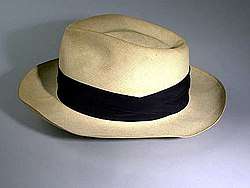
- A covering for the head, often in the approximate form of a cone or a cylinder closed at its top end, and sometimes having a brim and other decoration.
- 1913, Mrs. [Marie] Belloc Lowndes, chapter II, in The Lodger, London: Methuen, OCLC 7780546; republished in Novels of Mystery: The Lodger; The Story of Ivy; What Really Happened, New York, N.Y.: Longmans, Green and Co., 55 Fifth Avenue, [1933], OCLC 2666860, page 0091:
- There was a neat hat-and-umbrella stand, and the stranger's weary feet fell soft on a good, serviceable dark-red drugget, which matched in colour the flock-paper on the walls.
-
- (figuratively) A particular role or capacity that a person might fill.
- 1993, Susan Loesser, A Most Remarkable Fella: Frank Loesser and the Guys and Dolls in His Life: A Portrait by His Daughter, Hal Leonard Corporation (2000), →ISBN, p.121:
- My mother was wearing several hats in the early fifties: hostess, scout, wife, and mother.
- 1993, Susan Loesser, A Most Remarkable Fella: Frank Loesser and the Guys and Dolls in His Life: A Portrait by His Daughter, Hal Leonard Corporation (2000), →ISBN, p.121:
- (figuratively) Any receptacle from which numbers/names are pulled out in a lottery.
- (video games) A hat switch.
- 2002, Ernest Pazera, Focus on SDL, p.139:
- The third type of function allows you to check on the state of the joystick's buttons, axes, hats, and balls.
- 2002, Ernest Pazera, Focus on SDL, p.139:
- (typography, nonstandard, rare) = háček
- 1997 October 6th, “Patricia V. Lehman” (user name), rec.antiques (Usenet newsgroup), “Re: Unusual Mark – made in Cechoslovakia”, Message ID: <34390399.BD7@umich.edu>#1/1
- I’lll have to leave it up to antiques experts to tell you when objects were marked that way, but I can tell you it’s called a “hacek” (with the hat over the “c” and pronounced “hacheck”.) It is used to show that a “c” is pronounced as “ch” and an “s” as “sh.” Sometimes linguists just call it the “hat.”
- 1997 October 6th, “Patricia V. Lehman” (user name), rec.antiques (Usenet newsgroup), “Re: Unusual Mark – made in Cechoslovakia”, Message ID: <34390399.BD7@umich.edu>#1/1
- (Internet slang) User rights on a website, such as the right to edit pages others cannot.
Hyponyms
- See also Thesaurus:headgear
Derived terms
|
Translations
|
|
See also
Verb
hat (third-person singular simple present hats, present participle hatting, simple past and past participle hatted)
- (transitive) To place a hat on.
- 2004, David Mitchell, Cloud Atlas
- After the maids had hatted and gloved the girls, the carriage was summoned and I was carted around one church after another.
- 2004, David Mitchell, Cloud Atlas
- (transitive) To appoint as cardinal.
- 1929, "Five New Hats," Time, 2 December, 1929,
- It was truly a breathtaking rise. From the quiet school, Pope Pius XI had jumped Father Verdier over the heads of innumerable Bishops, made him Archbishop of Paris. Soon he was to be hatted a Prince of the Church and put in charge of the Cathedral of Notre-Dame.
- 1929, "Five New Hats," Time, 2 December, 1929,
Etymology 2
Verb
hat
- (Scotland, Northern England or obsolete) simple past tense of hit
- When I axed him why he hat 'im. He saidː "I ne know, I ne know, mate".
References
Further reading

Anagrams
Danish
Etymology
From Old Norse hattr, hǫttr.
Pronunciation
- IPA(key): [had̥]
Noun
hat c (singular definite hatten, plural indefinite hatte)
Inflection
German
Pronunciation
- IPA(key): /hat/
Audio (Germany) (file) - Rhymes: -at
Verb
hat
- Third-person singular present of haben.
Hungarian
Pronunciation
- IPA(key): [ˈhɒt]
Audio (file)
Etymology 1
From Proto-Finno-Ugric *kutte (“six”). Cognates include Finnish kuusi, Mansi хо̄т (hōt), Khanty хәт (xət).
Numeral
hat
| < 5 | 6 | 7 > |
|---|---|---|
| Cardinal : hat Ordinal : hatodik | ||
Declension
| Inflection (stem in -o-, back harmony) | ||
|---|---|---|
| singular | plural | |
| nominative | hat | hatok |
| accusative | hatot | hatokat |
| dative | hatnak | hatoknak |
| instrumental | hattal | hatokkal |
| causal-final | hatért | hatokért |
| translative | hattá | hatokká |
| terminative | hatig | hatokig |
| essive-formal | hatként | hatokként |
| essive-modal | — | — |
| inessive | hatban | hatokban |
| superessive | haton | hatokon |
| adessive | hatnál | hatoknál |
| illative | hatba | hatokba |
| sublative | hatra | hatokra |
| allative | hathoz | hatokhoz |
| elative | hatból | hatokból |
| delative | hatról | hatokról |
| ablative | hattól | hatoktól |
| Possessive forms of hat | ||
|---|---|---|
| possessor | single possession | multiple possessions |
| 1st person sing. | hatom | hatjaim |
| 2nd person sing. | hatod | hatjaid |
| 3rd person sing. | hatja | hatjai |
| 1st person plural | hatunk | hatjaink |
| 2nd person plural | hatotok | hatjaitok |
| 3rd person plural | hatjuk | hatjaik |
Derived terms
See also
Etymology 2
Verb
hat
Conjugation
| Infinitive | hatni | |||||||
|---|---|---|---|---|---|---|---|---|
| Past participle | hatott | |||||||
| Present participle | ható | |||||||
| Future participle | - | |||||||
| Adverbial participle | hatva | |||||||
| Potential | hathat | |||||||
| 1st person sg | 2nd person sg informal | 3rd person sg, 2nd person sg formal |
1st person pl | 2nd person pl informal | 3rd person pl, 2nd person pl formal | |||
| Indicative mood | Present | Indefinite | hatok | hatsz | hat | hatunk | hattok | hatnak |
| Definite | intransitive verb, definite forms are not used | |||||||
| Past | Indefinite | hatottam | hatottál | hatott | hatottunk | hatottatok | hatottak | |
| Definite | - | |||||||
| Conditional mood | Present | Indefinite | hatnék | hatnál | hatna | hatnánk | hatnátok | hatnának |
| Definite | - | |||||||
| Subjunctive mood | Present | Indefinite | hassak | hass or hassál |
hasson | hassunk | hassatok | hassanak |
| Definite | - | |||||||
| Conjugated infinitive | hatnom | hatnod | hatnia | hatnunk | hatnotok | hatniuk | ||
Synonyms
- (seem): tűnik
Derived terms
(With verbal prefixes):
Interlingue
Verb
hat
- past and passive participle of har
Irish
Pronunciation
- IPA(key): /hat̪ˠ/
Noun
hat
- h-prothesized form of at
Verb
hat
- h-prothesized form of at
Luxembourgish
Pronunciation
- IPA(key): /haːt/
Verb
hat
Verb
hat
Maricopa
Noun
hat (plural haat)
Norwegian Bokmål
Etymology 1
From Old Norse hatr, from Proto-Germanic *hataz.
Noun
hat n (definite singular hatet, indefinite plural hat, definite plural hata or hatene)
Derived terms
Related terms
- hate (verb)
Etymology 2
Verb
hat
- imperative of hate
References
- “hat” in The Bokmål Dictionary.
Norwegian Nynorsk
Pronunciation
- IPA(key): /hɑːt/
Etymology 1
From Old Norse hatr, from Proto-Germanic *hataz. Akin to English hate.
Noun
hat n (definite singular hatet, indefinite plural hat, definite plural hata)
Derived terms
Verb
hat
- imperative of hate
References
- “hat” in The Nynorsk Dictionary.
Old English
Pronunciation
- IPA(key): /hɑːt/
Etymology 1
From Proto-Germanic *haitaz. Cognate with Old Frisian hēt (West Frisian hjit, Old Saxon hēt, Dutch heet, Old High German heiz (German heiß), Old Norse heitr (Swedish het). Cognate to Albanian ethe (“shiver, fiever”), dialectal hethe and ith (“warmth, body heat”), dialectal hith.
Adjective
hāt
Declension
| Singular | Masculine | Feminine | Neuter |
|---|---|---|---|
| Nominative | hāt | hāt | hāt |
| Accusative | hātne | hāte | hāt |
| Genitive | hātes | hātre | hātes |
| Dative | hātum | hātre | hātum |
| Instrumental | hāte | hātre | hāte |
| Plural | Masculine | Feminine | Neuter |
| Nominative | hāte | hāta, -e | hāt |
| Accusative | hāte | hāta, -e | hāt |
| Genitive | hātra | hātra | hātra |
| Dative | hātum | hātum | hātum |
| Instrumental | hātum | hātum | hātum |
| Singular | Masculine | Feminine | Neuter |
|---|---|---|---|
| Nominative | hāta | hāte | hāte |
| Accusative | hātan | hātan | hāte |
| Genitive | hātan | hātan | hātan |
| Dative | hātan | hātan | hātan |
| Instrumental | hātan | hātan | hātan |
| Plural | Masculine | Feminine | Neuter |
| Nominative | hātan | hātan | hātan |
| Accusative | hātan | hātan | hātan |
| Genitive | hātra, hātena | hātra, hātena | hātra, hātena |
| Dative | hātum | hātum | hātum |
| Instrumental | hātum | hātum | hātum |
Descendants
Etymology 2
From Old English hātan.
Noun
hāt n
- a promise
Swedish
Etymology
From Old Norse hatr, from Proto-Germanic *hataz.
Pronunciation
- IPA(key): /hɑːt/
audio (Sweden) (file)
Noun
hat n (uncountable)
Declension
| Declension of hat | ||||
|---|---|---|---|---|
| Uncountable | ||||
| Indefinite | Definite | |||
| Nominative | hat | hatet | — | — |
| Genitive | hats | hatets | — | — |
Related terms
- hata
- hatbrott
- judehat
- rashat
Tok Pisin
Etymology 1
Noun
hat
Etymology 2
Adverb
hat
- hard
- 1989, Buk Baibel long Tok Pisin, Bible Society of Papua New Guinea, Genesis 3:19 (translation here):
- Na bai yu wok hat tru long kisim kaikai bilong yu na tuhat bai i kamap long pes bilong yu. Na bai yu hatwok oltaim inap yu dai na yu go bek long graun. Long wanem, mi bin wokim yu long graun, na bai yu go bek gen long graun.”
- 1989, Buk Baibel long Tok Pisin, Bible Society of Papua New Guinea, Genesis 3:19 (translation here):
Related terms
- hatpela
- hatwok
Turkish
Etymology
Noun
hat (definite accusative hatı, plural hatlar)
Declension
| Inflection | ||
|---|---|---|
| Nominative | hat | |
| Definite accusative | hatı | |
| Singular | Plural | |
| Nominative | hat | hatlar |
| Definite accusative | hatı | hatları |
| Dative | hata | hatlara |
| Locative | hatta | hatlarda |
| Ablative | hattan | hatlardan |
| Genitive | hatın | hatların |
Turkmen
Etymology
Noun
hat (definite accusative ?, plural ?)
- letter (written message)