了
| ||||||||
Translingual
| Stroke order | |||
|---|---|---|---|
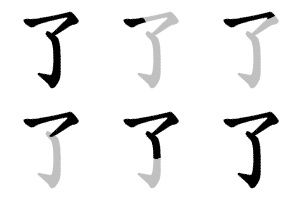 | |||
Han character
了 (radical 6, 亅+1, 2 strokes, cangjie input 弓弓 (NN), four-corner 17207, composition ⿱乛亅)
References
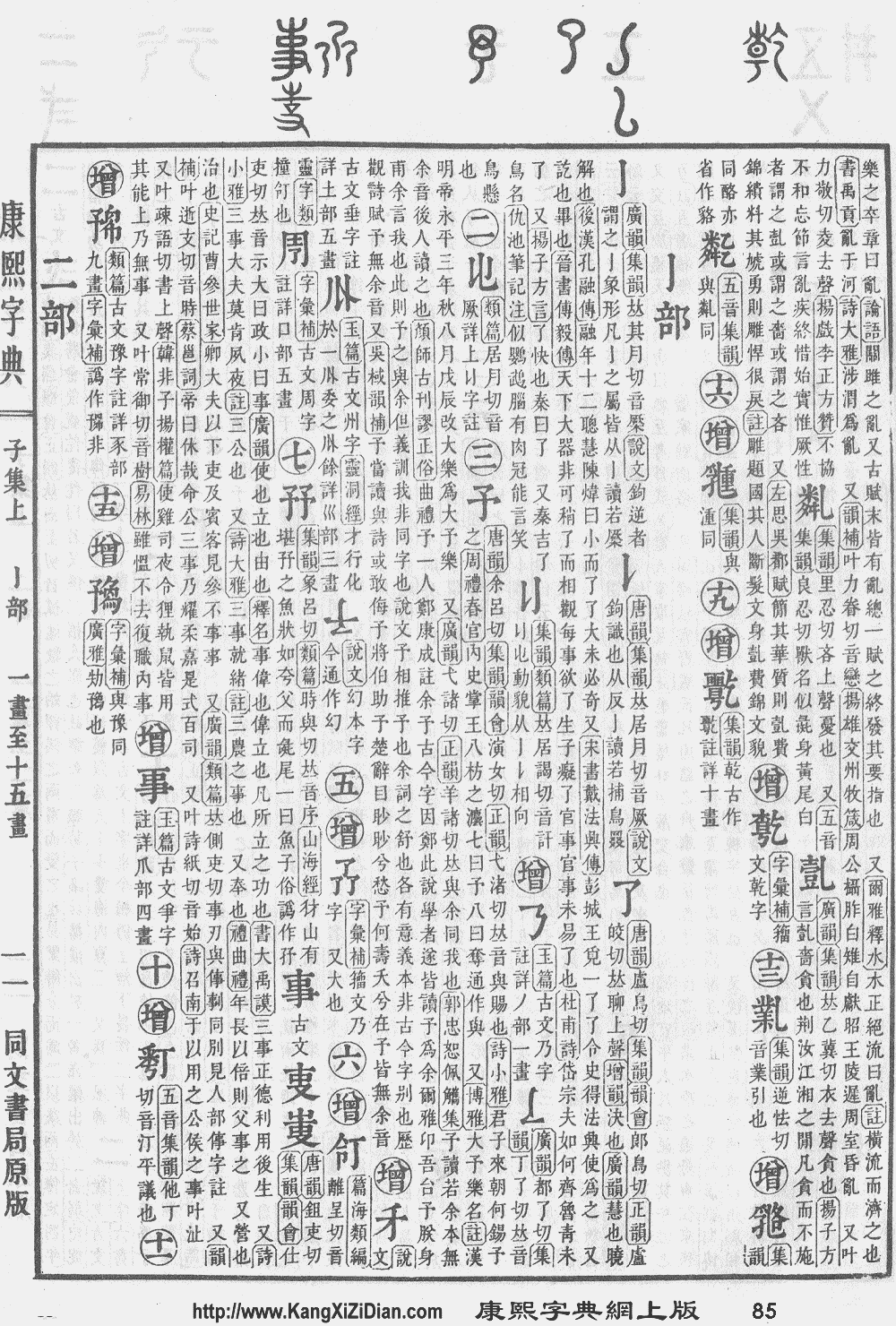
- KangXi: page 85, character 11
- Dai Kanwa Jiten: character 226
- Dae Jaweon: page 173, character 20
- Hanyu Da Zidian: volume 1, page 48, character 6
- Unihan data for U+4E86
Chinese
| trad. | 了/瞭* | |
|---|---|---|
| simp. | 了 | |
| 瞭 – sense “clear” | ||
Glyph origin
| Historical forms of the character 了 | ||||||||
|---|---|---|---|---|---|---|---|---|
| Shuowen Jiezi (compiled in Han) | ||||||||
| Small seal script | ||||||||
 | ||||||||
|
References: Mostly from Richard Sears' Chinese Etymology site (authorisation),
|


| Characters in the same phonetic series (了) (Zhengzhang, 2003) | |
|---|---|
| Old Chinese | |
| 釕 | *teːwʔ |
| 了 | *reːwʔ |
Pictogram (象形) – a baby wrapped in a blanket, with only the head visible. Compare with 子, where the arms are visible.
This etymology is incomplete. You can help Wiktionary by elaborating on the origins of this term.
Etymology 1
Verb “to finish; to be completed” > perfective aspect particle (了₁, weakened form) > change-of-state modal particle (了₂).
Two kinds of particle uses of 了 can be distinguished: the perfective aspect particle after verbs (conventionally written as 了₁) and the sentence-final modal particle (了₂). It is generally accepted (Wu, 1998) that these two uses of 了 are derived from the concrete verb “to finish”. The grammaticalisation of this verb had become common in the Tang Dynasty, initially in the form of ‹verb + (object) + perfective 了› to indicate the completion of an action.
The perfective particle subsequently underwent further grammaticalisation to become the sentence-final change-of-state modal particle; Liu (1985) has demonstrated that this last step may have involved the coalescence of sentence-final 了 with 也 in certain Mandarin dialects, as the pronunciations of 了₁ and 了₂ are distinct in these lects, with 了₂ rhyming with 也.
This word is cognate with Thai แล้ว (lɛ́ɛo, “to be finished; already; then, afterwards”), Lao ແລ້ວ (lǣu, “to finish; to be completed; perfective particle”) (Schuessler, 2007).
Pronunciation 1
Definitions
了
- Used after a verb to indicate perfective aspect (action completion).
- Used at the end of a sentence to indicate a change of state.
- Used at the end of a sentence to inform the beginning of an action.
Synonyms
| Dialectal synonyms of 了 (“perfective particle”) [map] | ||
|---|---|---|
| Variety | Location | Words |
| Formal (Written Standard Chinese) | 了 | |
| Mandarin | Beijing | 了 |
| Taiwan | 了 | |
| Malaysia | 了 | |
| Singapore | 了 | |
| Cantonese | Guangzhou | 咗 |
| Hong Kong | 咗 | |
| Taishan | 敢、啊 | |
| Hakka | Miaoli (N. Sixian) | 了 |
| Liudui (S. Sixian) | 了 | |
| Hsinchu (Hailu) | 了 | |
| Dongshi (Dabu) | 了 | |
| Zhuolan (Raoping) | 了 | |
| Yunlin (Zhao'an) | 矣 | |
| Min Nan | Xiamen | 啦、咯 |
| Quanzhou | 咯 | |
| Taipei | 矣、啦 | |
| Wu | Shanghai | 仔、了 |
| Wenzhou | 罷、爻 | |
Usage notes
- (perfective aspect particle): Most of the time, 了 is translated by a past tense. But it can also indicate that one action is completed before another.
- (change of state particle): When used as the change of state particle, 了 can be translated by “now”, “already” or “not anymore”.
- In a question, 了 is put before the particle 嗎/吗 (ma).
Compounds
|
|
|
Pronunciation 2
Definitions
了
- to be finished; to be completed
- to end; to finish
- to understand; to comprehend
- clear; plain; understandable
- bright; intelligent; smart
- (in negative sentences) completely; utterly; entirely
- Used with 不 (bù) or 得 (de) after verbs to express possibility.
Compounds
|
|
|
Etymology 2
| For pronunciation and definitions of 了 – see 潦 (“to flood; a puddle; etc.”). (This character, 了, is the second-round simplified form of 潦.) |
Notes:
|
Japanese
Kanji
Readings
- Goon: りょう (ryō, Jōyō)←れう (reu, historical)
- Kan’on: りょう (ryō, Jōyō)←れう (reu, historical)
- Kun: おえる (oeru, 了える)←をへる (woferu, historical); おわる (owaru, 了わる)←をはる (wofaru, historical); しまう (shimau, 了う)←しまふ (simafu, historical); ついに (tsuini, 了に)←つひに (tufini, historical)
Compounds
Noun
Proper noun
了 (hiragana さとる, rōmaji Satoru)
- A male given name.
Korean
Hanja
- This term needs a translation to English. Please help out and add a translation, then remove the text
{{rfdef}}.
Vietnamese
Han character
了 (liễu)
- This term needs a translation to English. Please help out and add a translation, then remove the text
{{rfdef}}.