餃子
See also: 饺子
Chinese
| dumplings with meat filling | child; son; (noun suff.); small thing; midnight; 11 p.m.-1 a.m.; seed; egg; 1st earthly branch | ||
|---|---|---|---|
| trad. (餃子) | 餃 | 子 | |
| simp. (饺子) | 饺 | 子 | |
Pronunciation
Noun
餃子
Hyponyms
Derived terms
Japanese
| Kanji in this term | |
|---|---|
| 餃 | 子 |
| ぎょう Hyōgaiji |
ざ Grade: 1 |
| Irregular | |
Alternative forms
Etymology
Borrowed from Chinese 餃子,[1][2][3] possibly from a dialectal Mandarin reading giaozi.
Pronunciation
Noun
餃子 (hiragana ぎょうざ, rōmaji gyōza)
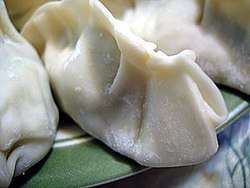
- gyoza: a kind of dumpling or potsticker with a thin skin, traditionally made with minced pork and then fried, boiled, or steamed
Derived terms
References
This article is issued from
Wiktionary.
The text is licensed under Creative Commons - Attribution - Sharealike.
Additional terms may apply for the media files.