字
| ||||||||
Translingual
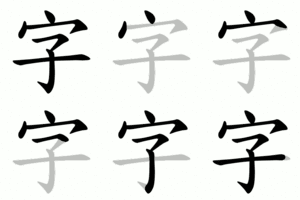
| Stroke order | |||
|---|---|---|---|
 | |||
Han character
字 (radical 39, 子+3, 6 strokes, cangjie input 十弓木 (JND), four-corner 30407, composition ⿱宀子)
References
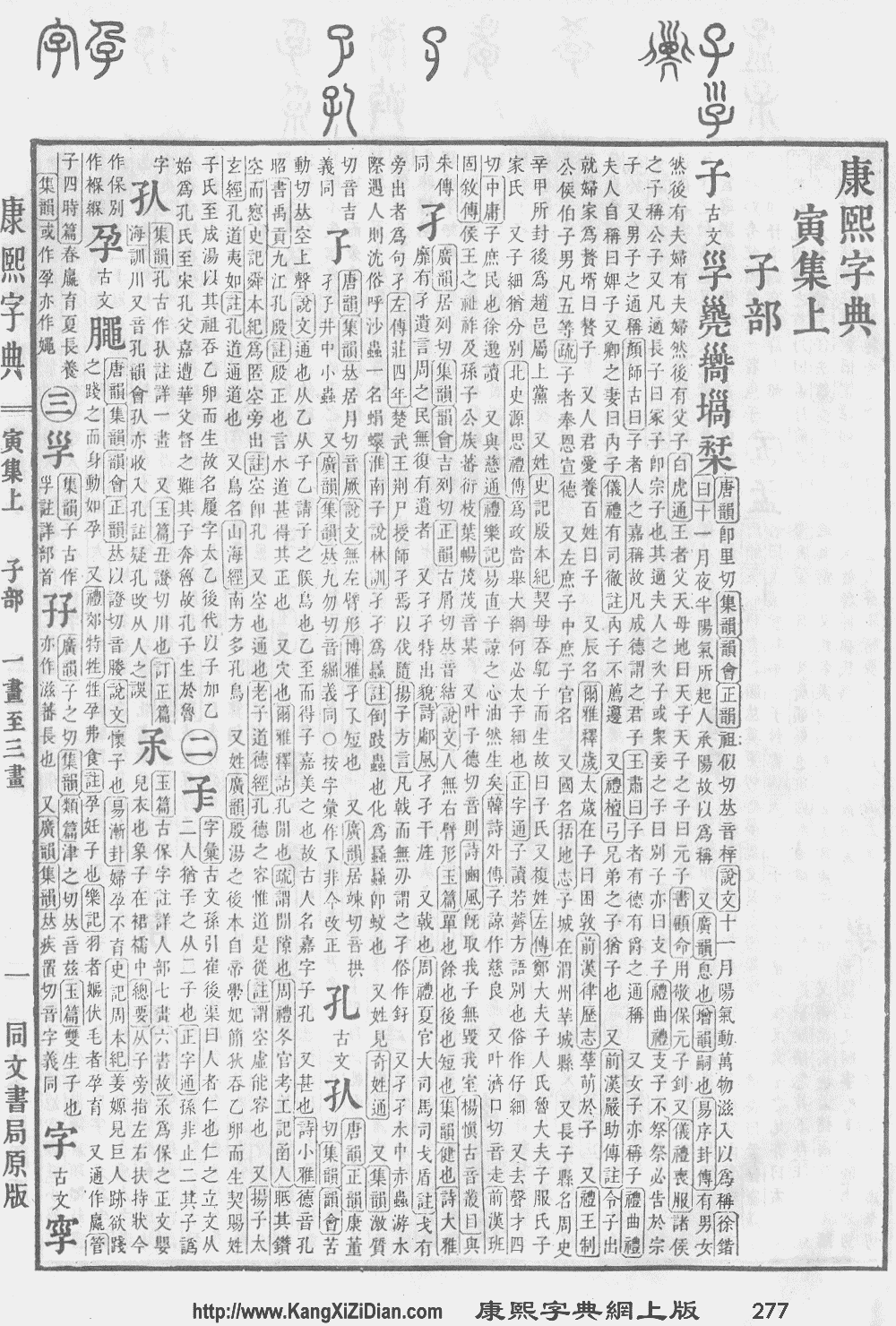
- KangXi: page 277, character 18
- Dai Kanwa Jiten: character 6942
- Dae Jaweon: page 545, character 7
- Hanyu Da Zidian: volume 2, page 1010, character 2
- Unihan data for U+5B57
Chinese
| simp. and trad. |
字 | |
|---|---|---|
Glyph origin
| Historical forms of the character 字 | |||||
|---|---|---|---|---|---|
| Shang | Western Zhou | Spring and Autumn | Warring States | Shuowen Jiezi (compiled in Han) | Liushutong (compiled in Ming) |
| Bronze inscriptions | Bronze inscriptions | Bronze inscriptions | Qin slip script | Small seal script | Transcribed ancient scripts |
 |
 |
 |
 |
 |
 |
| Characters in the same phonetic series (子) (Zhengzhang, 2003) | |
|---|---|
| Old Chinese | |
| 孜 | *ʔslɯ |
| 仔 | *ʔslɯ, *ʔslɯʔ |
| 孖 | *ʔslɯ, *zlɯs |
| 子 | *ʔslɯʔ |
| 虸 | *ʔslɯʔ |
| 耔 | *ʔslɯʔ |
| 秄 | *ʔslɯʔ |
| 杍 | *ʔslɯʔ |
| 籽 | *ʔslɯʔ |
| 字 | *zlɯs |
| 茡 | *zlɯs |
| 芓 | *zlɯs |
| 牸 | *zlɯs |
| 李 | *rɯʔ |
Phono-semantic compound (形聲, OC *zlɯs) : semantic 宀 (“roof”) + phonetic 子 (OC *ʔslɯʔ, “child”).
Etymology
From Proto-Sino-Tibetan *tsa ~ za (“child; to give birth; to take care; to be kind”). Related to:
- 子 (OC *ʔslɯʔ, “child, son”) (also its phonetic component)
- 慈 (OC *zɯ, “to be kind, loving”)
- 滋 (OC *ʔsɯ, “to nourish, to grow”)
- 詞 (OC *ljɯ, “word, term”)
- 辭 (OC *ljɯ, “word, from testimony”)
Original sense (1): “to become pregnant, to give birth to, to nurture, to love” has essentially become obsolete. The sense (2) “letter, character” is either from a different root or a derivation from the sense “to produce, to generate”.
Cognate with Tibetan ཚ་བོ (tsha bo, “nephew”), Tibetan ཚ་རུས (tsha rus, “descendant”), Tibetan བཙའ (btsa', “to give birth to; to guard”), Tibetan མཛའ (mdza', “kind, peaceful, friendly”) (Quan, 1996).
Pronunciation
Definitions
字
- † to give birth to; to deliver a baby; to bring into the world
- † to be pregnant; to be carrying a baby
- † (historical, of a girl) to be betrothed; to be allowed to marry
- † to bring up; to raise; to rear (a child)
- † to love; to cherish; to care very much for
- † to educate; to teach; to instruct
- † to govern; to administer
- Chinese character; hanzi (Classifier: 個/个; 隻/只 c)
- word; term; wording; diction
- (computing) word
- handwriting; writing
- (historical) courtesy name; Chinese-style name (a name traditionally given to Chinese males at the age of 20 and females at the age of 15)
- (historical) to style; to give someone a courtesy name
- letter; symbol; character
- (calligraphy) style of handwriting; printing type
- (calligraphy) (a calligrapher's) calligraphy work
- written letter; message; correspondence
- receipt; contract; slip
- pronunciation of a character; pronunciation
- (Cantonese, Min, Malaysia, Singapore) five minutes (derived from the locations of 1 to 12 on a clock face) (Classifier: 個/个 m c)
- A surname.
Compounds
|
|
|
Descendants
Others:
- Proto-Tai: *ɟɤ:ᴮ (“name”)
- Vietnamese: chữ (“script; letter; writing; word”)
Japanese
Kanji
Readings
Etymology 1
| Kanji in this term |
|---|
| 字 |
| じ Grade: 1 |
| on’yomi |
Borrowed from Middle Chinese 字 with the southern pronunciation (kango, Go-on).
Pronunciation
Noun
- a letter, character
- この字は何と読みますか?
- Kono ji wa nan to yomimasu ka?
- How do you pronounce this character?
- この字は何と読みますか?
- handwriting
- 彼女は字が上手い。
- Kanojo wa ji ga umai.
- She has good handwriting.
- 彼女は字が上手い。
Derived terms
- 永字 (eiji, “the character 永 (ei, “eternity”)”)
- 十字 (jūji, “cross”)
- 字解 (jikai)
- 字義 (jigi, “the meaning of a word”)
- 字源 (jigen, “the construction of a character”)
- 字体 (jitai, “font or lettering”)
- 字典 (jiten, “character dictionary”)
- 字母 (jibo, “letter (of the alphabet)”)
- 漢字 (kanji, “Chinese characters”)
- 漢字返し (kanjigaeshi, “kanji repeater”)
- 文字 (moji, “letter, character, or ideograph”)
- 字引 (jibiki, “dictionary”)
- 数字 (sūji, “numeral or number”)
- 字訳 (jiyaku)
- 二字 (niji, “two characters”)
- 大字 (daiji, “a large character”)
Counter
- letters, characters
- 40字以内で書いてください。
- Yonjū-ji inai de kaite kudasai.
- Please write it down in 40 letters or fewer.
- 40字以内で書いてください。
Etymology 2
| Kanji in this term |
|---|
| 字 |
| あざ Grade: 1 |
| kun’yomi |
Shortened form of あざな azana "a section of a village" of ancient Japanese origin (wago).
Pronunciation
Noun
Derived terms
Etymology 3
| Kanji in this term |
|---|
| 字 |
| あざな Grade: 1 |
| kun’yomi |
Of ancient Japanese origin (wago).
Pronunciation
Noun
字 (hiragana あざな, rōmaji azana)
- courtesy name
- nickname
- a section of a village
References
Korean
Hanja
Vietnamese
Han character
- This term needs a translation to English. Please help out and add a translation, then remove the text
{{rfdef}}.
References
- Thiều Chửu : Hán Việt Tự Điển, Hà Nội, 1942
- Trần Văn Chánh: Từ Điển Hán Việt NXB Trẻ, Ho Chi Minh Ville, 1999
- Vũ Văn Kính: Đại Tự Điển Chữ Nôm, NXB Văn Nghệ, Ho Chi Minh Ville, 1999