See also:
U+674E, 李
CJK UNIFIED IDEOGRAPH-674E

[U+674D]
CJK Unified Ideographs
[U+674F]

Translingual

Han character

(radical 75, +3, 7 strokes, cangjie input 木弓木 (DND), four-corner 40407, composition)

References

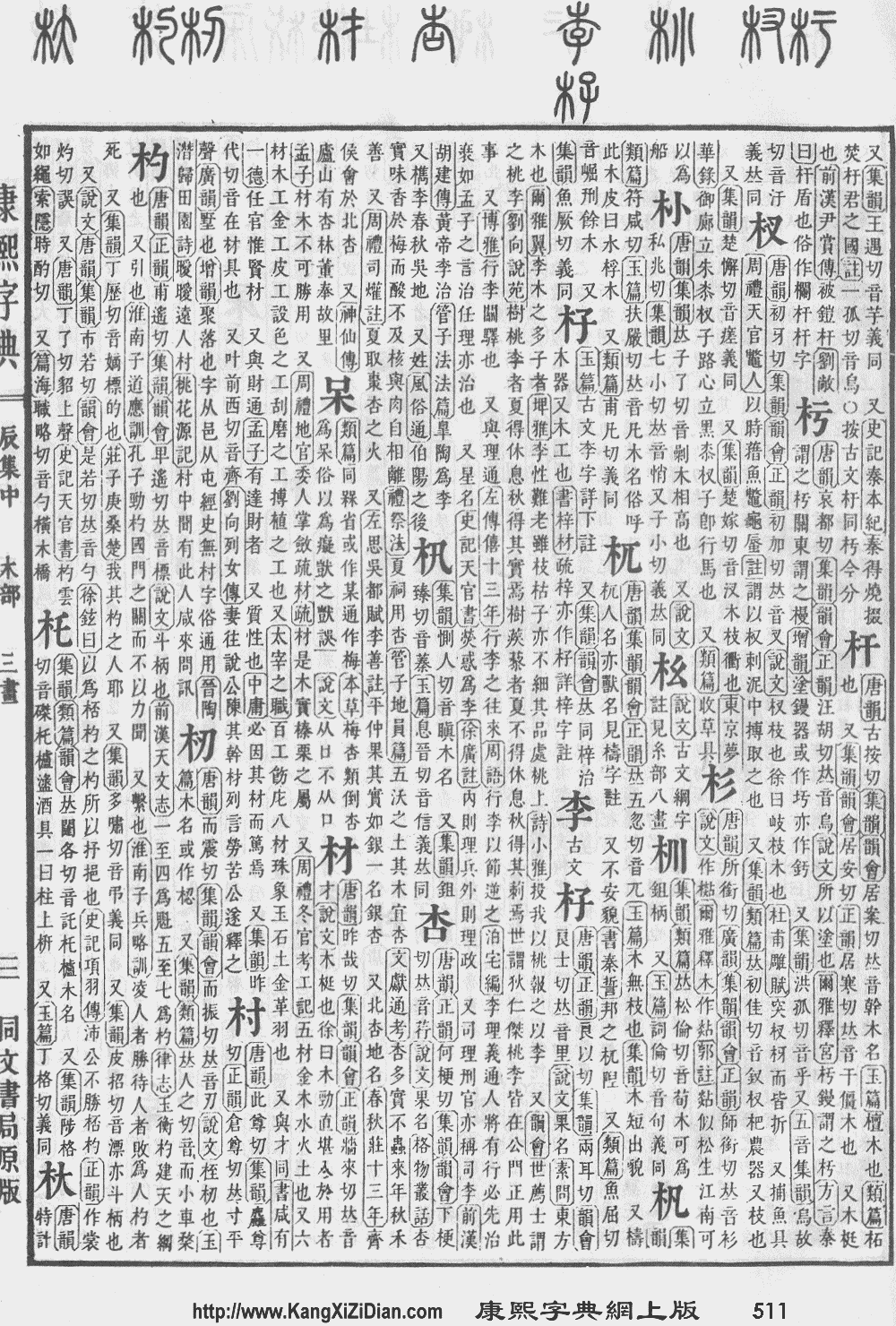
  • KangXi: page 511, character 11
  • Dai Kanwa Jiten: character 14459
  • Dae Jaweon: page 895, character 9
  • Hanyu Da Zidian: volume 2, page 1162, character 8
  • Unihan data for U+674E

Chinese

simp. and trad.

Glyph origin

Historical forms of the character
Western Zhou Shuowen Jiezi (compiled in Han) Liushutong (compiled in Ming)
Bronze inscriptions Small seal script Transcribed ancient scripts
Characters in the same phonetic series () (Zhengzhang, 2003) 
Old Chinese
*ʔslɯ
*ʔslɯ, *ʔslɯʔ
*ʔslɯ, *zlɯs
*ʔslɯʔ
*ʔslɯʔ
*ʔslɯʔ
*ʔslɯʔ
*ʔslɯʔ
*ʔslɯʔ
*zlɯs
*zlɯs
*zlɯs
*zlɯs
*rɯʔ

Oracle bone script: Phono-semantic compound (形聲, OC *rɯʔ) : phonetic  (OC *m·rɯːɡ, fruit) + semantic . The phonetic part became gradually corrupted to yield (“tree”).

Shuowen erroneously remarks that this is a phono-semantic compound (形聲, OC *rɯʔ) : semantic  (tree) + phonetic  (OC *ʔslɯʔ).

Pronunciation


  • Dialectal data
Variety Location
Mandarin Beijing /li²¹⁴/
Harbin /li²¹³/
Tianjin /li¹³/
Jinan /li⁵⁵/
Qingdao /li⁵⁵/
Zhengzhou /li⁵³/
Xi'an /li⁵³/
Xining /l̩⁵³/
Yinchuan /li⁵³/
Lanzhou /li⁴⁴²/
Ürümqi /li⁵¹/
Wuhan /ni⁴²/
Chengdu /ni⁵³/
Guiyang /ni⁴²/
Kunming /li⁵³/
Nanjing /li²¹²/
Hefei /zz̩²⁴/
Jin Taiyuan /li⁵³/
Pingyao /li⁵³/
Hohhot /li⁵³/
Wu Shanghai /li²³/
Suzhou /li³¹/
Hangzhou /li⁵³/
Wenzhou /lei³⁵/
Hui Shexian /li³⁵/
Tunxi /li²⁴/
Xiang Changsha /li⁴¹/
Xiangtan /ni⁴²/
Gan Nanchang /li²¹³/
Hakka Meixian /li³¹/
Taoyuan /li³¹/
Cantonese Guangzhou /lei²³/
Nanning /li²⁴/
Hong Kong /lei¹³/
Min Xiamen (Min Nan) /li⁵³/
Fuzhou (Min Dong) /li³²/
Jian'ou (Min Bei) /li²¹/
/sɛ⁴⁴/
Shantou (Min Nan) /li⁵³/
Haikou (Min Nan) /li²¹³/

Rime
Character
Reading # 1/1
Initial () (37)
Final () (19)
Tone (調) Rising (X)
Openness (開合) Open
Division () III
Fanqie
Reconstructions
Zhengzhang
Shangfang
/lɨX/
Pan
Wuyun
/lɨX/
Shao
Rongfen
/lieX/
Edwin
Pulleyblank
/lɨX/
Li
Rong
/liəX/
Wang
Li
/lĭəX/
Bernard
Karlgren
/liX/
Expected
Mandarin
Reflex
BaxterSagart system 1.1 (2014)
Character
Reading # 1/1
Modern
Beijing
(Pinyin)
Middle
Chinese
‹ liX ›
Old
Chinese
/*C.rəʔ/
English plum

Notes for Old Chinese notations in the Baxter–Sagart system:

* Parentheses "()" indicate uncertain presence;
* Square brackets "[]" indicate uncertain identity, e.g. *[t] as coda may in fact be *-t or *-p;
* Angle brackets "<>" indicate infix;
* Hyphen "-" indicates morpheme boundary;

* Period "." indicates syllable boundary.
Zhengzhang system (2003)
Character
Reading # 1/1
No. 17869
Phonetic
component
Rime
group
Rime
subdivision
0
Corresponding
MC rime
Old
Chinese
/*rɯʔ/

Definitions

  1. plum (tree and fruit)
  2. (astronomy) Zeta Virginis
  3. Alternative form of (, “judge; justice”).
  4. A surname, listed fourth in the Baijiaxing

Usage notes

In mainland China or among its expatriates, this name is generally romanized "Li" in accordance with the Hanyu Pinyin system. Although an identical transliteration is used in Wade-Giles, similarity to the English name has made the romanization "Lee" more common in Hong Kong and Taiwan. A notable example to this is Bruce Lee.

Descendants

  • English: Li, Lee
  • Tagalog: (from Hokkien) Sy

Compounds

  • 李廣射虎李广射虎
  • 李廣難封李广难封
  • 李思訓碑李思训碑
  • 李杜 (Lǐ-Dù)
  • 李爾王李尔王
  • 李耳
  • 李膺門李膺门
  • 李郭同舟
  • 李靖
  • 桃來李答桃来李答
  • 桃李 (táolǐ)
  • 桃李之教
  • 桃李滿門桃李满门
  • 桃李爭妍桃李争妍
  • 桃李爭輝桃李争辉
  • 桃李門牆桃李门墙
  • 檇李槜李
  • 歐李欧李
  • 正冠李下
  • 比張比李比张比李
  • 沉李浮瓜
  • 浮瓜沉李
  • 濃桃豔李浓桃艳李
  • 牛李黨爭牛李党争
  • 瓜李之嫌
  • 瓜田李下 (guātiánlǐxià)
  • 色豔桃李色艳桃李
  • 苦李
  • 行李 (xínglǐ)
  • 行李箱 (xínglǐxiāng)
  • 行李袋
  • 豔如桃李艳如桃李
  • 賣李鑽核卖李钻核
  • 道傍李
  • 道傍苦李
  • 郁李 (yùlǐ)
  • 鐵拐李铁拐李
  • 門牆桃李门墙桃李

Japanese

Kanji

(“Jinmeiyō” kanji used for names)

  1. plum

Readings

Noun

(hiragana すもも, rōmaji sumomo)

  1. plum (Prunus salicina)

Alternative forms

Proper noun

(katakana , hiragana , rōmaji Ri)

  1. Japanese reading of the Chinese or Korean surname.

(katakana リー, hiragana りい, rōmaji )

  1. Japanese reading of the Chinese surname.

(katakana , hiragana , rōmaji I)

  1. Japanese reading of the South Korean surname.

Korean

Hanja

• (ri, i)

  • Eumhun:
    • Sound (hangeul): , (revised: Lee, (NK) ri, Rhee, (SK) i, I, McCuneReischauer: (NK) ri, (SK) i, Yi, Yale: (NK) li, (SK) i)
    • Name (hangeul): 자두(Jadu)
  1. (North Korea) , (South Korea) : the second most common surname in Korea
  2. (North Korea) , (South Korea) : plum

Vietnamese

Han character

(lí, lý)

  1. A Vietnamese family name.
  2. An unisex given name.

References

This article is issued from Wiktionary. The text is licensed under Creative Commons - Attribution - Sharealike. Additional terms may apply for the media files.