scythe
See also: Scythe
English
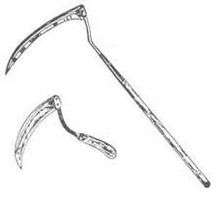
scythe (1) (larger) and sickle (smaller)
Alternative forms
Etymology
From Middle English sythe or sithe, from Old English sīðe (“sickle”). The silent c appeared in the early 15th century because it was wrongly thought that the word was linked to Latin scissor ("carver, cutter") and scindere ("to cut"). Cognate with Dutch zicht (“sickle”).
Pronunciation
- IPA(key): /ˈsaɪð/, (some accents) IPA(key): /ˈsaɪθ/
Audio (US) (file) - Rhymes: -aɪð, -aɪθ
Noun
scythe (plural scythes)
- An instrument for mowing grass, grain, or the like, by hand, composed of a long, curving blade, with the concave edge sharped, made fast to a long handle, called a snath.
- 1609, William Shakespeare, Sonnet 12:
- And nothing 'gainst Time's scythe can make defence
- Save breed, to brave him when he takes thee hence.
- 1609, William Shakespeare, Sonnet 12:
- A scythe-shaped blade attached to ancient war chariots.
- (cartomancy) The tenth Lenormand card.
Translations
farm tool
|
|
blade in the wheel of a war chariot
Verb
scythe (third-person singular simple present scythes, present participle scything, simple past and past participle scythed)
- (transitive) To cut with a scythe; to cut off as with a scythe; to mow.
- (intransitive, figuratively) To attack or injure as if cutting.
- 2011, Catherine Sampson, The Pool of Unease
- The boy began to keen, and the high-pitched noise scythed through Song's head.
- 2011, Catherine Sampson, The Pool of Unease
Translations
to cut with a scythe
|
|
Anagrams
This article is issued from
Wiktionary.
The text is licensed under Creative Commons - Attribution - Sharealike.
Additional terms may apply for the media files.