si
English
Alternative forms
Etymology
Acronym of Latin Sancte Ioannes, the phrase ending the hymn Ut queant laxis from earlier words of which the other notes of solfège were derived.
Pronunciation
- IPA(key): /si/
Noun
si (plural sis)
- (music) A syllable used in solfège to represent the seventh note of a major scale.
Translations
Anagrams
Albanian
Etymology
From instrumental Proto-Indo-European *kwi-h₁. Compare Latin qui (“how, why”), Old English hwȳ, hwī (“why”), Avar čī (čī, “how”). An interrogative and relative pronoun, especially in connection with a preposition.
Pronunciation
- IPA(key): [si]
Adverb
si
- how; in what way; in what state
- Si janë shokët e tu? ― How are your friends?
- like, as
- Si e dini, nuk kemi filluar ende.
- As you know, we've not yet begun.
Derived terms
See also
Alemannic German
Etymology 1
Pronoun
si f
Declension
Etymology 2
Alternative forms
Determiner
si
Declension
Inflected forms include:
| Singular | Plural | |||
|---|---|---|---|---|
| masculine | feminine | neuter | ||
| Nominative Accusative |
si | sini | si | sini |
| Genitive | sines & si's | sines | ||
| Dative | si'm & sim | siner | si'm & sim | sine |
Etymology 3
Alternative forms
Verb
si
References
- Umberto Patuzzi, ed., (2013) Ünsarne Börtar, Luserna: Comitato unitario delle linguistiche storiche germaniche in Italia / Einheitskomitee der historischen deutschen Sprachinseln in Italien
Asturian
Etymology
Conjunction
si
Bahnar
Etymology
From Proto-Bahnaric *ciː, from Proto-Mon-Khmer *ciiʔ (“louse”); cognate with Vietnamese chí, chấy.
Pronunciation
- IPA(key): /siː/
Noun
si
Catalan
Pronunciation
Etymology 1
From Old Occitan, from Latin si (“if”).
Conjunction
si
See also
Etymology 2
From Latin Sancte Iohannes (“Saint John”) in the hymn for St. John the Baptist.
Noun
si m (plural sis)
Etymology 3
From Old Occitan, from Latin sinus.
Noun
si m (plural sins)
- cavity, depression
- (anatomy) sinus
- (figuratively) uterus
- front portion of the breast
- (figuratively) heart
- estuary, bay
See also
- si d'Abraham m
Etymology 4
Pronoun
si
Usage notes
- Si is the stressed (or "strong", or "tonic") form of the reflexive pronoun es. As such, it is used after prepositions.
Declension
See also
- de si mateix
- en si
- entre si
- fora de si
- per a si
- per si mateix
- tornar en si
See also
Chamorro
Preposition
si
- Subject marker for personal names.
Chavacano
Etymology 1
Particle
si
Etymology 2
Conjunction
si
Czech
Pronunciation
- IPA(key): /sɪ/
Audio (file)
Pronoun
si (reflexive pronoun)
- (dative) to oneself (clitic form of reflexive pronoun sobě)
- myself
- yourself
- Posluž si. ― Serve yourself.
- himself
- herself
- itself
- ourselves
- yourselves
- themselves
Declension
Synonyms
Related terms
Dalmatian
Etymology
Numeral
si
Danish
Pronunciation
- IPA(key): /siː/, [siːˀ]
- Rhymes: -i
- Rhymes: -iː
Noun
si c (singular definite sien, plural indefinite sier)
Inflection
Verb
si (imperative si, infinitive at si, present tense sier, past tense siede, perfect tense har siet)
Dutch
Pronunciation
Audio (file)
Noun
si m, f (plural si's, diminutive sietje n)
- musical note; ti
Anagrams
Esperanto
Etymology
From Italian si, French soi, Spanish se, Latin se, plus the i of personal pronouns.
Pronunciation
- IPA(key): /si/
- Hyphenation: si
- Audio:
(file)
Pronoun
si (reflexive, accusative sin, possessive sia)
Usage notes
The reflexive pronoun si is only used to refer to the third person (In English: he/she/it/they) not the first or second person (In English: I/you).
Ewe
Verb
si
- to escape
Fala
Etymology 1
From Old Portuguese se, from Latin sī (“if”).
Conjunction
si
- if (used to introduce a condition or choice)
- 2000, Domingo Frades Gaspar, Vamus a falal: Notas pâ coñocel y platical en nosa fala, Editora regional da Extremadura, Theme I, Chapter 1: Lengua Española:
- I si “a patria do homi é sua lengua”, cumu idía Albert Camus, o que está claru é que a lengua está mui por encima de fronteiras, serras, rius i maris, de situaciós pulíticas i sociu-económicas, de lazus religiosus e inclusu familiaris.
- And if “a man’s homeland is his language”, as Albert Camus said, what is clear is that language is above borders, mountain ranges, rivers and seas, above political and socio-economic situations, of religious and even family ties.
- I si “a patria do homi é sua lengua”, cumu idía Albert Camus, o que está claru é que a lengua está mui por encima de fronteiras, serras, rius i maris, de situaciós pulíticas i sociu-económicas, de lazus religiosus e inclusu familiaris.
-
Etymology 2
Pronoun
si
- Alternative form of se
- 2000, Domingo Frades Gaspar, Vamus a falal: Notas pâ coñocel y platical en nosa fala, Editora regional da Extremadura, Theme I, Chapter 2: Númerus?:
- As lenguas, idiomas, dialectus o falas tenin un-as funciós mui claras desde o principiu dos siglu i si hai contabilizaus en o mundu un-as 8.000 lenguas, ca un-a con sua importancia numérica relativa, a nossa fala é un tesoiru mais entre elas.
- The tongues, languages or regional variants have some very clear functions since the beginning of the centuries and some 8,000 languages have been accounted for in the world, each with its relative numerical importance, Fala is yet another treasure among them.
- As lenguas, idiomas, dialectus o falas tenin un-as funciós mui claras desde o principiu dos siglu i si hai contabilizaus en o mundu un-as 8.000 lenguas, ca un-a con sua importancia numérica relativa, a nossa fala é un tesoiru mais entre elas.
-
French
 |
This entry is part of the phrasebook project, which presents criteria for inclusion based on usefulness, simplicity and commonness. |
Pronunciation
Etymology 1
From Old French se, from Latin si (“if”).
Conjunction
si
- if
- Je me demande si elle sera seule.
- I wonder if she'll be alone.
- Je veux savoir si tu viendras ou non.
- I want to know if you're coming or not.
- Si j'avais ses pouvoirs, je créerais un monde où le mal n'existe pas.
- If I had his power, I'd create a world where evil didn't exist.
- Si tu n'avais pas appelé, je serais morte.
- If you hadn't called, I'd be dead.
- even if
Derived terms
Etymology 2
From Old French si, from Latin sic (“so, thus”).
Interjection
si
- yes (used to contradict a negative statement) (often followed by I do, he is, etc. in English to indicate contradiction rather than affirmation).
- Tu ne m’aimes pas, n’est-ce pas ? — Si!
- You don’t like me, do you? — Yes, I do!
- Moi, je n'ai rien fait ! — Si!
- I didn't do anything! — Yes, you did!
Adverb
si
- so, such (intensifier)
- J’étais si fatigué ces jours-ci que je n’avais pas le courage de vous écrire.
- I was so tired those days that I didn't have the energy to write to you.
- Cela n'aurait pas été une si bonne idée.
- That wouldn't have been such a good idea.
- Si bavard qu'il soit, il ne dit rien de stupide.
- However talkative he may be, he doesn't say anything stupid.
Usage notes
Uncommon in Québec.
Etymology 3
Noun
si m (plural si)
Further reading
- “si” in le Trésor de la langue française informatisé (The Digitized Treasury of the French Language).
Friulian
Etymology
Pronoun
si (third person)
Related terms
Galician
Etymology 1
Interjection
si
Antonyms
- (yes): non
Etymology 2
From Latin sē, ablative and accusative pronoun form.
Pronoun
Usage notes
The pronoun si is used exclusively as the object of a preposition; no nominative form exists.
Etymology 3
Noun
si m (plural sis)
See also
Gothic
Romanization
si
- Romanization of 𐍃𐌹
Iau
Noun
si
Further reading
Bill Palmer, The Languages and Linguistics of the New Guinea Area (→ISBN, 2017), page 531, table 95, Comparative basic vocabulary in Lakes Plain Languages
Indonesian
Article
si
- Definite grammatical article (diminutive). There is no exact equivalent of the Indonesian si in languages such as English, but it can be described as a personal definite article. In the American sitcom Happy Days, a character is called The Fonz by his friends; in Indonesian, this could be translated as Si Fonz. Thus it is used when talking about someone else if they are on close, intimate terms with that person. Apart from the more friendly connotation, it is also a diminutive and can stand in for the words "little", "old" and "poor" when talking about others in a cute, disparaging, disrespectful or casual manner. It is used when talking about someone, not to them. It should not be used to those who are of higher rank or deserving of respect (unless mocking them)
- Tidak ada yang memperhatikan si Tigor. ― No-one paid any attention to poor Tigor.
- Aku bilang sama si Yopi, jangan khawatir ― I said to old Yopi, don't worry.
- Katanya si Tuti sakit (talking about a small child) ― I hear little Tuti is ill.
- Namanya si Putih (talking about a pet cat) ― Its name is Whitey.
- Si Gendut ― Fatso
- Si Goblok ― Old Muttonhead
- Definite grammatical article (title 1) Besides the more humorous uses, si can be a way of putting a name to someone when you do not know that person's name and want to refer to them in an informal, casual or personalised way. This is done by putting si in front of the group, occupation or category to which that person belongs.
- Si pemuda tersenyum lebar lalu pergi. ― The young man smiled broadly then left.
- Si penjual jamu itu cantik sekali. ― That jamu seller is very pretty.
- Dia ketawa sama si orang asing itu. ― She was laughing with the foreigner.
- Definite grammatical article (title 2) Similar to the preceding use, si is used to refer to all the members of a certain group or category.
- Si pembeli harus dilayani dengan ramah. ― The customer must be attended to in a friendly way.
- Kalau si suami beragama Kristen sedangkan si isteri beragama Islam, wah bisa ramai rumah tangganya. ― If the husband is a Christian and the wife is a Muslim, phew, you can expect fireworks in the household.
- Si ayah harus belajar mengenal si anak. ― The father has to learn to know the child.
Interlingua
Adverb
si
Italian
Alternative forms
- -si (enclitic)
Etymology
From Latin se (“him-, her-, it-, themselves”, reflexive third-person pronoun). Cognate with Spanish se and Portuguese se and si.
Pronunciation
Audio (file)
Pronoun
si
- (reflexive) oneself, himself, herself, itself, themselves
- Il tuo gatto si lava sul mio letto. ― Your cat cleans himself on my bed.
- Marco si è rotto il braccio. ― Marco has broken his arm.
- (reciprocal) each other, one another
- Carlo e Laura si amano. ― Carlo and Laura love each other.
- (indefinite) one, you, we, they, people
- In Italia si pranza intorno all'una. ― In Italy they eat lunch around 12.
- In Italia si tende ad andare a letto tardi. ― In Italy, people tend to go to bed late.
- Si dice che Maria volesse uccidere Giovanni. ― It is said that Maria wanted to kill Giovanni.
- Da questa finestra si vede la banca. ― From this window, one can see the bank.
- (si passivante) Used to form the passive voice of a verb; it
- Si vende latte. / Vendesi latte. ― Milk for sale.
- Non si accettano carte di credito. ― Credit cards are not accepted.
Usage notes
- When si is part of an infinitive, it can be placed before it as a separate word, but more often it is attached to the end. In this case, the final -e of the infinitive is dropped, or, in the case of infinitives ending in -rre, the final -re is dropped. Examples: amar(e) + si = amarsi; ridur(re) + si = ridursi.
- Often translated using the passive voice in English when used as indefinite personal pronoun:
- Si dice che […] ― It is said that […]
- Verb + si is often translated as become or get + [past participle] in English.
- In cases where si (indefinite pronoun) and si (reflexive pronoun) follow each other, the first si is replaced with ci:
- Ci si lava. ― One washes oneself.
- (instead of: *Si si lava.)
- Becomes se when followed by a third person direct object clitic (lo, la, li, le, or ne).
See also
| Number | Person | Gender | Nominative | Reflexive | Accusative | Dative | Locative | Genitive | Disjunctive |
|---|---|---|---|---|---|---|---|---|---|
| Singular | first | — | io | mi, m' | — | me | |||
| second | — | tu | ti, t' | te | |||||
| third | m | lui | si,2 s' | lo, l' | gli | ci, c', vi, v' (formal) |
ne, n' | lui, sé | |
| f 1 | lei, Lei | la, l', La | le,3 Le | lei, Lei, sé | |||||
| Plural | first | — | noi | ci, c' | — | noi | |||
| second | — | voi | vi, v' | voi | |||||
| third | m | loro, Loro | si, s' | li | gli, loro (formal), Loro |
ci, c', vi, v' (formal) |
ne, n' | loro, Loro, sé | |
| f 1 | le | ||||||||
| 1 | The feminine gender forms are also used as formal terms of address, often capitalised as Lei, Loro etc. to distinguish them. | ||||||||
| 2 | Also used as indefinite pronoun meaning “one”, and to form the passive. | ||||||||
| 3 | In informal speech sometimes replaced with gli (nonstandard). | ||||||||
Noun
si
See also
Japhug
Etymology
Probably from Proto-Sino-Tibetan *səj.
Verb
si
Further reading
- Guillaume Jacques, Argument Demotion in Japhug Rgyalrong (2012)
Koro (India)
Noun
si
References
- Roger Blench, Mark Post, (De)classifying Arunachal languages: Reconstructing the evidence (2011)
Ladin
Etymology
Adjective
si
Latin
Etymology
For Old Latin seī, apparently derived from the nominative stem of Proto-Indo-European *só (“this, that”); related to Old English sio (“she”).
Pronunciation
- (Classical) IPA(key): /siː/
- (Ecclesiastical) IPA(key): /si/
Audio (Classical) (file)
Conjunction
sī
- if, supposing that
- Sī versūs hōrum duōrum poetārum neglegētis, magnā parte litterārum carēbitis.
- If you neglect the verses of these two poets, you will miss a great part of literature.
Derived terms
Descendants
References
- si in Charlton T. Lewis and Charles Short (1879) A Latin Dictionary, Oxford: Clarendon Press
- si in Charlton T. Lewis (1891) An Elementary Latin Dictionary, New York: Harper & Brothers
- si in Charles du Fresne du Cange’s Glossarium Mediæ et Infimæ Latinitatis (augmented edition, 1883–1887)
- si in Gaffiot, Félix (1934) Dictionnaire Illustré Latin-Français, Hachette
- Carl Meissner; Henry William Auden (1894) Latin Phrase-Book, London: Macmillan and Co.
- if I live till then: si vita mihi suppeditat
- if I live till then: si vita suppetit
- if anything should happen to me; if I die: si quid (humanitus) mihi accidat or acciderit
- literally: si verba spectas
- Solon made it a capital offence to..: Solo capite sanxit, si quis... (Att. 10. 1)
- to put it exactly: si quaeris, si verum quaerimus
- if I live till then: si vita mihi suppeditat
- si in Richard Stillwell et al., editor (1976) The Princeton Encyclopedia of Classical Sites, Princeton, N.J.: Princeton University Press
- Sihler, Andrew L. (1995) New Comparative Grammar of Greek and Latin, Oxford, New York: Oxford University Press, →ISBN
Latvian
Noun
si m (invariable)
Luxembourgish
Pronunciation
- IPA(key): /zi/
Pronoun
si
- third-person feminine singular, nominative: she
- Si ass eng ganz schéi Fra ― She is a very beautiful woman
- third-person feminine singular, accusative: her
- Den Hond huet si gebass ― The dog bit her
- third-person plural, nominative: they
- Si wunnen zu Lëtzebuerg ― They live in Luxembourg
- third-person plural, accusative: them
Declension
| nominative | accusative | dative | reflexive | |||||
|---|---|---|---|---|---|---|---|---|
| str. | unstr. | str. | unstr. | str. | unstr. | |||
| 1st person singular | ech | — | mech | — | mir | mer | mech | |
| 2nd person singular (informal) |
du | de | dech | — | dir | der | dech | |
| 2nd person singular (formal) |
Dir | — | Iech | — | Iech | — | Iech | |
| 3rd person singular (m) | hien | en | en | — | him | em | sech | |
| 3rd person singular (f) | si / hatt | se / et | si / hatt | se / et | hir / him | — / em | sech | |
| 3rd person singular (n) | et | 't | et | 't | him | em | sech | |
| 1st person plural | mir | mer | eis / ons | — | eis / ons | — | eis / ons | |
| 2nd person plural | dir | der | iech | — | iech | — | iech | |
| 3rd person plural | si | — | si | — | hinnen | – | sech | |
Malay
Article
si
- the (primarily used with people, rarely necessary)
- Ke mana perginya si budak nakal yang aku jumpa di taman tadi?
- Where has the brat I just met in the park headed to?
- definite people used with adjectives to describe people
- si mati
- the dead (person)
- a definite article used in names or nicknames
- Si Polan
Synonyms
Mandarin
Romanization
si (Zhuyin ˙ㄙ)
si
- Nonstandard spelling of sī.
- Nonstandard spelling of sí.
- Nonstandard spelling of sǐ.
- Nonstandard spelling of sì.
Usage notes
- English transcriptions of Mandarin speech often fail to distinguish between the critical tonal differences employed in the Mandarin language, using words such as this one without the appropriate indication of tone.
Middle Dutch
Pronunciation
- IPA(key): /ziː/
Etymology 1
Pronoun
si
Inflection
Alternative forms
Descendants
- Dutch: zij
Etymology 2
Pronoun
si
- they (all genders)
- 1249, Schepenbrief van Bochoute, Velzeke, eastern Flanders:
- Si maken bekent die nu sien ende wesen selen
- They make known to those who are now and will be
- Si maken bekent die nu sien ende wesen selen
-
Inflection
Alternative forms
Descendants
- Dutch: zij
Etymology 3
See etymology on the main entry.
Verb
si
- first-person and third-person singular present subjunctive of wēsen
Further reading
- “si (II)”, in Vroegmiddelnederlands Woordenboek, 2000
- “si (III)”, in Vroegmiddelnederlands Woordenboek, 2000
- “si (I)”, in Middelnederlandsch Woordenboek, 1929
Middle French
Alternative forms
Etymology
From Old French se.
Adverb
si
Descendants
- French: si
Middle Low German
Pronunciation
Pronoun
sî
- Alternative form of sê
Molo
Noun
si
Further reading
Nalca
Noun
si
Norman
Etymology
From Old French si, from Latin si (“if”).
Conjunction
si
Norwegian Bokmål
Etymology 1
From Old Norse segja, from Proto-Germanic *sagjaną, ultimately from Proto-Indo-European *sekʷ-.
Verb
si (imperative si, present tense sier, passive sies, past tense sa, past participle sagt, present participle siende)
- to say
Derived terms
Etymology 2
Noun
si (uncountable)
- (music) seventh note of a major scale
Etymology 3
Synonymous with side (side)
Noun
si (uncountable)
Usage notes
This term is only used idiomatically in the phrase på si.
Etymology 4
Determiner
si
- feminine singular of sin
References
Norwegian Nynorsk
Etymology 1
See etymology on the main entry.
Pronunciation
Determiner
si
- feminine singular of sin
Etymology 2
Noun
si (uncountable)
- (music) seventh note of a major scale
Etymology 3
Synonymous with side (side)
Noun
si (uncountable)
Usage notes
This term is only used idiomatically in the phrase på si.
References
Old French
Alternative forms
Etymology 1
Adverb
si
- so; thus; in such a way
- circa 1180, Chrétien de Troyes, Lancelot ou le Chevalier de la charrette:
- Si li a dit eneslepas
- So he said to him quickly
- Si li a dit eneslepas
-
Descendants
Etymology 2
See se.
Conjunction
si
- Alternative form of se (if)
Old Portuguese
Etymology
From Latin sīc (“thus; so”), from Proto-Indo-European *so (“this, that”).
Pronunciation
- IPA(key): /ˈsi/
Adverb
si
- yes, affirmatively
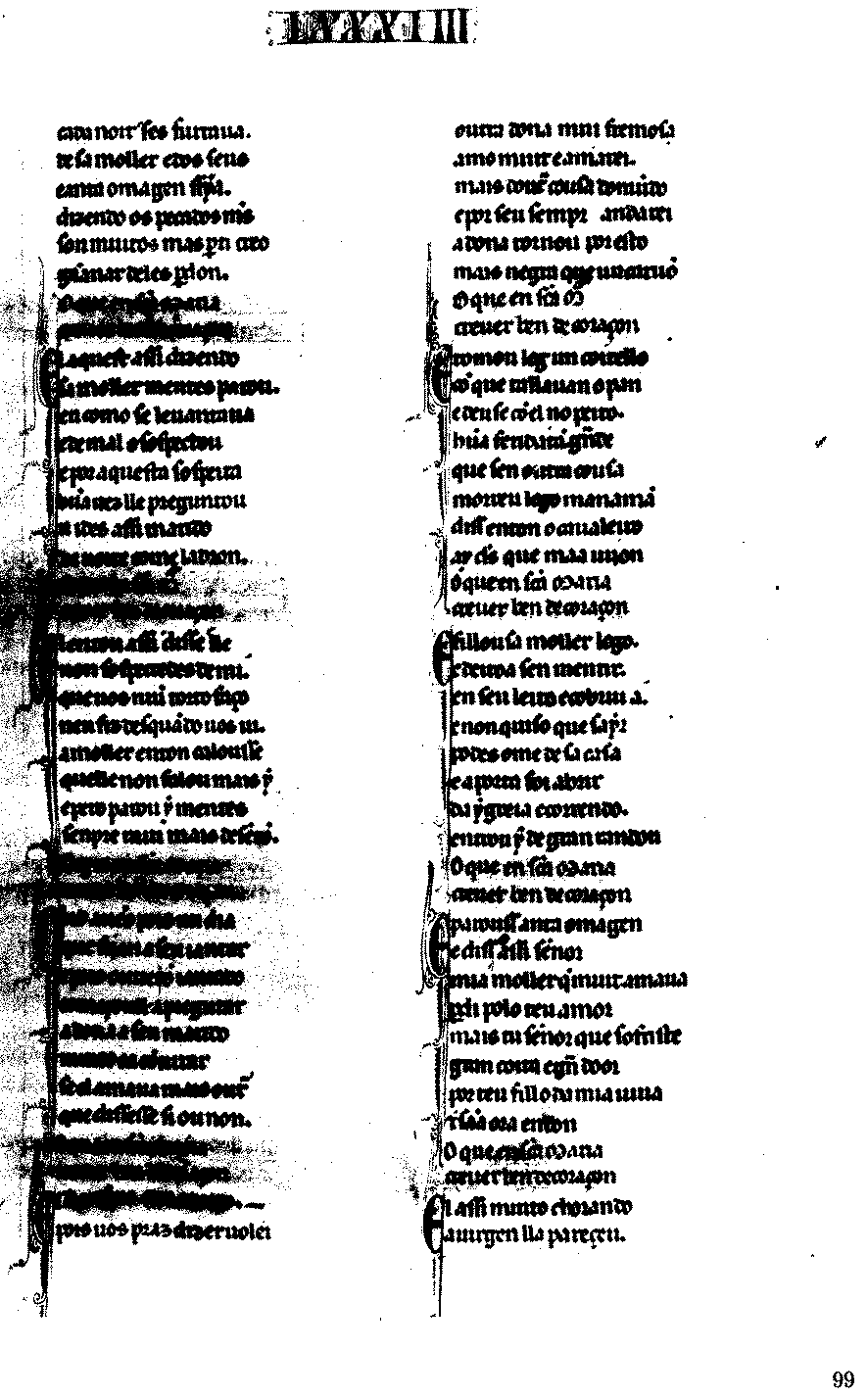
- 13th century, attributed to Alfonso X of Castile, Cantigas de Santa Maria, E codex, cantiga 84 (facsimile):
- ſi ou non
- yes or no
- ſi ou non
- 13th century, attributed to Alfonso X of Castile, Cantigas de Santa Maria, E codex, cantiga 84 (facsimile):
Descendants
Old Saxon
Pronunciation
- IPA(key): /si/
Article
si
- feminine nominative singular of sē
Declension
Conjunction
Papiamentu
Etymology
From Spanish si and Portuguese se and Kabuverdianu sí.
Conjunction
si
Portuguese
Pronunciation
- IPA(key): /ˈsi/
- Hyphenation: si
Etymology 1
From Latin sē (“him-, her-, it-, themselves”, reflexive third-person pronoun).
Alternative forms
- sy (obsolete)
Pronoun
si (reflexive)
- (following a preposition) oneself, yourself, himself, herself, itself, yourselves, themselves.
See also
| Portuguese personal pronouns (edit) | |||||||||||||
|---|---|---|---|---|---|---|---|---|---|---|---|---|---|
| Number | Person | Nominative (subject) |
Accusative (direct object) |
Dative (indirect object) |
Prepositional | Prepositional with com |
Non-declining | ||||||
| m | f | m | f | m and f | m | f | m | f | m | f | |||
| Singular | First | eu | me | mim | comigo | ||||||||
| Second | tu | te | ti | contigo | você | ||||||||
| o senhor | a senhora | ||||||||||||
| Third | ele | ela | o (lo, no) |
a (la, na) |
lhe | ele | ela | com ele | com ela | o mesmo | a mesma | ||
| se (reflexive) | si (reflexive) | consigo (reflexive) | |||||||||||
| Plural | First | nós | nos | nós | connosco (Portugal) conosco (Brazil) |
a gente | |||||||
| Second | vós | vos | vós | convosco | vocês | ||||||||
| os senhores | as senhoras | ||||||||||||
| Third | eles | elas | os (los, nos) |
as (las, nas) |
lhes | eles | elas | com eles | com elas | os mesmos | as mesmas | ||
| se (reflexive) | si (reflexive) | consigo (reflexive) | |||||||||||
| Indefinite | se (reflexive) | si (reflexive) | consigo (reflexive) | ||||||||||
Etymology 2
From Latin Sancte Iohannes (“Saint John”) in the hymn for St. John the Baptist.
Noun
si m (plural sis)
- si (musical note)
Coordinate terms
Etymology 3
Conjunction
si
- Eye dialect spelling of se, representing Brazilian Portuguese.
Romansch
Alternative forms
Etymology
From Vulgar Latin, Late Latin root sūsum, from Latin sūrsum.
Adverb
si
Serbo-Croatian
Pronunciation
- IPA(key): /si/
Pronoun
si (Cyrillic spelling си)
- Replaces the dative of a personal pronoun when the subject is of the same person as the dative object; to oneself (clitic dative singular of sȅbe (“oneself”))
- to myself
- to yourself
- to himself
- to herself
- to itself
- to ourselves
- to yourselves
- to themselves
Declension
Verb
si (Cyrillic spelling си)
- second-person singular present tense form of biti.
Slovak
Pronunciation
- IPA(key): /ˈsi/
Verb
si (second-person singular of byť)
Pronoun
si
- Replaces the dative of a personal pronoun when the subject is of the same person as the dative object. Roughly comparable with to oneself or for oneself.
- Kupujem si topánky. ― I am buying myself shoes.
- Komu kupuješ topánky? Sebe. ― Whom are you buying the shoes for? Myself.
Synonyms
Further reading
- si in Slovak dictionaries at korpus.sk
Slovene
Pronunciation
- IPA(key): /si/
Verb
si
- second-person singular present tense form of biti.
Pronoun
si
- to oneself (dative singular of sebe (“oneself”))
- Pripravljam si večerjo. ― I am making myself dinner. ("I am preparing dinner for myself.")
Synonyms
Spanish
Etymology
Pronunciation
- IPA(key): /si/
- Homophone: sí
- Rhymes: -i
Conjunction
si
See also
- si ... o
- sí
Swahili
Adverb
si
Tagalog
Article
si
- subject marker for personal names; similar in function to ang
Tok Pisin
Etymology
Noun
si
Vietnamese
Etymology
From Proto-Vietic *ɟ-riː, from Proto-Mon-Khmer *ɟriiʔ; cognate with Bahnar jri, Khmer ជ្រៃ (crɨy), Khasi jri, Old Mon jrey.
Pronunciation
- (Hà Nội) IPA(key): [si˧˧]
- (Huế) IPA(key): [ʂɪj˧˧]
- (Hồ Chí Minh City) IPA(key): [ʂɪj˧˧]
Noun
(classifier cây) si
Volapük
Interjection
si
Walloon
Etymology
From Old French, from Latin si (“if”).
Conjunction
si
Welsh
Alternative forms
Pronunciation
- IPA(key): /siː/
Noun
si m (plural sïon)
Westrobothnian
Etymology
From Old Norse séa, from Proto-Germanic *sehwaną, from Proto-Indo-European *sekʷ- (“to see, notice”). Doublet of sjå.
Pronunciation
Verb
si (preterite så or såg, supine sedt or sitt)
- To see.