du
Aiwoo
Determiner
du
References
- Greenhill, S.J., Blust. R, & Gray, R.D. (2008). The Austronesian Basic Vocabulary Database: From Bioinformatics to Lexomics. Evolutionary Bioinformatics, 4:271-283.
Alemannic German
Pronunciation
- IPA(key): /du/
Pronoun
du
Declension
Amanab
Noun
du
- a kind of bird
Bambara
Pronunciation
- IPA(key): [dúù]
Noun
du
References
- 2007. The UCLA Phonetics Lab Archive. Los Angeles, CA: UCLA Department of Linguistics.
Breton
Etymology
From Proto-Brythonic *duβ, from Proto-Celtic *dubus, from Proto-Indo-European *dʰewbʰ-.
Pronunciation
- IPA(key): /ˈdyː/
Adjective
du
Noun
du m
Mutation
Cornish
Etymology
From Proto-Brythonic *duβ, from Proto-Celtic *dubus, from Proto-Indo-European *dʰewbʰ-.
Pronunciation
Adjective
du
Mutation
| Cornish consonant mutation | |||||
|---|---|---|---|---|---|
| unmutated | soft | aspirate | hard | mixed | mixed after 'th |
| du | dhu | unchanged | tu | tu | tu |
Danish
Etymology 1
From Old Danish thu, from Old Norse þú, from Proto-Germanic *þū, from Proto-Indo-European *túh₂ (“you”).
Pronunciation
- IPA(key): /du/, [d̥u]
Pronoun
du (objective dig)
See also
| Number | Person | Inflection | Nominative | Accusative | Possessive | Reflexive | Reflexive possessive |
|---|---|---|---|---|---|---|---|
| Singular | First | common | jeg | mig | min | ||
| neuter | mit | ||||||
| plural | mine | ||||||
| Second | common | du | dig | din | |||
| neuter | dit | ||||||
| plural | dine | ||||||
| formal | De | Dem | Deres | ||||
| Third | masculine | han | ham | hans | sig | sin | |
| feminine | hun | hende | hendes | ||||
| common | den | den | dens | ||||
| neuter | det | det | dets | sit | |||
| plural | sine | ||||||
| Plural | First | — | vi | os | vores | ||
| common | vor | ||||||
| neuter | vort | ||||||
| plural | vore | ||||||
| Second | – | I | jer | jeres | |||
| formal | De | Dem | Deres | ||||
| Third | – | de | dem | deres | sig | ||
Etymology 2
From Old Danish dughæ, from Old Norse duga.
Pronunciation
- IPA(key): /duː/, [d̥uːˀ]
Verb
du (imperative du, present dur or duer, past duede, past participle duet)
Dena'ina
Particle
du
- interrogative particle (placed at the end of the sentence to make a question)
Dutch
Etymology
From Middle Dutch du, from Old Dutch thū, from Proto-Germanic *þū, from Proto-Indo-European *túh₂.
Pronoun
du
- (obsolete or dialectal) Second-person singular, subjective; thou.
Elfdalian
Etymology
From Old Norse þú, from Proto-Germanic *þū, from Proto-Indo-European *túh₂. Cognate with Swedish du.
Pronoun
du
Esperanto
| < 1 | 2 | 3 > |
|---|---|---|
| Cardinal : du Ordinal : dua Adverbial : due Multiplier : duobla Fractional : duona | ||
Etymology
From Latin duo, from Proto-Indo-European *dwóh₁.
Pronunciation
- IPA(key): /du/
Audio (file)
Numeral
du
Derived terms
French
Etymology
From Old French del.
Pronunciation
Contraction
du
Usage notes
- The partitive article signifies "some", but it often is not translated in English, Dutch, or German.
Gaikundi
Noun
du
Further reading
German
Alternative forms
Etymology
From Old High German du (akin to Old Saxon thu and English thou), itself from Proto-Germanic *þū, from Proto-Indo-European *túh₂.
Pronunciation
- (standard, generally) IPA(key): /duː/
audio (file) - Rhymes: -uː
- (colloquially in unstressed position) IPA(key): /də/
- In colloquial speech in Germany, the /d/ can assimilate to a preceding coronal when the word is unstressed. This always happens after the second person singular verb ending, except in purposefully enunciated speech.
Pronoun
du
Usage notes
- Du is the informal second person pronoun. In polite speech, the third person plural Sie (always capitalised) is used instead.
- A general rule of thumb is that du is used to address one's friends, relatives, and those under about 16 years of age. Du is always used to address children and non-human beings.
- Usage also depends on the setting: two unacquainted, middle-aged persons are likely to use du when they meet at social gatherings, but much less so when they happen on each other in the street.
- Usage varies throughout the German-speaking world. For example, strangers may call each other du more readily in Berlin than in Munich.
Inflection
| nominative | accusative | genitive | dative | possessive | ||
|---|---|---|---|---|---|---|
| 1st person singular | ich | mich | meiner († mein) | mir | mein | |
| 2nd person singular (familiar)1 | du | dich | deiner († dein) | dir | dein | |
| 3rd person singular | m | er | ihn | seiner († sein) | ihm | sein |
| f | sie | ihrer | ihr | |||
| n | es | seiner († sein) | ihm | sein | ||
| 1st person plural | wir | uns | unser | uns | unser | |
| 2nd person plural (familiar)1 | ihr | euch | euer | euch | euer | |
| 3rd person plural | sie | ihrer | ihnen | ihr | ||
| polite address | naturally: 2nd person sg. or pl.; grammatically: 3rd person pl. |
Sie | Ihrer | Ihnen | Ihr | |
1Often capitalized, especially in letters
Derived terms
Further reading
- du in Duden online
Gothic
Romanization
du
- Romanization of 𐌳𐌿
Hunsrik
Etymology
From Old High German du (akin to Old Saxon thu and English thou), itself from Proto-Germanic *þū, from Proto-Indo-European *túh₂.
Pronunciation
- IPA(key): /tuː/, /tə/
Pronoun
du
Inflection
| nominative | accusative | dative | ||||
|---|---|---|---|---|---|---|
| Proclitic | Enclitic | str. | unstr. | str. | unstr. | |
| 1st person singular | ich | -ich | mich | meer | mer | |
| 2nd person singular (informal) |
du | -du, -de | dich | deer | der | |
| 3rd person singular (m) | er, där | -er | ihn | en | ihm | em |
| 3rd person singular (f) | sie, die | -se | sie / ihns | se | eer | re |
| 3rd person singular (n) | es, das | 's | es | ihm | em | |
| 1st person plural | meer | mer | uns | uns | ||
| 2nd person plural | deer | der | eich | eich | ||
| 3rd person plural | sie, die | -se | sie | se | denne | |
Further reading
Ido
| < 1 | 2 | 3 > |
|---|---|---|
| Cardinal : du Ordinal : duesma Adverbial : dufoye Multiplier : duopla Fractional : duima | ||
| Ido Wikipedia article on du | ||
Etymology
From Esperanto du, from French deux, Spanish dos, Italian due, ultimately from Proto-Indo-European *dwóh₁.
Numeral
du
Interlingue
Numeral
du
Kalasha
Etymology
From Sanskrit द्व (dva), from Proto-Indo-European *dwóh₁. Compare Hindi दो (do), Bhojpuri दू (dū), Konkani दोन (don).
Numeral
du
Kurdish
Etymology
From Proto-Iranian *duu̯a (compare Persian دو (do), Pashto دوه (dwa), Avestan 𐬛𐬎𐬎𐬀 (duua)), from Proto-Indo-Iranian (compare Sanskrit द्व (dvá), Marathi दोन (don), Hindi दो (do)/Urdu دو (do), Punjabi ਦੋ (dō)), from Proto-Indo-European *dwóh₁ (compare Russian два (dva), Lithuanian du, Greek δύο (dýo), Spanish dos, English two).
Numeral
du
Lithuanian
Etymology
From Proto-Baltic *duwō, from Proto-Indo-European *dwóh₁. Compare Latvian divi. Cognate to Latin duo.
Numeral
| < 1 | 2 | 3 > |
|---|---|---|
| Cardinal : du Ordinal : antras | ||
du m (feminine dvi)
Declension
Lower Sorbian
Etymology
From Proto-Slavic *jьdǫ (first-person singular) and *jьdǫtь (third-person plural), inflected forms of *jьti.
Pronunciation
- IPA(key): /du/
Verb
du
- inflection of hyś:
- first-person singular present
- third-person plural present
Synonyms
- (first-person singular): źom
Luxembourgish
Etymology
From Proto-Germanic *þū.
Pronunciation
- IPA(key): /duː/
Pronoun
du
Declension
| nominative | accusative | dative | reflexive | |||||
|---|---|---|---|---|---|---|---|---|
| str. | unstr. | str. | unstr. | str. | unstr. | |||
| 1st person singular | ech | — | mech | — | mir | mer | mech | |
| 2nd person singular (informal) |
du | de | dech | — | dir | der | dech | |
| 2nd person singular (formal) |
Dir | — | Iech | — | Iech | — | Iech | |
| 3rd person singular (m) | hien | en | en | — | him | em | sech | |
| 3rd person singular (f) | si / hatt | se / et | si / hatt | se / et | hir / him | — / em | sech | |
| 3rd person singular (n) | et | 't | et | 't | him | em | sech | |
| 1st person plural | mir | mer | eis / ons | — | eis / ons | — | eis / ons | |
| 2nd person plural | dir | der | iech | — | iech | — | iech | |
| 3rd person plural | si | — | si | — | hinnen | – | sech | |
Mandarin
Romanization
du
- Nonstandard spelling of dū.
- Nonstandard spelling of dú.
- Nonstandard spelling of dǔ.
- Nonstandard spelling of dù.
Usage notes
- English transcriptions of Mandarin speech often fail to distinguish between the critical tonal differences employed in the Mandarin language, using words such as this one without the appropriate indication of tone.
Middle Dutch
Etymology
From Old Dutch thū, from Proto-Germanic *þū.
Pronunciation
Pronoun
du
Usage notes
This pronoun began to be replaced by gi in formal address during the Middle Dutch period, and eventually fell out of use altogether.
Inflection
Descendants
- Limburgish: doe
Further reading
Middle Low German
Etymology
From Old Saxon thū, from Proto-Germanic *þū.
Pronunciation
- IPA(key): /duː/
Pronoun
dû
Declension
| nominative | accusative | dative | genitive | ||
|---|---|---|---|---|---|
| 1st person singular | ik (ek) | mî (mê, mik, mek) | mîn (mîner) | ||
| 2nd person singular | dû | dî (dê, dik, dek) | dîn (dîner) | ||
| 3rd person singular | |||||
| m | hê (hî, hie) | ēne, en (ȫne, ȫn) | ēme, em (ȫme, en) | sîn (sîner) | |
| n | it (et) | ||||
| f | sê (sî, sie, sü̂) | ēre, ēr (ērer, ȫrer) | |||
| 1st person plural | wî (wê, wie) | uns (ûs, ös, ü̂sik) | unser (ûser) | ||
| 2nd person plural | gî (jê, î) | jû (jûwe, û, jük, gik) | jûwer (ûwer) | ||
| 3rd person plural | sê (sî, sie) | em, öm, jüm (en) | ēre, ēr (ērer, ȫrer) | ||
|
For an explanation of the forms in brackets see here. | |||||
Descendants
Norman
Etymology
From Latin dux, ducem.
Noun
du m
Related terms
- duchie
North Frisian
Alternative forms
- düünj (Mooring)
Etymology
From Old Frisian dwā, from Proto-Germanic *dōną. Cognates include West Frisian dwaan, English do.
Verb
du
- (Föhr-Amrum) to do
- (Föhr-Amrum) to give
Conjugation
| infinitive I | du | |
|---|---|---|
| infinitive II | tu duen | |
| past participle | den | |
| imperative singular | du | |
| imperative plural | du'em | |
| present | past | |
| 1st-person singular | ik du | ik ded, diad |
| 2nd-person singular | dü deest | dü dedst, diadst |
| 3rd-person singular | hi/hat/at dee | hi/hat/at ded, diad |
| 1st-person dual | wat du | wat ded, diad |
| 2nd-person dual | jat du | jat ded, diad |
| 1st-person plural | wi du | wi ded, diad |
| 2nd-person plural | jam du | jam ded, diad |
| 3rd-person plural | jo du | jo ded, diad |
| perfect | pluperfect | |
| 1st-person singular | ik haa den | ik hed den |
| 2nd-person singular | dü heest den | dü hedst den |
| 3rd-person singular | hi/hat/at hee den | hi/hat/at hed den |
| 1st-person dual | wat haa den | wat hed den |
| 2nd-person dual | jat haa den | jat hed den |
| 1st-person plural | wi haa den | wi hed den |
| 2nd-person plural | jam haa den | jam hed den |
| 3rd-person plural | jo haa den | jo hed den |
| future (skel) | future (wel) | |
| 1st-person singular | ik skal du | ik wal du |
| 2nd-person singular | dü skääl du | dü wääl du |
| 3rd-person singular | hi/hat/at skal du | hi/hat/at wal du |
| 1st-person dual | wat skel du | wat wel du |
| 2nd-person dual | jat skel du | jat wel du |
| 1st-person plural | wi skel du | wi wel du |
| 2nd-person plural | jam skel du | jam wel du |
| 3rd-person plural | jo skel du | jo wel du |
Northern Sami
Pronunciation
- (Kautokeino) IPA(key): /ˈtuː/
Pronoun
dū
- accusative and genitive of don
Norwegian Bokmål
Etymology
From Old Norse þú, from Proto-Germanic *þū, from Proto-Indo-European *túh₂.
Pronunciation
- IPA(key): /dʉː/
Pronoun
du (objective case deg)
References
- “du” in The Bokmål Dictionary.
See also
| Nominative | Objective case | Genitive/Possessive pronoun | |
|---|---|---|---|
| Singular | |||
| First person | jeg | meg | min, mi, mitt, mine |
| Second person | du | deg | din, di, ditt, dine |
| Third person m | han | han/ham | hans |
| Third person f | hun | henne | hennes |
| Third person n | det | det | dets |
| Third person, nonhuman m/f | den | den | dens |
| Plural | |||
| First person | vi | oss | vår m |
| Second person | dere | dere | deres |
| Third person | de | dem | deres |
Norwegian Nynorsk
Etymology
From Old Norse þú, from Proto-Germanic *þū, from Proto-Indo-European *túh₂.
Pronunciation
- IPA(key): /dʉː/ (example of pronunciation)
Pronoun
du (objective case deg)
References
- “du” in The Nynorsk Dictionary.
See also
| Nominative | Objective case | Genitive/Possessive pronoun | |
|---|---|---|---|
| Singular | |||
| First person | eg, je1 | meg | min, mi, mitt, mine |
| Second person | du | deg | din, di, ditt, dine |
| Third person m | han | han, honom2 | hans |
| Third person f | ho | ho, henne | hennar, hennes1 |
| Third person n | det, dat3 | det, dat3 | dess 4 |
| Plural | |||
| First person | me, vi | oss | vår m |
| Second person | de, dokker | dykk, dokker | dykkar, dokkar |
| Third person | dei | dei, deim2 | deira, deires1 |
| Notes | |||
| 1No longer part of the official written norm. These non-traditional forms were added to the norm to either approach the Samnorsk ideal or certain dialects. | |||
| 2Traditional forms that are no longer part of the official written norm. Now primarily used in Høgnorsk texts. | |||
| 3Never part of official Nynorsk/Landsmål. Primarily used before Landsmål received an official written norm. | |||
| 4Rare or literary | |||
Novial
| < 1 | 2 | 3 > |
|---|---|---|
| Cardinal : du Ordinal : duesmi | ||
Numeral
du
Obokuitai
Noun
du
Further reading
Bill Palmer, The Languages and Linguistics of the New Guinea Area (→ISBN, 2017), page 531, table 95, Comparative basic vocabulary in Lakes Plain Languages
Old French
Alternative forms
Contraction
du
Old High German
Alternative forms
Etymology
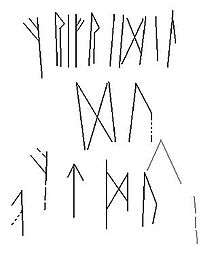
From Proto-Germanic *þū, whence also Old English þu, Old Norse þú, and ultimately from Proto-Indo-European *túh₂. Perhaps the earliest attestation of the pronoun is the inscription on the Bülach fibula, which may show ᛞᚢ (du) already differentiated from other Germanic languages’ þu.
Pronunciation
- IPA(key): /du/
Pronoun
du
- thou, you (second-person singular pronoun)
- 3rd-6th century, inscription on the Bülach fibula:
- ᚠᚱᛁᚠᚱᛁᛞᛁᛚ / ᛞᚢ / ...
- frifridil / du / […]
- Frifridil, you / […]
- frifridil / du / […]
- ᚠᚱᛁᚠᚱᛁᛞᛁᛚ / ᛞᚢ / ...
- 3rd-6th century, inscription on the Bülach fibula:
Inflection
| Number | Person | Gender | Nominative | Genitive | Dative | Accusative |
|---|---|---|---|---|---|---|
| Singular | First | ih | mīn | mir | mih | |
| Second | dū | dīn | dir | dih | ||
| Third | Masculine | (h)er | (sīn) | imu, imo | inan, in | |
| Feminine | siu; sī, si | ira, iru | iro | sia | ||
| Neuter | iz | es, is | imu, imo | iz | ||
| Plural | First | wir | unsēr | uns | unsih | |
| Second | ir | iuwēr | iu | iuwih | ||
| Third | Masculine | sie | iro | im, in | sie | |
| Feminine | sio | iro | im, in | sio | ||
| Neuter | siu | iro | im, in | siu | ||
| Polite form | Second | ir | iuwēr | iu | iuwih |
Descendants
- German: du
See also
- fridil (“a pet name for a male lover”)
References
- Heinz Klingenberg, Runenfibel von Bülach, Kanton Zürich. Liebesinschrift aus alemannischer Frühzeit, in the Alemannisches Jahrbuch (1973/75), page 308
- Heinz Klingenberg, Die Runeninschrift aus Bülach, in Helvetia archaeologica, volume 7 (1976), pages 116–121
- Stephan Opitz, Südgermanische Runeninschriften im älteren Futhark aus der Merowingerzeit (Freiburg im Breisgau, 1977)
Pennsylvania German
Etymology
Pronoun
du
Romanian
Pronunciation
- IPA(key): [du]
Verb
du
Swedish
Alternative forms
Etymology
From Old Swedish þū, from Old Norse þú, from Proto-Germanic *þū, from Proto-Indo-European *túh₂.
Pronunciation
- IPA(key): /dʉː/, [d̪ʉː]
audio (file) - Rhymes: -ʉː
Pronoun
du
Usage notes
While du is the traditionally familiar mode of address, it is since the early '70s the standard in almost all circumstances, possibly capitalized in formal communications. This was the result of the so-called du-reformen.
Recently, use of the second-person plural pronoun ni as a less familiar (and thus more formal) pronoun has appeared to some extent, but mainly amongst shopkeepers towards the customers.
The same pronoun ni has also been used historically as a formal way of address, but its use has (in particular in Sweden, not so much in Swedish-speaking parts of Finland) been restricted to addressing people of lower social status, whereby a plethora of different constructions were employed as to avoid the issue of pronouns whatsoever. See also the article about T-V distinction in Wikipedia.
Declension
*Not universally accepted.
Venetian
Etymology
Compare Italian due
Numeral
du m
Synonyms
Vietnamese
Etymology
Sino-Vietnamese word from 遊/游.
Pronunciation
- (Hà Nội) IPA(key): [zu˧˧]
- (Huế) IPA(key): [jʊw˧˧]
- (Hồ Chí Minh City) IPA(key): [jʊw˧˧]
Verb
du
- (only in compounds) to walk
Derived terms
Welsh
Etymology
From Proto-Brythonic *duβ, from Proto-Celtic *dubus, from Proto-Indo-European *dʰewbʰ-.
Pronunciation
- (North Wales) IPA(key): /dɨː/
- (South Wales) IPA(key): /diː/
- Homophone: dŷ; (South Wales) di
Adjective
du (feminine singular du, plural duon, equative dued, comparative duach, superlative duaf)
- black
- Mae ganddo fo fwstash du.
- He has a black mustache
Mutation
| Welsh mutation | |||
|---|---|---|---|
| radical | soft | nasal | aspirate |
| du | ddu | nu | unchanged |
| Note: Some of these forms may be hypothetical. Not every possible mutated form of every word actually occurs. | |||
See also
| Colors in Welsh · lliwiau (layout · text) | |||||
|---|---|---|---|---|---|
| gwyn | llwyd | du | brown | ||
| pinc | coch ; rhudd | oren, melyngoch | melyn ; melynwyn | ||
| gwyrdd leim | gwyrdd | gwyrddlas ; glaswyrdd | |||
| asur, gwynlas | glas | fioled ; indigo | majenta ; porffor | ||
White Hmong
Adjective
du