lee
English
Pronunciation
-
Audio (US) (file) - Rhymes: -iː
- Homophones: lea
Etymology 1
From Middle English lee, from Old English hlēo, hlēow (“shelter, protection”), from Proto-Germanic *hliwą (compare German Lee (“lee”), lau (“lukewarm”), Swedish lä, Danish læ, Norwegian le, Old Norse hlé, Dutch lij), from Proto-Indo-European *ḱelh₁- (compare Welsh clyd (“warm, cozy”), Latin calēre (“to warm up”), Lithuanian šiltas (“warm, pleasant”), Sanskrit शरद् (śarad, “autumn”)).
Noun
lee (plural lees)
- (sailing) A protected cove or harbor, out of the wind.
- (sailing) The side of the ship away from the wind.
- A sheltered place, especially a place protected from the wind by some object; the side sheltered from the wind; shelter; protection.
- the lee of a mountain, an island, or a ship
- Morte d'Arthure
- We lurked under lee.
- Tyndall
- Desiring me to take shelter in his lee.
Adjective
lee (not comparable)
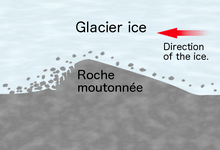
Lee side on the left; stoss side on the right
Antonyms
Derived terms
Translations
side of the ship away from the wind
|
Etymology 2
Noun
lee (uncountable)
Further reading
-

Anagrams
Afar
Noun
lee
References
- Tomoyuki Yabe, The Morphosyntax of Complex Verbal Expressions in the Horn of Africa (2007), which cites Hayward (1976) as the source of a usex lee fax-te "the water boiled"
Luxembourgish
Verb
lee
- second-person singular imperative of leeën
Middle English
Verb
lee
- To lie; to speak falsely.
- (Can we find and add a quotation of Chaucer to this entry?)
Norwegian Bokmål
Etymology
From ledd.
Verb
lee (present tense leer, past tense lea or leet, past participle lea or leet)
- to move; to make a body part, or a thing (such as a bolder), move
Scots
Verb
lee (third-person singular present lees, present participle leein, past leet, past participle leet)
- to lie (tell lies)
Spanish
Verb
lee
- Informal second-person singular (tú) affirmative imperative form of leer.
- Formal second-person singular (usted) present indicative form of leer.
- Third-person singular (él, ella, also used with usted?) present indicative form of leer.
Tswana
Pronunciation
- IPA(key): /ˈlɪ.ɪ/
Noun
lee class 5 (plural mae)
This article is issued from
Wiktionary.
The text is licensed under Creative Commons - Attribution - Sharealike.
Additional terms may apply for the media files.