bale
English
Pronunciation
- IPA(key): /beɪ̯l/, [ˈbeɪ̯(ə)ɫ], [beə̯ɫ]
Audio (US) (file) - Rhymes: -eɪl
- Homophone: bail
Etymology 1
From Middle English bale (“evil”), Old English bealo, from Proto-Germanic *balwą. Cognate with Low German bal- (“bad, ill”), Gothic 𐌱𐌰𐌻𐍅𐌴𐌹𐌽𐍃 (balweins, “torture”), Old High German balo (“destruction”), Old Norse bǫl (“disaster”).
Noun
bale (uncountable)
- Evil, especially considered as an active force for destruction or death.
- Suffering, woe, torment.
- 1596, Edmund Spenser, The Faerie Queene, VI.7:
- That other swayne, like ashes deadly pale, / Lay in the lap of death, rewing his wretched bale.
- 1596, Edmund Spenser, The Faerie Queene, VI.7:
Derived terms
Etymology 2
From Middle English bale (“pyre, funeral pyre”), from Old English bǣl (“pyre, funeral pyre”), from Proto-Germanic *bēlą (“pyre”), from Proto-Indo-European *bʰel- (“to shine; gleam; sparkle”). Cognate with Old Norse bál (which may have been the direct source for the English word).
Noun
bale (plural bales)
- (obsolete) A large fire, a conflagration or bonfire.
- (archaic) A funeral pyre.
- (archaic) A beacon-fire.
Derived terms
Etymology 3
From Middle English bale (“bale”); further derivation uncertain: perhaps from Old French bale, balle, from Medieval Latin balla (“ball, rounded package”), from Germanic; or perhaps from the Middle Dutch ancestor Dutch baal, itself borrowed from Middle French.
Noun
bale (plural bales)
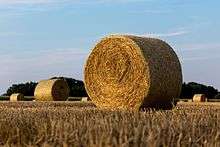
- A rounded bundle or package of goods in a cloth cover, and corded for storage or transportation.
- A bundle of compressed wool or hay, compacted for shipping and handling.
- A measurement of hay equal to 10 flakes. Approximately 70-90 lbs (32-41 kg).
- A measurement of paper equal to 10 reams.
Coordinate terms
Derived terms
Translations
See also

Verb
bale (third-person singular simple present bales, present participle baling, simple past and past participle baled)
- (transitive) To wrap into a bale.
Translations
Etymology 4
Alternative spelling of bail
Verb
bale (third-person singular simple present bales, present participle baling, simple past and past participle baled)
Translations
See also

Anagrams
Buginese
Noun
bale
Dutch
Pronunciation
Audio (file)
Verb
bale
- (archaic) singular present subjunctive of balen
Anagrams
French
Alternate forms
Etymology
From Gaulish *balu.
Pronunciation
- IPA(key): /bal/
Noun
bale f (uncountable)
- chaff (inedible casing of a grain seed)
Kapampangan
Etymology
From Proto-Philippine *balay, from Proto-Malayo-Polynesian *balay, from Proto-Austronesian *balay.
Noun
bale
Middle English
Etymology 1
From Old English bealo, from Proto-Germanic *balwą.
Alternative forms
Pronunciation
- IPA(key): /ˈbaːl(ə)/
Noun
bale (plural bales)
- An evil or wrong act; a bad deed.
- Maliciousness, iniquity, damage.
- Devastation and doom; the causing of lifelessness.
- Woe or torment; hurting, agony.
Related terms
Descendants
- English: bale (dated)
References
- “bāle (n.(1))” in MED Online, Ann Arbor, Mich.: University of Michigan, 2007, retrieved 2018-05-19.
Adjective
bale
References
- “bāle (adj.)” in MED Online, Ann Arbor, Mich.: University of Michigan, 2007, retrieved 2018-05-19.
Etymology 2
Either from Old English bǣl, Old Norse bál, or a conflation of both; in any case, from Proto-Germanic *bēlą.
Pronunciation
- IPA(key): /baːl/
Noun
bale
- Any large fire; a bonfire or pyre.
- A fire for inhumation; a funeral pyre.
- A fire for execution or killing.
Related terms
Descendants
References
- “bāl(e (n.(2))” in MED Online, Ann Arbor, Mich.: University of Michigan, 2007, retrieved 2018-05-19.
Etymology 3
Probably from Old French bale, balle, from Medieval Latin balla.
Alternative forms
Pronunciation
- IPA(key): /ˈbaːl(ə)/
Noun
bale (plural bales)
- A bale (rounded bundle)
Descendants
- English: bale
References
- “bāle (n.(3))” in MED Online, Ann Arbor, Mich.: University of Michigan, 2007, retrieved 2018-05-19.
Portuguese
Pronunciation
Verb
bale
- first-person singular (eu) present subjunctive of balar
- third-person singular (ele and ela, also used with você and others) present subjunctive of balar
- third-person singular (você) affirmative imperative of balar
- third-person singular (você) negative imperative of balar
- third-person singular (ele and ela, also used with você and others) present indicative of balir
- second-person singular (tu, sometimes used with você) affirmative imperative of balir
Romanian
Etymology
From Vulgar Latin root *baba. Compare French bave, Italian bava, Spanish and Portuguese baba. The normal result, *ba, is not used as the singular has been replaced with bală through analogy.
Noun
bale f pl (plural only)
Declension
| plural | ||
|---|---|---|
| f gender | indefinite articulation | definite articulation |
| nominative/accusative | (niște) bale | balele |
| genitive/dative | (unor) bale | balelor |
Synonyms
Derived terms
- bălos
Spanish
Verb
bale
- Formal second-person singular (usted) imperative form of balar.
- First-person singular (yo) present subjunctive form of balar.
- Formal second-person singular (usted) present subjunctive form of balar.
- Third-person singular (él, ella, also used with usted?) present subjunctive form of balar.
Turkish
Etymology
Noun
bale (definite accusative baleyi, plural baleler)