ham
English
Etymology 1
From Middle English hamme, from Old English hamm (“inner or hind part of the knee, ham”), from Proto-Germanic *hamō, *hammō, *hanmō, from Proto-Indo-European *kónh₂m (“leg”). Cognate with Dutch ham (“ham”), dialectal German Hamme (“hind part of the knee, ham”), dialectal Swedish ham (“the hind part of the knee”), Icelandic höm (“the ham or haunch of a horse”), Old Irish cnáim (“bone”), Ancient Greek κνήμη (knḗmē, “shinbone”). Compare gammon.
Pronunciation
Audio (US) (file) Audio (UK) (file) - enPR: hăm, IPA(key): /hæm/
- Rhymes: -æm
Noun
ham (countable and uncountable, plural hams)
- (anatomy) The region back of the knee joint; the popliteal space; the hock.
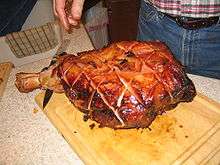
- (countable) A thigh and buttock of an animal slaughtered for meat.
- (uncountable) Meat from the thigh of a hog cured for food.
- a little piece of ham for the cat
- (Can we date this quote?), Audra Lilly Griffeth, A King's Daughter →ISBN:
- She put some ham in the beans and cut up some sweet potatoes to boil.
- The back of the thigh.
- (Internet, informal, uncommon) Electronic mail that is wanted; mail that is not spam or junk mail.
- Antonym: spam
Derived terms
Translations
|
|
- The translations below need to be checked and inserted above into the appropriate translation tables, removing any numbers. Numbers do not necessarily match those in definitions. See instructions at Wiktionary:Entry layout#Translations.
Etymology 2
From Old English hām.
Noun
ham (uncountable)
- Obsolete form of home.
Usage notes
- Persists in many old place names, such as Buckingham.
References
- “ham” in Douglas Harper, Online Etymology Dictionary, 2001–2018.
Etymology 3
Of uncertain origin, though it is generally agreed upon that it first appeared in print around the 1880s. At least four theories persist:
- It came naturally from the word amateur. Deemed likely by Hendrickson (1997), but then the question would be why it took so long to pop up. He rejects the folk etymology of Cockney slang hamateur because it originated in American English.[1]
- From the play Hamlet, where the title character was often played poorly and/or in an exaggerated manner. Also deemed likely by Hendrickson, though he raises the issue that the term would have likely been around earlier if this were case.
- From the minstrel's practice of using ham fat to remove heavy black makeup used during performances.[2]
- Shortened from hamfatter (“inferior actor”), said to derive from the 1863 minstrel show song The Ham-fat Man.[3] William and Mary Morris (1988) argue that it's not known whether the song inspired the term or the term inspired the song, but that they believe the latter is the case.
Noun
ham (plural hams)
- (acting) An overacting or amateurish performer; an actor with an especially showy or exaggerated style.
- (radio) An amateur radio operator.
Related terms
Synonyms
- (overacting performer): hambone, hamfatter, overactor, tear-cat
- (amateur radio operator): radio amateur
Translations
|
|
Verb
ham (third-person singular simple present hams, present participle hamming, simple past and past participle hammed)
- (acting) To overact; to act with exaggerated emotions.
Synonyms
References
Anagrams
Caribbean Hindustani
Etymology
Pronoun
ham
References
- Beknopt Nederland-Sarnami Woordenboek met Sarnami Hindoestani-Nederlanse Woordenlijst (in Dutch), Paramaribo: Instituut voor Taalwetenschap, 2002
Catalan
Etymology
Pronunciation
Noun
ham m (plural hams)
Cebuano
Etymology
From English ham, from Middle English hamme, from Old English hamm (“inner or hind part of the knee, ham”), from Proto-Germanic *hamō, *hammō, *hanmō, from Proto-Indo-European *kónh₂m (“leg”).
Noun
ham
Danish
Etymology 1
Pronunciation
- IPA(key): /ham/, [hɑmˀ]
Noun
ham c (singular definite hammen, plural indefinite hamme)
Declension
Derived terms
- dyreham
- fjederham
- fugleham
- hamskifte, hamskifter
- slangeham
- snogeham
- svaneham
Etymology 2
See han.
Pronunciation
- IPA(key): /ham/, [hɑm]
Pronoun
ham
- (personal) objective case of han
See also
| Number | Person | Inflection | Nominative | Accusative | Possessive | Reflexive | Reflexive possessive |
|---|---|---|---|---|---|---|---|
| Singular | First | common | jeg | mig | min | ||
| neuter | mit | ||||||
| plural | mine | ||||||
| Second | common | du | dig | din | |||
| neuter | dit | ||||||
| plural | dine | ||||||
| formal | De | Dem | Deres | ||||
| Third | masculine | han | ham | hans | sig | sin | |
| feminine | hun | hende | hendes | ||||
| common | den | den | dens | ||||
| neuter | det | det | dets | sit | |||
| plural | sine | ||||||
| Plural | First | — | vi | os | vores | ||
| common | vor | ||||||
| neuter | vort | ||||||
| plural | vore | ||||||
| Second | – | I | jer | jeres | |||
| formal | De | Dem | Deres | ||||
| Third | – | de | dem | deres | sig | ||
Dutch
Etymology
From Proto-Germanic *hammō, from Proto-Indo-European *kónh₂m (“leg”).
Pronunciation
- IPA(key): /ɦɑm/
audio (file) - Rhymes: -ɑm
Noun
ham f (plural hammen, diminutive hammetje n)
Derived terms
- beenham
- schouderham
Fiji Hindi
Etymology
Pronoun
ham
- I (1st person singular personal pronoun)
- Ham khelegaa!
- I will play!
Fyer
Etymology
Noun
ham
References
- Roger Blench, Ron Comparative Wordlist
- Takács, Gábor (1999-2008) Etymological Dictionary of Egyptian, volume 3, Leiden: Brill, →ISBN, page 201:
- […] we should carefully distinguish the following Ch. roots from AA *m-ˀ "water" [GT]:
- (1) Ch. *h-m "water" [GT]: WCh. *hama [Stl.]: AS *ham (Gmy. *hām) [GT 2004, 153] = *am [Stl. 1977] = *ham [Dlg.] = *ham [Stl. 1987]: […] Ron *ham [GT]: Fyer & Bks. & DB & Sha ham, Klr. ˀaàm […]
- Václav Blažek, A Lexicostatitical comparison of Omotic languages, in In Hot Pursuit of Language in Prehistory: Essays in the four fields of anthropology, page 122
Irish
Pronunciation
- IPA(key): [haːmˠ], [hamˠ]
Noun
ham m
- h-prothesized form of am
Middle English
Etymology 1
Pronoun
ham
- Alternative form of hem
References
- “hem, (pron.)” in MED Online, Ann Arbor, Mich.: University of Michigan, 2007, retrieved 12 June 2018.
Etymology 2
From Old English hām.
Noun
ham
- Alternative form of home
Middle French
Noun
ham m (plural hams)
Montol
Etymology
Noun
hàm
References
- Takács, Gábor (1999-2008) Etymological Dictionary of Egyptian, volume 3, Leiden: Brill, →ISBN, page 201:
- […] we should carefully distinguish the following Ch. roots from AA *m-ˀ "water" [GT]:
- (1) Ch. *h-m "water" [GT]: WCh. *hama [Stl.]: AS *ham (Gmy. *hām) [GT 2004, 153] = *am [Stl. 1977] = *ham [Dlg.] = *ham [Stl. 1987]: […] Tal hàm [Jng./JI], Mnt. hàm "Wasser" [Jng. 1965, 171], […]
Norwegian Bokmål
Pronunciation
- IPA(key): /hɑm/
Pronoun
ham
Old English
Pronunciation
- IPA(key): /hɑm/
Etymology 1
From Proto-Germanic *hamō-. Cognate with Middle Dutch hamme (Dutch ham), Old High German hamma (dialectal German Hamm), Old Norse hǫm.
Noun
ham f
- (anatomy) ham, inner knee
- Monegum men gescrincaþ his fet to his homme: with many men the feet shrink up to the knee. (Leechbook)
Descendants
Etymology 2
From Proto-Germanic *hammaz. Cognate with Old Frisian ham, Middle Low German hamme (Low German Hamm).
Pronunciation
- IPA(key): /hɑːm/
Noun
ham m
- enclosure, especially an enclosed pasture or dwelling
Etymology 3
From Proto-Germanic *haimaz, from Proto-Indo-European *kōim- (“village”), *ḱóymos, *(t)ḱoimos. Cognate with Old Frisian hām (West Frisian hiem), Old Saxon hēm, Frankish *haim (Dutch heem), Old High German heim (German Heim), Old Norse heimr (Swedish hem, Danish hjem), Gothic 𐌷𐌰𐌹𐌼𐍃 (haims). The Indo-European root is also the source of Greek κωμη (komi), Old Irish cóim, Lithuanian šeimà, Russian семья (semʹja).
Noun
hām m
- home, house
- Sēo Cwēn hæfþ hiere hām æt Windlesōran.
- Hǣlend cōm tō Lazares hām. : The Saviour came to the home of Lazarus.
- property, estate, farm
- village; community
Declension
Derived terms
Descendants
Old French
Etymology
Borrowed from Frankish *haim (“home, village”).
Noun
ham m (oblique plural hans, nominative singular hans, nominative plural ham)
Descendants
Rohingya
Noun
ham
Romanian
Pronunciation
- IPA(key): /ham/
Etymology 1
Noun
ham n (plural hamuri)
Derived terms
Etymology 2
Interjection
ham!
- woof, the sound a barking dog makes
See also
Ron
Etymology
Noun
ham
- (most dialects, including Mangar, Bokkos, Daffo-Butura, Shagawu) water
Synonyms
- àyîn (Monguna)
References
- Roger Blench, Ron Comparative Wordlist
- Takács, Gábor (1999-2008) Etymological Dictionary of Egyptian, volume 3, Leiden: Brill, →ISBN, page 201:
- […] we should carefully distinguish the following Ch. roots from AA *m-ˀ "water" [GT]:
- (1) Ch. *h-m "water" [GT]: WCh. *hama [Stl.]: AS *ham (Gmy. *hām) [GT 2004, 153] = *am [Stl. 1977] = *ham [Dlg.] = *ham [Stl. 1987]: […] Ron *ham [GT]: Fyer & Bks. & DB & Sha ham, Klr. ˀaàm […]
Serbo-Croatian
Alternative forms
Etymology
Noun
hȃm m (Cyrillic spelling ха̑м)
Sha
Etymology
Noun
ham
References
- Roger Blench, Ron Comparative Wordlist
Tal
Etymology
Noun
hàm
References
- Takács, Gábor (1999-2008) Etymological Dictionary of Egyptian, volume 3, Leiden: Brill, →ISBN, page 201:
- […] we should carefully distinguish the following Ch. roots from AA *m-ˀ "water" [GT]:
- (1) Ch. *h-m "water" [GT]: WCh. *hama [Stl.]: AS *ham (Gmy. *hām) [GT 2004, 153] = *am [Stl. 1977] = *ham [Dlg.] = *ham [Stl. 1987]: […] Tal hàm [Jng./JI], Mnt. hàm "Wasser" [Jng. 1965, 171], […]
Tambas
Etymology
Noun
ham
References
- Roger Blench, Ron Comparative Wordlist
Turkish
Etymology
Adjective
ham (comparative daha ham, superlative en ham)
Vietnamese
Pronunciation
- (Hà Nội) IPA(key): [haːm˧˧]
- (Huế) IPA(key): [haːm˧˧]
- (Hồ Chí Minh City) IPA(key): [haːm˧˧]
Adjective
ham (𫺧, 𫻎)
West Frisian
Noun
ham c (plural hammen)