sine
English
Etymology
From Latin sinus (“bosom”), a translation (or possibly a mistranslation) of Arabic جَيْب (jayb, “bosom”).
Pronunciation
- enPR: sīn, IPA(key): /saɪn/
- Homophone: sign
- Rhymes: -aɪn
Noun
sine (plural sines)
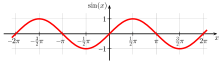
- (trigonometry, mathematics) In a right triangle, the ratio of the length of the side opposite an angle to the length of the hypotenuse.
Usage notes
In various branches of mathematics, the sine of an angle is determined in various ways, including the following:
- The y-coordinate of the point on the unit circle at the given anticlockwise angle from the x-axis.
- The sum of the real or complex power series
where x is in radians.

Synonyms
- Symbol: sin
Derived terms
Translations
|
|
See also
Anagrams
Danish
Pronunciation
- IPA(key): /siːnə/, [ˈsiːnə], [ˌsiːnə]
Pronoun
sine
- plural of sin
See also
| Number | Person | Inflection | Nominative | Accusative | Possessive | Reflexive | Reflexive possessive |
|---|---|---|---|---|---|---|---|
| Singular | First | common | jeg | mig | min | ||
| neuter | mit | ||||||
| plural | mine | ||||||
| Second | common | du | dig | din | |||
| neuter | dit | ||||||
| plural | dine | ||||||
| formal | De | Dem | Deres | ||||
| Third | masculine | han | ham | hans | sig | sin | |
| feminine | hun | hende | hendes | ||||
| common | den | den | dens | ||||
| neuter | det | det | dets | sit | |||
| plural | sine | ||||||
| Plural | First | — | vi | os | vores | ||
| common | vor | ||||||
| neuter | vort | ||||||
| plural | vore | ||||||
| Second | – | I | jer | jeres | |||
| formal | De | Dem | Deres | ||||
| Third | – | de | dem | deres | sig | ||
Finnish
(index si)
Etymology
Noun
sine
- bluing (blue pigment used for coloring clothes when washing)
- blueprint (paper-based reproduction usually of a technical drawing), diazo print, ammonia print
Declension
| Inflection of sine (Kotus type 48/hame, no gradation) | |||
|---|---|---|---|
| nominative | sine | sineet | |
| genitive | sineen | sineiden sineitten | |
| partitive | sinetta | sineita | |
| illative | sineeseen | sineisiin sineihin | |
| singular | plural | ||
| nominative | sine | sineet | |
| accusative | nom. | sine | sineet |
| gen. | sineen | ||
| genitive | sineen | sineiden sineitten | |
| partitive | sinetta | sineita | |
| inessive | sineessa | sineissa | |
| elative | sineesta | sineista | |
| illative | sineeseen | sineisiin sineihin | |
| adessive | sineella | sineilla | |
| ablative | sineelta | sineilta | |
| allative | sineelle | sineille | |
| essive | sineena | sineina | |
| translative | sineeksi | sineiksi | |
| instructive | — | sinein | |
| abessive | sineetta | sineitta | |
| comitative | — | sineineen | |
Anagrams
Irish
Pronunciation
- IPA(key): /ˈʃinʲə/
Etymology 1
From Old Irish sine, siniu, comparative form of sen (“old”).
Adjective
sine
Etymology 2
From Old Irish sine (“teat, dug, pap”), from Proto-Celtic *sɸenyos, from Proto-Indo-European *pstḗn. Cognate with Old Norse speni (“teat”), English spean (“teat (of a cow)”).
Noun
sine f (genitive singular sine, nominative plural siní)
Declension
Fourth declension
|
Bare forms
|
Forms with the definite article
|
Mutation
| Irish mutation | ||
|---|---|---|
| Radical | Lenition | Eclipsis |
| sine | shine after an, tsine |
not applicable |
| Note: Some of these forms may be hypothetical. Not every possible mutated form of every word actually occurs. | ||
References
- "sine" in Foclóir Gaeilge-Béarla, An Gúm, 1977, by Niall Ó Dónaill.
- “1 sine” in Dictionary of the Irish Language, Royal Irish Academy, 1913–76.
- “3 sine” in Dictionary of the Irish Language, Royal Irish Academy, 1913–76.
Latin
Pronunciation
- (Classical) IPA(key): /ˈsi.ne/, [ˈsɪ.nɛ]
- (Ecclesiastical) IPA(key): /ˈsi.ne/, [ˈsiː.ne]
Audio (Classical) (file)
Etymology 1
The function of this preposition was previously done with the use of sē, sēd (see sē-, sed), from Proto-Indo-European *swé (“self”), thus meaning "by itself", "without". Some still refer the si- in sine to this root, others refer it to Proto-Indo-European *só (“this”), whence si (“if”). And as sometimes nesi was also written, with -ne being nē (“not”), sine might literally mean "not this". Compare with nisi.
Others yet refer sine to Proto-Indo-European *seni (“for oneself, without”), itself maybe related to *swé. Thus cognate with Ancient Greek ἄτερ (áter, “without”), Old English sundor.
Preposition
sine
- (with ablative) without
- Sum sine regno.
- I am without a kingdom.
Derived terms
|
|
|
Descendants
References
- sine in Charlton T. Lewis and Charles Short (1879) A Latin Dictionary, Oxford: Clarendon Press
- Pokorny, Julius (1959) Indogermanisches etymologisches Wörterbuch [Indo-European Etymological Dictionary] (in German), volume III, Bern, München: Francke Verlag, page 907
Etymology 2
Verb
sine
- second-person singular present active imperative of sinō
Middle Dutch
Determiner
sine
- inflection of sijn:
- feminine nominative and accusative singular
- nominative and accusative plural
Neapolitan
Pronunciation
- IPA(key): /ˈsinɛ/, /ˈsinɐ/
Particle
sine
Norwegian Bokmål
Etymology
From Old Norse sínir.
Pronunciation
- IPA(key): /siːne/
Determiner
sine pl
- plural of sin
References
- “sin” in The Bokmål Dictionary / The Nynorsk Dictionary.
Norwegian Nynorsk
Etymology
From Old Norse sínir.
Pronunciation
- IPA(key): /²siːnə/ (example of pronunciation)
Determiner
sine pl
- plural of sin
References
- “sin” in The Nynorsk Dictionary.
Old French
Noun
sine m (oblique plural sines, nominative singular sines, nominative plural sine)
- Alternative form of cisne
Noun
sine m (oblique plural sines, nominative singular sines, nominative plural sine)
- Alternative form of signe
Romanian
Etymology
Pronunciation
- IPA(key): /ˈsi.ne/
- Rhymes: -ine
Pronoun
sine (stressed reflexive-accusative form of el, ea, ei, and ele)
- (direct object, preceded by preposition, such as "pe", "cu", "la", or "pentru") himself, herself, itself, themselves
Synonyms
- se (unstressed form)
Scottish Gaelic
Pronunciation
- IPA(key): /ˈʃinə/
Etymology 1
From Old Irish sine (“teat, dug, pap”), from Proto-Celtic *sɸenyos, from Proto-Indo-European *pstḗn. Cognate with Old Norse speni (“teat”), English spean (“teat (of a cow)”).
Noun
sine f (genitive singular sine, plural sinean)
Etymology 2
Noun
sine f
- gin (drink)
Etymology 3
Adjective
sine
- comparative degree of sean
Westrobothnian
Pronunciation
Pronoun
sine n sg
- (possessive pronoun): dative neuter singular of sänn
Declension
| Possessive pronoun | |||
| Singular | Masculine | Feminine | Neuter |
| Nominative | sänn | si | sätt |
| Accusative | (säänn) | siin | |
| Dative | sinom | sännar | sine |
| Plural | Masculine | Feminine | Neuter |
| Nominative | siin | siin | siin |
| Accusative | |||
| Dative | sinom | sinom | sinom |