mine
English
Pronunciation
- enPR: mīn, IPA(key): /maɪn/
Audio (US) (file) - Rhymes: -aɪn
Etymology 1
From Middle English min, myn, from Old English mīn, from Proto-Germanic *mīnaz, from Proto-Indo-European *méynos. Cognate with Saterland Frisian mien, West Frisian myn, Dutch mijn, Low German mien, German mein, Danish, Swedish and Norwegian min, Icelandic mín.
Pronoun
mine
- My; belonging to me; that which belongs to me.
- Used predicatively.
- The house itself is mine, but the land is not.
- Used substantively, with an implied noun.
- Mine has been a long journey.
- Used absolutely, set off from the sentence.
- Mine for only a week so far, it already feels like an old friend.
- (archaic) Used attributively after the noun it modifies.
- a. 1611, William Shakespeare, The Tempest, Act V, Scene 1:
- […] Flesh and blood, / You, brother mine, that entertain'd ambition, / […]
- a. 1611, William Shakespeare, The Tempest, Act V, Scene 1:
- (archaic) Used attributively before a vowel.
- 1862 February, Julia Ward Howe, "The Battle Hymn of the Republic", in The Atlantic Monthly, Volume IX, Number LII, page 10,
- Mine eyes have seen the glory of the coming of the Lord: / […]
- 1862 February, Julia Ward Howe, "The Battle Hymn of the Republic", in The Atlantic Monthly, Volume IX, Number LII, page 10,
- Used predicatively.
Usage notes
- My and mine are essentially two forms of the same word, with my being used attributively before the noun, and mine being used in all other cases, as may be seen in most of the usage examples and quotations above. In this respect, this word is analogous to most of the other possessive pronouns (e.g. your vs. yours), as well as a number of other noun modifiers, such as lone/alone.
- Historically, my came to be used only before a consonant sound, and later came to be used regardless of the following sound. Nonetheless, mine still sees archaic pre-vocalic use, as may be seen in the 1862 quotation above.
Translations
|
|


See also
| personal pronoun | possessive pronoun | possessive determiner | |||||
|---|---|---|---|---|---|---|---|
| subjective | objective | reflexive | |||||
| first person | singular | I | me | myself | mine | my mine (before vowels, archaic) | |
| plural | we | us | ourselves ourself | ours | our | ||
| second person | singular | standard | you | you | yourself | yours yourn (obsolete outside dialects) | your |
| archaic, informal | thou | thee | thyself theeself | thine | thy thine (before vowels) | ||
| plural | standard | you you all ye (archaic) | you you all | yourselves | yours yourn (obsolete outside dialects) | your | |
| informal / dialectal | (see list of dialectal forms at you and inflected forms in those entries) | ||||||
| third person | singular | masculine | he | him | himself hisself (archaic) | his hisn (obsolete outside dialects) | his |
| feminine | she | her | herself | hers hern (obsolete outside dialects) | her | ||
| neuter | it | it | itself | its his (archaic) | its his (archaic) | ||
| genderless | they | them | themself, themselves | theirs | their | ||
| genderless, nonspecific (formal) |
one | one | oneself | – | one's | ||
| plural | they | them | themselves | theirs theirn (obsolete outside dialects) | their | ||
Etymology 2
From Middle English, from Old French mine, from Late Latin mina, from Gaulish (compare to Welsh mwyn, Irish míanach (“ore”)), from Proto-Celtic *mēnis (“ore, metal”).
Noun
mine (plural mines)
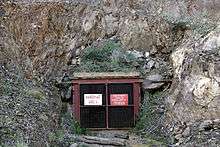
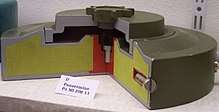
- An excavation from which ore or solid minerals are taken, especially one consisting of underground tunnels.
- This diamond comes from a mine in South Africa.
- He came out of the coal mine with a face covered in black.
- Most coal and ore comes from open-pit mines nowadays.
- (figuratively) Any source of wealth or resources.
- She's a mine of information.
- (military) A passage dug toward or underneath enemy lines, which is then packed with explosives.
- (military) A device intended to explode when stepped upon or touched, or when approached by a ship, vehicle, or person.
- His left leg was blown off after he stepped on a mine.
- The warship was destroyed by floating mines.
- (pyrotechnics) A type of firework that explodes on the ground, shooting sparks upward.
- (entomology) The cavity made by a caterpillar while feeding inside a leaf.
- (computing) A machine used to extract units of a cryptocurrency.
Derived terms
- anti-personnel mine
- anti-tank mine
- coal mine
- gold mine, goldmine
- land mine, landmine
- limpet mine
- magnetic mine
- minefield
- minelayer
- mine of information
- miner
- mineral
- mine run
- mine shaft, mineshaft
- minesweeper
- mineworker
- naval mine
- open-pit mine
- proximity mine
- proxy mine
- salt mine
- strip-mine, strip mine
Translations
|
|
|
|
Verb
mine (third-person singular simple present mines, present participle mining, simple past and past participle mined)
- (transitive, intransitive) To remove (ore) from the ground.
- Crater of Diamonds State Park is the only place in the world where visitors can mine their own diamonds.
- To dig into, for ore or metal.
- Ure
- Lead veins have been traced […] but they have not been mined.
- Ure
- (transitive) To sow mines (the explosive devices) in (an area).
- We had to slow our advance after the enemy mined the road ahead of us.
- (transitive) To damage (a vehicle or ship) with a mine (an explosive device).
- (intransitive) To dig a tunnel or hole; to burrow in the earth.
- the mining cony
- To dig away, or otherwise remove, the substratum or foundation of; to lay a mine under; to sap; to undermine; hence, to ruin or destroy by slow degrees or secret means.
- Hayward
- They mined the walls.
- Sir Walter Scott
- Too lazy to cut down these immense trees, the spoilers […] had mined them, and placed a quantity of gunpowder in the cavity.
- Hayward
- (slang) To pick one's nose.
- (computing) To earn new units of cryptocurrency by doing certain calculations.
Derived terms
Translations
|
|
|
- The translations below need to be checked and inserted above into the appropriate translation tables, removing any numbers. Numbers do not necessarily match those in definitions. See instructions at Wiktionary:Entry layout#Translations.
|
Etymology 3
Noun
mine (plural mines)
- Alternative form of mien
Anagrams
Aromanian
Pronoun
mine
- Alternative form of mini
Crimean Gothic
Etymology
From Proto-Germanic *mēnô.
Noun
mine
- moon
- 1562, Ogier Ghiselin de Busbecq:
- Mine. Luna.
- 1562, Ogier Ghiselin de Busbecq:
Czech
Pronunciation
- IPA(key): [ˈmɪnɛ]
- Rhymes: -ɪnɛ
- Hyphenation: mi‧ne
Verb
mine
- third-person singular present indicative of minout
Danish
Pronunciation
- IPA(key): /miːnə/, [ˈmiːnə], [ˈmiːn̩]
Noun
mine c (singular definite minen, plural indefinite miner)
Inflection
Pronoun
mine
- (possessive) Plural form of min
See also
| Number | Person | Inflection | Nominative | Accusative | Possessive | Reflexive | Reflexive possessive |
|---|---|---|---|---|---|---|---|
| Singular | First | common | jeg | mig | min | ||
| neuter | mit | ||||||
| plural | mine | ||||||
| Second | common | du | dig | din | |||
| neuter | dit | ||||||
| plural | dine | ||||||
| formal | De | Dem | Deres | ||||
| Third | masculine | han | ham | hans | sig | sin | |
| feminine | hun | hende | hendes | ||||
| common | den | den | dens | ||||
| neuter | det | det | dets | sit | |||
| plural | sine | ||||||
| Plural | First | — | vi | os | vores | ||
| common | vor | ||||||
| neuter | vort | ||||||
| plural | vore | ||||||
| Second | – | I | jer | jeres | |||
| formal | De | Dem | Deres | ||||
| Third | – | de | dem | deres | sig | ||
French
Pronunciation
- IPA(key): /min/
audio (une mine) (file)
Etymology 1
From Vulgar Latin *mina, Gaulish *meina (see also Welsh mwyn, Irish míanach (“ore”)), from Proto-Celtic *mēnis (“ore, metal”).
Noun
mine f (plural mines)
- mine (excavation or explosive)
- pencil lead
Etymology 2
Borrowed from Breton min (“beak, muzzle”) (from Proto-Celtic *mēnis, in the sense of "red")[1], or from Italian mina, from Latin minio (“to redden”).[2]
Noun
mine f (plural mines)
- appearance, physical aspect; expression
Derived terms
- avoir bonne mine
- avoir mauvaise mine
- faire bonne mine à mauvais jeu
- faire mine de/que
- mine de rien
Etymology 3
From miner
Verb
mine
Anagrams
Further reading
- “mine” in le Trésor de la langue française informatisé (The Digitized Treasury of the French Language).
References
Irish
Pronunciation
- IPA(key): /ˈmʲɪnʲə/
Adjective
mine
Noun
mine f
- genitive singular of min
Mutation
| Irish mutation | ||
|---|---|---|
| Radical | Lenition | Eclipsis |
| mine | mhine | not applicable |
| Note: Some of these forms may be hypothetical. Not every possible mutated form of every word actually occurs. | ||
Italian
Noun
mine f
- plural of mina
Anagrams
Japanese
Romanization
mine
Middle Dutch
Etymology 1
Borrowed from Old French mine.
Noun
mine f
Inflection
This noun needs an inflection-table template.
Descendants
Etymology 2
See etymology on the main entry.
Determiner
mine
- inflection of mijn:
- feminine nominative and accusative singular
- nominative and accusative plural
Further reading
- “mine (II)”, in Middelnederlandsch Woordenboek, 1929
Middle English
Determiner
mine (subjective pronoun I)
- Alternative form of min
Pronoun
mine (subjective I)
- Alternative form of min
References
- “min, (pron.)” in MED Online, Ann Arbor, Mich.: University of Michigan, 2007, retrieved 6 May 2018.
Norwegian Bokmål
Etymology
From Old Norse mínir, or from Old French mine
Noun
mine f, m (definite singular mina or minen, indefinite plural miner, definite plural minene)
- a mine (excavation or explosive)
Derived terms
Determiner
mine
- plural of min
References
Norwegian Nynorsk
Pronunciation
- IPA(key): /²miːnə/ (example of pronunciation)
Etymology 1
From Old Norse mínir, or from Old French mine
Noun
mine f (definite singular mina, indefinite plural miner, definite plural minene)
- a mine (excavation or explosive)
Derived terms
Verb
mine (present tense minar/miner, past tense mina/minte, past participle mina/mint, passive infinitive minast, present participle minande, imperative mine/min)
- Alternative form of mina
Determiner
mine
- plural of min
References
Phuthi
Etymology
From Proto-Nguni *miná.
Pronoun
miné
Portuguese
Verb
mine
- first-person singular (eu) present subjunctive of minar
- third-person singular (ele and ela, also used with você and others) present subjunctive of minar
- third-person singular (você) affirmative imperative of minar
- third-person singular (você) negative imperative of minar
Romanian
Pronunciation
- Rhymes: -ine
Etymology 1
From Latin mē, possibly through a Vulgar Latin root *mēne, or through analogy with cine, from *quene, from quem. It also possibly acquired this ending through adopting the common Latin accusative inflection -inem. Compare tine, sine. Compare also Aromanian mini, Dalmatian main.
Pronoun
mine (stressed accusative form of eu)
- (direct object, preceded by preposition, such as "pe", "cu", "la", or "pentru") me
Related terms
- mă (unstressed form)
See also
Etymology 2
Noun
mine
- plural of mină
Scots
Pronunciation
- IPA(key): /məin/
Pronoun
mine
Scottish Gaelic
Noun
mine f
- genitive singular of min
Spanish
Verb
mine
- Formal second-person singular (usted) imperative form of minar.
- First-person singular (yo) present subjunctive form of minar.
- Formal second-person singular (usted) present subjunctive form of minar.
- Third-person singular (él, ella, also used with usted?) present subjunctive form of minar.
Swazi
Etymology
From Proto-Nguni *miná.
Pronoun
miné
Westrobothnian
Pronunciation
Pronoun
mine n sg
- (possessive pronoun): dative neuter singular of männ
Declension
| Possessive pronoun | |||
| Singular | Masculine | Feminine | Neuter |
| Nominative | männ | mi | mätt |
| Accusative | (määnn) | miin | |
| Dative | minom | männar | mine |
| Plural | Masculine | Feminine | Neuter |
| Nominative | miin | miin | miin |
| Accusative | |||
| Dative | minom | minom | minom |